Miniature Worlds Unit Plan Tiny Worlds Overview Guide
8th Grade 3D Art & Sculpture | 10-Day Unit Plan
Unit ID: CLAY-MINI-08
Unit Vision
This unit challenges art extension students to master the unique constraints of small-scale sculpture. Using Model Magic and mixed media, students will transition from concept to finished miniature, emphasizing studio habits, problem-solving, and the integration of personal experience into their work.
Key Learning Targets
Develop professional studio habits through planning and organization.
Conceptualize and generate original artistic ideas for 3D forms.
Relate personal narratives to artistic choices in miniature environments.
Materials List
Model Magic Clay Essential
Clay Tools / Picks Detailing
Paint Markers Coloring
Permanent Markers Linework
Scale References Rulers
Teacher Pro-Tip: Keep Model Magic in sealed bags during the ideation phase to prevent premature drying and hardening.
10-Day Pacing Guide
Days 1-2
Concept
Introduction to miniatures and career paths. Brainstorming themes and primary sketches.
Days 3-4
Foundations
Building structural bases. Establishing form and scale using basic modeling.
Days 5-7
Development
Adding texture/detail. Continuous self-analysis and revision based on peer feedback.
Days 8-9
Finishing
Color application using paint markers. Finalizing surfaces and unifying elements.
Day 10
Reflection
Final critique, self-assessment, and portfolio documentation of the journey.
Careers
Set Designer
Creating maquettes to visualize spatial relationships and lighting.
Sculptor / Potter
Mastering fine-motor control and material science for miniature forms.
Skills
Innovation
Using brainstorming as a free exchange of visual ideas to solve scale issues.
Ownership
Making meaningful revisions based on critical self-analysis of work.
Blueprint for Small Things Worksheet Blueprint for Small Things
Brainstorming & Ideation Worksheet
Name:
Date:
1. Concept Exploration
Brainstorm 3 potential tiny worlds:
Personal Connection: Why did you choose this?
2. Technical Strategy
Texture Goals
Color Palette
Unity Strategy
Tip: Think about your career path. If you are a Set Designer, how does the scale help tell your world's story?
3. The Sketchbook Blueprint
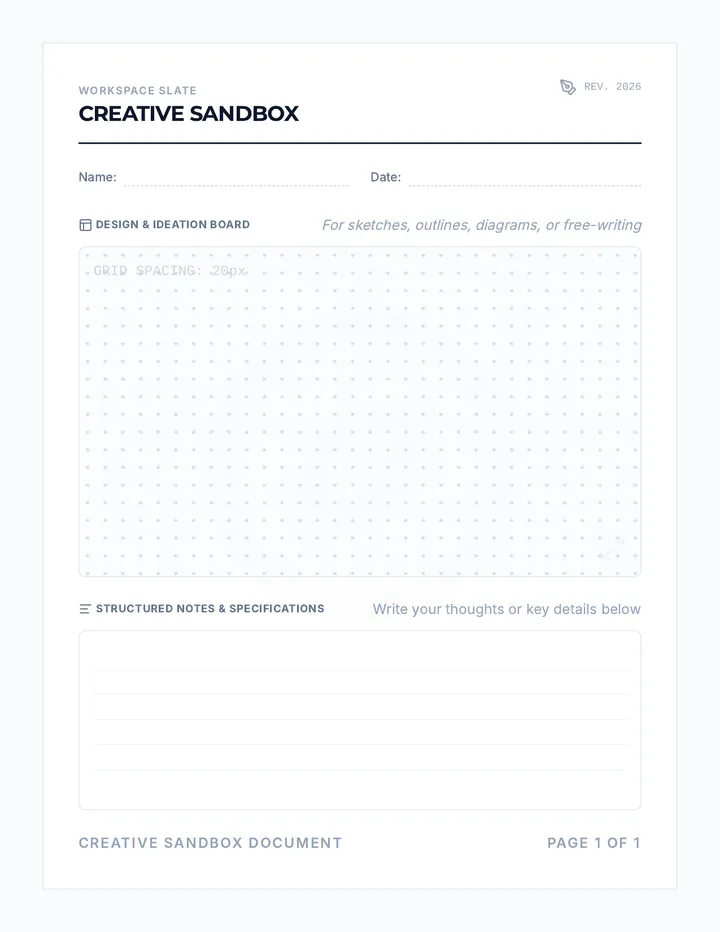
Draw your miniature from two different angles. Maintain consistent scale and detail level.
View A: Front Perspective SCALE 1:1 or 2:1
View B: Side or Top Detail DEPTH FOCUS
Artist Challenge: Use annotations to label specific parts of your sketch (e.g., "Rough texture here," "Metallic finish," "Translucent area").
Sculptors Revision Log Sculptor's Revision Log
Progress Monitoring & Studio Habits
ARTIST: ___________________
DATE: ___________________
Instructions: Document your goals and revisions daily. High-quality art requires intentional problem-solving .
Days Daily Goal / Action Obstacle Encountered Revision Strategy 1-2 3-4 5-6 7-8 9-10
Mid-Process Critique
Identify one part of your sculpture that wasn't working. How did you change your approach?
Studio Ethics
How did you assist a peer or maintain high productivity once your goals were met?
Ownership Reflection
Exit Ticket
Reflect on the ownership you took. What is the most significant visual revision you made to improve quality?
Miniature Magic Slides 8th Grade 3D Art & Sculpture
Miniature Magic
Small scale, big impact: Exploring the world of 3D miniatures and professional studio habits.
Our 10-Day Journey
01
Ideation & Planning
Conceptualizing tiny worlds and career paths.
02
Foundation & Form
Building structural integrity with Model Magic.
03
Detail & Revision
Adding texture and refining based on analysis.
Materials Toolkit
Model Magic Clay
Paint & Sharpie Markers
Sculpture Tools
Creative Persistence
Career Spotlight: Set Designer
Set designers create Maquettes—small scale models—to visualize films or theater productions before they are built full-size.
"The magic of a miniature is that it allows us to control an entire universe from above."
Industry Connection
• Spatial Awareness & Ratio
• Visual Storytelling
• Textural Illusion
• Durability & Structural Design
Sculptors & Ceramicists
Fine Art Sculptor
Focuses on form, anatomy, and balance. Many sculptors start small to test poses and proportions.
Production Potter
Understands the chemistry of clay and the precision required for uniform shapes.
Material Science
How does the clay behave? How do markers react to the surface?
Studio Habits of Mind
Envision
Picture the next step in your work before you take it.
Reflect
Ask yourself: "What isn't working? How can I fix it?"
Persist
Don't give up when the clay doesn't cooperate.
Day 1 Mission
Open the Blueprint
1. Complete your Tiny Ideas Worksheet .
2. Sketch your miniature from two angles .
3. Connect your concept to a personal experience .