Backstage Foundations Slides Production Call • Stagecraft 101
Unit 1 : Lesson 1
Behind The Velvet Curtain
Stage Crew Roles &
Backstage Protocol
Every breath of theater magic relies on invisible precision. Discover the chain of command, critical safety rules, and the language of headsets.
Focus: Safety • Hierarchy • Comm Protocol Headsets On • Clear The Wings
Command Hierarchy
Who Answers To Whom?
Chain of Command
Top Authority
Stage Manager
The pilot of live performances. Calls every lighting, sound, and deck cue. In charge of overall show safety.
Radio: "Stage Manager"
Deck Command
Assistant SM
Eyes and ears backstage. Manages deck crew, tracks actors in wings, oversees props and quick changes.
Post: Stage Left / Right
Control Booth & Deck
Department Crew
Light Board Op, Sound Op, Stage Grips, Prop Master, and Wardrobe. Execute actions strictly on SM call.
Rule: Never trigger early
Key Rule: The Director steps back on Opening Night—the SM takes total command.
Backstage Specialties
Core Technical Disciplines
Run Crew Focus
Lighting Board Operator
Booth
Operates the lighting console. Fires cues, controls spots, and monitors dimmer racks.
Skill: Split-second cue timing
Sound Board Operator
Booth / FOH
Mixes wireless actor mics live, triggers sound effects (SFX), and stops feedback.
Skill: Constant fader balance
Props Master & Run Crew
Wings
Maintains prop tables, hands props to actors, and shifts furniture silently in blackout.
Skill: Zero-noise dark movement
Wardrobe & Dressers
Offstage
Organizes racks, executes 30-second quick changes offstage, and maintains costumes.
Skill: Calm speed under pressure
Notice: Every role directly safeguards the actors' physical performance.
Zero Tolerance
Backstage Safety Protocols
Safety First
01
Show Blacks & PPE
Wear matte black clothing and closed-toe work boots. Tie hair back; no jewelry near fly lines.
02
Whisper Alleys
The wings are silent zones. No loud chatter, no phone screens, and wear soft-soled quiet shoes.
03
Cables & Exits
Gaff tape every walkway cable. Keep backstage corridors and fire exits 100% free of loose props.
EMERGENCY RULE: Anyone can call "HOLD! HOLD! HOLD!" if a human is in danger. Universal Stop
Communication Standard
The Headset Call Cadence
Clear-Com Etiquette
1. WARNING
SM gives notice 1–2 minutes before cue.
"Warning Light Cue 24 and Sound Cue B." Crew checks controls.
2. STANDBY
SM alerts operator 15–30 seconds before action.
"Standby Lights 24." Operator responds: "Lights standing by."
3. THE "GO"
The cue happens ON the exact word "GO", never before.
"Lights 24... [actor touches knob] ... GO! " Button is pressed.
The Golden Backstage Rule: Acknowledge every directive with: "Thank you, Stage Manager!"
Crew Protocol Field Guide Stagecraft Operations Manual
Crew Protocol Field Guide
Lesson 1 • Deck Doc
Crew Member Name:
Assigned Dept:
Date / Call Time:
Part 1
Operational Hierarchy & Role Dispatch
Match each backstage situation to the specific crew member responsible: (A) Stage Manager (SM) , (B) Assistant Stage Manager (ASM) , (C) Light Board Op , (D) Sound Board Op , or (E) Prop Master .
1. Actor enters stage right with an empty hand instead of the essential gold dagger prop.
2. A wireless bodypack mic on the lead actor develops loud static during a quiet monologue.
3. The scenic traveler curtain stalls midway; who determines whether to hold or proceed?
4. Cue 42 requires a 3-second sunset crossfade exactly when the character blows out the lantern.
Part 2
Clear-Com Protocol Translation
Examine the flawed headset call exchange below. Identify two critical protocol violations , then write the correct three-step call sequence (Warning, Standby, and GO).
SM: "Hey everyone, lights are coming up in a second."
Light Board Op: [Hits 'Go' button immediately while actor is still offstage]
SM: "Wait no! I didn't say go yet!"
Identified Protocol Violations (List two):
Standard Clear-Com Correction (Script SM & Op lines with Standby and GO):
STAGE OPERATIONS // CALL DISCIPLINE PAGE 1 OF 2
Backstage Safety & Risk Audit
Wing Hazard Inspection
Safety Sign-Off
Part 3
Visual Safety Inspection (The Offstage Wings)
During a pre-show deck check, you spot four active backstage safety hazards. Describe the physical risk and write the immediate corrective action required before house opens.
HAZARD A: XLR Audio Cable draped loose across Stage Left main actor crossover. Trip Risk
Potential Danger:
Required Protocol Action:
HAZARD B: Run crew member wearing white sneakers and looking at glowing phone in wing. Visual Bleed
Potential Danger:
Required Protocol Action:
HAZARD C: Scenic wagon rolled offstage blocks the marked exit door to the fire stairwell. Code Violation
Potential Danger:
Required Protocol Action:
Part 4
The "HOLD" Protocol Simulation
Scenario: Mid-performance, an actor trips on a riser and is visibly writhing in pain onstage while an automated scenic wall is moving directly toward them. Explain exactly who yells "HOLD", what happens across audio/lighting/deck, and how crew responds.
PRODUCTION SAFETY MATRIX // RUN CREW CERTIFICATION PAGE 2 OF 2
Backstage Briefing Teacher Guide Educator Facilitation Plan
Backstage Briefing Teacher Guide
Lesson 1 • Faculty Reference
Session Duration 50–60 Minutes
Primary Modality Simulation & Audit
Key Standard TH:Pr4.1 / Tech Safety
Target Output Field Guide Mastery
Recommended Lesson Sequence
10 MIN
Hook: The Blackout Blind Walk: Dim room lights completely. Have students navigate a short obstacle path in shoes. Debrief: Why do show blacks, gaffed cables, and glow tape exist?
20 MIN
Interactive Lecture (Slides 1–5): Emphasize chain of command, headset protocol, and universal authority to call "HOLD". Practice group choral response: "Thank you, Stage Manager!"
20 MIN
Field Guide Completion: Students work individually or in buddy pairs to complete role analysis, protocol correction, and the offstage hazard audit.
10 MIN
Simulation Drill: Execute 3 mock headset calls from the podium. Select students play Light Board Op, Sound Op, and ASM.
Crew Protocol Field Guide • Official Answer Key
Part 1: Hierarchy Situations
1: E (Prop Master) • 2: D (Sound Board Op) • 3: A (Stage Manager) • 4: C (Light Board Op)
Part 2: Headset Protocol Violations & Fix
Violations: (1) SM failed to use formal "Warning" or "Standby", offering vague casual speech. (2) Light board op triggered cue before explicit "GO" and failed to acknowledge standby. (3) Operator failed to say "Thank you, Stage Manager."
Correct Transcript: SM: "Standby Lights 12." Op: "Lights standing by." SM: "Lights 12... GO." Op: "Thank you, Stage Manager."
Part 3: Hazard Corrections
Hazard A (Loose XLR): Immediate tripping hazard for actors in dark crossover. Fix: Tape down flat with wide black gaffer tape across entire run, or route around perimeter.
Hazard B (White shoes / glowing phone): Visual spill catches audience sightlines and ruins onstage illusion. Fix: Enforce matte black footwear; all personal devices locked in green room.
Hazard C (Blocked fire exit): Severe life-safety fire code violation. Fix: Instantly relocate wagon to approved offstage storage footprint; clear 36" egress.
Part 4: "HOLD" Protocol Response
Protocol: ANY crew member who sees the injury immediately calls "HOLD! HOLD! HOLD!" loud and clear. All deck movement halts instantaneously, lights freeze or go to safety worklights, sound cuts playback, ASM attends to injured actor, SM manages communication.
TEACHER RESOURCE • LESSON 1 OF 3 SAFETY COMPLIANCE CERTIFIED
Technical Systems Slides Technical Production • Stagecraft 101
Unit 1 : Lesson 2
The Hardware Behind The Emotion
Lighting, Audio &
Stagecraft Systems
Explore the primary technical engines of theater: lighting fixtures, wireless audio paths, prop table organization, and precision spike marks.
Focus: Instruments • Signal Flow • Spike Marks Tools Ready • Safety Cables Clipped
Lighting Instruments
Shaping Focus & Atmosphere
Electrics Dept
Sharp Beam
ERS / Leko
Ellipsoidal Reflector Spotlight. Projects crisp beam edges, internal shutters shape light, slots hold patterns (gobos).
Use: Specials & Textures
Soft Edge
Fresnel
Uses stepped glass lens. Produces smooth, blended diffused wash across acting areas without visible beam edges.
Use: General Stage Washes
Saturated Color
LED PAR / Wash
High-output LED fixtures capable of instant color changes without physical plastic gels. Extremely energy efficient.
Use: Mood & Backdrop Color
Safety Rule: Every overhead lighting instrument MUST have a steel safety cable looped around the batten.
Audio Engineering
The Sound Signal Journey
Audio Signal Path
1. SOURCE
Mic / Element
Actor lavalier mic near hairline or cheek element.
2. TRANSMIT
Wireless Pack
Bodypack belt pouch sends radio frequency (RF).
3. MIX
Sound Console
Audio engineer blends volume, EQ, and sound effects.
4. OUTPUT
FOH Speakers
Amplified sound reaches audience ears clearly.
Feedback Prevention
Never point active actor mics directly at stage monitors or main house speaker horns.
Mute When Offstage
Pro Tip: Fresh alkaline or rechargeable batteries are installed before EVERY dress rehearsal and show.
Stage Deck Management
Props & Spike Discipline
Deck Crew & Props
The Golden Prop Table
Every prop has an outlined footprint drawn on butcher paper with black marker and labeled with the character name and scene.
Rule: If it isn't your personal prop, do NOT touch it!
Spike Marks on Deck
Color-coded thin gaffer tape marked in 90-degree corners or "T" shapes on stage floor indicating exact furniture positions.
Convention: Red = Scene 1, Blue = Scene 2, Glow = Blackout
Shift Speed: Preset tables Stage Left and Stage Right balance crew walking paths. Accuracy > Speed
Wardrobe Mechanics
The 30-Second Quick Change
Wardrobe Logistics
STEP 1
Offstage Quick Booth
Black pipe-and-drape dressing pod located immediately outside the stage door with floor carpet and blue running lights.
STEP 2
Preset Garments
Costumes unzipped, shoes stepped into trousers (fireman roll), fasteners prepped with Velcro snaps for rapid transfer.
STEP 3
Two-Dresser Drill
Dresser A handles top garments & wig checks; Dresser B handles boots and mic wire routing. Zero speaking except time counts.
Dresser Call: "15 seconds... 10 seconds... zipped and clear!"
Production Cue Sheet Worksheet Technical Systems • Lab Workbook
Production Cue Sheet Worksheet
Lesson 2 • Tech Ops
Student Name:
Department Track:
Production Title / Date:
Part 1
Instrument Selection Logic
Select the correct lighting instrument or audio gear for each design requirement: (ERS / Leko, Fresnel, LED PAR, Wireless Lavalier, FOH Shotgun) .
1. Crisp window shutter cut with foliage gobo pattern:
2. Soft blended general warm wash over center stage:
3. Fast color morph from deep cyan to saturated red:
4. Mobile actor moving rapidly across wide stage deck:
Part 2
Master Technical Cue Builder
Read the script excerpt below and populate the official technical cue sheet for both Lighting (LX) and Sound (SQ). Include cue numbers, visual/audio triggers, fade counts, and clear descriptions.
[SCENE EXCERPT • ACT I, SCENE 2]
(ELENA stands near the window as rain patters against glass. Clock ticks.)
ELENA: "He swore he would arrive before midnight." (She strikes a match and touches it to the lantern wick.)
(Sudden deafening thunder cracks overhead; the window rattles violently. Elena gasps as the room plunges into silhouette.)
Cue ID
Script Trigger Point
Time (s)
Action / Channel Description
LX 10
Elena touches match to lantern
1.5s
Warm amber pool snaps up on lantern + table
SQ 22
0s
LX 11
Simultaneous with SQ 22 thunder
LX 12
Immediately following lightning flash
3.0s
CUE DESIGN SPECIFICATION // ELECTRIC & AUDIO PAGE 1 OF 2
Stage Deck Tracking • Logistics
Prop Preset & Deck Spikes
Deck Sign-Off
Part 3
Prop Master Tracking Chart
Complete the preset and tracking status for four critical show props used in Scene 2.
Prop Item
Preset Location
Carried By
Post-Scene Strike Plan
1. Brass Lantern & Matchbox
Stage Left Table
Elena
Remains on set table for Act II
2. Telegram Envelope
Courier
3. Leather Doctor Bag
Dr. Hayes
4. Staged Umbrella (Wet)
Dr. Hayes
Part 4
Spike Tape Geometry & Shift Plan
A four-legged antique study table must be positioned rapidly in a 12-second blackout shift. Outline the spike tape protocol below:
A. Tape Shape & Placement
Why do crew members use an "L" or corner mark instead of a full square of tape under furniture legs?
B. Color-Coding System
Explain how to prevent crew from putting Scene 2 furniture on Scene 1 marks during a live blackout:
C. Deck Shift Crew Choreography (Step-by-Step Blackout Plan)
Write the 3 sequential actions of Grip 1 and Grip 2 from Blackout GO to Deck Clear:
DECK SPIKE & PROP PRESET SPECIFICATION PAGE 2 OF 2
Tech Systems Answer Key Educator Technical Guide
Tech Systems Answer Key
Lesson 2 • Key & Rubric
Part 1: Fixture Selection Key Workbook Pg 1
1. Foliage window pattern: ERS / Leko (with Gobo & Shutters)
2. Blended center stage wash: Fresnel (Stepped Lens)
3. Instant color morph cyan → red: LED PAR / Wash
4. Mobile rapid actor movement: Wireless Lavalier Bodypack
Part 2: Master Cue Sheet Exemplar Act I, Sc 2 Scene Builder
Cue ID
Trigger Point
Time
Action Description
SQ 22
Elena touches wick / gasps
0.0s
Thunder crack sound FX at +4dB; bass rumble reverb decays over 6s.
LX 11
Simultaneous with SQ 22 thunder
0.2s
Strobe / High-intensity cold white overhead flash through window.
LX 12
Immediately following flash
3.0s
Room general wash cuts to 15%; silhouette backlight remains on Elena.
Parts 3 & 4: Props & Spike Solutions Deck Logistics
Prop Preset Destinations: Telegram: Preset Stage Right table; courier enters SR, handed to Elena; Elena pockets at end of scene. Doctor Bag: Preset Stage Left table; Dr. Hayes enters SL; exits SL at curtain. Wet Umbrella: Preset SL table with drip cloth; struck to umbrella stand backstage.
Spike Geometry (Part 4A/B): "L" corner marks align the front outside corners of furniture legs. Corners require less tape, don't peel off when dragged, and provide precise rotational alignment. Color-coding ensures Scene 1 (e.g. Red) isn't confused with Scene 2 (e.g. Blue); glow tape marks corners for zero-light transitions.
Emergency Tech Troubleshooting Protocol
Audio Feedback Squeal
Mute channel instantly on console. Notch out offending high frequency (2k-4kHz) on parametric EQ. Instruct actor to step upstage of speaker boundary.
Wireless Mic Drop / Static
Switch receiver antenna bank; ASM confirms bodypack transmitter frequency and battery telemetry; bring up area shotgun or boundary mic backup.
Blown Lamp During Show
Never climb batten mid-show. SM alerts lighting op to boost adjacent wash fixture intensity by +15% on manual fader override to fill shadow.
TEACHER RESOURCE • LESSON 2 OF 3 TECHNICAL SPECIFICATION ARCHIVE
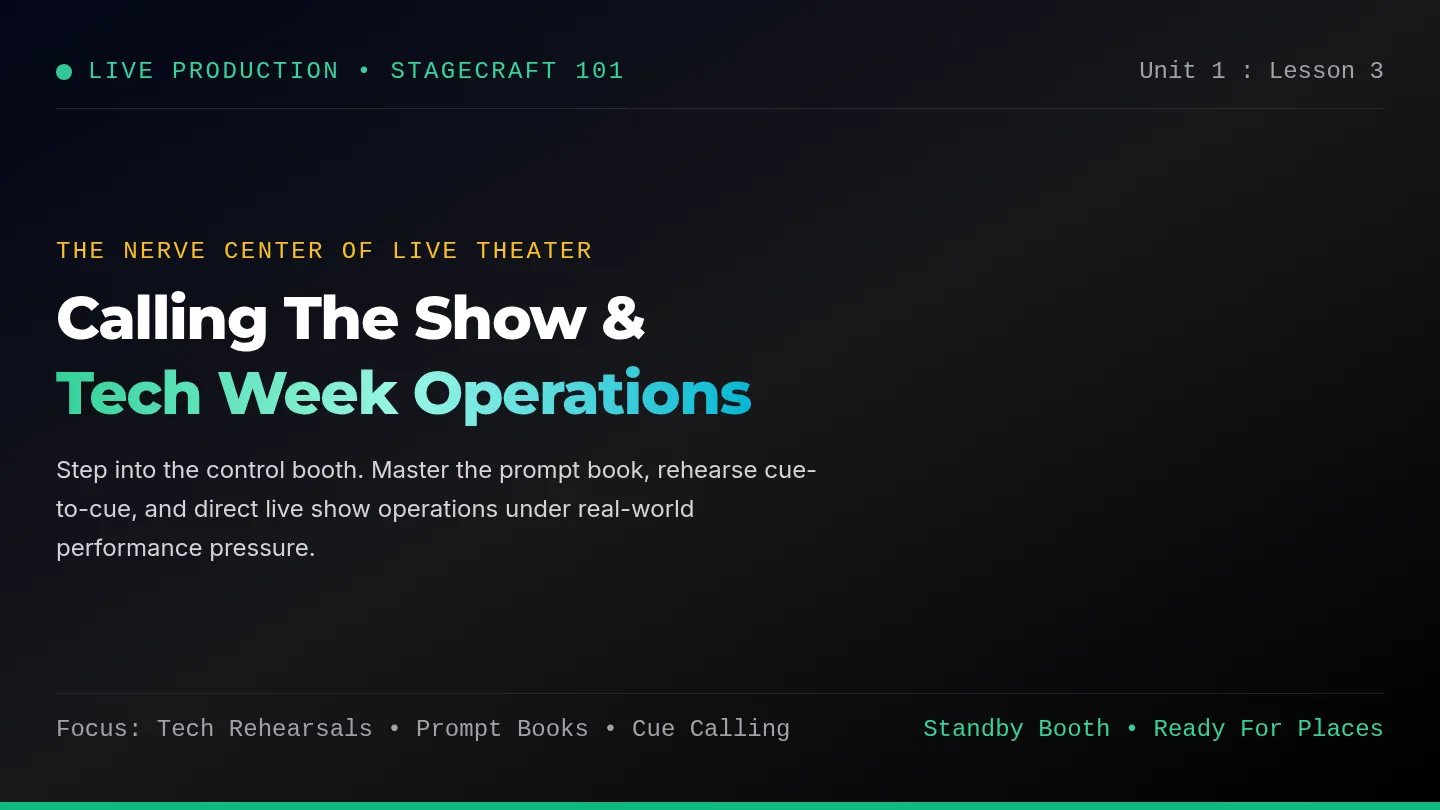
Show Operations Slides Live Production • Stagecraft 101
Unit 1 : Lesson 3
The Nerve Center of Live Theater
Calling The Show &
Tech Week Operations
Step into the control booth. Master the prompt book, rehearse cue-to-cue, and direct live show operations under real-world performance pressure.
Focus: Tech Rehearsals • Prompt Books • Cue Calling Standby Booth • Ready For Places
Rehearsal Progression
The Tech Rehearsal Pipeline
Tech Week Stages
PHASE 1
Paper Tech
SM, Director, and Designers sit around a table writing cues into script without actors.
Focus: Script alignment
PHASE 2
Dry Tech
Crew runs through lighting, sound, and scenic automation without actors onstage.
Focus: Technical safety
PHASE 3
Cue-To-Cue
Actors jump from one technical cue to the next, skipping long dialogue passages.
Focus: Timing & transitions
PHASE 4
Dress Rehearsal
Full run-through in costumes and makeup without stopping, simulating opening night.
Focus: Real-time stamina
Key Truth: Tech rehearsals test the technical systems—patience and calm communication are vital.
The Show Bible
Anatomy of the Prompt Book
Stage Manager Binder
Left Page: Script & Blocking
• Complete script dialogue and stage directions printed with wide margins.
• Choreographed blocking notations showing actor entrances and stage crosses.
• Lead lines connecting text to precise visual trigger points.
Right Column: Technical Cues
• Warning: Written 1 page before the cue triggers.
• Standby Bracket: Grouped standby calls written 3–4 lines above the GO.
• GO Line: Sharp horizontal rule pointing to the exact syllable or action.
If the Stage Manager gets sick, an ASM must be able to open the book and call the show immediately.
Headset Cadence
The Rhythm of Calling Cues
Execution Discipline
1
Grouped Standbys Save Headset Airtime
Never call separate standbys when cues hit together. Call: "Standby Lights 31 and Sound 18." Both operators confirm.
2
Eyes on the Visual Trigger, Hand on Mic
Watch the actor's hand or footstep. Do NOT look down at the script when the trigger approaches.
3
Crisp, Decisive "GO" Execution
The word "GO" is a sharp punch, never drawn out. Say: "Lights... [beat]... GO!"
Rule of Thumb: Standbys create readiness; the "GO" creates action.
Live Operations
Show Countdown & Crisis Protocol
Curtain Operations
Pre-Show Countdown Routine
T - 30 MIN: Half-Hour Call (Cast in dressing rooms, check props)
T - 15 MIN: Fifteen-Minute Call (House opens to audience)
T - 5 MIN: Five-Minute Call (Cast clears halls, preset check)
T - 0 MIN: "Places for Act One!" (All actors & crew in position)
Handling Live Mishaps
If an actor skips two pages of dialogue:"Hold Cues 14 through 18. Standby Cue 19 next!"
If an automated set piece jams:"Deck Hold! ASM confirm safety before we proceed."
The Golden Show Creed: An audience never sees a calm stage manager sweat.
Master Prompt Book Activity Stage Management Operations
Master Prompt Book Activity
Lesson 3 • Call Lab
Student Stage Manager:
Calling Station:
Show Title / Date:
Part 1
Prompt Book Notation (Act II Climax)
Annotate the prompt script below like a professional Stage Manager. Draw a bracket for Standby Cues 3 lines prior, and write the cue notation in the right-hand column with arrows pointing to the exact action trigger.
[SCENE SCRIPT • THE CLOCK TOWER]
MARCUS backs toward the iron railing, clutching the brass key against his chest.
MARCUS: "You think you can seal the gates before the bells toll? Look outside that archway!"
VALERIA lunges forward. MARCUS hurls the key into the machinery gearworks.
VALERIA: "Marcus, no! The gears are locking!"
(Sound of grinding iron gears shrieks. The grandfather clock strikes twelve. Stage lights flicker red, and main traveler curtain drops swiftly.)
SM Cue Column
Standby Cues: [Write Standby Call]
SQ 41 (Gear Shriek): [Exact Word Trigger]
LX 88 (Red Flicker): [Trigger Action]
Deck Cue 6 (Curtain): [Trigger Point]
Keep standbys clean and grouped.
Part 2
Verbal Calling Script Transcription
Write out the exact words you will speak over the headset to your crew for this sequence. Include the grouped standby call, operator confirmations, and the final execution call.
1. SM Grouped Standby Call (to Lights, Sound, and Deck Crew):
2. Required Crew Acknowledgments (What must each operator respond?):
3. SM Final Trigger Call (Script the exact word cadence with "GO"):
MASTER PROMPT ARCHIVE // CALL CADENCE LAB PAGE 1 OF 2
Live Operations & Contingency
Pre-Flight Checklist & Crisis Log
Show Execution
Part 3
The 30-Minute Stage Manager Pre-Flight Checklist
Before calling "Places", the Stage Manager must verify all technical systems. Check off each mandatory station inspection:
Clear-Com headsets checked with all ops
Lighting dimmer dimmer-check complete
Audio RF batteries & mic line-check clear
Stage Left & Right prop tables verified
Deck spike marks & glow tape recharged
House Manager cleared house for seating
Part 4
Live Crisis Resolution Matrix
Real live theater throws curveballs. How do you respond on the headset? Document your immediate command and recovery plan:
SCENARIO A: Dialogue Skip Pacing Error
Lead actor skips 2 pages of script, jumping straight to the scene exit line while three cues remain uncalled.
Immediate Headset Command:
Crew Action / Cue Adjustment:
SCENARIO B: Stage Scenery Obstruction Safety Hazard
An automated scenic wall tracks across the deck, but an actor dropped a wooden chair directly on its track line.
Immediate Headset Command:
Deck Crew / Operator Response:
SHOW OPERATIONS RUN PROTOCOL // STAGE MANAGEMENT LAB PAGE 2 OF 2
Stage Operations Teacher Guide Educator Production Guide
Stage Operations Teacher Guide
Lesson 3 • Cue Lab
Simulation Time 25–30 Minutes
Student Roles SM, Ops, Cast, ASMs
Focus Skills Cadence • Crisis Call
Culminating Event Live Mock Cue-to-Cue
Facilitating the Classroom Mock Cue-to-Cue
1. Role Stationing (5 min): Assign 1 Stage Manager (front of room or booth), 2 Board Ops (Light/Sound desks or laptops/clickers), 2 Stage Grips (deck stage left/right), and 2 volunteer actors onstage.
2. Dry Run Simulation (10 min): SM calls the Clock Tower climax using their annotated Master Prompt Book. Instruct Board Ops to tap desks or trigger bell/lights apps exactly on "GO".
3. "Curveball Injection" (10 min): Whisper to an actor to intentionally skip two lines, or place an obstacle on deck. Assess how the student Stage Manager maintains headset composure and issues commands.
Stage Manager Performance Rubric
Criteria
Proficient (3 pts)
Exemplary (4 pts)
Standby Timing
Calls standbys 15–20s prior; occasionally calls them singly.
Calls grouped standbys smoothly; verifies every operator acknowledgement.
The "GO" Punch
Calls "GO" near the trigger; minor vocal hesitation.
Sharp, crisp, decisive "GO" exactly on actor action or syllable.
Crisis Decisiveness
Pauses before halting or adjusting skipped lines.
Instant, calm commands: "Hold cues X... Standby next cue immediately!"
Master Prompt Book Official Key (Exemplar Responses)
Part 1 & 2 (Calling Transcript): SM: "Standby Lights 88, Sound 41, and Deck Cue 6." → Ops: "Lights standing by" / "Sound standing by" / "Deck standing by." → SM: "Sound 41 and Lights 88... [key hits gears]... GO!" → SM: "Deck Cue 6... [curtain falls]... GO!" → Ops: "Thank you, Stage Manager!"
Scenario A (Dialogue Skip): Command: "Hold Lights 85 and Sound 39! Standby Lights 86 and Curtain GO!" Op action: Jump cue stack immediately to next active cue without panic.
Scenario B (Track Obstruction): Command: "Deck Hold! Deck Hold! Grip 1 clear chair immediately!" Op action: Automation stops instantly until ASM confirms track is 100% clear.
TEACHER RESOURCE • LESSON 3 OF 3 PRODUCTION RUN CERTIFICATION