Sonic Anatomy Slides
6th Grade General Music Unit 1 • Sound Architecture
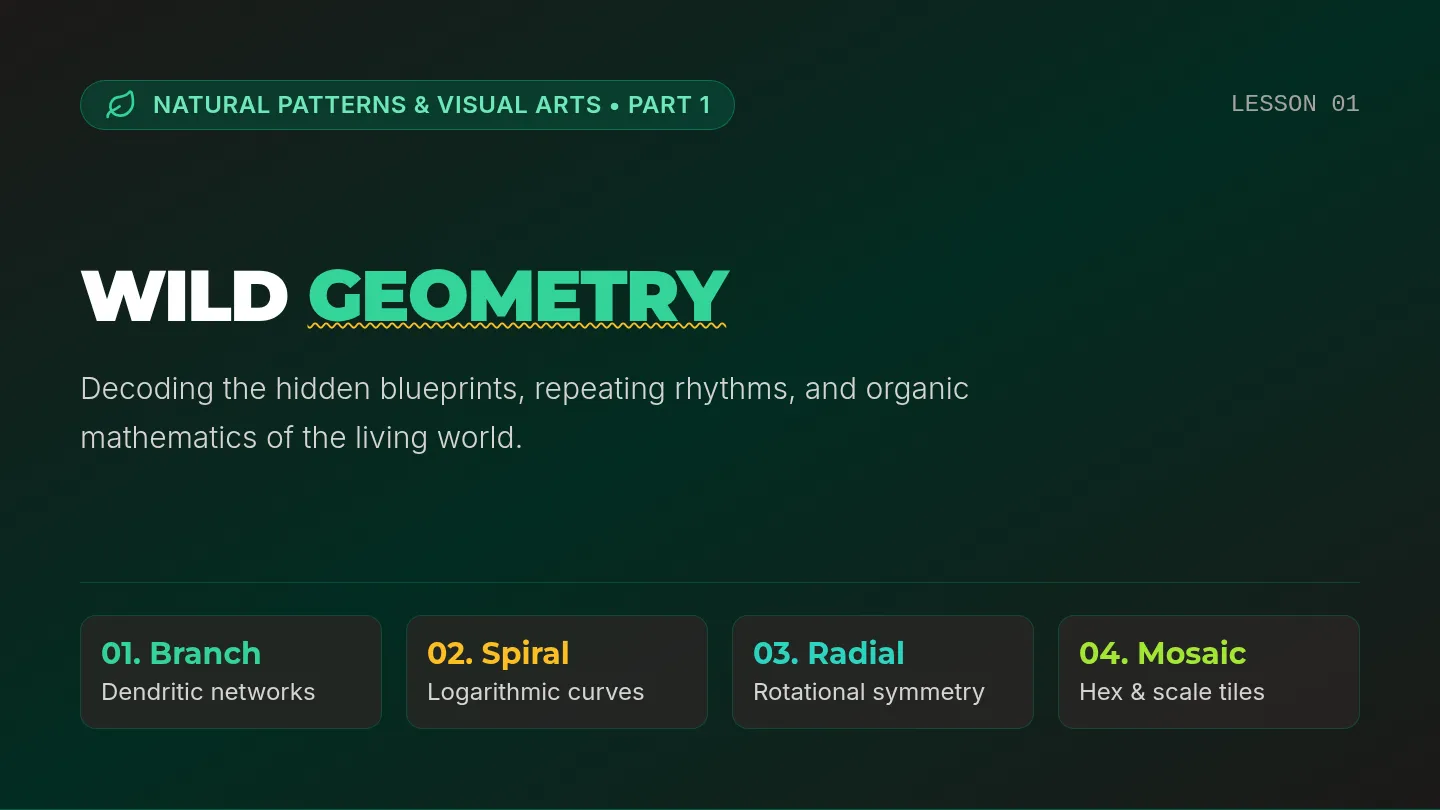
Deconstruct The Sound
Sonic Anatomy
The 12 essential building blocks every musician uses to craft rhythm, mood, color, and texture.
Part 1: Pulse & Speed
Part 2: Pitch, Volume & Color
Part 3: Harmony & Texture
The Time Engine |
Beat, Rhythm & Tempo
Concept 01
Beat
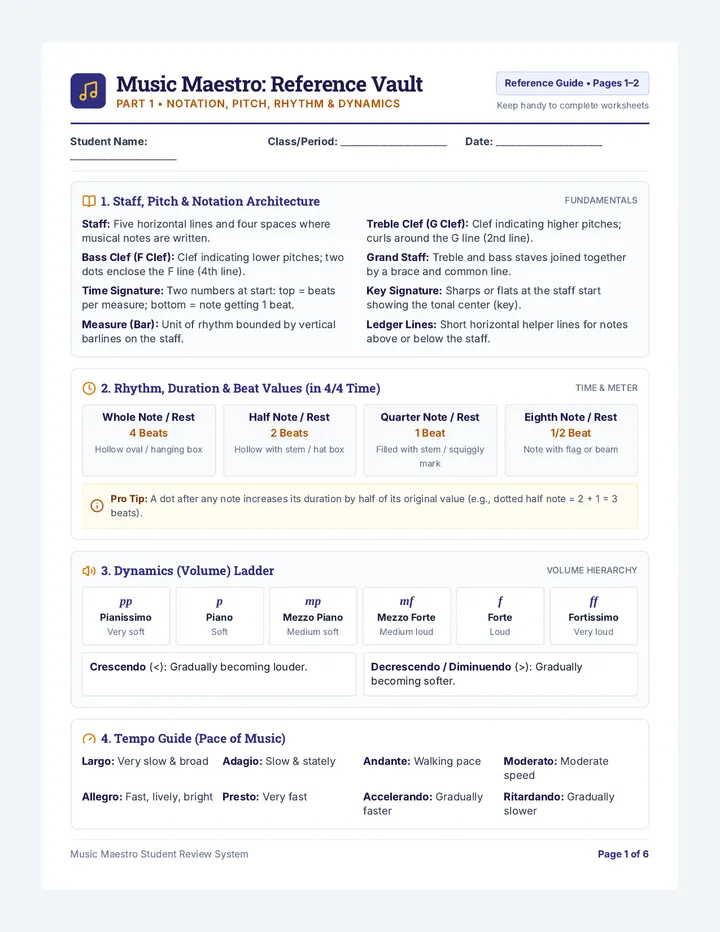
The steady, underlying pulse of the music that keeps time—like your heartbeat.
Tap your foot constantly
Tick • Tick • Tick • Tick
Rhythm
The pattern of long and short sounds and silences placed over the beat.
Clap the syllables
Short-long • short-short-long
Tempo
The speed of the beat: how fast, moderate, or slow the music flows.
Measured in BPM
Largo (Slow) vs Allegro (Fast)
Listening Check: Can the beat stay steady while the rhythm changes?
Yes! The beat is constant.
Groove Framework |
Meter & Syncopation
Concept 02
Meter
The way beats are organized into regular repeating patterns or bars.
Common Patterns:
4/4 Meter: ONE, 2, 3, 4
3/4 Waltz: ONE, 2, 3
Syncopation
Placing an accent or emphasis on weak beats or unexpected off-beats.
The Secret to Groove:
1 & 2 & 3 & 4 & — common in Jazz, Funk, Hip-Hop, and Latin music!
Ear Challenge: Listen for the surprise "kick" that lands in-between the counts.
Syncopation creates bounce!
Sound Dimensions |
Pitch & Dynamics
Concept 03
Pitch
The highness or lowness of a musical sound, determined by vibration frequency.
High Pitch: Flute, bird chirp (Fast vibrations)
Low Pitch: Tuba, bass drum (Slow vibrations)
Dynamics
The volume of sound in music: how loud or soft the notes are performed.
p (Piano) = Soft
f (Forte) = Loud
Dynamics create drama, suspense, and emotional energy!
Common Mistake: Don't confuse pitch (high/low) with dynamics (loud/soft)!
A flute can play quietly!
Tone Color |
Timbre (TAM-bur)
Concept 04
What is Timbre?
The unique tone quality or color of a sound that allows you to distinguish one voice or instrument from another, even when they play the same pitch at the same dynamic.
Trumpet
Bright, Brass, Piercing
Sharp overtone profile
Cello
Warm, Rich, Resonant
Vibrating wooden body
Clarinet
Mellow, Woody, Smooth
Single vibrating reed
Voice Recognition: When your best friend says "Hello" on the phone, you know who it is because of timbre!
Sonic Fingerprint
Layering Pitches |
Harmony
Concept 05
What is Harmony?
When two or more different pitches sound at the same time, producing chords and harmonic accompaniment.
Melody vs. Harmony:
Melody is horizontal (notes in sequence over time).
Harmony is vertical (notes stacked together simultaneously).
How Chords Feel
Consonance
Notes that blend smoothly, sounding peaceful, stable, and resolved.
Dissonance
Notes that clash, creating tension, suspense, or a need to resolve.
Great music balances both consonance and dissonance!
In the Band: The lead singer sings melody; the piano and rhythm guitar supply harmony.
Vertical Sound
The Fabric of Music |
Musical Texture: The 3 Types
Concept 06
Mono = One
Monophonic
A single melodic line with no accompaniment or harmony whatsoever.
Example: Singing alone in the shower or Gregorian chant.
Homo = Same/Together
Homophonic
One main melody supported by chords or harmonic accompaniment.
Example: A pop singer with guitar chords or church hymn.
Poly = Many
Polyphonic
Two or more independent melodies weaving together at the same time.
Example: A vocal round ("Row, Row, Row Your Boat") or Bach fugue.
Pop Music Test: Almost 95% of songs on the radio use which texture?
Homophonic (Melody + Chords)
Classroom Mission |
Sonic Detective: Track Breakdown
Active Listening
1
Find the Foundation
Tap the steady beat. Is the tempo allegro (fast) or adagio (slow)? Can you feel the meter in 3s or 4s?
2
Spot the Groove
Do you hear unexpected syncopation off the beat, or does the rhythm strictly lock with the pulse?
3
Identify the Colors
Describe the timbre of the lead instrument. How do dynamics change from verse to chorus?
4
Unpack the Texture
Is it monophonic (solo), homophonic (melody + chords), or polyphonic (overlapping melodies)?
Ready to apply your knowledge?
Turn to your Sonic Anatomy Worksheet!
Sonic Anatomy Worksheet
Sonic Anatomy
Mastery Worksheet • 6th Grade General Music
Name:
Period:
Date:
Score:
Word Bank (12 Essential Terms) Use each term once in Part 1
Beat Rhythm Tempo Meter Syncopation Pitch Dynamics Timbre Harmony Monophonic Homophonic Polyphonic
1 Part 1: Term Matching Matrix
Write the exact word from the word bank on the line.
1. The steady, continuous pulse that you can tap your foot to throughout a song.
2. The pattern of long and short sounds and silences arranged across time.
3. The organization of musical pulses into repeating groups or measures (e.g., 3/4 or 4/4).
4. The speed of the musical beat, ranging from slow (adagio) to fast (allegro).
5. The perceived highness or lowness of a sound based on sound wave frequency.
6. The degree of loudness or softness in a piece of music (e.g., piano or forte).
7. The distinct "tone color" or sound quality that makes a trumpet sound different from a cello.
8. Two or more different pitches sounding at the same time to form chords.
9. Accenting weak beats or off-beats unexpectedly, giving music a lively groove.
10. A musical texture with a single, solo melodic line and no background accompaniment.
11. A texture with one primary lead melody accompanied by supporting harmony chords.
12. A musical texture featuring two or more distinct, independent melodies at once.
2 Part 2: Sonic Detective Identification
Read each scenario and write the targeted term on the line.
Scenario A: The school choir is singing "Row, Row, Row Your Boat." Section 1 begins, and 4 measures later, Section 2 starts the same melody, creating an intricate weave of overlapping voices. What texture is this?
Answer:
Scenario B: A violinist and a flutist both play Middle C at a loud dynamic level (forte). You can instantly tell which instrument is which with your eyes closed because of what element?
Answer:
Scenario C: During a drum solo, the drummer plays a snappy rimshot on the "and" between beats 2 and 3, surprising the listener and making heads bob. What rhythmic technique did the drummer use?
Answer:
Sonic Anatomy Answer Key
Sonic Anatomy
Teacher Key
Instructional Guide & Master Scoring Solutions
6th Grade General Music
Total Assessment: 30 Points
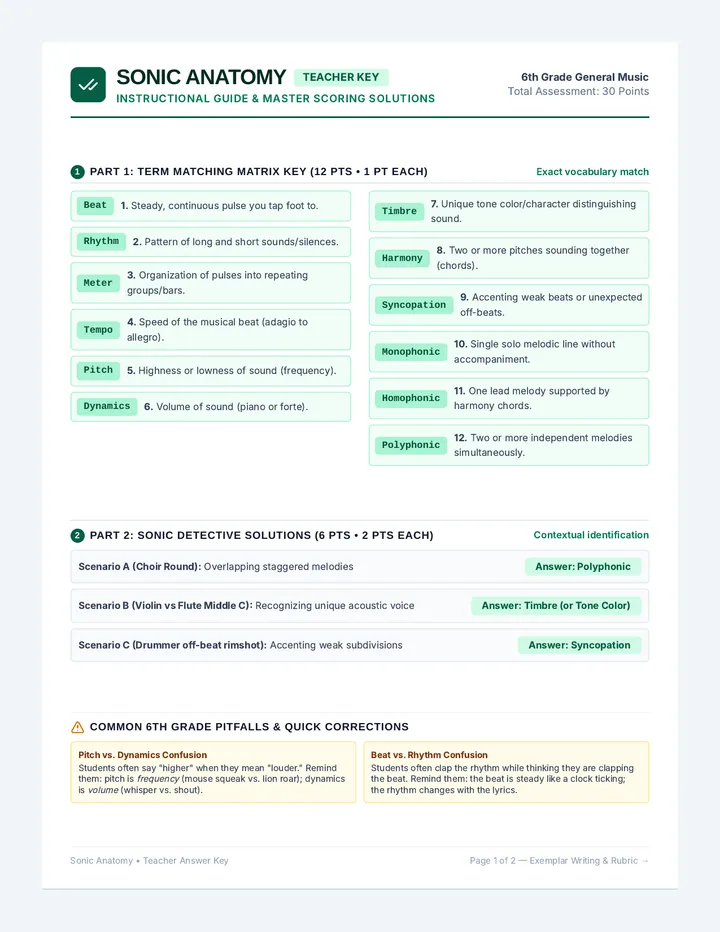
1 Part 1: Term Matching Matrix Key (12 Pts • 1 pt each)
Exact vocabulary match
Beat 1. Steady, continuous pulse you tap foot to.
Rhythm 2. Pattern of long and short sounds/silences.
Meter 3. Organization of pulses into repeating groups/bars.
Tempo 4. Speed of the musical beat (adagio to allegro).
Pitch 5. Highness or lowness of sound (frequency).
Dynamics 6. Volume of sound (piano or forte).
Timbre 7. Unique tone color/character distinguishing sound.
Harmony 8. Two or more pitches sounding together (chords).
Syncopation 9. Accenting weak beats or unexpected off-beats.
Monophonic 10. Single solo melodic line without accompaniment.
Homophonic 11. One lead melody supported by harmony chords.
Polyphonic 12. Two or more independent melodies simultaneously.
2 Part 2: Sonic Detective Solutions (6 Pts • 2 pts each)
Contextual identification
Scenario A (Choir Round): Overlapping staggered melodies Answer: Polyphonic
Scenario B (Violin vs Flute Middle C): Recognizing unique acoustic voice Answer: Timbre (or Tone Color)
Scenario C (Drummer off-beat rimshot): Accenting weak subdivisions Answer: Syncopation
Common 6th Grade Pitfalls & Quick Corrections
Pitch vs. Dynamics Confusion
Students often say "higher" when they mean "louder." Remind them: pitch is frequency (mouse squeak vs. lion roar); dynamics is volume (whisper vs. shout).
Beat vs. Rhythm Confusion
Students often clap the rhythm while thinking they are clapping the beat. Remind them: the beat is steady like a clock ticking; the rhythm changes with the lyrics.
Sonic Anatomy • Teacher Answer Key Page 1 of 2 — Exemplar Writing & Rubric →
Sonic Anatomy: Written Application Exemplars
Scoring Standards
3 Part 3: Exemplar Student Sentences (6 Pts • 2 pts per prompt)
Students must demonstrate conceptual accuracy, not just dictionary repetition.