Vivaldi Soundscapes Reference Sheet
Grade 6 Music Baroque Masterworks Reference Sheet • Page 1
Name: Date: Period:
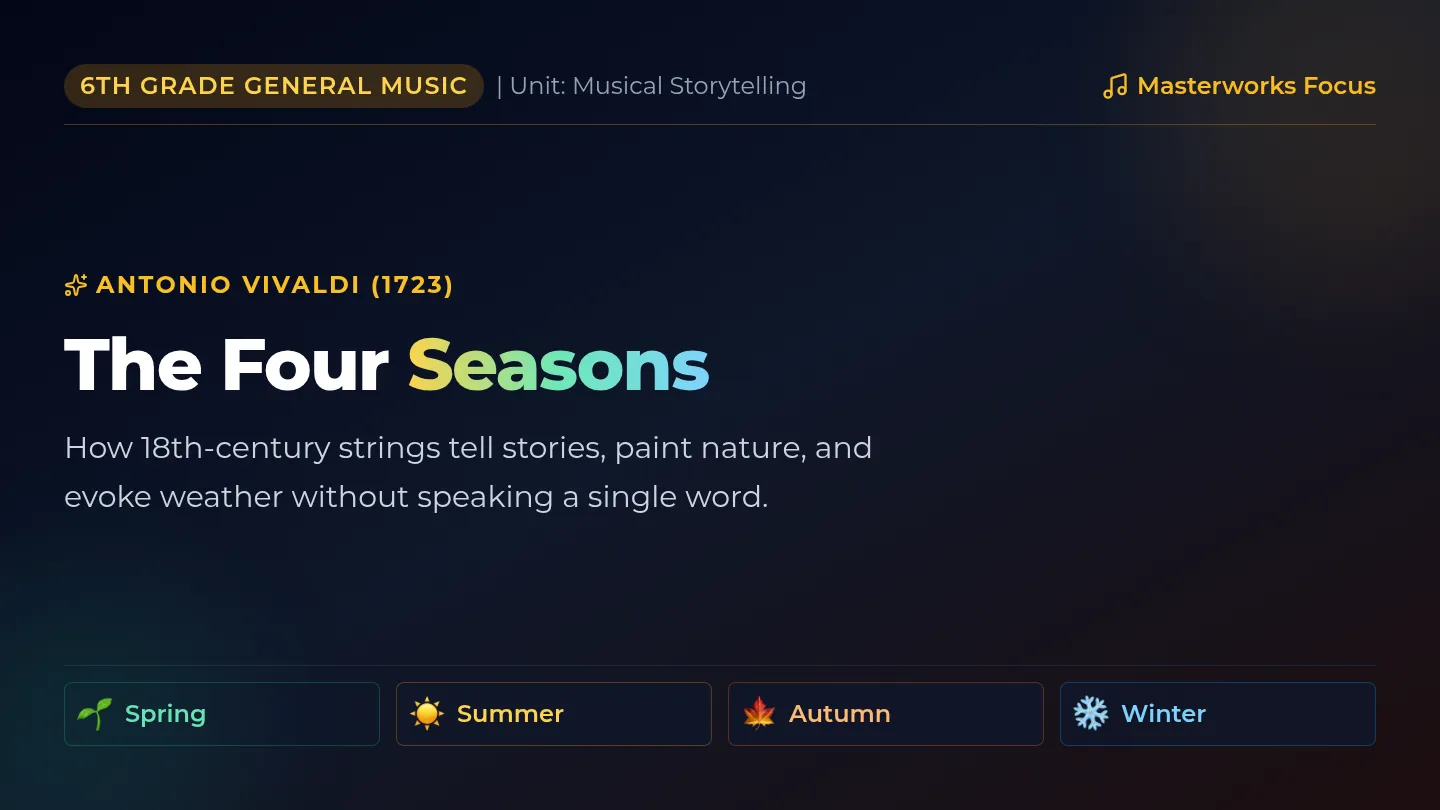
Vivaldi’s The Four Seasons c. 1723
Part I: Musical Era, Architectural Forms, and Violin Techniques
Antonio Vivaldi (1678–1741)
Venice, Italy • "The Red Priest"
The Baroque Era (c. 1600–1750): Known for dramatic contrast, rich ornamentation, and intricate layered melodies. Vivaldi taught violin at a Venetian girls' orphanage (Ospedale della Pietà), writing over 500 concertos.
1. Core Forms & Musical Concepts
Program Music
Definition
Instrumental music designed to depict an external story, mood, painting, or nature scene without any singers singing lyrics.
In this work: Each concerto is tied directly to an accompanying Italian sonnet (poem).
Solo Concerto
Musical Form
A composition for one solo instrument (here, the virtuoso solo violin) accompanied by a full string orchestra.
Movement Structure: 3 Movements arranged in a Fast – Slow – Fast tempo pattern.
Ritornello Form
Structure
From Italian for "little return." The full orchestra plays a recurring theme (the refrain), alternating with imaginative solo violin episodes.
[Tutti Refrain] → [Solo 1] → [Refrain] → [Solo 2] → [Refrain]
Terraced Dynamics
Volume
Sudden shifts between loud (f - forte) and soft (p - piano) without gradual crescendos or decrescendos.
Echo Effect: Vivaldi frequently repeats a loud orchestral phrase as an immediate soft whisper.
2. The Ensemble: Who Is Playing?
The Soloist
Solo Violin: Plays the most difficult, flashy, and descriptive melodies representing birds, lightning, or a drunken peasant.
Ripieno (Tutti)
Full String Orchestra: 1st Violins, 2nd Violins, Violas, and Cellos. They provide power, accompany the soloist, and state the Ritornello theme.
Basso Continuo
Rhythm & Harmony Foundation: Played by a chordal instrument (harpsichord or organ) paired with a low bass instrument (cello or bass).
3. Violin Techniques: How Vivaldi Creates Nature Sounds
Pizzicato
Plucking the violin string with the finger instead of bowing. Sounds like crisp raindrop splashes or ticking clocks.
Tremolo
Moving the bow back and forth rapidly on one pitch. Mimics trembling from freezing cold or rumbling thunder.
Trill
Fingers rapidly alternating between two adjacent notes. Perfect for bird chatter, whistling warblers, and insect chirps.
Staccato
Short, sharp, detached notes. Used for chattering teeth on icy roads, hunting dogs barking, and stomping boots.
Turn over for Part II: Season-by-Season Listening Decoder Page 1 of 2
Grade 6 Music Tone-Painting Field Guide • Page 2
Listening Ear Checklist
The Four Seasons: Tone-Painting Decoder
How Vivaldi translates scenes, weather, and creatures into musical notes
Tone Painting = Musical Storytelling
Concerto No. 1: Spring (La Primavera) • E Major
Fast – Slow – Fast
Movt. 1 (Allegro)
- Singing Birds: High violin trills.
- Flowing Brooks: Gentle sixteenth notes.
- Thunderstorm: Tremolo & lightning runs.
Movt. 2 (Largo)
- Goatherd Sleeping: Sweet violin song.
- Rustling Leaves: Muted violin chords.
- Barking Dog: Loud viola "bow-wow" accents!
Movt. 3 (Allegro)
- Pastoral Dance: Cheerful 12/8 rhythm.
- Nymphs & Shepherds: Solo violin leaps.
- Bagpipes: Long sustained bass drone.
Concerto No. 2: Summer (L’Estate) • G Minor
Fast – Slow – Fast
Movt. 1 (Allegro)
- Sweltering Heat: Dragging, tired tempo.
- Cuckoo & Finch: Rapid solo bird calls.
- Sudden Gusts: Violent winds burst in.
Movt. 2 (Adagio)
- Nervous Shepherd: Trembling violin tune.
- Buzzing Swarm: Irritating fly motifs.
- Distant Thunder: Abrupt orchestral blasts.
Movt. 3 (Presto)
- The Tempest: Wild virtuoso sixteenth notes.
- Hailstones: Rapid downward scales ruin crops.
- Thunder Roars: Driving low-bass pulse.
Concerto No. 3: Autumn (L’Autunno) • F Major
Fast – Slow – Fast
Movt. 1 (Allegro)
- Harvest Dance: Upbeat peasant folk rhythm.
- Wine Revelers: Stumbling arpeggios hiccup.
- Falling Asleep: Music slows to a crawl.
Movt. 2 (Adagio)
- Sleeping Drunkards: Long quiet chords.
- Harpsichord Color: Delicate arpeggio textures.
- Serene Peace: No loud sudden outbursts.
Movt. 3 (Allegro)
- The Hunt Begins: Horn calls copied by violins.
- Baying Hounds: Snapping staccato notes.
- Fleeing Game: Fast solo runs depict chase.
Concerto No. 4: Winter (L’Inverno) • F Minor
Fast – Slow – Fast
Movt. 1 (Allegro)
- Teeth Chattering: Staccato repeated beats.
- Stomping Boots: Heavy unison accents.
- Icy Winds: Rapid violin virtuoso squalls.
Movt. 2 (Largo)
- By the Warm Fire: Gorgeous lyrical violin tune.
- Rain on Glass: Pizzicato string plucking.
- Indoor Contentment: Sweet major harmony.
Movt. 3 (Allegro)
- Skating on Ice: Smooth, cautious sliding notes.
- Slips & Falls: Abrupt crashing full chords.
- Winter Battle: Clashing winds end the work.
Listening Detective: 4 Clues to Ask While Listening
Active Listening Protocol
1. Who plays? Solo violin vs. Tutti orchestra (Ritornello)?
2. What technique? Bowed (arco), plucked (pizzicato), trill, or tremolo?
3. Volume changes? Are dynamics terraced (sudden forte to piano)?
4. Nature story? Which scene from the poem is being painted right now?
Vivaldi: Il cimento dell'armonia e dell'inventione (Op. 8) Page 2 of 2