Barbizon Moods Teacher Guide Grade 6 Visual Arts • 2-Session Studio Unit
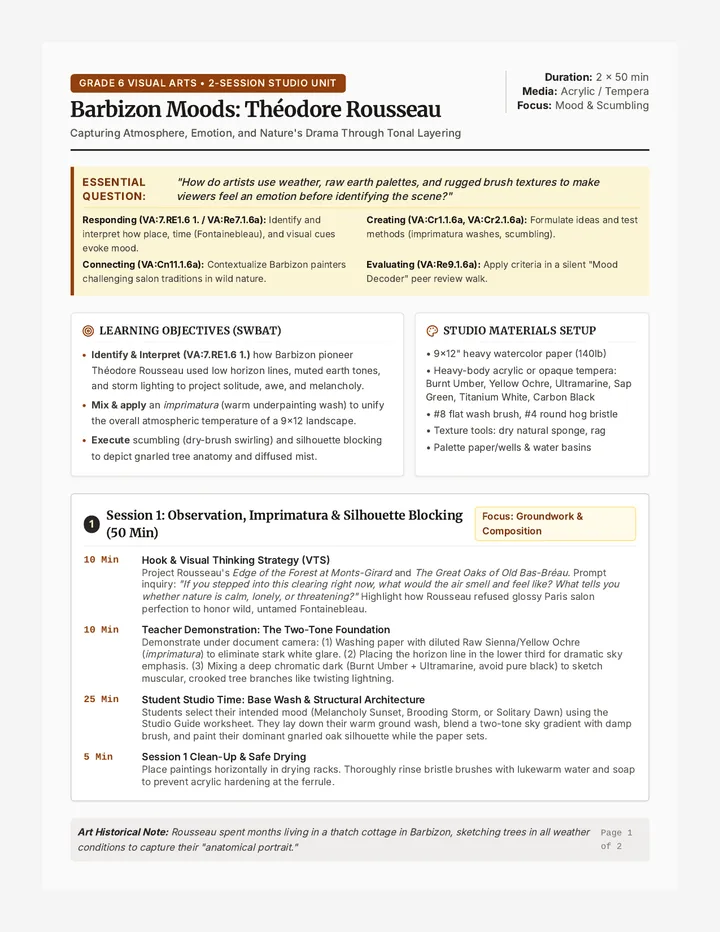
Barbizon Moods: Théodore Rousseau
Capturing Atmosphere, Emotion, and Nature's Drama Through Tonal Layering
Duration: 2 × 50 min
Media: Acrylic / Tempera
Focus: Mood & Scumbling
Essential Question:
"How do artists use weather, raw earth palettes, and rugged brush textures to make viewers feel an emotion before identifying the scene?"
Responding (VA:7.RE1.6 1. / VA:Re7.1.6a): Identify and interpret how place, time (Fontainebleau), and visual cues evoke mood.
Creating (VA:Cr1.1.6a, VA:Cr2.1.6a): Formulate ideas and test methods (imprimatura washes, scumbling).
Connecting (VA:Cn11.1.6a): Contextualize Barbizon painters challenging salon traditions in wild nature.
Evaluating (VA:Re9.1.6a): Apply criteria in a silent "Mood Decoder" peer review walk.
Learning Objectives (SWBAT)
• Identify & Interpret (VA:7.RE1.6 1.) how Barbizon pioneer Théodore Rousseau used low horizon lines, muted earth tones, and storm lighting to project solitude, awe, and melancholy.
• Mix & apply an imprimatura (warm underpainting wash) to unify the overall atmospheric temperature of a 9×12 landscape.
• Execute scumbling (dry-brush swirling) and silhouette blocking to depict gnarled tree anatomy and diffused mist.
Studio Materials Setup
• 9×12" heavy watercolor paper (140lb)
• Heavy-body acrylic or opaque tempera: Burnt Umber, Yellow Ochre, Ultramarine, Sap Green, Titanium White, Carbon Black
• #8 flat wash brush, #4 round hog bristle
• Texture tools: dry natural sponge, rag
• Palette paper/wells & water basins
1 Session 1: Observation, Imprimatura & Silhouette Blocking (50 Min)
Focus: Groundwork & Composition
10 Min
Hook & Visual Thinking Strategy (VTS)
Project Rousseau's Edge of the Forest at Monts-Girard and The Great Oaks of Old Bas-Bréau . Prompt inquiry: "If you stepped into this clearing right now, what would the air smell and feel like? What tells you whether nature is calm, lonely, or threatening?" Highlight how Rousseau refused glossy Paris salon perfection to honor wild, untamed Fontainebleau.
10 Min
Teacher Demonstration: The Two-Tone Foundation
Demonstrate under document camera: (1) Washing paper with diluted Raw Sienna/Yellow Ochre (imprimatura ) to eliminate stark white glare. (2) Placing the horizon line in the lower third for dramatic sky emphasis. (3) Mixing a deep chromatic dark (Burnt Umber + Ultramarine, avoid pure black) to sketch muscular, crooked tree branches like twisting lightning.
25 Min
Student Studio Time: Base Wash & Structural Architecture
Students select their intended mood (Melancholy Sunset, Brooding Storm, or Solitary Dawn) using the Studio Guide worksheet. They lay down their warm ground wash, blend a two-tone sky gradient with damp brush, and paint their dominant gnarled oak silhouette while the paper sets.
5 Min
Session 1 Clean-Up & Safe Drying
Place paintings horizontally in drying racks. Thoroughly rinse bristle brushes with lukewarm water and soap to prevent acrylic hardening at the ferrule.
Art Historical Note: Rousseau spent months living in a thatch cottage in Barbizon, sketching trees in all weather conditions to capture their "anatomical portrait." Page 1 of 2
2
Session 2 Facilitation & Studio Assessment
Barbizon Moods Studio Unit
2 Session 2: Scumbling, Atmospheric Depth & Critique (50 Min)
Focus: Atmosphere, Scumbling & Reflection
8 Min
Technique Demo: Scumbling & Atmospheric Veil
Demonstrate scumbling: take a stiff, nearly dry bristle brush, dip tip into tinted opaque pigment (e.g. pale ochre or mist gray), blot vigorously on a paper towel, and gently drag/swirl across the dry tree branches. This creates semi-transparent veils of mist and shimmering light without obliterating the branch anatomy.
27 Min
Studio Production: Building Drama & Environmental Detail
Students apply dry-brush scumbling over silhouettes to produce canopy foliage, rolling ground fog, and sunbeams breaking through storm clouds. Emphasize contrast: deep darks in foreground shrubs against glowing, hazy background horizons.
10 Min
Silent Mood Walk & Critique
Display paintings along tables. Students rotate with 2 sticky notes answering: "1. What mood emotion hits you first?" and "2. Which specific technique (scumbling, value contrast, brush stroke) creates that emotion?"
5 Min
Final Studio Polish & Storage
Students attach completed Studio Reflection worksheets to the back of dry paintings for formative assessment.
Differentiation & Scaffolding
Support: Provide pre-printed branch anatomy silhouette reference cards; offer sea-sponge dabbers for students struggling with dry-brush pressure.
Extension: Challenge advanced students to add dramatic contre-jour (backlit sun bursting through tree crowns) and multi-layered atmospheric perspective planes.
Common Pitfalls & Remedies
Too much water on brush: Paint will streak into muddy puddles instead of scumbling. Remedy: Mandate the paper towel test before touching canvas.
Symmetrical "Lollipop" Trees: Remedy: Emphasize Rousseau's rule: nature is weathered, bent by wind, and asymmetrical. Every branch forks like a lightning bolt.
Standards-Based Assessment Rubric
Criteria Proficient (3 pts) Approaching (2 pts) Developing (1 pt) Atmospheric Mood Clear emotional tone achieved via deliberate palette & sky lighting. Mood attempted; color harmony slightly inconsistent with mood. Color choices feel random; mood is indeterminate. Rousseau Scumbling Dry-brush scumbling reveals semi-transparent texture and mist layers. Scumbling applied, but brush was either too wet or covered underlayer entirely. Solid opaque paint blocks; no dry-brush texturing observed. Organic Form & Value Gnarled, asymmetrical tree silhouette with strong tonal values. Tree silhouette has organic shapes but values lack depth. Rigid, schematic tree forms with flat, single-tone value.
Théodore Rousseau Studio Unit • Teacher Instructional Reference Page 2 of 2
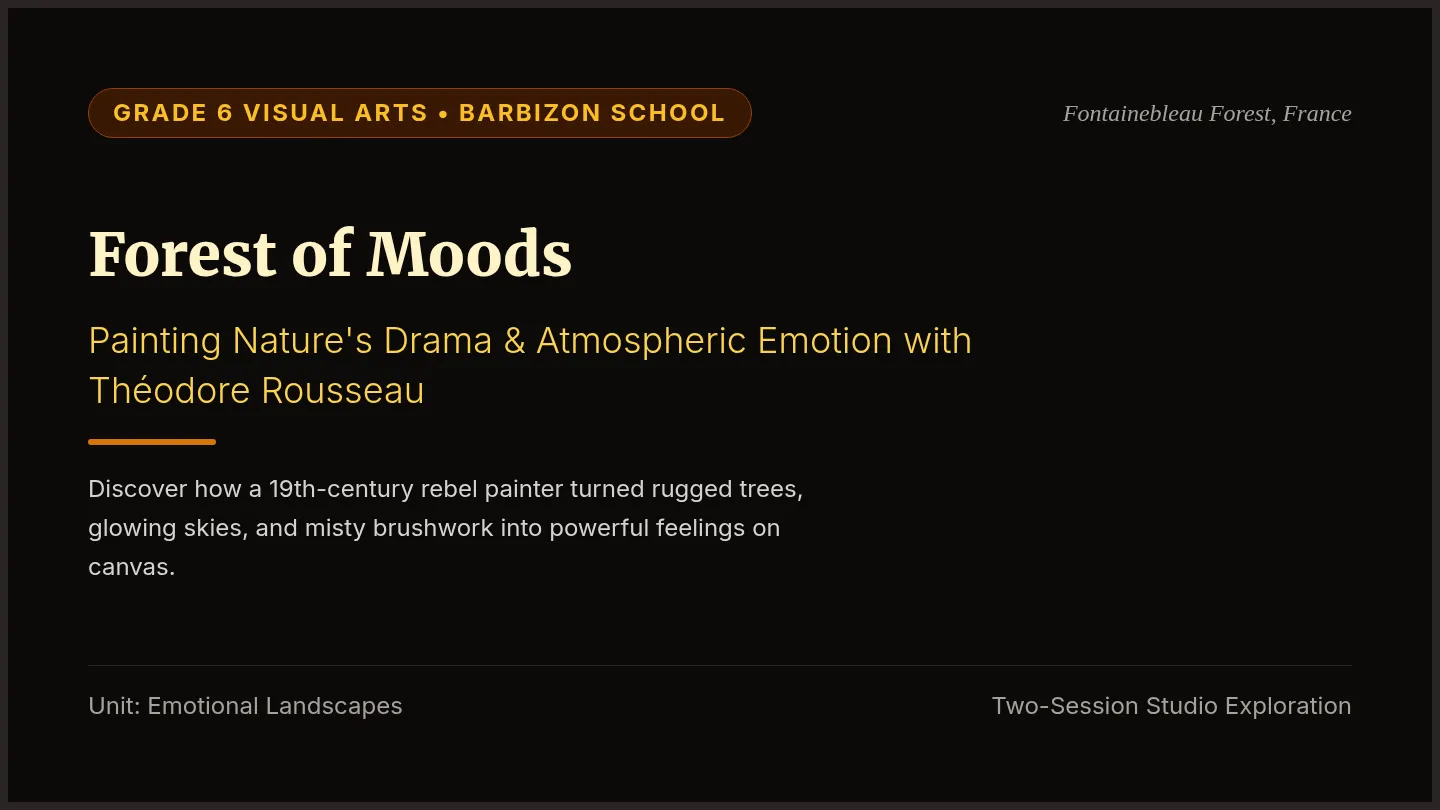
Moody Landscapes Slides Grade 6 Visual Arts • Barbizon School Fontainebleau Forest, France
Forest of Moods
Painting Nature's Drama & Atmospheric Emotion with Théodore Rousseau
Discover how a 19th-century rebel painter turned rugged trees, glowing skies, and misty brushwork into powerful feelings on canvas.
Unit: Emotional Landscapes Two-Session Studio Exploration
Art History Context
Théodore Rousseau: The Forest Rebel
1
Rejecting the Studio Rules
In the 1830s, official art salons demanded smooth, polite, idealized paintings. Rousseau fled Paris to live in a humble thatch cottage in the wild forest of Fontainebleau.
"I wanted nature in its untamed truth."
2
Trees with Personalities
Rousseau did not see trees as background decoration. He treated ancient, twisted oaks as living characters with scars, muscle, resilience, and sorrow.
Every branch tells a story of weather and time.
Barbizon Painters: The first artists to paint directly in the wild Slide 2 / 8
Visual Analysis
How Does a Landscape Create Mood?
1. Color Palette
Warm ochres and rust browns project quiet sunset contemplation. Cold blues and slate grays project brewing peril or isolation.
Feeling: Warmth vs. Chill
2. Sky Proportion
Placing the horizon very low (in the bottom third) makes the sky vast, mighty, and overwhelming, making human worries feel small.
Feeling: Humility & Awe
3. Silhouette Shapes
Sharp, jagged, wind-whipped branches create tension and unease. Soft, rounded canopies foster calm safety and quiet shelter.
Feeling: Tension vs. Peace
Question: What emotion will your forest convey? Slide 3 / 8
Technique Breakdown #1
The Imprimatura: The Golden Ground
What is an Imprimatura?
A thin, transparent wash of warm earthy paint (Yellow Ochre or Raw Sienna) brushed over the entire white surface before painting begins.
• Kills the glare: Harsh white paper distracts your eyes from subtle atmospheric shades.
• Unifies temperature: Warm tones peek through tiny gaps, giving the whole landscape a golden, unified glow.
Studio Golden Rule
Never start with stark, blinding white paper! Rousseau always began with a warm, breathing undertone.
Water + Touch of Ochre
Foundation Layer: Applied in Session 1 Slide 4 / 8
Barbizon Moods Studio Worksheet Studio Guide 6th Grade Visual Arts • Unit: Forest of Moods
Théodore Rousseau Technique Study
Atmospheric Landscape Planner
Name: Date: Period:
1
Decoding Rousseau's Mood (Visual Analysis)
A. Palette Temperature
What dominant colors does Rousseau use, and do they make the air feel hot, chilly, or damp?
B. Sky & Horizon Placement
Where is the horizon line placed (high, middle, low)? How does this affect the emotional scale?
C. Tree Character & Line
Are the branches stiff, graceful, or twisted? What human feeling does the tree posture evoke?
2
My Mood & Color Strategy
Target Emotion (Circle One):
Brooding Storm
Solitary Twilight
Quiet Autumn Fog
Restless Dawn
Imprimatura Wash Tint Water + warm earth pigment:
Sky Gradient (Top vs Horizon) Two mixed colors blended:
Chromatic Dark (Tree) Umber + Blue mix (no tube black):
3
Thumbnail Value & Composition Study
Plan light vs. dark before painting on 9×12 paper
SKETCH BOX • 4:3 PROPORTION
[ Draw low horizon • Asymmetrical gnarled oak skeleton • Value shading ]
Rousseau Composition Check:
Rule of Thirds: Horizon is kept in the lower third for dramatic sky dominance.Asymmetrical Trunk: Main tree leans or twists organically off-center.Branch Lightning: Heavy limbs split into sharp angular elbows.
Barbizon School Studio Unit • Session 1 Groundwork Page 1 of 2
Studio Tracker
Session 2 Execution & Artist Reflection
Barbizon Moods Studio Unit
4
Two-Session Studio Checklist
Session 1: Foundation
Warm imprimatura wash laid over 9×12 paper
Sky gradient blended (dark upper sky to glowing horizon)
Twisted oak silhouette blocked with chromatic darks
Session 2: Atmosphere & Light
Brush blotted bone-dry on paper towel before painting
Dry-brush scumbling swirled for foliage & ground mist
Light accents added to trunk rim or horizon glow
5
Dry-Brush Scumbling Test Strip
★ Must test brush here before touching final painting!
Dip brush tip, blot hard on paper towel, then swirl in the test box below. It should look like a delicate semi-transparent haze, NOT a wet streak!