Culinary Stocks Pop Quiz
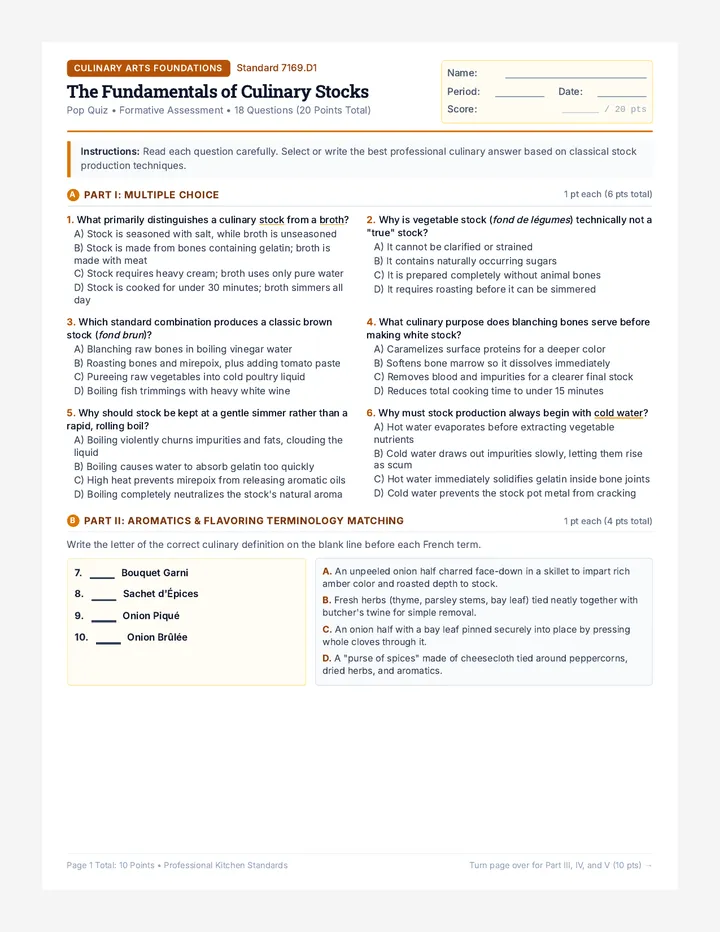
Culinary Arts Foundations Standard 7169.D1
The Fundamentals of Culinary Stocks
Pop Quiz • Formative Assessment • 18 Questions (20 Points Total)
Name:
Period: Date:
Score: _______ / 20 pts
Instructions: Read each question carefully. Select or write the best professional culinary answer based on classical stock production techniques.
A Part I: Multiple Choice
1 pt each (6 pts total)
- What primarily distinguishes a culinary stock from a broth?
A) Stock is seasoned with salt, while broth is unseasoned
B) Stock is made from bones containing gelatin; broth is made with meat
C) Stock requires heavy cream; broth uses only pure water
D) Stock is cooked for under 30 minutes; broth simmers all day
- Why is vegetable stock (fond de légumes) technically not a "true" stock?
A) It cannot be clarified or strained
B) It contains naturally occurring sugars
C) It is prepared completely without animal bones
D) It requires roasting before it can be simmered
- Which standard combination produces a classic brown stock (fond brun)?
A) Blanching raw bones in boiling vinegar water
B) Roasting bones and mirepoix, plus adding tomato paste
C) Pureeing raw vegetables into cold poultry liquid
D) Boiling fish trimmings with heavy white wine
- What culinary purpose does blanching bones serve before making white stock?
A) Caramelizes surface proteins for a deeper color
B) Softens bone marrow so it dissolves immediately
C) Removes blood and impurities for a clearer final stock
D) Reduces total cooking time to under 15 minutes
- Why should stock be kept at a gentle simmer rather than a rapid, rolling boil?
A) Boiling violently churns impurities and fats, clouding the liquid
B) Boiling causes water to absorb gelatin too quickly
C) High heat prevents mirepoix from releasing aromatic oils
D) Boiling completely neutralizes the stock's natural aroma
- Why must stock production always begin with cold water?
A) Hot water evaporates before extracting vegetable nutrients
B) Cold water draws out impurities slowly, letting them rise as scum
C) Hot water immediately solidifies gelatin inside bone joints
D) Cold water prevents the stock pot metal from cracking
B Part II: Aromatics & Flavoring Terminology Matching
1 pt each (4 pts total)
Write the letter of the correct culinary definition on the blank line before each French term.
-
Bouquet Garni
-
Sachet d'Épices
-
Onion Piqué
-
Onion Brûlée
A. An unpeeled onion half charred face-down in a skillet to impart rich amber color and roasted depth to stock.
B. Fresh herbs (thyme, parsley stems, bay leaf) tied neatly together with butcher's twine for simple removal.
C. An onion half with a bay leaf pinned securely into place by pressing whole cloves through it.
D. A "purse of spices" made of cheesecloth tied around peppercorns, dried herbs, and aromatics.
Page 1 Total: 10 Points • Professional Kitchen Standards Turn page over for Part III, IV, and V (10 pts) →
The Fundamentals of Culinary Stocks (Cont.)
Student Name:
Part III - Part V 10 Points Remaining
C Part III: True or False
1 pt each (3 pts total)
Circle T for True or F for False.
T / F
- During mise en place, chefs must strictly peel all mirepoix vegetables because skins ruin stock clarity and harbor toxic compounds.
T / F
- Fish stock (fumet de poisson) uses lean fish bones and should only be simmered briefly (approx. 30-45 min) to prevent bitter off-flavors.
T / F
- Commercial bouillon cubes and granules are authentic stocks containing gelatin, whereas liquid broths contain none.
D Part IV: Culinary Ratios & Production Science (Fill in the Blank)
1 pt each (3 pts total)
Word & Value Bank (Some options will not be used; items may be used once)
25% 50% 75% Gelatin Scum Skimming Blanching Starch
- Standard Classical Mirepoix: From the bank above, write the standard percentage weight for each vegetable: [1 pt]
Onion Ratio: %
Carrot Ratio: %
Celery Ratio: %
-
While simmering, foamy impurities float to the surface. This coagulated layer is called , and ladling it off to keep stock clear and clean-tasting is called . [1 pt]
-
Slow simmering dissolves collagen found in animal bones and connective tissue into , which gives properly made stock its signature viscosity, richness, and mouthfeel. [1 pt]
E Part V: Short Answer & Practical Kitchen Application
2 pts each (4 pts total)
-
Finishing & Food Safety: What kitchen equipment is used to strain stock solids, and why is cooling hot stock quickly essential before walk-in storage? [2 pts]
-
Culinary Pairing: For (a) a hearty Beef Stew / French Onion Soup, and (b) a delicate Seafood Risotto, state which stock you would use and explain why its specific flavor profile fits that dish. [2 pts]
Page 2 Total: 10 Points • Culinary Arts Vocational Standards Total Quiz Score: 20 Points • End of Quiz
Culinary Stocks Answer Key
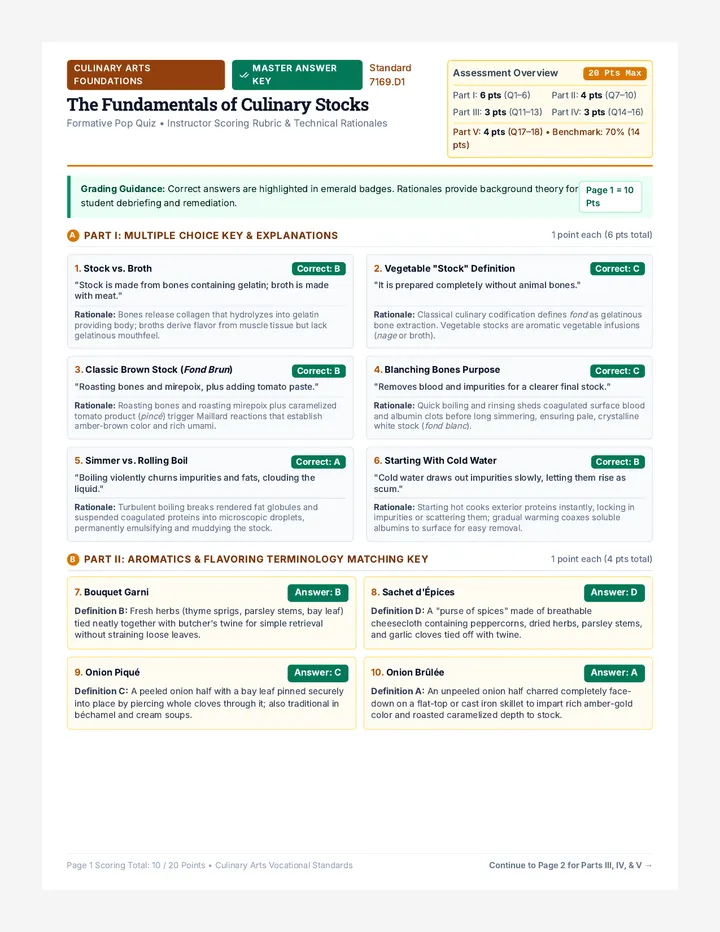
Culinary Arts Foundations Master Answer Key Standard 7169.D1
The Fundamentals of Culinary Stocks
Formative Pop Quiz • Instructor Scoring Rubric & Technical Rationales
Assessment Overview 20 Pts Max
Part I: 6 pts (Q1–6)
Part II: 4 pts (Q7–10)
Part III: 3 pts (Q11–13)
Part IV: 3 pts (Q14–16)
Part V: 4 pts (Q17–18) • Benchmark: 70% (14 pts)
Grading Guidance: Correct answers are highlighted in emerald badges. Rationales provide background theory for student debriefing and remediation.
Page 1 = 10 Pts
A Part I: Multiple Choice Key & Explanations
1 point each (6 pts total)
- Stock vs. Broth Correct: B
"Stock is made from bones containing gelatin; broth is made with meat."
Rationale: Bones release collagen that hydrolyzes into gelatin providing body; broths derive flavor from muscle tissue but lack gelatinous mouthfeel.
- Vegetable "Stock" Definition Correct: C
"It is prepared completely without animal bones."
Rationale: Classical culinary codification defines fond as gelatinous bone extraction. Vegetable stocks are aromatic vegetable infusions (nage or broth).
- Classic Brown Stock (Fond Brun) Correct: B
"Roasting bones and mirepoix, plus adding tomato paste."
Rationale: Roasting bones and roasting mirepoix plus caramelized tomato product (pincé) trigger Maillard reactions that establish amber-brown color and rich umami.
- Blanching Bones Purpose Correct: C
"Removes blood and impurities for a clearer final stock."
Rationale: Quick boiling and rinsing sheds coagulated surface blood and albumin clots before long simmering, ensuring pale, crystalline white stock (fond blanc).
- Simmer vs. Rolling Boil Correct: A
"Boiling violently churns impurities and fats, clouding the liquid."
Rationale: Turbulent boiling breaks rendered fat globules and suspended coagulated proteins into microscopic droplets, permanently emulsifying and muddying the stock.
- Starting With Cold Water Correct: B
"Cold water draws out impurities slowly, letting them rise as scum."
Rationale: Starting hot cooks exterior proteins instantly, locking in impurities or scattering them; gradual warming coaxes soluble albumins to surface for easy removal.