Four Seasons Slides
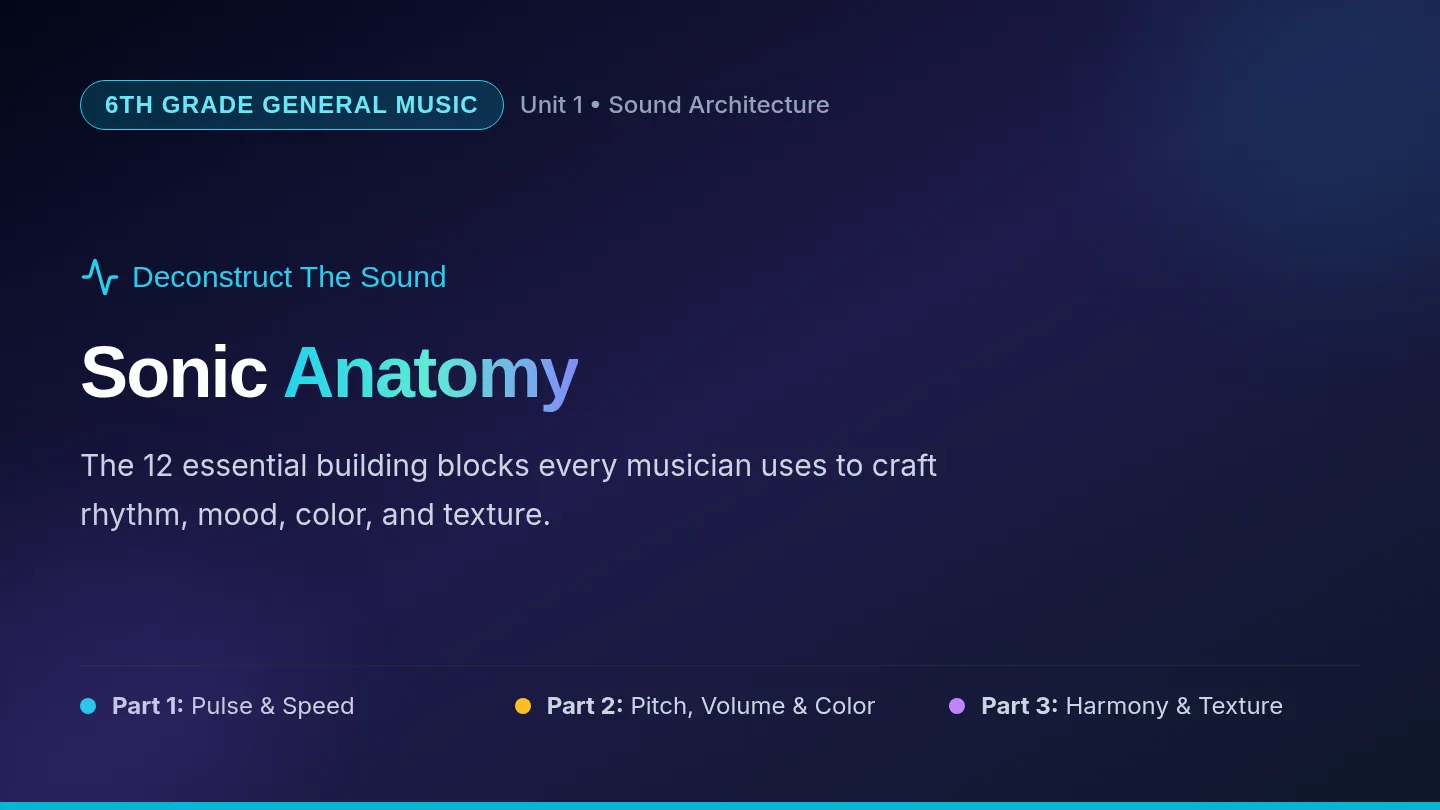
6th Grade General Music | Unit: Musical Storytelling
Masterworks Focus
Antonio Vivaldi (1723)
The Four Seasons
How 18th-century strings tell stories, paint nature, and evoke weather without speaking a single word.
🌱 Spring
☀️ Summer
🍁 Autumn
❄️ Winter
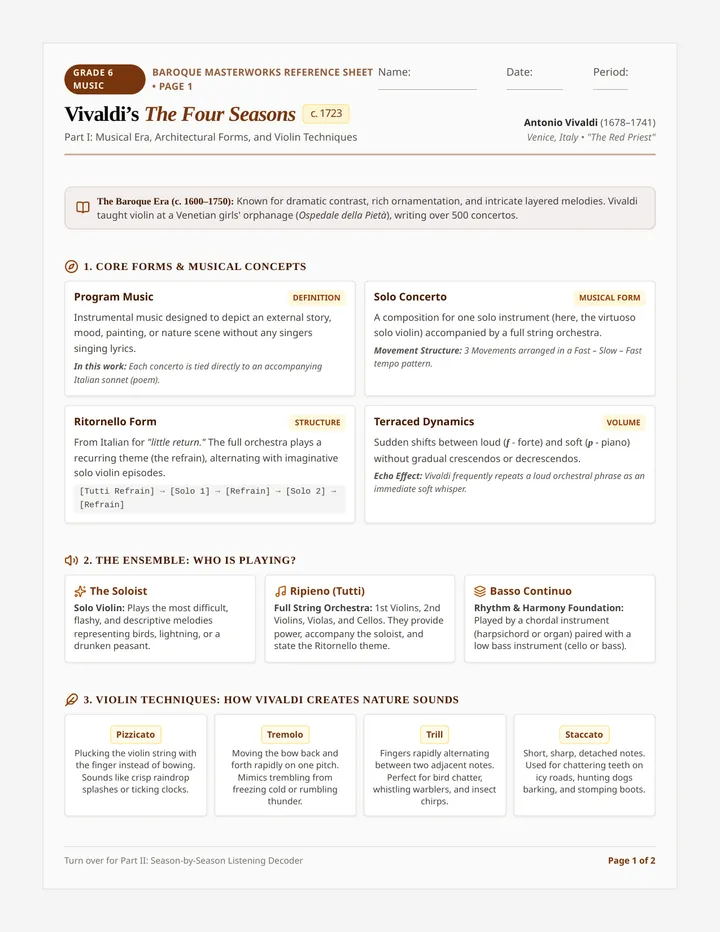
What is Program Music?
Concept Discovery
Core Definition
Music That Tells a Story
Program Music is purely instrumental music written to depict a specific scene, poem, idea, or narrative from outside the music world.
Vivaldi published four sonnets (poems) alongside the sheet music to guide listeners!
The Composer
Antonio Vivaldi (1678–1741)
- • Italian Baroque composer and virtuoso violinist from Venice.
- • Nicknamed "The Red Priest" for his bright red hair.
- • Taught at an orphanage music school, training world-class musicians.
💡 Ahead of his time: Using strings as sound effects!
Key Question: How can violins imitate thunder, birds, or chattering teeth without human words?
The Ensemble: Solo Concerto Form
Instrument Roles
The Star
Solo Violin
A master player performing acrobatic, dazzling, rapid solos. Represents the main characters: bird songs, falling rain, and sudden hunters.
Concerto Formula:
Fast – Slow – Fast (3 Movements in each season concerto)
String Orchestra + Basso Continuo
High Strings
Violin I & Violin II
Melody, breeze, bird calls
Middle Strings
Viola
Warm harmonies, barking dog
Low Strings
Cello & Double Bass
Thunderclaps, freezing pulse
Rhythm & Harmony
Harpsichord
Plucked keyboard continuo
Tutti (everyone together) vs. Solo (individual spotlight) creates dynamic contrast!
Family: Chordophones (Strings) Tutti = "All" in Italian
🌱
Spring (La Primavera) – Mvt. I: Allegro
Tempo: Allegro (Brisk/Lively)
1. Joyful Arrival
The opening ritornello theme is bright, bouncy, and memorable. Nature awakens!
Musical Clue: Major tonality, forte dynamics, dance-like pulse.
2. Birdsong Solos
Three solo violins imitate chirping and singing birds greeting the spring air.
Musical Clue: Trills (rapidly alternating notes) and high-pitch staccato.
3. Spring Storm
Dark clouds roll in quickly with flashing lightning and rolling thunder.
Musical Clue: Fast low repeated notes (tremolo) + rapid ascending scales.
🎧 Listen For: The barking sheepdog in Movement II played by the violas! Key: E Major
☀️
Summer (L'Estate) – Mvt. III: Presto
Tempo: Presto (Extremely Fast)
The Story Behind the Notes
The summer heat was oppressive and exhausting, but the shepherd's real fear comes true: a sudden, terrifying hailstorm destroys the ripening corn and crops.
Sonnet Line: "Ah, his fears were only too true: thunder and lightning in the heavens tear off the heads of grain..."
Elements in Action
- ⚡ Dynamics: Explosive fortissimo (ff) accents simulate crashing thunder and driving hail.
- 🌪️ Articulation: Non-stop rapid tremolo and frantic bow strokes show violent wind gusts.
- 🎵 Timbre: Dark, gritty minor tonality (G Minor) creating genuine urgency and dread.
One of the most famous energetic and ferocious movements in all of classical music!
🍁
Autumn (L'Autunno) – Harvest & The Hunt
Mvt. I & III Contrasts
Movement I
Harvest Feast & Drunken Slumber
Peasants celebrate the abundant harvest with wine, energetic folk dancing, and singing until they fall into a deep, hazy sleep.
Musical Clues:
• Stumbling rhythms & sudden pauses depict tipsy villagers.
• Slow, sustained sweet chords in Mvt. II paint quiet slumber.
Movement III
The Dawn Hunt (La Caccia)
Hunters head out at sunrise with horn calls, barking hounds, and firearms galloping across the hills.
Musical Clues:
• Galloping 6/8 meter mimics galloping horses.
• Violins imitate brass hunting horn fanfares using open strings.
Notice the Shift: Festive folk dance celebration ➔ Eerie, peaceful sleep ➔ Morning hunt chase.
❄️
Winter (L'Inverno) – Shivering & Fireside
Mvt. I: Allegro / Mvt. II: Largo
Movement I: Freezing Blast
Shivering in the bitter cold, stamping feet to stay warm, and teeth chattering relentlessly in the icy gale.
• Pizzicato (Plucking): Mimics stamping boots on frozen crust.
• Dissonance: Clashy, biting notes depict biting frostbite wind.
• Rapid 32nd notes: Teeth chattering uncontrollably!
Movement II: Warm Fireside
Sitting peacefully in total comfort by the hearth while outside the winter rain pours down against the windowpanes.
• Solo Violin: Plays a serene, warm, song-like (cantabile) melody.
• Pizzicato Violins: Light plucking beneath sounds like raindrops falling on the roof!
Vivaldi wrote in the score: "This is winter, but it brings great joy!"
Musical Detective Toolkit
Listening Activity
Tempo
Speed
• Largo (Very slow)
• Allegro (Lively fast)
• Presto (Violent/rapid)
Dynamics
Volume
• Piano (p - soft/gentle)
• Forte (f - loud/storm)
• Crescendo (getting louder)
Articulation
Bow Touch
• Staccato (short/peck)
• Legato (smooth/flowing)
• Tremolo (rapid shaking)
Technique
Special FX
• Pizzicato (plucked)
• Trill (fluttering bird)
• Dissonance (harsh cold)
Now Open Your Detective Worksheet!
Listen to the mystery movements, record your clues, and identify each season.
Ready for Listening!
Season Sleuths Worksheet
6th Grade General Music
Season Sleuths: Listening Guide
Investigating Antonio Vivaldi's The Four Seasons
Name: ________________________________
Date: _________________ Period: _______
Part 1: Detective Briefing (Fill in the blanks)
1. Program Music is instrumental music that tells a ____________________ or paints a picture of nature without words.
2. In a Solo Concerto, a single star instrument (here, the ____________________) alternates with the full orchestra (tutti).
Part 2: Mystery Listening Evidence Log
Listen closely to each mystery excerpt and check your evidence
Case File #1 Movement A (Spring: Mvt. 1 - Allegro)
Mood: Joyful / Awakening
Tempo (Speed): Largo (Slow) Allegro (Brisk/Lively) Presto (Very Fast)
Dynamics (Volume): Piano (Soft) Forte (Loud) Terraced (Sudden jumps)
Technique Detected: Trills (Birdsong fluttering) Tremolo (Thunder rolling) Rapid rising scales
Detective deduction: What scene in nature is Vivaldi painting here? (Quote 1 musical clue to support your answer):
Case File #2 Movement B (Summer: Mvt. 3 - Presto)
Mood: Intense / Stormy
Tempo (Speed): Adagio (Very slow) Andante (Walking) Presto (Frantic/Furious)
Dynamics (Volume): Mostly Pianissimo Explosive Fortissimo (ff) Sudden harsh accents
Technique Detected: Relentless string tremolo Fast descending passages Heavy bass thumps
Detective deduction: What weather catastrophe is happening? How does the string orchestra create the feeling of danger?
Four Seasons Soundscapes • Page 1 of 2 Turn page for Autumn, Winter & Sonnet Decoders ➔
Part 3: Mystery Evidence Continued
Name: _______________________________
Case File #3 Movement C (Autumn: Mvt. 1 - Allegro / Mvt. 3 - La Caccia)
Mood: Celebratory / Galloping
Musical Clues in Mvt. 1:
• Bouncy folk dance meter celebrating harvest
• Stumbling pauses mimic tipsy partygoers
Musical Clues in Mvt. 3:
• Galloping 6/8 horse rhythm
• Violins imitate brass hunting horns
Describe how the tempo and rhythm change between the peasant celebration and the morning hunt:
Case File #4 Movement D (Winter: Mvt. 1 & Mvt. 2)
Mood: Shivering / Cozy Fire
Mvt. 1 (The Freezing Blast):
• Biting dissonance & icy rapid notes
• Teeth chattering on rapid repeated pitches
Four Seasons Teacher Guide
Teacher Facilitation Guide & Key
Four Seasons Soundscapes
6th Grade General Music • Antonio Vivaldi Masterwork Exploration
Duration: 50–60 Minutes
Setting: Whole Class & Partner
Learning Objectives
- • Define program music and differentiate solo violin from tutti strings.
- • Identify how tempo, dynamics, and timbre evoke specific weather phenomena.
- • Analyze sonnet imagery mapped to musical techniques (tremolo, trills, pizzicato).
National Standards Alignment
- • MU:Re7.2.6a: Explain how music concepts and context inform listener responses.
- • MU:Re8.1.6a: Describe how creators' intent and expressive qualities evoke meaning.
- • MU:Cn11.0.6a: Connect music to historical and extra-musical narrative contexts.
Suggested Lesson Timeline
1. Hook (8 min)
Sound effects game: Can strings sound like birds, thunder, or shivering? Intro Vivaldi & slides 1–3.
2. Spring & Summer (15 min)
Slides 4–5. Listen to Spring Mvt. 1 and Summer Mvt. 3. Students log evidence on Worksheet Page 1.
3. Autumn & Winter (15 min)
Slides 6–7. Listen to Autumn Mvt. 1/3 and Winter Mvt. 1/2. Complete worksheet Case Files #3 & #4.
4. Debrief (12 min)
Sonnet decoder puzzle (Part 4) and partner sharing of the synthesis verdict (Part 5). Wrap-up review.
Listening Guide & Timestamp Cues (Part 1)
🌱 Spring (La Primavera) – Concerto No. 1 in E Major, Op. 8, RV 269 Track Timing: ~3:20
0:00 - 0:31
Ritornello Theme: Joyous tutti celebration in E Major; lively Allegro tempo with terraced dynamic repeat.
0:32 - 1:05
Birdsong Solo: 3 solo violins play rapid staccato chirps and trills; whisper-quiet strings underneath.
1:35 - 2:00
Spring Thunderstorm: Low string tremolo simulates rumble; ascending virtuosic violin runs mimic lightning!
☀️ Summer (L'Estate) – Concerto No. 2 in G Minor, Op. 8, RV 315 (Mvt. III) Track Timing: ~2:50
0:00 - 0:40
Storm Unleashed: Presto tempo bursts in immediately with furious downward scales and violent fortissimo.
0:41 - 1:25
Driving Hail: Non-stop 16th-note string tremolo. The solo violin fights against the raging wind and hail.