Beat Builders Slides Unit 1: Music Fundamentals
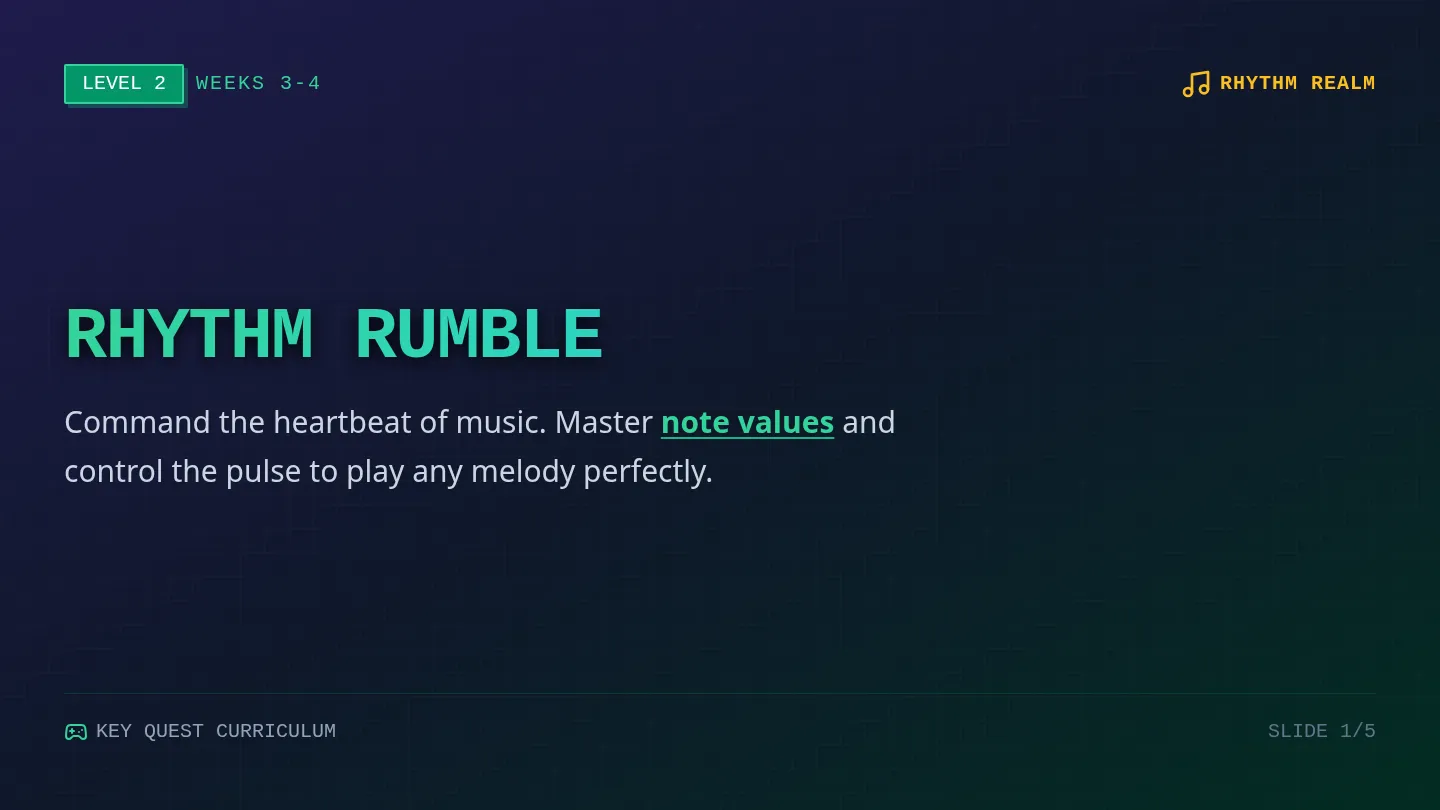
BEAT
BUILDERS
Decoding the mathematical language of rhythm and rests.
The Challenge
01 / Rhythm Math
In music, every symbol has a numerical value. If you can do simple math, you can read music!
๐
Whole Note
๐
Whole Note
=
8 Beats
The Note Family
02 / Subdivision
๐
Whole Note
4 Beats
๐
Half Note
2 Beats
๐
Quarter Note
1 Beat
๐
Eighth Note
1/2 Beat
The Sound of Silence
03 / Rests
A Rest is a symbol that tells you to be silent for a specific duration.
They have the exact same names as notes.
They have the exact same beat values.
They are just as important as the notes!
๐ป
Whole Rest
๐ผ
Half Rest
๐ฝ
Quarter Rest
๐พ
Eighth Rest
The Beat Tree
04 / Visualizing Division
๐
๐
๐
๐
๐
๐
๐
Everything divides by 2!
Double Time
05 / Sixteenths
๐
ก
Sixteenth Note
1/4 Beat
Pro Tip: Beaming
When we have 4 sixteenth notes in one beat, we "beam" them together with two bars.
๐
Count: 1 e & a
Rhythm Math War
Ready to put your skills to the test? Grab your math hats (and your ears).
1
Identify the Symbol
2
Convert to Numbers
3
Solve the Equation
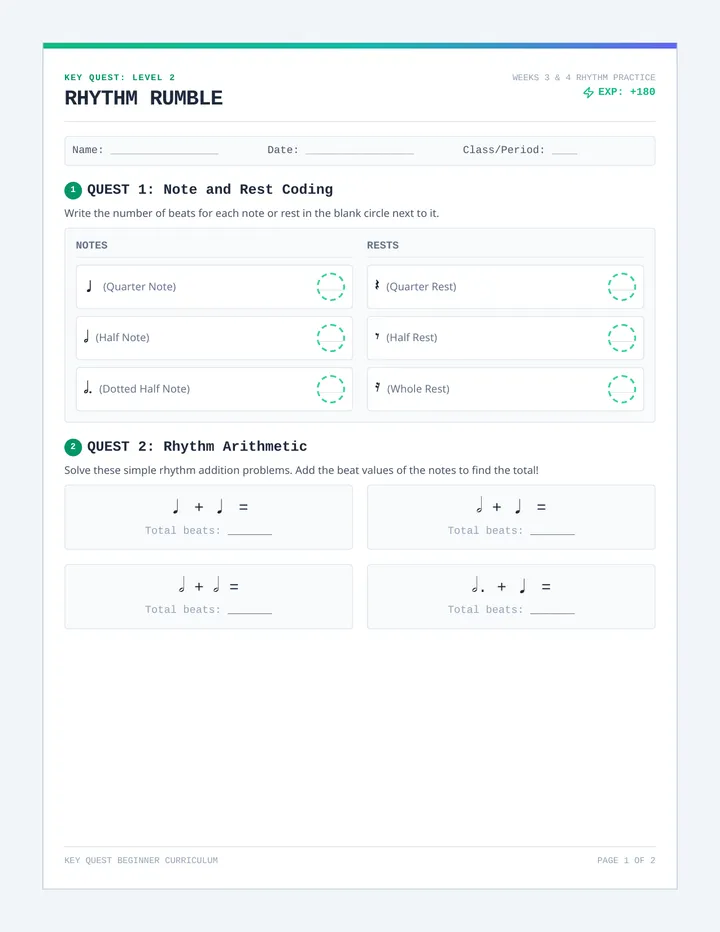
Rhythm Math Worksheet Rhythm Math Challenge
Topic: Note Values & Rest Durations
Name:
Date:
Cheat Sheet
๐
/ ๐ป
Whole (4)
๐
/ ๐ผ
Half (2)
๐
/ ๐ฝ
Quarter (1)
๐
/ ๐พ
Eighth (0.5)
๐
ก / ๐ฟ
Sixteenth (0.25)
1
The Addition Alleys
Convert the symbols into their beat values and find the sum.
๐
+ ๐
=
๐
+ ๐
=
๐ฝ + ๐ผ =
๐
+ ๐ป =
2
Fractional Fire
๐
+ ๐
+ ๐
+ ๐
=
๐
ก + ๐
ก + ๐
ก + ๐
ก =
๐
- ๐
=
3
The Missing Link
Draw the missing Note or Rest that completes the equation.
๐
+
?
= 2 Beats
๐
-
?
= 3 Beats
RHYTHM MATH CHALLENGE v1.0 TOTAL BEATS POSSIBLE: 25.5
Beat Builders Teacher Guide Teacher Guide
Beat Builders
Instructional Plan
Lesson 1 of 5
Duration: 50 Min
Learning Objectives
โข Identify whole, half, quarter, eighth, and sixteenth notes and rests.
โข Explain the mathematical subdivision of beats in common time.
โข Calculate beat sums and differences using musical notation.
Materials Needed
โข Beat Builders Slides
โข Rhythm Math Worksheet (1 per student)
โข Mini-whiteboards (for the Hook game)
โข Metronome (physical or app)
Lesson Timeline
00 - 10 Min
The "Rhythm Math War" Hook
Divide the class into two teams. Display a simple rhythmic equation (e.g., ๐
+ ๐
) on the board. The first student to hold up their whiteboard with the correct number of beats wins a point for their team. Gradually increase complexity.
Discussion Prompt: "Why do you think music uses symbols instead of numbers? How does this help a performer?"
10 - 25 Min
Direct Instruction (Slides)
Walk through the Beat Builders slides. Emphasize the "Family Tree" concept. Introduce sixteenth notes last, as they are often the most challenging to visualize as quarters of a beat.
25 - 50 Min
Independent Practice & Workshop
Distribute the Rhythm Math Worksheet. Circulate the room to assist students with Section 2 (Fractional Fire), which involves subtracting eighth notes and adding sixteenths. Use a metronome at 60 BPM to let students "hear" the beat lengths as they calculate.
Answer Key
Section 1
1. ๐
+ ๐
= 2
2. ๐
+ ๐
= 3
3. ๐ฝ + ๐ผ = 3
4. ๐
+ ๐ป = 8
Section 2 & 3
5. ๐
+๐
+๐
+๐
= 3
6. ๐
ก+๐
ก+๐
ก+๐
ก = 1
7. ๐
- ๐
= 1.5
8. Missing Link: ๐
(Quarter)
9. Missing Link: ๐
(Quarter)
Meter Masters Slides Unit 2: Organization
Meter
Masters
The architecture of a musical measure.
The Code
01 / Time Signatures
4
4
โ
How many?
This number tells you how many beats live in each measure.
โ
Which note?
This number tells you which note value gets the beat (4 = Quarter Note).
The Big Three
02 / 4, 3, and 2
4/4
Common Time
The heartbeat of Rock, Pop, and Jazz. Strong accents on 1 and 3.
1 2 3 4
3/4
Waltz Time
The circular feel of a dance. Strong accent on 1.
1 2 3
2/4
March Time
The left-right-left-right feel of a parade. Strong-weak.
1 2
The Barline Bandit
03 / Measures
A Barline acts as a fence.
It groups notes into manageable chunks called Measures .
Once you reach the number of beats allowed by the time signature... CLOSE THE GATE!
|
๐
๐
๐
๐
| ๐
๐
๐
๐
4 Beats | 4 Beats
The Finish Line
04 / Conclusion
||
Double Bar
New section coming up!
||
Final Bar
Song is over.
Watch Out!
If you go over the limit, the measure will collapse! Keep your math sharp.
Barline Bandit Worksheet The Barline Bandit
Stop the Bandit from stealing our structure!
Name:
Date:
Mission Objective
A rhythmic thief has stolen all the barlines from these songs! Look at the Time Signature at the start of each line. Use your pencil to draw Barlines in the correct places to divide the measures. End each line with a Final Barline (thick/thin) .
4/4
Level 1: Steady Rock
๐
๐
๐
๐
๐
๐
๐
๐
๐
๐
๐
Total beats: 12 (Should be 3 measures)
3/4
Level 2: The Spinning Room
๐
๐
๐
๐
๐
๐
๐
๐
๐
๐
Watch out! One of these notes is too long for this meter. Circle the mistake!
2/4
Level 3: Parade Route
๐
๐
๐
๐
๐
๐
๐
๐
The Ultimate Challenge
Write your own 2-measure rhythm in 4/4 using at least one Rest symbol and two sixteenth notes.
4/4 | _________________________________ | _________________________________ ||
Conducting the Beat Guide Teacher Resource
Conducting the
Beat Guide
Lesson 2 Supplement
Meter Analysis
To understand meter, students must feel it physically. This guide provides instructions for the three standard conducting patterns and listening suggestions for the Lesson 2 Hook.
2/4 Pattern
J-shape: Down (1), then up and out (2)
Feeling:
Strict, militaristic, "Left-Right".
3/4 Pattern
Triangle: Down (1), Out (2), Up-In (3)
Feeling:
Circular, floating, "Oom-pah-pah".
4/4 Pattern
Cross: Down (1), In (2), Out (3), Up (4)
Feeling:
Balanced, solid, symmetrical.
The "Feel the Beat" Hook
Suggested tracks for listening comparison:
4/4 Rock Queen - "Another One Bites the Dust"
Focus on the bass line.
3/4 Waltz Johan Strauss II - "Blue Danube"
Feel the swaying "1-2-3".
2/4 March John Philip Sousa - "Stars and Stripes Forever"
Ideal for marching in place.
Answer Key: Barline Bandit
Level 1 (4/4): | ๐
๐
๐
๐
| ๐
๐
| ๐
| ๐
๐
๐
๐
||
Level 2 (3/4): | ๐
๐
๐
| ๐
๐
| ๐
๐
๐
๐
| ERROR: ๐
is 4 beats ||
Level 3 (2/4): | ๐
๐
๐
| ๐
๐
๐
๐
| ๐
||
Extra Length Slides Unit 3: Duration Extension
Extra
Length
Breaking the standard rules of subdivision with Dots and Ties.
The Rule of the Dot
01 / Dotted Notes
๐
.
The Mathematical Law
A dot adds HALF of the note's original value to itself.
๐
(1) + half of ๐
(0.5) = 1.5 Beats
๐
(2) + half of ๐
(1) = 3 Beats
Seeing the Math
02 / Breakdown
๐
.
=
๐
๐
+๐
๐
.
=
๐
๐
+๐
The Rhythmic Tie
03 / Beyond Barlines
A Tie is a curved line connecting two notes of the same pitch.
The Effect
You play the first note and HOLD IT for the duration of the second note. Do not re-strike!
๐
อก๐
1 + 1 = 2 Beats
Ties are the only way to hold a note across a barline.
Dot vs. Tie
04 / Which to Use?
The Dot
Compact & cleaner notation.
Cannot cross barlines.
Fixed mathematical formula.
The Tie
Can connect ANY two values.
Can cross barlines easily.
Looks more complex on paper.
Dot and Tie Lab Worksheet Dot & Tie Lab
Measuring the un-measurable durations.
Name:
Date:
1
The Dot Formula
Complete the equations below. Remember: Note + (Note / 2) = Dotted Note.
๐
. =
?
?
=
Total Beats
๐
. =
?
?
=
Total Beats
2
Tie Transformations
Add the notes together and draw the SINGLE symbol (Note or Dotted Note) that represents the same value.
๐
อก ๐
?
๐
อก ๐
?
3
The Crossing Guard
Look at the rhythm below in 4/4. One note needs to cross the barline to complete its duration. Draw the tie!
๐
๐
๐
๐
| ๐
๐
๐
๐
Challenge: If you wanted the note on beat 4 of the first measure to hold through beat 1 of the second measure, how would you connect them? Draw it on the line above.
Rhythm Telephone Teacher Notes Teacher Notes
Rhythm Telephone
Hook Instructions
Lesson 3 Hook
Activity Overview
Students will simulate the "travel" of a rhythm down a line of people, focusing specifically on ties and dotted notes . This highlights how easily complex rhythms can be misinterpreted if not clearly felt.
Setup: Lines of 5-8 students standing one behind another.
Action: Taps on the shoulder to represent beats.
The Rules
1
The teacher whispers a 4-beat rhythm to the person at the back of the line.
2
Notes: Single tap. Ties: Tap once and rest hand on shoulder for the duration. Dotted Notes: Heavy tap followed by a shorter "lift".
3
The rhythm is passed forward. The person at the front must clap/speak the rhythm they felt.
Level 1 Rhythms (Whisper these)
๐
๐
อก ๐
๐
๐
. ๐
๐
๐
๐
. ๐
๐
อก ๐
๐
Worksheet Answer Key
Experiment 1: Dot Formula
๐
. = ๐
+ ๐
= 3 Beats
๐
. = ๐
+ ๐
= 1.5 Beats
Experiment 2: Ties
๐
อก ๐
= ๐
. (Dotted Half)
๐
อก ๐
= ๐
. (Dotted Quarter)
Offbeat Energy Slides Unit 4: Rhythm Dynamics
Offbeat
Energy
The art of syncopation and the power of the upbeat.
Breaking the Pulse
01 / Syncopation
Syncopation occurs when we place stress or accents on the weak beats or between the beats.
On-Beat
Safe, predictable, walking pace.
Off-Beat
Exciting, unstable, groovy.
The Visual "Pop"
1
2
3
4
The Running Start
02 / Upbeats
4 &...
Anacrusis
A note (or notes) that come before the first full measure.
Famous Examples
"Happy...
...Birthday to you"
"And...
...I will always love you"
Notice how the first word is never on Beat 1!
Living on the "And"
03 / Subdividing
Let's try a body percussion groove.
STOMP
Beat 1 & 3
CLAP
The "&"s
1 & 2 & 3 & 4 &
The Groove
Grid
Syncopation is hard for the brain because it fights against our natural clock. Focus, subdivisions, and feel the pull!
Task: Compose a rhythm where NO accents land on Beat 1.
Groove Grid Worksheet The Groove Grid
Mastering the art of syncopation.
Name:
1
Analyze the Beat
Circle the note in each measure that represents a syncopated accent (a note played on a weak beat or on the "&").
Measure 1: | ๐
๐
๐
๐
|
Time: 4/4
Measure 2: | ๐
๐
. ๐
|
Time: 3/4
2
Build a Syncopated Measure
In the grid below, mark an X for where you want a sound to occur. To make it syncopated, ensure at least three of your "X"s land on an "&" .
1
&
2
&
3
&
4
&
Now, try to "perform" your grid by patting your knees on the numbers and clapping on your "X"s.
3
The Upbeat Entrance
Convert these spoken phrases into rhythmic notation. The bold word is the Upbeat!
"One ... TWO!"
Example: ๐
| ๐
"And ... STOP!"
"Happy Birthday"
Syncopation Trainer Guide Teacher Resource
Syncopation
Trainer Guide
Lesson 4 Facilitation
Step-by-Step Body Percussion
Step 1:
Establish a steady quarter-note pulse with feet (STOMP on 1, 2, 3, 4). Keep it slow (~60 BPM).
Step 2:
Introduce the "And" (subdivision). Students vocalize "1 & 2 & 3 & 4 &" while feet continue the pulse.
Step 3:
The "Anti-Clap": Students clap ONLY on the "&" of beat 2 and beat 4. Stomps must remain steady.
Step 4:
The "Upbeat Entry": Practice starting a sentence on "4 &". (e.g., "And NOW we start!")
Common Misconceptions
The "Magnet" Effect
Students will naturally want to pull their syncopated clap toward the nearest strong beat. Encourage them to "land on the island" of the "&".
Rushing the Upbeat
Upbeats (anacrusis) are often rushed. Remind students that an upbeat has its own mathematical space; it's not just a "quick start".
Groove Grid Answer Key
Part 1 (Measure 1): The 2nd and 4th notes (eighth notes) land on weak subdivisions. The 2nd note (Quarter) is syncopated.
Part 1 (Measure 2): The dotted quarter starts on the "&" of 1, making it highly syncopated.
Part 3 (Upbeat Discovery):
"And... STOP!": ๐
(rest) | ๐
(or ๐
| ๐
)
"Happy Birthday": ๐
๐
| ๐
Percussion Premiere Slides Final Capstone
Percussion
Premiere
From theory to performance. Your rhythm, your rules.
The Composition Brief
01 / Project Goals
You are now the composer. Your task is to write a 16-measure rhythmic score for a percussion trio.
The Specs:
Minimum of 4 measures in 3/4 or 4/4.
Must use at least 2 dotted notes.
Must include 1 syncopated groove.
Must be playable by humans!
Step 1: Write
Notate your 16 measures clearly.
Step 2: Cast
Assign parts to your ensemble.
Step 3: Rehearse
Practice until it's locked in.
Step 4: Perform
Premiere your work for the class.
The Composer's Toolkit
02 / Clear Writing
Alignment
Line up your beats vertically if you have multiple instruments. If beat 1 is a rest in the drums, it should line up with beat 1 of the shaker.
Stem Direction
Usually, stems go up if the note is low on the staff, and down if the note is high. Keep them consistent!
Beaming
Connect your eighth and sixteenth notes to show where the main beats are. It makes reading 10x easier.
"A messy score is a messy performance. Be neat!"
The Drum Circle Leader
03 / Leading
How do you teach your rhythm without speaking?
Eye contact is everything.
Exaggerated physical movements for the "pulse".
Layering: Start one person, then add the next.
Pro Rehearsal Tip
Start at 50% speed. If you can't play it slow, you can't play it fast. Increase speed only when the locking (rhythmic unison) is perfect.
GO!
"Music is the silence between the notes." โ Claude Debussy
Percussion Premiere Project Sheet Percussion Premiere
Final Composition Score
Composer:
Ensemble:
Time Signature
Tempo
BPM
Instruments
Msr 1
Msr 2
Msr 3
Msr 4
Msr 5
Msr 6
Msr 7
Msr 8
Msr 9
Msr 10
Msr 11
Msr 12
Msr 13
Msr 14
Msr 15
Msr 16
Composer's Note
Explain where you used syncopation or dotted rhythms in your piece:
Percussion Premiere Rubric Teacher Assessment
Percussion Premiere
Project Rubric
Final Assessment
Category 4 - Mastery 3 - Proficient 2 - Developing 1 - Beginning Notation Accuracy All measures are mathematically correct; barlines and stems are perfect. 1-2 minor mathematical errors; notation is generally clear. Several measures have incorrect beat totals; messy notation. Notation is illegible or mathematically inconsistent. Rhythmic Complexity Clever use of syncopation, dots, and ties; distinct instrument parts. Includes required dots/syncopation but lacks variety. Missing one or more required elements (e.g., no syncopation). Only uses basic quarter and half notes. Performance Quality Steady tempo throughout; perfect locking with ensemble members. Steady tempo; occasional minor rhythmic slips. Noticeable rushing or dragging; ensemble often falls apart. Unable to perform the written rhythm at any tempo. Ensemble Leadership Excellent non-verbal cues; leads the group with confidence. Clear cues; group follows without major confusion. Weak cues; group struggles to stay together. No leading or coordination with other players.
Strengths
Areas for Growth
Final Score:
/ 16