Roots of the Call Slides Roots of the Call
Jazz & Folk Roots: Lesson 1
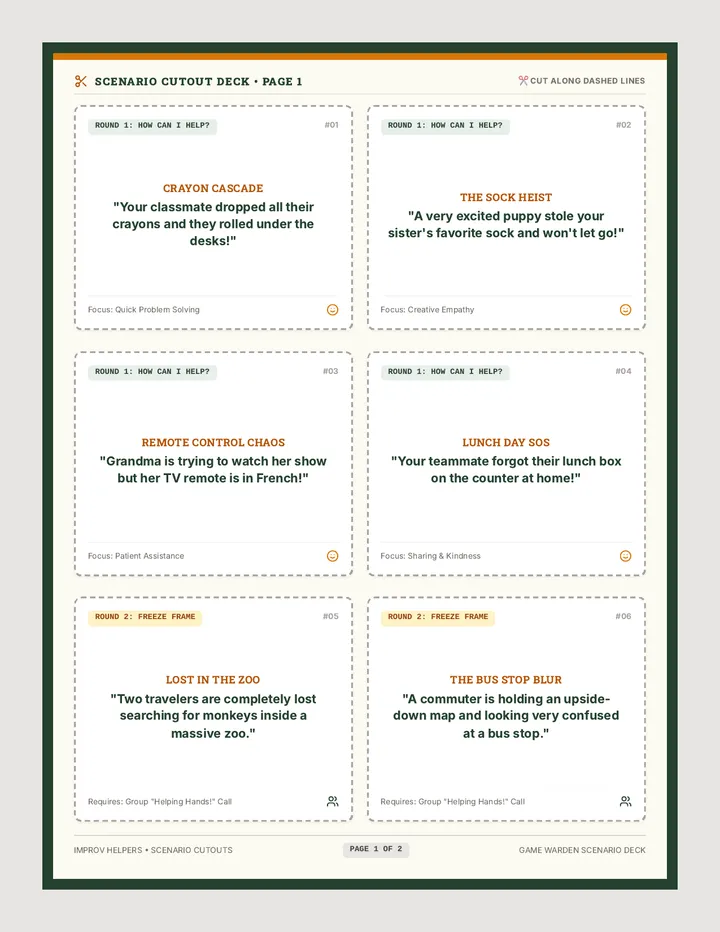
"If I sing a question, can you sing the answer back to me?"
What is Call and Response?
The Call
A leader sings or plays a short musical phrase—like asking a question.
The Response
The group answers back with a phrase of their own—like giving an answer.
Why did people use it?
To Coordinate Work
Helping everyone pull or lift at the exact same time.
To Share Feelings
Songs of hope, sadness, and togetherness.
To Communicate
Sharing stories when they couldn't speak freely.
Work Songs & Spirituals
Long ago, enslaved people in America used music to get through difficult days.
A Famous Pattern:
Call: "Swing Low..."
Response: "Sweet Chariot!"
This pattern is the foundation of almost all American music—including Jazz!
Listening Experience
Listen to "Swing Low, Sweet Chariot" or a traditional Work Song.
Let's Try It!
I will sing a "Call." You respond with the "Response" as a class!
ROUND 1
Call: "Oh, what a morning!"
Response: "What a morning!"
ROUND 2
Call: "Working all day..."
Response: "Working all day!"
Roots of the Call Teacher Guide Roots of the Call
Teacher Facilitation Guide
Grade
2
Objectives
Identify call-and-response patterns in music.
Perform a vocal response with rhythmic accuracy.
Connect musical patterns to historical work songs.
Key Skills
Vocal matching
Ensemble coordination
Historical context awareness
Pacing
45-50 Minutes total
Hook: 5 mins
Instruction: 15 mins
Practice: 15 mins
Reflect: 10 mins
Instructional Roadmap
1. The Vocal Conversation (The Hook)
Start by singing a simple greeting: "Hello, Class!" on a So-Mi interval. If they don't respond, prompt them: "Can you sing it back?" Repeat with different silly sounds or animal noises. Explain that they are doing one of the oldest forms of music-making in the world.
"Music isn't always someone singing AT you. Sometimes, it's a conversation."
2. Work Songs & Community
Discuss the historical context of West African traditions brought to America. Focus on the functional nature of work songs.
Concept: Coordination
When lifting a heavy boat or hammer, everyone needs to pull at the same time. The "Call" signals the preparation, the "Response" is the action.
Concept: Connection
Songs helped people feel less alone during hard times. It turned a group of individuals into a community.
3. The Echo Game
Lead the class through the following patterns. You sing the Call, they sing the Response:
Level The Call (Teacher) The Response (Students) Easy "I say Yo!" "You say Yo!" Medium "Swing Low, Sweet Chariot" "Comin' for to carry me home!" Challenge Sing a 4-beat rhythm on 'La' Imitate the melody and rhythm exactly
Essential Discussion Prompts
1
"How does it feel to sing together compared to singing alone?"
2
"What happened if the response was too late? Why was timing so important for workers?"
3
"Where else do you hear call-and-response today? (Think about sports, church, or concerts)."
Feeling the Blues Slides Feeling the Blues
Jazz & Folk Roots: Lesson 2
"Sometimes you have to sing the blues to lose the blues."
What are the Blues?
The Blues is a style of music that started over 100 years ago. It's used to tell stories about life, feelings, and hard times.
The Emotion
Sad, Lonely, or Hopeful
The Story
Real things that happen to people
The Magic Secret:
The Blues doesn't just make you sad—it helps you feel better by letting those feelings out!
The Blue Notes
🎹
Regular Notes
Straight and clear
🎷
Blue Notes
"Bent," "Slidey," or "Worried"
"Imagine a note that is hiding right in the middle of two piano keys—that's a blue note!"
The 3-Line Story
LINE 1: STATEMENT A
"I woke up this morning, had no shoes for my feet."
LINE 2: REPEAT (The Echo) A
"Yes, I woke up this morning, had no shoes for my feet."
LINE 3: THE RHYMING RESPONSE B
"I had to walk all the way, down to the end of the street."
Your Turn!
Think of one thing that made you feel "Blue" today. It can be something small!
"I lost my favorite pencil..."
"It started raining at recess..."
"I can't find my other sock..."
Feeling the Blues Lyric Worksheet Name:
Date:
Blues Songwriter
Lesson 2: Lyric Workshop
The AAB Recipe
Blues songs usually follow a special pattern called AAB . It's like a story that repeats itself before giving an answer!
LINE 1 (A)
Tell your problem or feeling.
LINE 2 (A)
Repeat Line 1 exactly the same.
LINE 3 (B)
Make a rhyme and finish the story!
Step 1: Pick a "Blues" Problem
Example: "I lost my favorite ball" or "My broccoli is cold."
My 3-Line Blues
LINE 1 (A)
State your problem...
LINE 2 (A)
Repeat Line 1 (sing it again!)
LINE 3 (B)
Rhyme with the first lines!
Draw how your song feels
Ragtime Rhythm Slides Rhythm Trickery
Ragtime & Syncopation: Lesson 3
"Prepare to trick your brain!"
The King of Ragtime
Scott Joplin
1868 — 1917
Scott Joplin...
Was a master piano player and composer.
Invented a jumpy, energetic style called Ragtime .
Wrote the famous "The Entertainer."
Ragtime sounds like "Ragged Time" because the rhythm feels broken and jumpy!
What is Syncopation?
Normal Rhythm
Clapping right on the big beats (1, 2, 3, 4).
Syncopation
Clapping between the beats or on the "weak" spots!
"It's like a musical surprise for your ears!"
Level 1: The Basic Beat
1
PAT
2
PAT
3
PAT
4
PAT
NOW TRICK IT!
pat...
CLAP!
pat...
CLAP!
Feel the Rag!
Let's listen to "The Entertainer" and try to find the "jumpy" spots!
Tap your toe to the steady beat
Wait for the surprise note!
Wiggle your fingers like a piano player
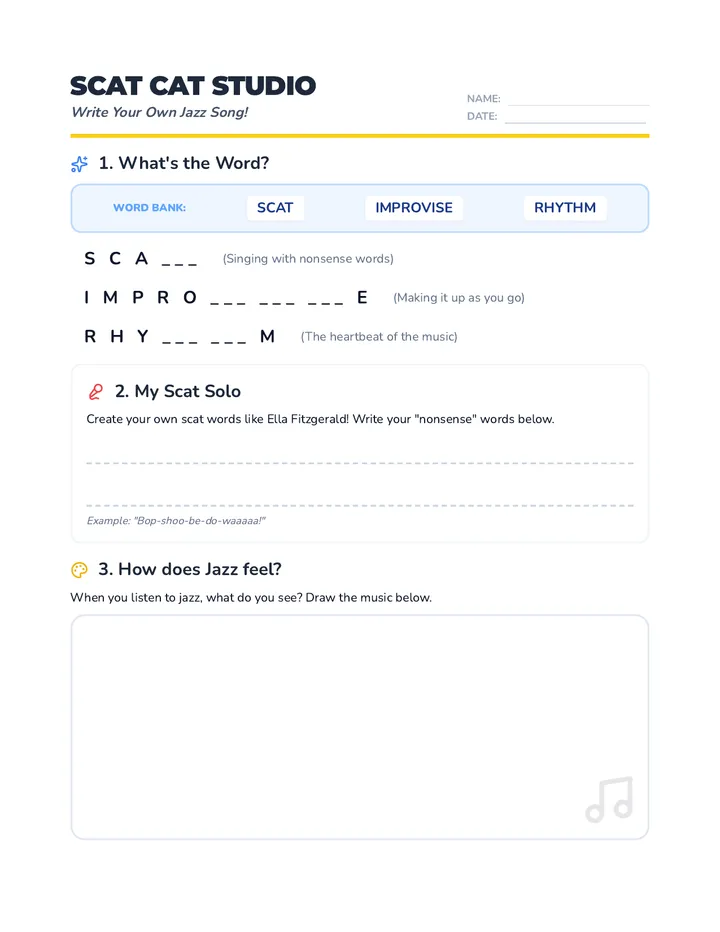
Scat Singing Slides Scat Singing Showdown
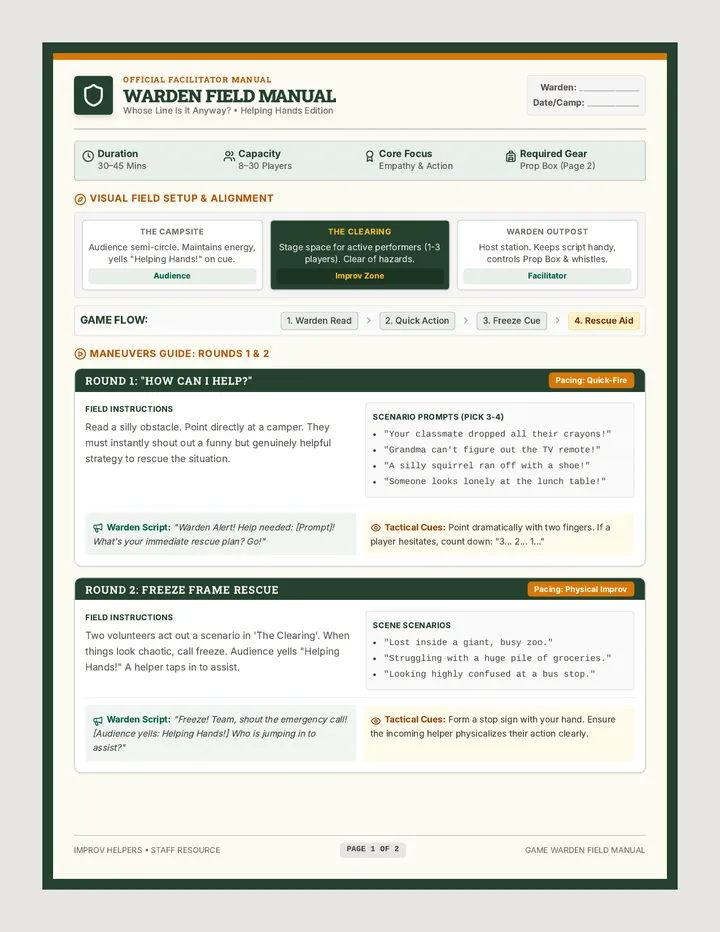
Jazz & Improvisation: Lesson 4
"Talking like an instrument!"
Making it Up!
In Jazz, we use Improvisation.
That’s a fancy word for making up the music right while you are playing it!
"It's like a musical playground where there are no wrong notes, just new ideas."
NO SCRIPT!
What is Scat Singing?
1
Singing with nonsense syllables instead of real words.
2
The singer uses their voice to sound like a trumpet or a saxophone.
"Skoo-be-do-wap!"
"Da-ba-da-bee!"
"Doot-doot-dolla!"
The Kings & Queens of Scat
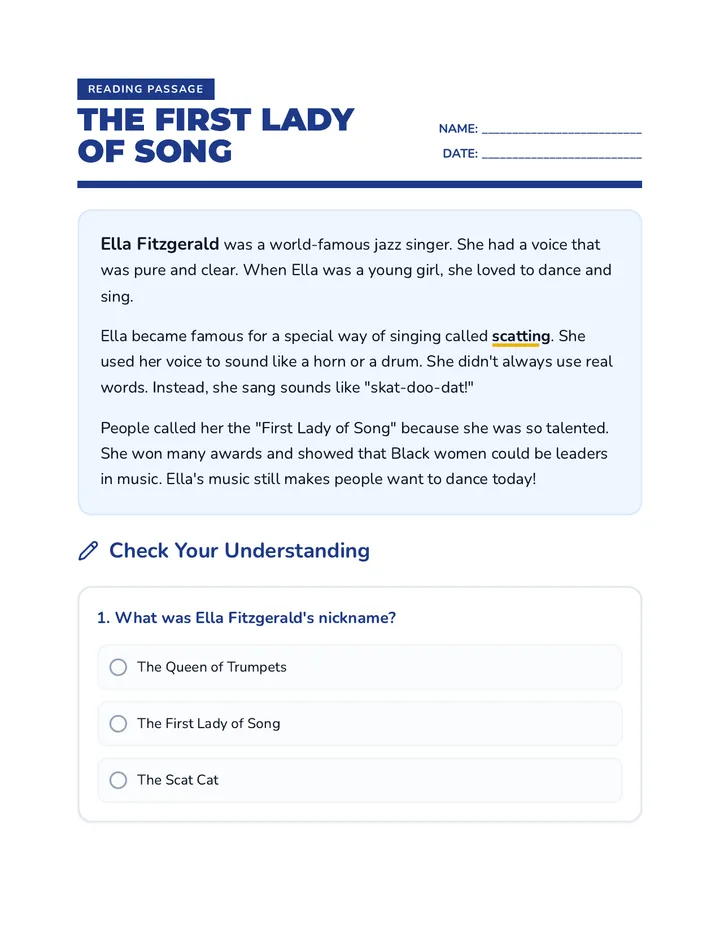
Ella Fitzgerald
The First Lady of Song
Famous for singing faster than any instrument could play!
Louis Armstrong
"Satchmo"
Known for his gravelly voice and amazing trumpet improvisation.
Scat Attack!
Let's practice our syllables. I'll sing a phrase, and you echo it back in a silly jazz voice!
BOP!
SKOO-DEE!
WAP-PA!
DOO-DOT!
The Big Swing Show Slides The Big Swing Show
Grand Finale: Lesson 5
"It don't mean a thing if it ain't got that swing!"
The Swing Feel
In the 1930s, people wanted music they could dance to.
Long-Short, Long-Short
Swing rhythm isn't straight. It has a bounce. It feels like skipping instead of walking!
Straight
SWING!
Our Classroom Orchestra
Rhythm Section
Drums, Shakers, Pats.
Keep the steady bounce!
Vocal Horns
Singing melodies and "horn riffs" like a trumpet section.
The Soloists
The stars who will improvise and scat during the solo break!
The Concert Plan
1
The Intro
Drums start the steady "skipping" beat.
2
The Theme (The Head)
Everyone sings the main melody together with energy!
3
The Solo Break
One person stands up and scat sings for 4 beats!
4
The Big Finish
Loudest note ever on the final beat!
Ready to Swing?
"One, two, you know what to do!"
Curtain Up!