Tempo Train Teacher Guide Tempo Train
Teacher Facilitation Guide
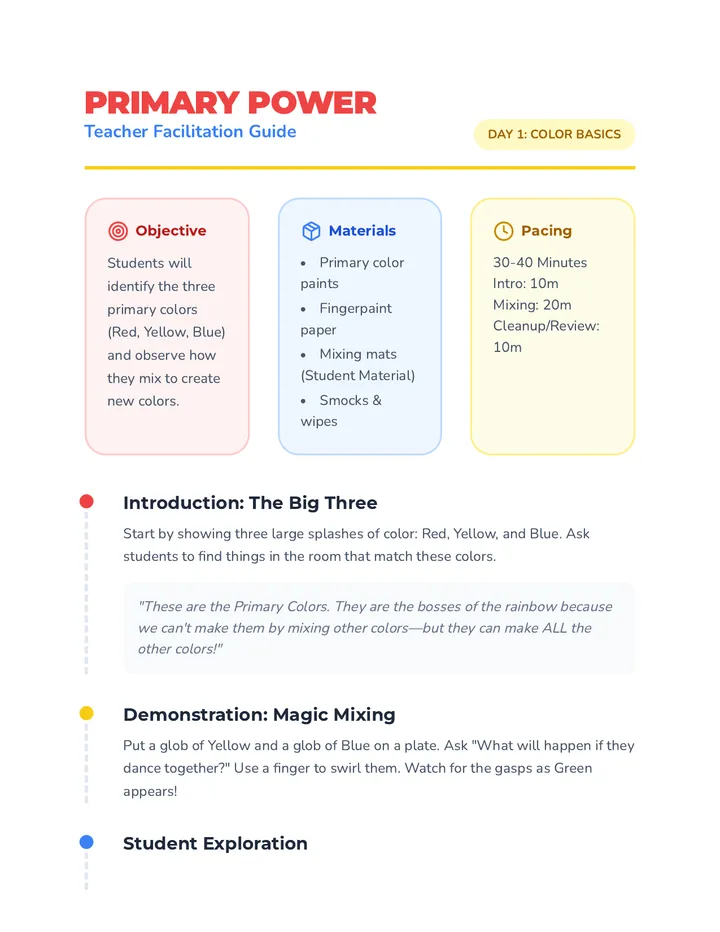
Movement Lab: Lesson 1
Target: Pre-K Dance & Choreography
Lesson Goal
Students will differentiate between fast and slow tempos by moving their bodies like a cheetah and a sloth, matching the beat of various musical tracks.
Supplies
• Tempo Train Slides
• Fast/Slow Music Playlist
• Tempo Train Coloring Log
The Hook
"Have you ever seen a sloth move? They are the kings of slow motion. What about a cheetah? They are the fastest runners on land! Today, our bodies are going to become the Tempo Train, switching between super slow and super fast!"
Action Plan
1
The Slow Sloth (5-7 mins)
Play very slow, ambient music. Encourage students to move in "honey"—thick, slow, and continuous. Challenge them: Can you blink slowly? Can you reach for a leaf slowly? If they speed up, remind them they are "Sloths in the Sun."
2
The Speedy Cheetah (5-7 mins)
Transition to high-tempo, upbeat music. Use the prompt: "Quick feet! Quick hands!" Encourage vibrating movements, jumping, and rapid arm circles while staying in their own "bubble space."
3
The Tempo Train Game (10 mins)
Act as the "Conductor." When you say "Slow... Slow...", they move like sloths. When you shout "Fast! Fast!", they burst into cheetah mode. Use a drum or clap to reinforce the tempo changes.
Dance Discussion
"Which one felt easier to do? Being a slow sloth or a fast cheetah?"
Expected answer: Fast might feel "sillier" or "crazier"; slow might feel "sleepy."
"What happens to your heart when we move fast? What about when we move slow?"
Teacher Tip
"Watch out for collisions! Pre-K students tend to lose spatial awareness during 'fast' tempos. Remind them to keep their 'invisible force field' (bubble space) up at all times."
Look For
- Clear contrast in speed
- Matching feet to the beat
- Controlled stops (Freeze!)
Tempo Train Slides Tempo Train
Lesson 1: Fast & Slow
🦥
Meet the Sloth
Sloths move slowly.
They take their time. They move through the air like it's thick, sweet honey.
Try it! Move your arms in slow motion.
🐆
Meet the Cheetah
Cheetahs move FAST!
They are quick and zippy. They run with lightning speed!
Try it! Tap your toes super fast!
All Aboard!
LISTEN
Is the music slow or fast?
MOVE
Dance like the sloth or the cheetah!
Remember your bubble space!
Show Me...
🐌
SLOW
🚀
FAST
Stomp and Float Teacher Guide Stomp and Float
Teacher Facilitation Guide
Movement Lab: Lesson 2
Target: Pre-K Dance & Choreography
Lesson Goal
Students will explore weight by contrasting heavy, grounded movements with light, airy movements using scarves and beanbags.
Supplies
Dance scarves (1 per child)
Soft beanbags (1 per child)
Heavy and Light music
The Hook
"I have a heavy rock in this hand and a floating feather in this one. If our feet were made of heavy rocks, how would we walk? What if our arms were made of feathers?"
Action Plan
1
The Heavy Giant (Beanbags)
Distribute beanbags. Ask students to place them on their shoulders or heads. They must walk "heavy" so the beanbag stays grounded. Use low-frequency, "thumping" music. Focus on stomping and "pressing" into the floor.
2
The Floating Feather (Scarves)
Swap beanbags for scarves. Throw scarves up and try to move exactly like they do—drifting, swaying, and landing softly. Use high-pitched, light music (flute or glockenspiel). Focus on tiptoes and high reaches.
3
Weight Switcheroo
Call out "Stone!" or "Feather!" as students dance. When they hear "Stone," they must sink to the floor heavily. When they hear "Feather," they must rise up and float. This builds core control and muscle engagement.
Weighty Words
Prompt:
"Which one felt stronger? Which one felt like you were flying?"
Concept:
Help students understand that Heavy is strong and down, while Light is gentle and up.
Stomp and Float Slides Stomp & Float
Lesson 2: Heavy & Light
🪨
Heavy Like a Rock
Feel your feet push DOWN into the floor.
You are strong. You are solid. Every step is a loud THUMP!
Try it! Stomp your feet like a giant!
🪶
Light Like a Feather
Reach UP to the clouds.
You are soft. You are airy. You move like a bubble in the wind.
Try it! Twirl on your tiptoes!
Weight Switch!
STAY DOWN
STAY UP
Which is which?
🐘
Heavy
🦋
Light
Robot and Spaghetti Teacher Guide Robot & Spaghetti
Teacher Facilitation Guide
Movement Lab: Lesson 3
Target: Pre-K Dance & Choreography
Lesson Goal
Students will explore texture by contrasting sharp, jagged movements (Robots) with smooth, fluid movements (Spaghetti).
Concepts
Sharp (Staccato)
Smooth (Legato)
The Hook
"Can you move like a robot made of stiff, metal plates? BEEP-BOOP! Now... imagine you just turned into a long piece of wiggly, slippery spaghetti! How does that change your dance?"
The Texture Lab
1
The Sharp Robot
Use music with clear, sharp beats (electronic or percussion). Encourage "stop and start" movement. Every arm reach should have a clear ending. Tell them their joints are "rusty" and need to click into place.
2
The Smooth Spaghetti
Transition to flowing classical or ambient music. Ask them to remove all "edges" from their movement. Their bodies are like butter melting on a hot pancake or seaweed waving under the ocean.
3
The Magic Wand Game
Use a "magic wand" (or a pointer). When the wand is held stiff and straight, they are Robots. When you wave it in circles, they are Spaghetti. Switch quickly to test their reaction and control.
The Texture Talk
Prompt:
"Which one felt 'pointy'? Which one felt 'round'?"
Concept:
Students are learning articulation. Sharp movement requires muscle tension; smooth movement requires release and flow.
Robot and Spaghetti Slides Robot & Spaghetti
Lesson 3: Sharp & Smooth
🤖
Be a Robot
Move with SHARP edges.
BEEP! STOP! CLICK!
Every move has a beginning and a middle and a clear end.
Try it! Move your arms like metal wings!
🍝
Be Spaghetti
Move with SMOOTH flow.
Wiggle! Melt! Flow!
No stopping! One move turns into the next one like water.
Try it! Make your body melt like butter!
Magic Wand Game
SHARP
Stop and Go!
SMOOTH
Keep it Flowing!
Which Texture is it?
🔨
SHARP
🍯
SMOOTH
Sound Signals Teacher Guide Sound Signals
Teacher Facilitation Guide
Movement Lab: Lesson 4
Target: Pre-K Dance & Choreography
Lesson Goal
Students will practice auditory discrimination by instantly changing their movement dynamic in response to different instrument sound cues.
The Instrument Key
Drum = Sharp / Fast
Triangle = Light / High
Low Chime = Heavy
The Hook
"Close your eyes and listen with your super-ears. My instruments are going to tell your body exactly how to dance! Can you keep up with the sound signals?"
Reactive Dance Drills
1
The Drum Beat (Sharp/Fast)
Play a rapid, steady beat on a drum. Students must jump or tap their hands to every single beat. If the drum stops, they freeze! Focus on the "snap" of the movement.
2
The Triangle Ring (Light/High)
Strike a triangle and let it ring. While the sound is ringing, students float high on their tiptoes. If the sound is short, they do a quick light flick of the hands.
3
The Sound Signal Mix-Up
The ultimate challenge! Switch between instruments rapidly. Drum... Triangle... Drum... Silence! Students must react instantly. Reward the most "reactive" dancers who catch every change.
Visual Cues
For students who struggle with auditory cues, hold up a colored card that matches the instrument (e.g., Red for Drum, Blue for Triangle).
Assessment
Look for: Instant change in energy level. Correct identification of the dynamic (e.g., stopping when the sound stops).
Sound Signals Slides Sound Signals
Lesson 4: Auditory Reactivity
Super Ears!
"I am listening with my whole body."
When the sound changes, my dance changes INSTANTLY!
The Drum
Sharp & Fast
BOOM! TAP! BOOM!
Jump on the beat!
Make every move snap like a robot!
The Triangle
Light & High
TING! RING! TING!
Rise to your tiptoes!
Float like a feather in the sky!
Reaction Challenge!
DRUM = SHARP
TRIANGLE = LIGHT
SILENCE = FREEZE!
Dynamic Dance Teacher Guide Dynamic Dance Lab
Teacher Facilitation Guide
Movement Lab: Lesson 5
Target: Pre-K Dance & Choreography
Lesson Goal
Students will improvise a short dance study by choosing and switching between their favorite movement qualities (Fast/Slow, Heavy/Light, Sharp/Smooth).
The Menu
- Speed (Sloth / Cheetah)
- Weight (Stone / Feather)
- Texture (Robot / Spaghetti)
The Hook
"Today, you are the Choreographer! That means you are the boss of your own dance. You get to pick your favorite ways to move and put them together in a special dance story just for us!"
Mastery Session
1
The Choice Board (5 mins)
Review all the dynamics we've learned. Ask students to "think in their brains" of two qualities they love most. (e.g., "I love being a fast robot!").
2
Guided Improvisation (10 mins)
Play a neutral, versatile track. Give cues for the "Whole Group" to try combinations. "Everyone try being a heavy sloth!" "Now everyone try being smooth like spaghetti but fast like a cheetah!"
3
Performance Circle (10-15 mins)
Students sit in a circle. Call 2-3 students at a time to the center. They perform their favorite dynamic for 20 seconds. Encourage the "audience" to guess which quality they are using.
The Dynamic Debrief
Prompt:
"When we saw our friends dance, how did we know they were being heavy? How did we know they were being sharp?"
Takeaway:
Choreography isn't just what you do, but how you do it. Energy changes the dance story!
Dynamic Dance Slides Dynamic Dance
Lesson 5: You are the Choreographer!
You are the Boss!
A Choreographer is the boss of the dance.
You get to choose HOW you move.
Choose Your Energy
SPEED
🦥 🐆
Fast or Slow
WEIGHT
🪨 🪶
Heavy or Light
TEXTURE
🤖 🍝
Sharp or Smooth
Choose Your Favorite Two!
The Show!
Audience Rule:
Can you guess the movement quality?
Wait for the music... then DANCE!
Great Job!
You are a Dynamic Dancer!
Dynamic Dancers Worksheet Dynamic Dancers
Movement Choice Board
Name: ____________________ Date: ____________________
Instructions
Circle your two favorite ways to move! You will use these for your own dynamic dance study.
🐆
FAST
🦥
SLOW
🪨
HEAVY
🪶
LIGHT
🤖
SHARP
🍝
SMOOTH
My Special Dance Sketch
Draw a picture of you doing your favorite move!