Zoo Zoom Slides Zoo Zoom
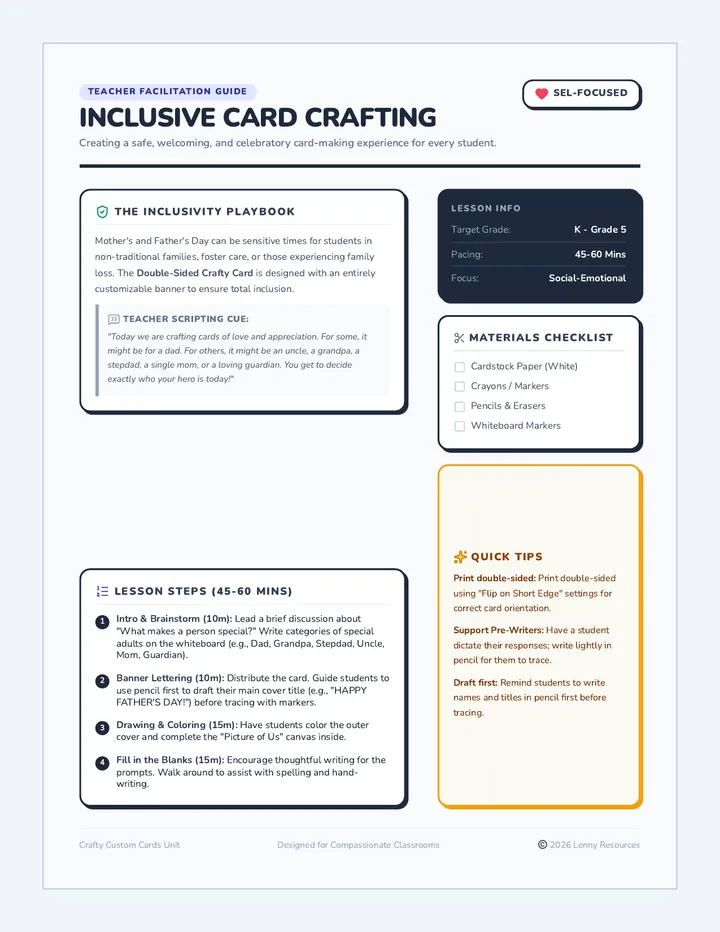
Moving Like Our Animal Friends
HEAVY
Stomp, stomp, stomp!
Use your whole body to be big and strong.
"Can you make your feet go BOOM?"
Stay Low
Move Slow
LIGHT
Flutter and float!
Dance on your tippy-toes like you're made of air.
"Can you move without making a sound?"
Stay High
Soft Arms
SMOOTH
Slide and glide!
Keep moving without stopping, like water in a river.
"Can you make your body look like a wavy noodle?"
No Stops
Zig-Zag
JERKY
Start and stop!
Move fast, then freeze. Jump like a popcorn kernel!
"Can you wiggle and then stay super still?"
Freeze!
Quick Bits
Wild Walks Teacher Guide Wild Walks
Teacher Facilitation Guide • Lesson 1
30-45 Minutes
Lesson Overview
Students explore movement dynamics (heavy, light, smooth, jerky) by embodying different animals. This lesson bridges familiar biological concepts with abstract physical expression, helping students understand how energy and weight change how we move.
Movement Vocabulary
Heavy (Elephant)
Light (Butterfly)
Smooth (Snake)
Jerky (Monkey)
1. The Hook (5 mins)
"If you were a giant elephant walking through the mud, how would your feet hit the floor? Would they make a 'tap' or a 'BOOM'?"
Have students try to stomp while sitting on the floor first. Then, have them stand and walk in place "heavily."
2. Zoo Zoom Exploration (15 mins)
Use the Zoo Zoom Slides to guide students through the four movement types. For each animal:
Analyze: "What does this animal look like when it moves?"
Practice: Guide students to move around the room (establish "safety bubbles" so they don't touch others).
Prompt: "Can you be lighter? Like you're walking on clouds?"
3. Guided Improvisation (15 mins)
Play a variety of music and call out "Mystery Animals." Students must guess the quality based on your description:
"I'm thinking of an animal that is very small and moves in quick, jerky jumps..." (Frog)
"I'm thinking of an animal that is smooth and slides through the grass..." (Snake)
Music Tips
• Heavy: Use percussion/drums (e.g., "The Elephant" from Carnival of the Animals ).
• Light: Use flutes or pizzicato strings.
• Smooth: Use cello or flowing piano.
• Jerky: Use upbeat jazz or staccato rhythms.
Safety Rule
Teach the "Marshmallow Bubble" : Every student has a big, soft marshmallow bubble around them. If you touch someone else, your bubble pops! Keep your bubbles safe.
Animal Artist Worksheet Animal Artist
Movement Journal
Name:
Date:
Which animal dance was your favorite? Circle one!
HEAVY
LIGHT
SMOOTH
JERKY
Draw yourself doing your favorite animal dance! Storm Swirl Slides Storm Swirl
Let's Dance Like the Sky!
Rain
Lightning
Wind
Pitter Patter
Tap your fingers on your knees...
Can you make a soft rain sound?
Whoosh!
Spin and swirl your arms!
Move like the wind is pushing you!
Flash!
Quick, sharp jumps!
BOOM! CRACK! Move like a lightning bolt!
Rainbow
Make a big arc with your arms!
Move slowly and peacefully.
Sky Stories Teacher Guide Sky Stories
Teacher Facilitation Guide • Lesson 2
35-50 Minutes
Lesson Overview
Students use environmental inspiration to explore energy variation and group coordination . By simulating a storm, they practice transitioning between slow, soft movements and sharp, explosive actions.
Weather Dynamics
Rain: Sustained tapping
Wind: Circular swirling
Lightning: Explosive jumps
Rainbow: Smooth arcs
The Storm Narrative
Read this script slowly, giving students time to move between each cue.
Sunny Day: "Imagine we are standing in a warm, sunny meadow. Stretch your arms up to the sun. Now, walk through the tall grass slowly and happily."
First Clouds: "Look up! I see some gray clouds moving in. The wind starts to blow just a little bit. (Start swaying side to side). Whooosh... the wind is getting stronger! Let's swirl our arms!"
Raindrops: "Oh! I felt a drop. (Tap one finger on your palm). Now more! (Tap all fingers). The rain is tapping on our heads, our shoulders, our knees! Tap, tap, tap!"
The Storm: "CRACK! A lightning bolt! (Big jump). The storm is here! More lightning! The wind is spinning us! (Spin in circles). The rain is pouring! (Stomp feet while tapping knees)."
Clearing Up: "Wait... the rain is slowing down. Tap... tap... tap... The wind is just a whisper. (Move softly). Shhh..."
Rainbow: "Look! The sun is back. And what's that in the sky? A beautiful rainbow. Let's make a giant rainbow shape with our whole bodies. Reach high and stretch wide. We are safe and happy."
Music Suggestions
Rain: "Raindrops Keep Fallin' on My Head" (Instrumental)
Wind/Storm: "The Four Seasons: Summer (Storm)" by Vivaldi
Rainbow: "Somewhere Over the Rainbow" (Lullaby version)
Differentiation
For students with sensory sensitivities, provide a "safe sun spot" where they can stay in the calm sunny day movement if the storm movement feels too loud or fast.
Weather Wanders Worksheet Weather Wanders
Tracing Movement
Name:
Date:
Use your crayon to trace how the weather moves!
Rain
Lightning
Wind
Rainbow
Feeling Flows Slides Feeling Flows
Dance How You Feel!
HAPPY
Make your body BIG!
Reach wide, jump high, and shine like the sun!
SAD
Make your body SMALL...
Curl up low, move slowly, and drop your head.
ANGRY
Make your body SHARP!
Strong arms, quick steps, and heavy feet.
!
Wow!
Freeze and Open!
Wide eyes, wide arms, and a quick "Pop!" jump.
Heart Dance Teacher Guide Heart Dance
Teacher Facilitation Guide • Lesson 3
30-45 Minutes
Lesson Overview
Students bridge emotional literacy with non-verbal communication . They learn that their whole body (not just their face) can tell a story about how they feel. This lesson builds empathy and self-expression.
Feeling Shapes
Happy: Wide, high, airy
Sad: Low, narrow, heavy
Angry: Sharp, direct, fast
Surprised: Sudden, open
1. Face to Body (10 mins)
Ask students: "Show me with your face what 'happy' looks like." Wait for smiles.
"Now, can you show me what 'happy' looks like with your knees and elbows?"
Encourage big, bouncy movements. Repeat for "Sad" (dropping shoulders/head) and "Angry" (stomping/tense arms).
2. Feeling Flows Activity (15 mins)
Use the Feeling Flows Slides . For each emotion, have the students "freeze" in a shape that shows that feeling. Then, "unfreeze" and dance in that quality.
Prompt: "Dance like you just got the best surprise ever! Is your dance fast or slow? High or low?"
3. Empathy Mirrors (10 mins)
In pairs (or teacher-led), one person makes a "feeling shape" and the other person copies it exactly. Ask: "How does your body feel when you are in that shape?"
Reflection Questions
• "Can we dance 'sad' and 'happy' at the same time? Why or why not?"
• "What part of your body is best at showing 'angry'?"
• "How can we help a friend who is doing a 'sad' dance?"
Social-Emotional Note
Remind students that all feelings are okay to have. In dance, we can "practice" our feelings in a safe way. If someone feels genuinely upset during the lesson, allow them to take a break in the "Sunny Meadow" (a designated calm area).
Mood Moves Worksheet Mood Moves
Feeling Shapes
Name:
Date:
How does your body look when you are...
Happy
Small
Big & Wide
Sad
Low & Curled
High
Draw your own "Feeling Shape"!
"Every dance tells a story about our hearts."
Scarf Spells Slides Scarf Spells
Dancing with Our Magic Scarves!
FLOW
Move your scarf slowly...
Like it's swimming through water or floating on a cloud.
FLOAT
Toss it up high!
Can you catch it before it hits the floor? Be as quiet as a feather.
SNAP
Quick, sharp shakes!
Wiggle your scarf fast! Can you make a little "snap" sound?
Safety
Not for faces!
Not for capes!
Keep them in your hands!
Ribbon Rider Teacher Guide Ribbon Rider
Teacher Facilitation Guide • Lesson 4
30-40 Minutes
Lesson Overview
Students use scarves or ribbons to extend their physical presence. This lesson focuses on flow and continuity , helping students visualize the "path" of their movement through the air. Props can also reduce self-consciousness in shy students.
Scarf Qualities
Flow: Continuous loops
Float: High toss & wait
Snap: Rapid vibrations
1. Magic Scarf Intro (5 mins)
"I have some magic scarves today. They love to dance, but they are very shy! They need you to hold their hands and show them how to fly."
Hand out scarves one by one. Students should sit quietly with their "sleeping" scarf in their lap until everyone has one.
2. Scarf Spells (15 mins)
Use the Scarf Spells Slides to guide the exploration. For each quality:
Flow: "Make a giant circle in the air. Now a figure-eight. Can you make your scarf look like a slow river?"
Float: "On the count of three, toss it to the ceiling! 1... 2... 3! Now, can you catch it on your elbow? Your head? Your knee?"
Snap: "Wiggle it as fast as you can! Like it's a shivering leaf!"
3. Statue & Scarf Game (10 mins)
Play music. When the music plays, students dance with their scarves. When it stops, they must freeze, but they have to try to keep their scarf moving for as long as possible (letting it float down slowly to the floor).
Safety Management
Pre-K students often want to tie scarves around their necks or faces.
The Rule: "Scarves are for hands, not for heads." If a student puts it on their face, the scarf has to go "back to sleep" (put away) for 2 minutes.
Prop Tips
If you don't have scarves, you can use:
• Tissue paper (tossed/floated)
• Plastic grocery bags (highly floaty!)
• Strips of streamers/crepe paper taped to a popsicle stick.
Magic Path Worksheet Magic Path
Scarf Dancing
Name:
Date:
Draw the "Magic Path" your scarf made in the air!
Flowy Lines
High Tosses
Quick Snaps
"My scarf felt like it was..."
Wind
A Bird
A Cloud
Adventure Act Slides Adventure Act
Let's Tell a Story with Our Bodies!
Forest
River
Mountain
The Forest
Creep slowly through the trees...
Can you be as quiet as a mouse? Don't wake the sleeping owl!
The River
Swim and splash across!
Big arm circles. Jump over the slippery rocks! 1, 2, 3... JUMP!
The Mountain
Climb, climb, climb!
Reach your hands up high to the peaks. Can you touch the clouds?
The Cave
Crawl inside...
Make yourself small. It's time to rest after our big adventure.
Story Step Teacher Guide Story Step
Teacher Facilitation Guide • Lesson 5
45-60 Minutes
Lesson Overview
This final lesson synthesizes the skills learned throughout the sequence: movement qualities, weather dynamics, emotional shapes, and prop manipulation. Students follow a narrative arc , practicing auditory processing and collaborative play.
Story Skills
Listening: Movement cues
Levels: High/Low/Middle
Emotion: Embodying the story
The Great Adventure Script
Encourage students to use the "Marshmallow Bubbles" from Lesson 1.
The Start: "Today, we are going on a hunt for a secret treasure! First, we need to walk through the tall, tall grass. It's thick and heavy. (Walk with high, heavy knees). Oh! I see a butterfly ! Let's follow it with light feet. (Lesson 1: Light quality)."
The Forest: "We've reached the Deep Dark Forest. It's very quiet. Shhh... creeping slowly... (Slide 2: Forest). I see a snake slithering! Let's slide and glide through the trees. (Lesson 1: Smooth quality)."
The Storm & River: "Oh no! The sky is getting gray. (Slide 3: River). The wind is blowing us toward the river! Whoosh! (Lesson 2: Wind). The river is cold and splashy! We have to swim across with big, wide arms. Reach... reach... and JUMP over the rocks!"
The Mountain: "We made it! Now we have to climb the Great Rocky Mountain. (Slide 4: Mountain). It's so high. Reach your fingers to the clouds. (Lesson 3: Happy/High shape). It's a long way up... climb... climb... we're at the top! How do you feel? (Surprised/Excited shape)."
The Treasure Cave: "Look! A secret cave. (Slide 5: Cave). Let's crawl inside very quietly. Make yourself small. (Lesson 3: Sad/Small shape - but for sneaking). There it is! The treasure! It's a box of Magic Scarves ! (Hand out scarves/Lesson 4)."
The Celebration: "Let's celebrate! Throw your scarves high! Dance with joy! Spin like the wind! (Free dance with all learned qualities)."
Collaboration Tip
If the group is large, have half the class "act" while the other half "observes" like an audience, then swap. This teaches performance and observation skills.
Performance Note
End the session by having students take a "stage bow." This acknowledges their hard work and marks the end of the "Emotion Motion" journey.
Hero Hike Worksheet Hero Hike
Adventure Map
Name:
Date:
Draw your path through the adventure!
Start: Forest
River
End: Cave
Mountain
Draw your path here!
How did you feel on your hike?
Mission Complete!