Master Sculptors Lesson Plan Meet the Master Sculptors
Lesson Plan
Middle School 45-55 Minutes
Why This Lesson?
Understanding the history of sculpture and the artists behind it helps students appreciate different forms of artistic expression and broadens their cultural knowledge. It also inspires creativity by showcasing diverse approaches to art.
Learning Objective
Students will be able to identify at least three famous sculptors and describe a key characteristic of their artistic style or an iconic work.
Materials Needed
Whiteboard or projector
Gallery of Great Sculptors Slides
Artist Spotlight Biographies
Sculptor Match-Up Challenge
Teacher Prep
• Review the Gallery of Great Sculptors presentation and prepare discussion prompts for each artist.
• Ensure projector is set up and working for the slide deck.
• Print enough copies of the Artist Spotlight Biographies and Match-Up Challenge for all students.
• (Optional) Prepare a few clay samples or small 3D objects to pass around during the intro.
Instructional Steps
5m
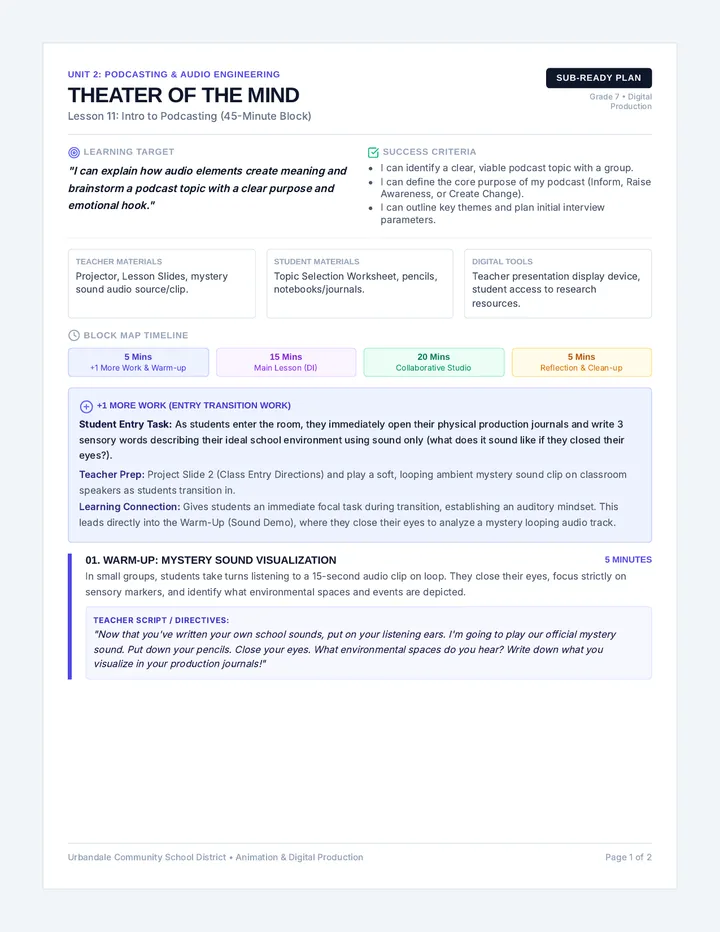
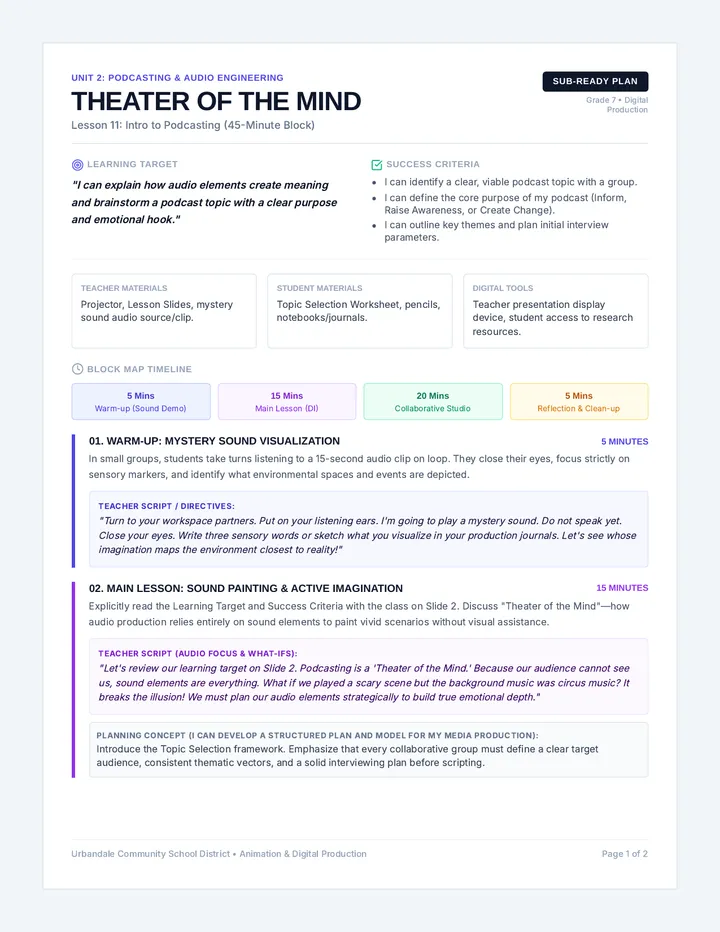
Introduction: What is Sculpture?
• Ask: "What comes to mind when you hear the word 'sculpture'?"
• Facilitate a brief class discussion, writing key terms (3D, statue, clay, metal) on the board.
• Hook: "Today, we're going on a journey to meet the 'sculpture superstars' who changed how we see the world!"
15m
Gallery of Great Sculptors Presentation
• Present the slide deck, introducing each sculptor and their iconic works.
• Engagement: Pause after each artist. Ask: "How do you think they made stone look so soft?" or "Why do you think it moves?"
• Encourage students to make quick sketches or jot down one keyword for each artist.
15m
Spotlight Biographies: Read & Discuss
• Distribute the Artist Spotlight Biographies handout.
• Have students choose one sculptor to "specialize" in and read their biography (7 mins).
• Share: Students turn to a partner and share one "wow factor" about their chosen artist.
10m
Sculptor Match-Up Challenge
• Distribute the Sculptor Match-Up Challenge .
• Explain rules: Match artists to their works and styles using the info they just learned.
• Play as a race or in small groups to see who can get the most correct in 5 minutes.
5m
Reflection: Meet the Artist
• Reflection: "If you could meet one of these superstars in their studio, who would it be and why?"
• Summarize the diversity: from Michelangelo's marble to Calder's hanging mobiles.
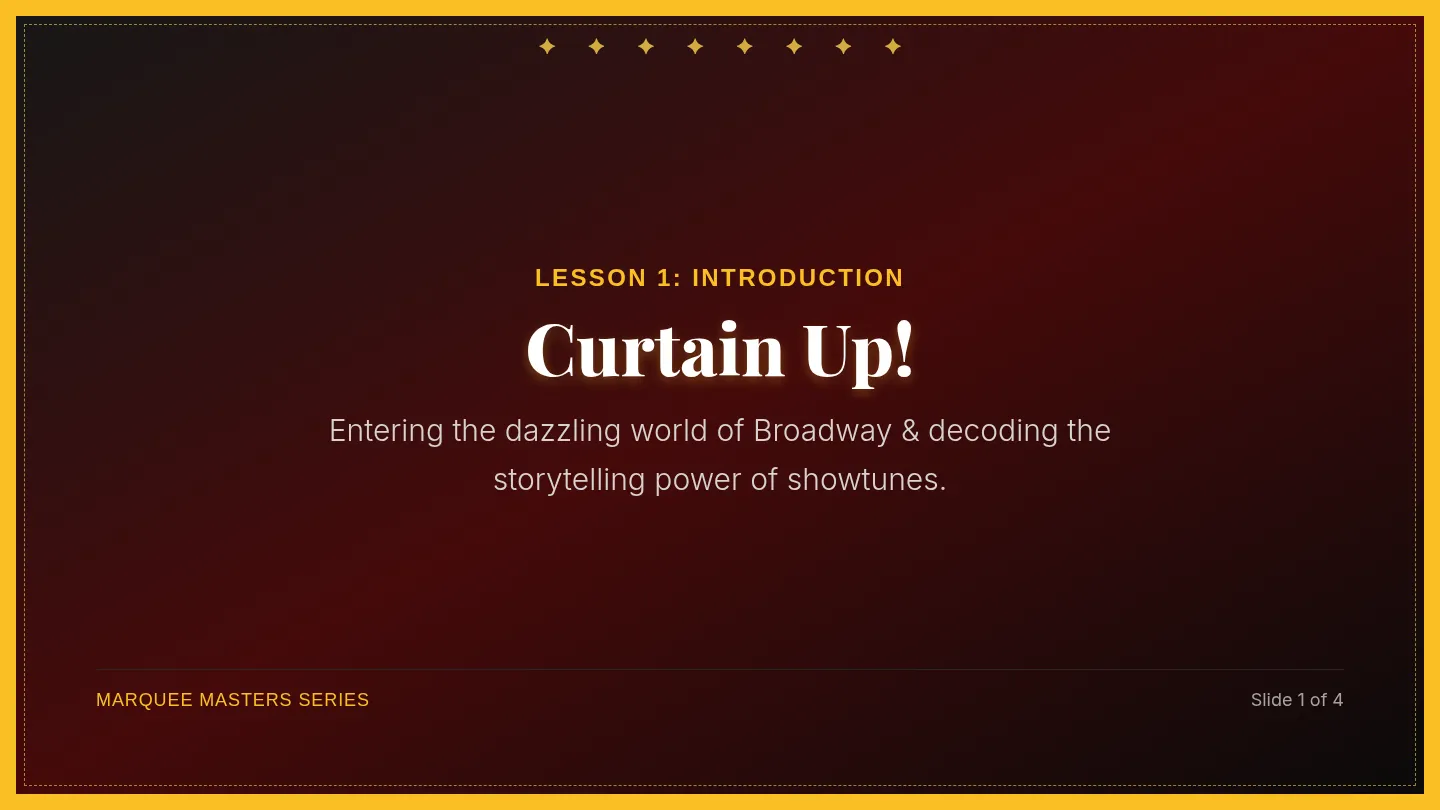
Gallery of Great Sculptors Slides Who Are the
Sculpture Superstars?
Discovering Iconic Artists & Their Masterpieces
Teacher Note: Welcome students and gauge their prior knowledge of sculpture. Encourage participation and write down their ideas on the board.
Our Artistic Journey Today
Today, we'll explore:
Famous sculptors from different eras
Their unique artistic styles
Some of their most well-known works
Get ready to be inspired!
Teacher Note: Briefly introduce the scope of the lesson – meeting famous sculptors throughout history.
Michelangelo: The Renaissance Master
1475-1564 • ITALY
Style
High Renaissance; known for incredible realism and emotional depth.
Famous Works
David (Giant marble statue)
Pietà (Mary holding Jesus)
"I saw the angel in the marble and carved until I set him free."
[Image Recommendation]
The colossal 'David' statue, showing detailed muscles and expression.
Think: How do you make stone look so lifelike?
Teacher Note: Introduce Michelangelo. Highlight his connection to the Renaissance and his mastery of marble. Show images of David and Pietà.
Bernini: The Dynamic Baroque
1598-1680 • ITALY
[Image Recommendation]
'Apollo and Daphne' - focus on the fingers turning into leaves.
Think: How does he make it feel mid-action?
Style
Baroque; known for capturing intense action, drama, and narrative.
Famous Works
Apollo and Daphne (Transformation)
Ecstasy of St. Teresa (Theatrical)
Bernini "forced" marble to act like dough, creating textures like skin and hair in stone.
Teacher Note: Introduce Bernini. Emphasize his Baroque style – drama, motion, and emotion. Show images of Apollo and Daphne and Ecstasy of Saint Teresa.
Rodin: Emotion in Bronze
1840-1917 • FRANCE
Style
Impressionistic Modern; left surfaces rough to show emotion and touch.
Famous Works
The Thinker (Philosophy in bronze)
The Kiss (Passionate embrace)
What emotions do Rodin's sculptures make you feel?
[Image Recommendation]
'The Thinker' highlighting the rough, textured surface of the bronze.
Teacher Note: Introduce Rodin. Focus on his expressive, emotional approach and his break from classical smoothness. Show images of The Thinker and The Kiss.
Artist Spotlight Biographies Handout Artist Spotlight Biographies
Exhibition Guide: Master Sculptors
Student Name
Michelangelo
1475–1564 • Italy
Michelangelo Buonarroti was an Italian sculptor, painter, architect, and poet of the High Renaissance. Born in Tuscany, he is considered one of the greatest artists of all time. He worked for powerful patrons like the Medici family and several popes.
Michelangelo believed that every block of marble contained a sculpture waiting to be released, and his job was to free it. His intense focus on the human form allowed him to create works that seemed to breathe with life.
Key Works
David (1501-1504): A colossal marble statue celebrating anatomical precision and emotional intensity.
Pietà (1498-1499): A marble sculpture of Mary cradling Jesus, known for its beauty, realism, and tender emotion.
Gian Lorenzo Bernini
1598–1680 • Italy
Gian Lorenzo Bernini was a brilliant Italian sculptor and architect, a leading figure in the Baroque era. He was known for his dramatic, theatrical style, capturing peak moments of emotion and movement.
Bernini often worked with marble, making it appear fluid and light. He designed many parts of St. Peter's Basilica in Rome and was a favorite artist of the popes, often blending sculpture and architecture.
Key Works
Apollo and Daphne (1622-1625): Captures the exact moment Daphne transforms into a laurel tree; full of motion and intricate detail.
Ecstasy of Saint Teresa (1647-1652): Depicts a dramatic religious vision using sculpture and hidden theatrical lighting.
Modern Masters
Auguste Rodin
1840–1917 • France
Auguste Rodin was a French sculptor whose work broke away from traditional academic rules. He is often considered the pioneer of modern sculpture.
Rodin focused on capturing raw emotion and movement, often leaving surfaces rough and unfinished to emphasize the vitality of the material.
Key Works
The Thinker (1880): A bronze figure deep in contemplation, a universal symbol of intellectual activity.
The Kiss (1882): A marble sculpture of two lovers, celebrated for its sensuality and intensity.
Alexander Calder
1898–1976 • USA
Alexander Calder was an American sculptor best known for inventing the mobile—kinetic sculpture that moves with air currents. He also created 'stabiles' (stationary abstract works).
His work is characterized by playful nature, bright colors, and industrial materials, bringing lightness to monumental forms.
Sculptor Match-Up Challenge Activity Sculptor Match-Up Challenge
Assessment Activity
Student Name
Date
Instructions: Test your knowledge of the Sculpture Superstars! Match the sculptor with their famous work or artistic style. Write the letter of the correct match in the box next to the sculptor's name.
Part 1: Who's Who?
Michelangelo
Gian Lorenzo Bernini
Auguste Rodin
Alexander Calder
Barbara Hepworth
A. Invented the mobile, a kinetic sculpture that moves with air currents.
B. High Renaissance master who believed he was "freeing" the figure from marble.
C. Known for organic forms with "voids" (holes) to explore inner/outer space.
D. Baroque sculptor who captured intense motion and dramatic narratives.
E. Modern pioneer who used rough surfaces to convey raw human emotion.
Part 2: The Masterpieces
Identify which artist created each work below:
The Thinker
David
Apollo and Daphne
Flamingo
Single Form
Part 3: Artistic Voice
If you were a sculptor, which medium would you prefer: Marble (like Michelangelo), Bronze (like Rodin), or Industrial Metal (like Calder)? Explain why.
Sculptor Match-Up Answer Key Challenge Answer Key
Teacher Resource
Official Key
Part 1: Who's Who?
B
Michelangelo "Freeing the figure from marble"
D
Gian Lorenzo Bernini "Intense motion and dramatic narratives"
E
Auguste Rodin "Rough surfaces for human emotion"
A
Alexander Calder "Invented the kinetic mobile"
C
Barbara Hepworth "Organic forms and voids/holes"
Part 2: The Masterpieces
Artwork The Thinker Auguste Rodin
Artwork David Michelangelo
Artwork Apollo and Daphne Gian Lorenzo Bernini
Artwork Flamingo Alexander Calder
Artwork Single Form Barbara Hepworth
Part 3: Grading Note
The reflection question is subjective. Look for students who can justify their choice using descriptive language or facts learned during the lesson (e.g., "I choose marble because I like the realism of Michelangelo" or "I choose industrial metal because I want my work to move like a mobile").