High School Nutrition & Wellness — Lab Packet Page 1 of 4
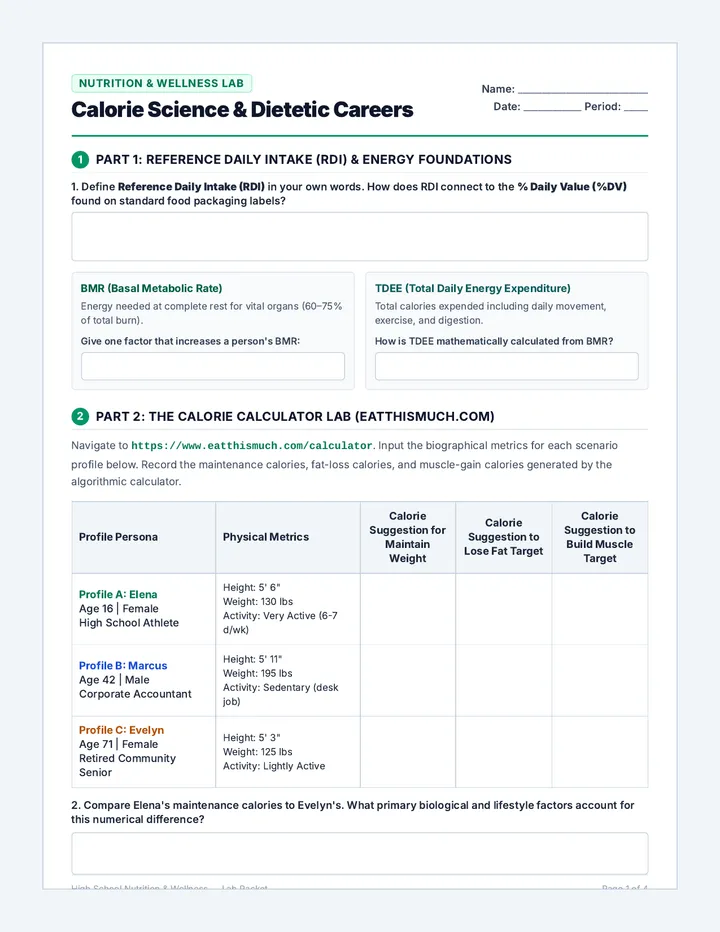
EatThisMuch Lab
Input your personal metrics (age, height, weight, activity level) directly into the calculator at eatthismuch.com/calculator. Do not record your personal metrics on this page. Record only your resulting estimated calorie outputs below:
Maintain Weight Baseline daily requirement
calories / day
Fat Loss Target Moderate caloric deficit
calories / day
Building Muscle Target Supportive caloric surplus
calories / day
3. Personal Lifestyle & Calorie Intake Reflection:
Choose the goal that best aligns with your current lifestyle (maintaining weight, fueling sports, or building muscle). Based on your typical daily meals and snacks, do you feel you are currently eating close to, below, or above the recommended calories for your goal? What specific daily routines, meal choices, or activity levels make you feel this way?
4. Activity Shift Analysis (Marcus):
Marcus (Profile B) sits at a desk 9 hours daily. If he decides to train for a half-marathon (changing from Sedentary to Very Active), how will his daily caloric demand shift? Why is the quality of food as vital as calorie quantity during this athletic transition?
5. Scientific Limitations of Calorie Calculators:
Why can online calculators provide only an estimate rather than an exact prescription? Why should you not design your meals based ONLY on a calory calculator?
High School Nutrition & Wellness — Lab Packet Page 2 of 4
Culinary Nutrition Application
Recipe Breakdown
On EatThisMuch.com, enter your daily calorie target and click "Generate" to produce a customized 1-day meal plan. Click on each meal title to view its full recipe, ingredients, and preparation directions. Dissect each recommended meal below:
Recommended Breakfast
Recipe Name:
Calories:
Core Recipe Ingredients Listed:
Food Groups & Nutritional Purpose:
Recommended Lunch
Recipe Name:
Calories:
Core Recipe Ingredients Listed:
Food Groups & Nutritional Purpose:
Recommended Dinner
Recipe Name:
Calories:
Core Recipe Ingredients Listed:
Food Groups & Nutritional Purpose:
6. Food Group Audit across Generated Recipes:
Did the 3 recipes generated by the website incorporate all 5 USDA food groups (Vegetables, Fruits, Grains, Protein Foods, and Dairy)? Which group was dominant, and which was lacking?
7. Culinary Feasibility & Recipe Modification:
Select one of the three recipes above. Would you realistically prepare this at home? What is one ingredient or cooking step you would modify to make it tastier, more affordable, or more culturally familiar while keeping the calorie target intact?
High School Nutrition & Wellness — Lab Packet Page 3 of 4
Allied Health Exploration
Indiana Career Focus
A Nutrition and Dietetics Technician, Registered (NDTR) is a credentialed food and healthcare professional who works independently or alongside Registered Dietitian Nutritionists (RDNs). They screen patients, calculate nutrient needs, monitor therapeutic hospital diets, and educate communities. Use the https://www.eatright.org/become-an-ndtr website to locate your information.
8. Education & Credentialing Pathway:
What degree level is required to become an NDTR, how many supervised practice hours must be completed, and what national exam is required?
9. Work Environments & Settings:
List at least three distinct clinical or community environments where an NDTR is employed.
10. Collaboration: NDTR vs. Registered Dietitian Nutritionist (RDN):
What are 3 job duties of a NDTR?
Real-World Case Study: Hospital Tray Audit
You are working as an NDTR at an Indiana healthcare facility (such as IU Health or Ascension St. Vincent). A patient with Type 2 Diabetes is prescribed an 1,800-calorie consistent-carbohydrate meal plan. On their lunch tray, you find: fried chicken breast, macaroni and cheese, sweet tea, a dinner roll, and a slice of chocolate cake.
As the NDTR, what immediate action do you take with this meal tray, and what nutritional modifications would you recommend to align with their clinical diet order?
11. Personal Career Reflection:
With an average starting wage in Indiana of $18–$22/hour and entry via an Associate Degree program (such as community college), does a career as a Dietetic Technician appeal to you? Why or why not?
High School Nutrition & Wellness — Lab Packet Page 4 of 4
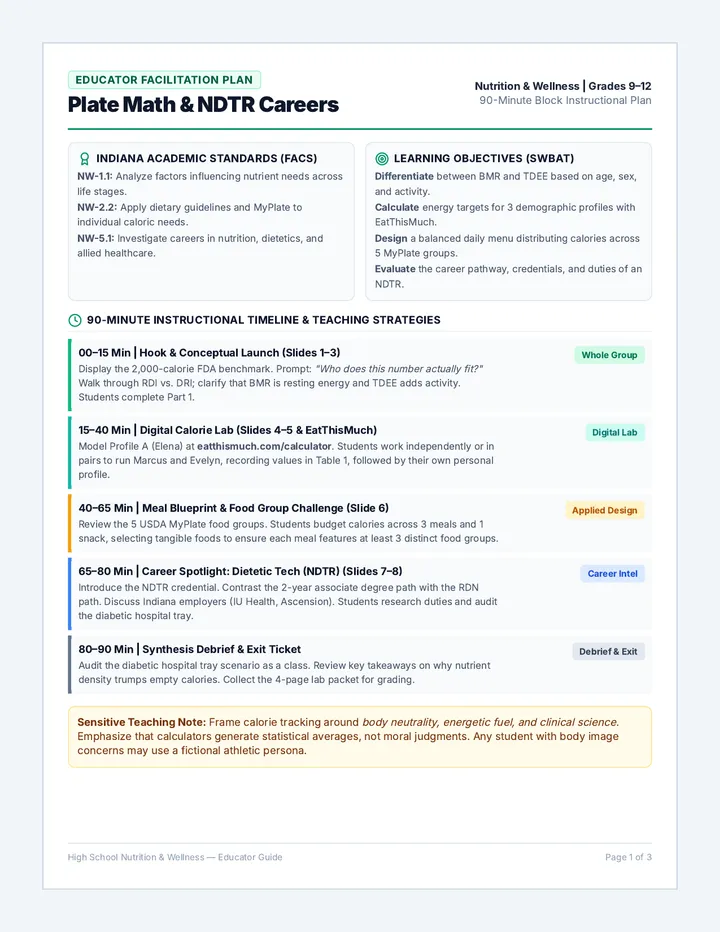
High School Nutrition & Wellness — Educator Guide Page 1 of 3
Official Master Key
Teacher Reference
1. Definition of RDI & % Daily Value:
Model Answer: RDI is the daily intake level of vitamins and minerals sufficient for 97–98% of healthy individuals. On Nutrition Facts labels, % Daily Value (%DV) shows how much one serving contributes toward daily micronutrient goals based on a 2,000-calorie reference diet.
Factors Increasing BMR:
Higher lean muscle mass, younger age (growth spurts), taller stature, fever/infection, male biological sex.
TDEE Calculation:
TDEE = BMR × Physical Activity Level (PAL) multiplier (1.2 to 1.9), plus thermic effect of digestion (~10%).
*Accept answers within +/- 100 kcal margin due to algorithmic calculator revisions.
| Persona Profile | Biometrics & Activity | Maintenance (TDEE) | Lose Fat (-20%) | Build Muscle (+10%) |
|---|---|---|---|---|
| Elena (16, F) | 5'6", 130 lbs, Very Active | ~2,350–2,500 kcal | ~1,880–2,000 kcal | ~2,600–2,750 kcal |
| Marcus (42, M) | 5'11", 195 lbs, Sedentary | ~2,150–2,300 kcal | ~1,720–1,840 kcal | ~2,360–2,530 kcal |
| Evelyn (71, F) | 5'3", 125 lbs, Lightly Active | ~1,500–1,650 kcal | ~1,200–1,320 kcal | ~1,650–1,800 kcal |
2. Elena vs. Evelyn Caloric Divergence Analysis:
Elena needs ~800–1,000 more kcal daily due to: (a) Age/Growth: Adolescent cellular turnover requires elevated energy, whereas baseline metabolism slows with age; (b) Activity Intensity: Elena trains at varsity intensity (PAL ~1.725) versus Evelyn's light walking (PAL ~1.375); and (c) Lean Muscle: Higher muscle tissue burns more calories at rest.
3. Marcus Half-Marathon Training Transition:
Endurance training increases Marcus's PAL multiplier to ~1.725, increasing TDEE by 700–900 kcal/day (to ~3,000 kcal). Nutrient density is vital because marathon training causes muscle damage; whole foods provide anti-inflammatory antioxidants and glycogen-replenishing complex carbs.
4. Limitations of Online Calculators:
Calculators use population formulas assuming average body fat. They cannot account for: individual body composition (muscle vs. fat ratio), thyroid and endocrine health, gut absorption efficiency, and daily spontaneous movement (NEAT).
High School Nutrition & Wellness — Educator Guide Page 2 of 3
Official Master Key
Teacher Reference
Breakfast (~550 kcal | 25%)
2 eggs, whole wheat toast, 1 cup strawberries, 1 cup 1% milk.
Groups: Protein, Grains, Fruits, Dairy
Lunch (~770 kcal | 35%)
Turkey-avocado wrap, 1 cup carrots with hummus, 1 apple.
Groups: Grains, Protein, Vegetables, Fruits
Dinner (~660 kcal | 30%)
4 oz grilled salmon, 3/4 c brown rice, roasted broccoli, fortified yogurt.
Groups: Protein, Grains, Vegetables, Dairy
Snack (~220 kcal | 10%)
1/2 cup Greek yogurt with almonds and blueberries.
Groups: Dairy, Protein, Fruits
Question 6 Refutation ("A Calorie is a Calorie"): 2,000 kcal of soda/chips delivers rapid simple sugars with zero fiber, triggering insulin spikes, hunger rebound, and nutrient deficiencies. In contrast, 2,000 kcal of whole foods supplies complete amino acids for tissue repair, dietary fiber for gut health, and essential micronutrients (iron, calcium, folate, vitamins A & C) required to meet RDIs.
7. NDTR Education & Credentials:
Associate Degree from an ACEND-accredited program (or Didactic Bachelor's in Nutrition), 450 supervised practice hours, and passing the national CDR registration exam.
8. Work Settings:
Acute care hospitals, long-term care rehabilitation facilities, public school nutrition, WIC clinics, community wellness centers, and corporate test kitchens.
9. Scope: NDTR vs. Registered Dietitian (RDN):
RDNs (Master's level) provide Medical Nutrition Therapy (MNT), diagnose nutritional disorders, and prescribe tube feedings. NDTRs collaborate under RDN supervision, conducting patient intake screenings, auditing tray lines, managing food service, and teaching general wellness.
Real-World Case Study Solution (Diabetic Hospital Tray Audit):
Immediate Action: Hold the tray; it contains excessive refined carbohydrates and saturated fat (sweet tea, chocolate cake, white roll, fried chicken, mac and cheese).
Modifications: Swap sweet tea for unsweetened tea/water; swap cake for fresh berries; replace fried chicken with baked chicken breast; replace mac and cheese with steamed green beans; provide a 100% whole grain roll (15g carb allotment).
Indiana Outlook & Pathways:
In Indiana, Ivy Tech Community College offers allied health pathways. Major employers include IU Health (Methodist, Riley Children's), Ascension St. Vincent, and Parkview. Starting pay is $18.00–$22.50/hour ($37,000–$46,000/yr). Many NDTRs complete their RDN degree while working.
High School Nutrition & Wellness — Educator Guide Page 3 of 3