Teacher Answer Key • Culinary Arts Assessment Module Page 1 of 3
Teacher Answer Key • Potage Parmentier Recipe Analysis & Sequence
Parts 2 & 3 Key
Part 2
6 Points (1 pt each)
Recipe Ingredient
Correct Culinary Function & Purpose
1. Sliced Leeks
Aromatic Foundation: Provides the sweet, delicate onion flavor profile characteristic of classic French soups; must be sweated gently without color to maintain pale appearance.
2. Unsalted Butter
Cooking Medium & Flavor: Fat medium used to sweat leeks gently; carries fat-soluble aromatic flavor compounds and contributes rich, dairy mouthfeel.
3. Russet Potatoes
Body & Natural Starch Thickener: High-starch potatoes gelatinize and soften during simmering, providing natural viscosity when pureed without needing flour or roux.
4. Chicken / Veg Stock
Liquid Simmering Medium: The liquid foundation that cooks the solids, dissolves starches, extracts aromatics, and contributes savory umami depth.
5. Bouquet Garni
Herbal Aromatics & Infusion: Infuses subtle woodsy, herbal notes (thyme, bay) during simmering; tied securely so it can be easily removed prior to pureeing.
6. Heavy Cream
Finishing Enrichment & Texture: Added at the end to provide velvety mouthfeel, soften vegetable starch fibers, balance salt/acidity, and impart an attractive sheen.
Part 3
5 Points Total
1. Thickening Mechanism Key (1 pt)
Model Answer: Thickened naturally through starch gelatinization from russet potatoes. Potato starch granules swell and burst during simmering; mechanical blending disperses them evenly throughout the liquid to create a smooth, velvety suspension without roux or cornstarch.
2. Soup Classification Key (1 pt)
Model Answer: Thick Soup (specifically a Pureed Soup / potage purée, or acceptable as Cream Soup once enriched with cream). Justified because it is opaque, viscous, and pureed to uniform consistency.
3. Cooking Procedure Chronological Sequence Key 3 Points (0.5 pt per correct position)
Students must number each scrambled step card with numbers 1 through 6. The correct chronological culinary order is:
1 Card B (Mise en Place): Wash leeks, cube potatoes, prepare bouquet garni.
2 Card D (Sweat Aromatics): Melt butter, gently sweat leeks without color.
3 Card A (Simmer): Add potatoes, stock, and herbs; simmer until tender.
4 Card C (Puree): Discard herbs; blend soup until silky smooth.
5 Card E (Finish & Enrich): Return to low heat, stir in cream, adjust seasonings.
6 Card F (Plating & Service): Ladle into warm bowls and garnish with chives.
Quick Visual Check: Card A = 3 • Card B = 1 • Card C = 4 • Card D = 2 • Card E = 5 • Card F = 6 Sequence: B → D → A → C → E → F
Teacher Answer Key • Culinary Arts Assessment Module Page 2 of 3
Teacher Answer Key • Kitchen Knowledge, Food Safety & Holistic Rubric
Part 4 & Rubric
Part 4
4 Points (1 pt each)
1. Knife Skills Uniformity (1 pt) Core Concept: Even Cooking Rate
Model Answer: Vegetables must be cut to uniform sizes to ensure they cook at the exact same rate. Irregular pieces cause smaller cuts to overcook into mush while larger pieces remain raw or crunchy in the center. Uniform cuts also produce consistent texture and professional presentation.
2. Temperature Control (Simmer vs. Boil) (1 pt) Core Concept: Gentle Extraction / Emulsification
Model Answer: A gentle simmer (185°F–205°F) extracts flavors gently without scorching. A rapid rolling boil violently breaks up vegetable fibers, scorches starchy potatoes on the bottom of the stockpot, evaporates liquid too quickly, and emulsifies fats and impurities into the broth, making it greasy and cloudy.
3. Sensory Evaluation & Seasoning Adjustments (1 pt) Core Concept: Evaporation & Temperature Perception
Model Answer: As soup simmers, evaporation concentrates salinity and flavors. In addition, human taste buds perceive salt and acid differently at hot serving temperatures compared to room temperature. Tasting immediately prior to service allows the chef to calibrate salt balance, acid brightness, and herbal aroma.
4. Sanitation & Food Safety Hazard (1 pt) Core Concept: HACCP / Cooling / Danger Zone
Acceptable Student Answers (any 1):
• Two-Stage Cooling: Thick starchy soups hold heat; must cool from 135°F to 70°F within 2 hours, and from 70°F to 41°F within 4 more hours using ice wands, ice baths, or shallow hotel pans.
• Temperature Danger Zone: Keeping soup out of 41°F–135°F (or 40°F–140°F) to prevent pathogen multiplication (e.g., Bacillus cereus or Clostridium perfringens).
• Reheating Standards: Reheating previously cooled soup rapidly to 165°F (74°C) for 15 seconds within 2 hours before holding hot at 135°F+.
25-Point Assessment Holistic Rubric & Grade Conversion 100% Scale
Exemplary (A) 23 – 25 pts (92-100%)
Mastery of culinary chemistry, accurate terminology, flawless sequencing, and precise food safety rationale.
Proficient (B) 20 – 22 pts (80-88%)
Solid understanding with complete sentences; minor omissions in technical phrasing or 1 sequencing error.
Developing (C) 17 – 19 pts (68-76%)
Partial comprehension; misses multiple ingredient purposes, sequencing mix-ups, or superficial safety answers.
Needs Revision ≤ 16 pts (< 68%)
Significant conceptual errors; incomplete sentences; student should complete targeted review before lab readmission.
Common Misconceptions to Flag: • Confusing stock with broth (thinking stock is salted or made purely from meat).
• Believing cream is what thickens the soup initially (clarify that cream is an enricher added at the end; potato starch provides primary body).
• Boiling pureed soup rapidly after adding cream (will curdle or break the dairy emulsion).
Teacher Answer Key • Culinary Arts Assessment Module Page 3 of 3
Recipe Ingredient
Specific Purpose & Function in This Soup
1. Diced Chicken
2. Diced Mirepoix
3. Olive Oil / Butter
4. Chicken Broth (or Stock)
5. Egg Noodles
6. Thyme, Salt & Parsley
Part 3
5 Points Total
1. Soup Category: (1 pt)
Why is this soup classified as a Clear Soup even though it contains chicken and noodles?
2. The Noodle Timing Rule: (1 pt)
Why are noodles added near the end of cooking rather than at the very beginning?
3. Cooking Procedure Sequencing: The steps to make chicken noodle soup are scrambled below. Write numbers 1 through 6 in the boxes to put them in the correct order. (3 points — 0.5 pt each)
Simmer Chicken & Broth: Pour in the chicken broth and add the diced chicken; bring to a boil, then turn down heat and simmer gently until chicken is cooked through.
Mise en Place (Prep): Wash vegetables, dice mirepoix vegetables into uniform pieces, and cut raw chicken on a dedicated sanitized cutting board.
Sauté Mirepoix: Heat oil in a large stockpot over medium heat; add diced mirepoix vegetables, cooking until softened and fragrant (about 5 minutes).
Cook Noodles: Stir in the egg noodles and dried thyme; simmer uncovered for about 8 to 10 minutes until the noodles are tender.
Finish & Season: Remove pot from heat, stir in fresh chopped parsley, taste the broth, and adjust seasoning with salt and black pepper as needed.
Ladle & Serve: Using a soup ladle, spoon hot soup with an even balance of noodles, chicken, and vegetables into warmed soup bowls.
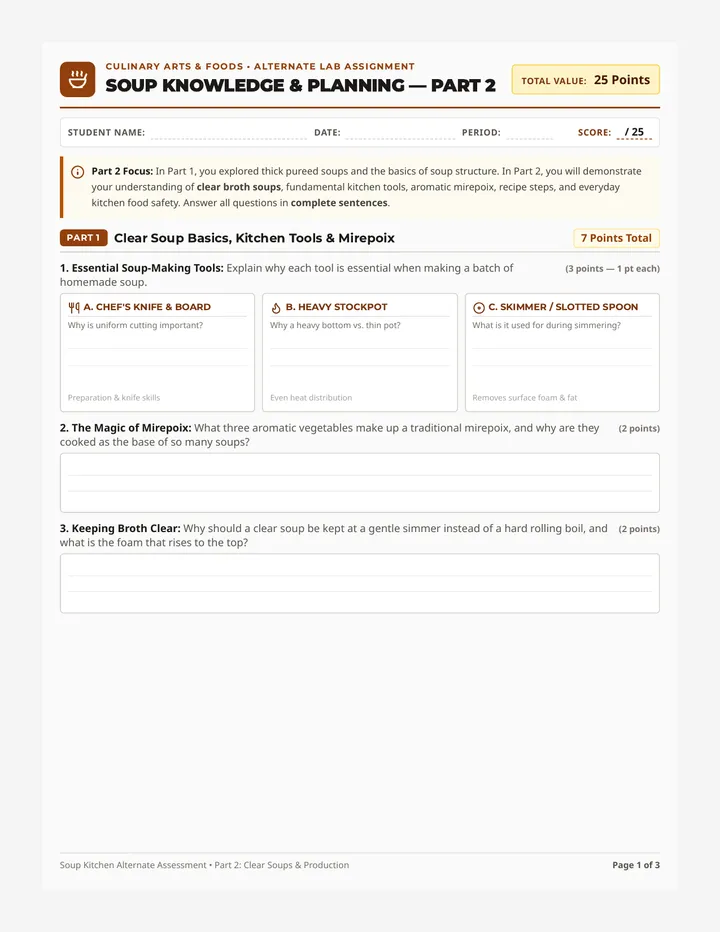
Soup Kitchen Alternate Assessment • Part 2: Clear Soups & Production Page 2 of 3
Culinary Arts Lab Assessment • Kitchen Safety, Sanitation & Evaluation
Student:
Part 4
7 Points Total
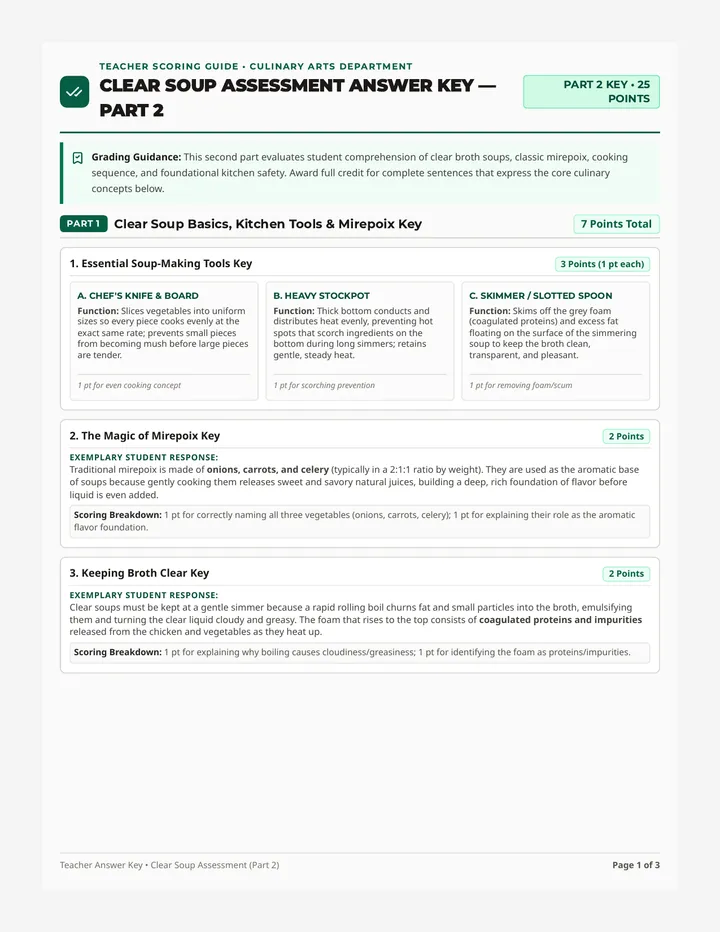
Answer each question below in complete sentences based on commercial kitchen safety and health rules.
1. Raw Chicken & Cross-Contamination: (2 points)
When prepping raw chicken and fresh vegetables for soup, what two specific sanitary rules must you follow to prevent cross-contamination (e.g., cutting boards, knife washing, handwashing)?
2. Safe Cutting & Guide Hand Technique: (1.5 points)
When slicing vegetables for soup, what is the name of the recommended hand position for your non-knife guide hand, and how does this position protect you from accidental cuts?
3. The Temperature Danger Zone: (1.5 points)
What temperature range is known as the "Temperature Danger Zone"? Why is it dangerous to leave a warm pot of soup sitting on the kitchen counter for several hours?
4. Safe Cooling of Leftover Soup: (2 points)
Why should a large hot pot of soup be divided into smaller, shallow containers before placing it in the refrigerator, instead of putting a huge deep pot directly into the fridge?
Part 2 Completion Checklist
Answered in full sentences Explained 3 kitchen tools Six ingredient functions listed Numbered steps 1 through 6 Covered raw chicken safety Explained safe cooling method
Part 2 Score Summary 25 Pts Max
Part 1: Tools & Mirepoix ____ / 7 pts
Part 2: Ingredient Functions ____ / 6 pts
Part 3: Recipe & Sequencing ____ / 5 pts
Part 4: Safety & Sanitation ____ / 7 pts
Part 2 Final Score: ____ / 25 pts
Soup Kitchen Alternate Assessment • Part 2: Clear Soups & Production Page 3 of 3
Parts 2 & 3 Key
Part 2
6 Points (1 pt each)
Recipe Ingredient
Correct Culinary Function & Purpose
1. Diced Chicken
Main Protein & Flavor: Provides savory chicken flavor and chewable protein substance; enriches the simmering broth with savory fats and juices.
2. Diced Mirepoix
Aromatic Flavor Foundation: Sautéed first to build the foundational background sweetness (onions/carrots) and earthy savoriness (celery).
3. Olive Oil / Butter
Cooking Medium & Flavor Release: Fat used to soften and sauté the mirepoix vegetables; carries fat-soluble aromatic flavor compounds into the soup.
4. Chicken Broth (or Stock)
Liquid Base & Simmering Medium: The unthickened liquid foundation that cooks the chicken and noodles, blending all flavors into a comforting clear soup.
5. Egg Noodles
Starch Garnish & Heartiness: Adds carbohydrates, tender chew, and filling body to transform the broth into a hearty meal.
6. Thyme, Salt & Parsley
Herbal Seasonings & Color: Thyme infuses herbal depth; salt enhances taste buds' perception of flavor; fresh parsley adds bright color and fresh finish.
Part 3
5 Points Total
1. Clear Soup Classification Key (1 pt)
Model Answer: It is classified as a Clear Soup because its liquid base remains an unthickened, transparent broth. The presence of solid chicken, vegetables, and noodles acts as floating garnish rather than a thickening agent (there is no roux, cream, or pureed vegetable paste).
2. Noodle Timing Rule Key (1 pt)
Model Answer: Noodles are added near the end because if they simmer too long, they soak up too much broth, swell excessively, release clouding starch into the clear soup, and turn mushy and falling apart. Adding them for just 8–10 minutes keeps them tender and intact.
3. Cooking Procedure Chronological Sequence Key 3 Points (0.5 pt per correct position)
Students must number each scrambled step card with numbers 1 through 6. The correct chronological culinary order is:
1 Card B (Mise en Place): Wash vegetables, dice mirepoix, cut chicken safely.
2 Card C (Sauté Mirepoix): Heat oil in stockpot and cook aromatics until soft.
3 Card A (Simmer Broth & Chicken): Add broth and chicken; simmer until cooked.
4 Card D (Cook Noodles): Stir in egg noodles & thyme; cook 8–10 min until tender.
5 Card E (Finish & Season): Stir in parsley, taste, and adjust salt and pepper.
6 Card F (Ladle & Serve): Ladle hot soup evenly into warmed soup bowls.
Quick Visual Check: Card A = 3 • Card B = 1 • Card C = 2 • Card D = 4 • Card E = 5 • Card F = 6 Sequence: B → C → A → D → E → F
Teacher Answer Key • Clear Soup Assessment (Part 2) Page 2 of 3
Teacher Answer Key • Kitchen Safety, Sanitation & Scoring Rubric
Part 4 & Rubric
Part 4
7 Points Total
1. Raw Chicken & Cross-Contamination (2 pts) Core Concept: Sanitation Separation
Model Answer (must state two): (1) Use separate cutting boards and knives for raw chicken and ready-to-eat vegetables (or prep vegetables first before raw poultry); (2) Wash hands with warm water and soap for 20 seconds immediately after touching raw poultry; (3) Clean and sanitize all prep tables, sinks, and tools that contact raw meat juices.
Award 1 pt per valid rule.
2. Safe Cutting & Guide Hand Technique (1.5 pts) Core Concept: The Claw Grip
Model Answer: The recommended hand position is "The Claw" (or claw grip). The cook curls fingertips and thumb inward like a bear claw, resting the flat side of the knife blade against the middle knuckles while cutting. This keeps vulnerable fingertip pads and fingernails tucked far away from the blade edge, preventing painful accidental cuts.
0.5 pt for naming "the claw"; 1 pt for explaining curled fingers & knuckle guide.
3. Temperature Danger Zone (1.5 pts) Core Concept: Bacterial Multiplication
Model Answer: The Temperature Danger Zone is 40°F to 140°F (or ServSafe 41°F to 135°F). It is dangerous to leave soup at room temperature because bacteria multiply exponentially in this warm environment (doubling every 20 minutes), producing harmful toxins that can cause severe food poisoning.
0.5 pt for temperature range; 1 pt for bacterial multiplication explanation.
4. Safe Cooling of Leftover Soup (2 pts) Core Concept: Surface Area & Rapid Heat Release
Model Answer: A deep pot holds a large volume of liquid that insulates itself; the center of a deep pot can remain in the danger zone for 12 to 24 hours inside a refrigerator. Dividing soup into small, shallow containers increases surface area, allowing heat to escape quickly so the soup cools below 40°F/41°F safely before bacteria can multiply.
1 pt for core insulation trap in deep pot; 1 pt for shallow container heat release.
Part 2 Assessment Holistic Rubric & Grading Guide 25 Points Total
Exemplary (A) 23 – 25 pts (92-100%)
Accurate tool functions, complete mirepoix knowledge, flawless sequencing, and thorough food safety rationale.
Proficient (B) 20 – 22 pts (80-88%)
Clear grasp of concepts; answers in full sentences; minor omissions in technical safety or 1 sequencing error.
Developing (C) 17 – 19 pts (68-76%)
Partial comprehension; multiple missing ingredient purposes, mixed-up cooking steps, or incomplete safety rules.
Needs Revision ≤ 16 pts (< 68%)
Significant gaps in kitchen safety or cooking steps; incomplete sentences; requires re-teaching before kitchen lab.
Instructor Grading Tips: • Accept either 40°F–140°F (USDA home standard) or 41°F–135°F (FDA ServSafe commercial standard) for the Danger Zone.
• In Part 3, ensure students numbered the steps chronologically (B → C → A → D → E → F).
• Verify that students answered in complete sentences as required by the directions.
Teacher Answer Key • Clear Soup Assessment (Part 2) Page 3 of 3