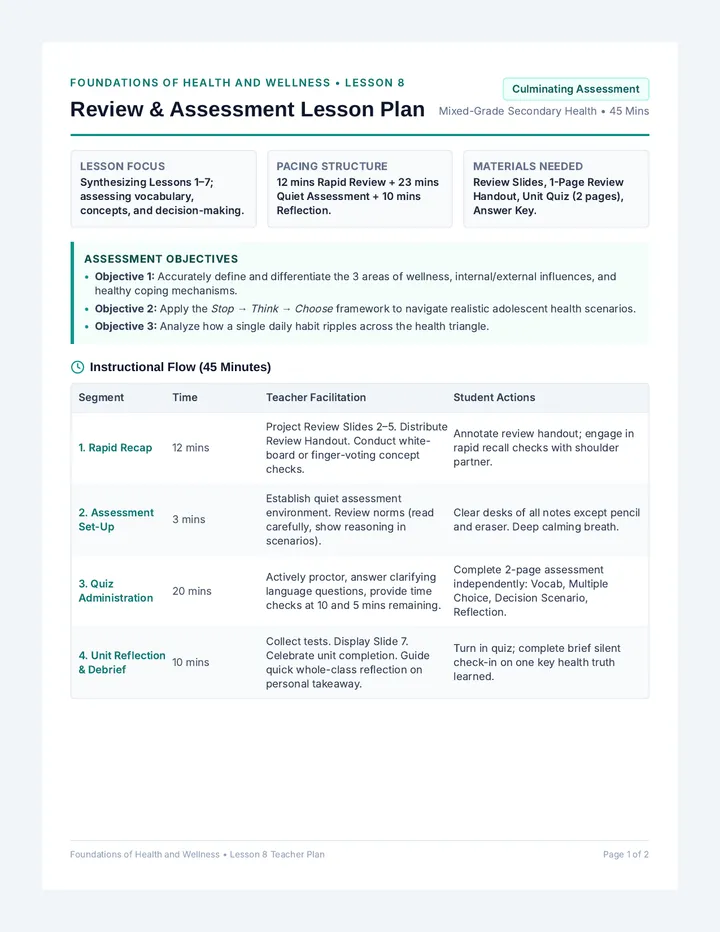
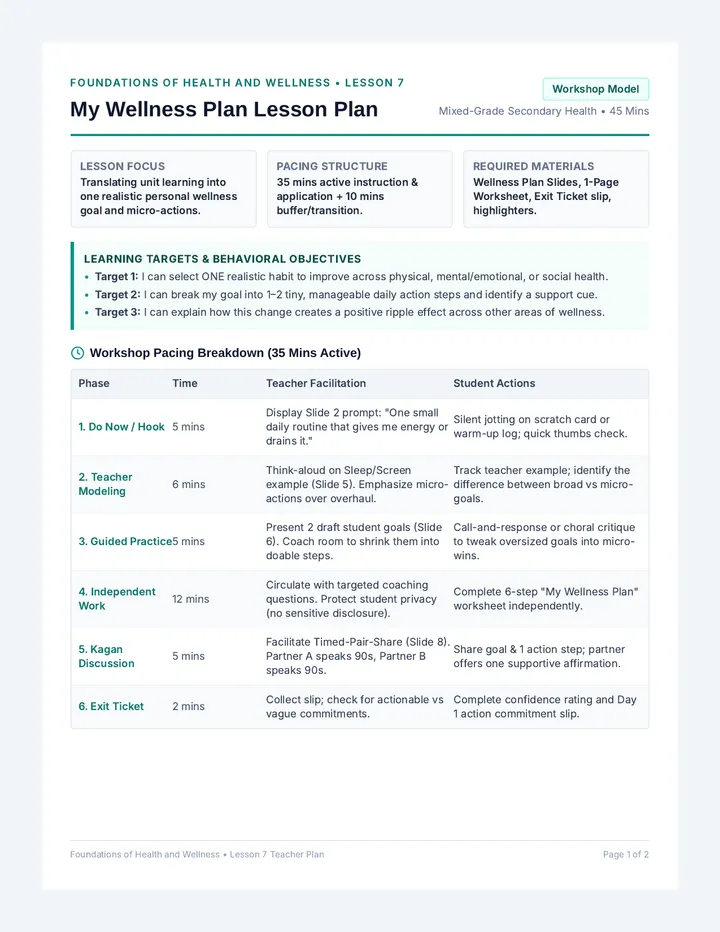
An 8-lesson comprehensive health sequence exploring personal wellness, influences, stress management, habits, decision-making, and goal-setting for mixed-grade secondary health classes.
Teacher reads out real-life situations (e.g., "Skipping lunch before practice," "Talking through a disagreement with a friend," "Taking 5 deep breaths during a test.") Students hold up 1 finger for Physical, 2 for Mental/Emotional, 3 for Social. If it touches all three, they raise both hands. This reinforces connectivity before testing!
Grading & Constructive Mastery Policy
The goal of this assessment is to demonstrate understanding of personal health decision-making. Partial credit should be generously awarded on Parts 3 and 4 for authentic, thoughtful reasoning that reflects the decision framework.
Foundations of Health and Wellness • Lesson 8 Teacher Plan Page 2 of 2
Recap 4: Stop → Think → Choose
Lessons 5 & 6 • The Healthy Decision Framework
Concept 4
1. STOP
Hit pause before reacting on impulse or emotion. Take a breath and recognize you have a choice.
2. THINK
What are the options? Who is influenced? What are the short-term and long-term consequences?
3. CHOOSE
Pick the option that aligns with your values, respects your wellness triangle, and protects others.
On the quiz, you will apply this exact 3-step sequence to a real-life scenario!
Foundations Assessment: Focus Norms
Time: 20 Minutes • Independent Work
Quiz Time
Four Sections on Today's Quiz:
Part 1 Vocabulary Matching: Match key terms to their accurate definitions.
Part 2 Concept Multiple Choice: Read each question and select the best answer.
Part 3 Scenario Analysis: Apply Stop → Think → Choose to a real peer situation.
Part 4 Short Response: Connect a daily habit to two sides of the wellness triangle.
Quiet focus in the room. When you finish, check your work and keep your paper face down.
Unit Complete!
Foundations of Health
Congratulations on Finishing the Unit!
You now have the knowledge and tools to balance your health triangle, manage stress, evaluate influences, build healthy habits, and make choices that protect your future.
Remember: Real wellness isn't being perfect every single day — it's making conscious, caring choices for yourself and others.
Foundations of Health and Wellness • You've got this!
Show Your Steps: In the scenario problem, explicitly state what to Stop, what to Think, and what to Choose.
Triangle Connect: In short answers, name at least TWO sides of the triangle and explain the connection.
Foundations of Health and Wellness • Review Reference Page 1 of 1
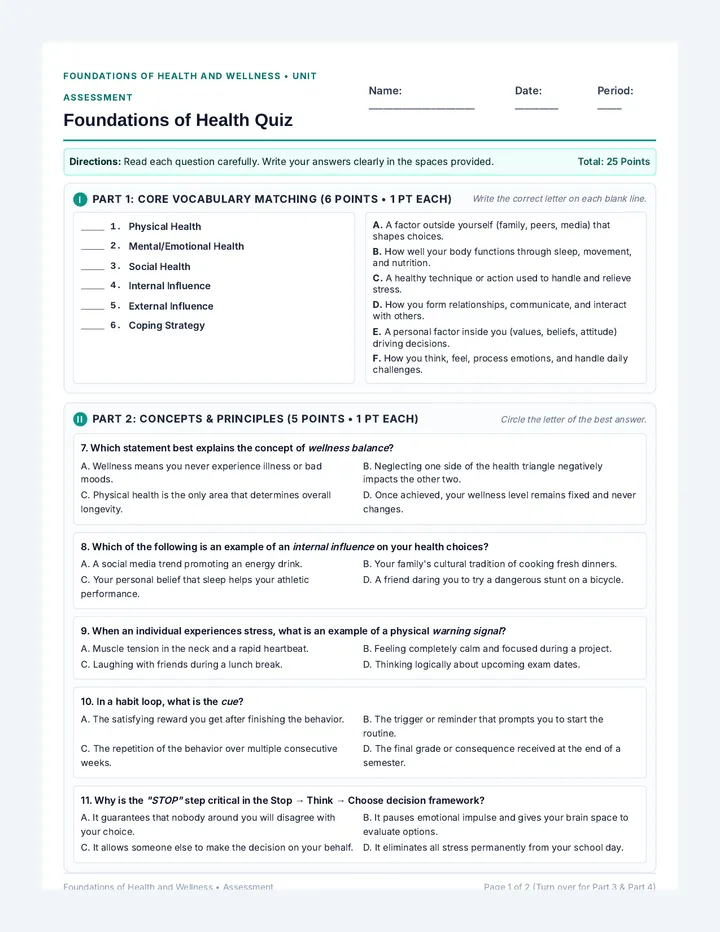
cue
A. The satisfying reward you get after finishing the behavior.
B. The trigger or reminder that prompts you to start the routine.
C. The repetition of the behavior over multiple consecutive weeks.
D. The final grade or consequence received at the end of a semester.
11. Why is the "STOP" step critical in the Stop → Think → Choose decision framework?
A. It guarantees that nobody around you will disagree with your choice.
B. It pauses emotional impulse and gives your brain space to evaluate options.
C. It allows someone else to make the decision on your behalf.
D. It eliminates all stress permanently from your school day.
Foundations of Health and Wellness • Assessment Page 1 of 2 (Turn over for Part 3 & Part 4)
Foundations of Health and Wellness • Unit Assessment
Part 3: Decision Scenario & Part 4: Reflection
Name: ______________________
III Part 3: Scenario Analysis — Stop → Think → Choose (6 Points)
Apply the 3-step decision model.
Scenario: Marcus has a major health and science presentation due first period tomorrow morning that is only half finished. At 8:30 PM, his friends start a group call asking him to join an online gaming tournament that will run past midnight. Marcus feels torn, his heart starts racing, and his friends are messaging: "We need you or we have to forfeit!"
12a. Stop: What should Marcus pause and notice about his physical feelings or impulses before responding? (2 Pts)
12b. Think: Identify TWO realistic options Marcus has, and one consequence for each option. (2 Pts)
12c. Choose: What is the healthiest decision Marcus can make that balances his responsibilities and well-being? What could he say to his friends? (2 Pts)
IV Part 4: Short Constructive Response & Reflection (8 Points)
Answer in complete sentences.
13. The Wellness Ripple Effect (5 Pts): Select ONE daily health habit (e.g., getting 8 hours of sleep, drinking water throughout the day, or daily physical movement). Explain how this one habit positively impacts at least TWO different sides of the health triangle (Physical, Mental/Emotional, or Social).
14. Personal Health Takeaway (3 Pts): What is ONE key strategy or realization from this unit that you can use to protect your health and manage stress during this school year?
Foundations of Health and Wellness • Assessment Page 2 of 2 • End of Quiz
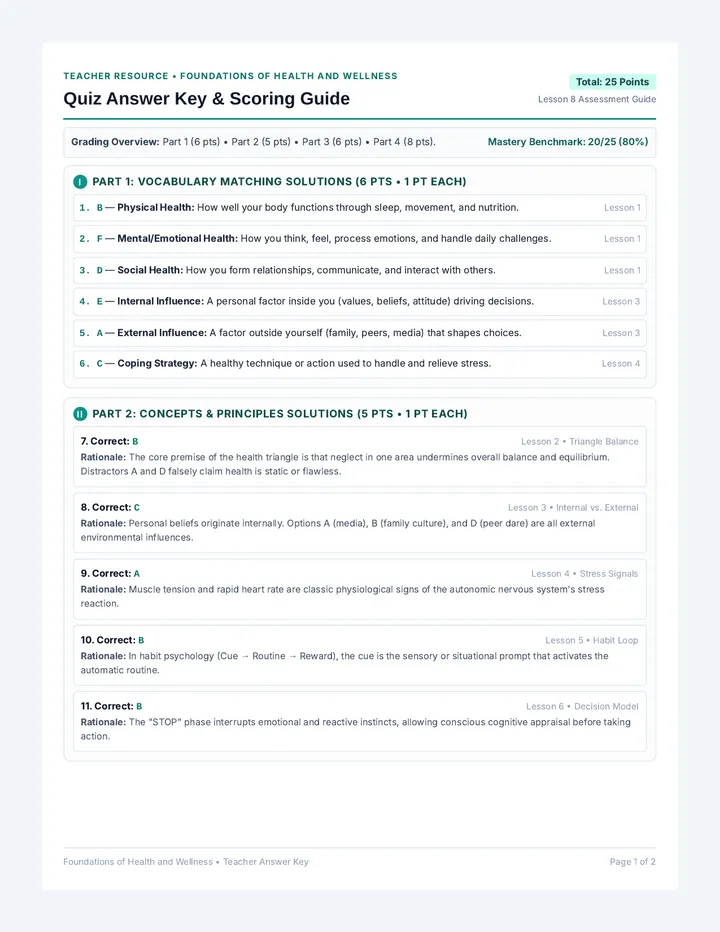
Teacher Resource • Scoring Rubrics & Exemplars
Part 3 & Part 4 Evaluation Guides
Pages 2 of Assessment
Part 3: Marcus Scenario Rubric (6 Points Total) Stop → Think → Choose
Full Credit (2 Pts): Identifies physical body signals (racing heart, tight chest) AND recognizes the emotional urge/pressure to agree right away to avoid disappointing peers. Partial (1 Pt): Mentions only one physical signal or only the urge without bodily awareness.
12b. Think (2 Points): Two Options & Consequences
Full Credit (2 Pts): States two clear options with realistic consequences. E.g., Option 1: Play game → have fun tonight, but fail presentation and feel panicked tomorrow. Option 2: Decline game → finish project, sleep well, but risk minor FOMO with friends.
12c. Choose (2 Points): Healthy Choice & Communication
Full Credit (2 Pts): Chooses to prioritize his school presentation/health AND drafts a polite, clear refusal to friends. E.g., "Marcus finishes his project and texts: 'Can't make it tonight guys, I have a big presentation due first period. Good luck tonight, I'll play this weekend!'"
Part 4: Short Response Rubric (8 Points Total) Ripple Effect & Reflection
13. The Wellness Ripple Effect (5 Points): Triangle Connectivity
• 1 Pt: Selects a realistic, positive daily health habit.
• 2 Pts: Explicitly names at least TWO sides of the triangle (Physical, Mental/Emotional, or Social).
• 2 Pts: Thoroughly explains how the habit produces a positive chain reaction connecting both areas.
Model Exemplar: "If I get 8 hours of sleep on school nights, it helps my physical health because my body repairs itself and I have natural energy for sports without needing energy drinks. It also ripples into my mental/emotional health because when I'm rested, I feel less anxious, my brain can focus during tests, and I don't get annoyed as easily by small frustrations."
14. Personal Takeaway (3 Points): Self-Reflection
Full Credit (3 Pts): Articulates an authentic, specific insight or actionable tool learned in the unit (e.g., using Stop-Think-Choose before snapping at family, recognizing stress signals before burnout, or focusing on micro-habits). Answer must be in complete sentences.