Stations 3 & 4: Equipment SOPs, Culinary Chemistry & HACCP Two-Stage Cooling
Chef Candidate:
20 Points (7169.D1.1, 7169.D1.2)
A. Thermal Control & Sweating (8 pts):
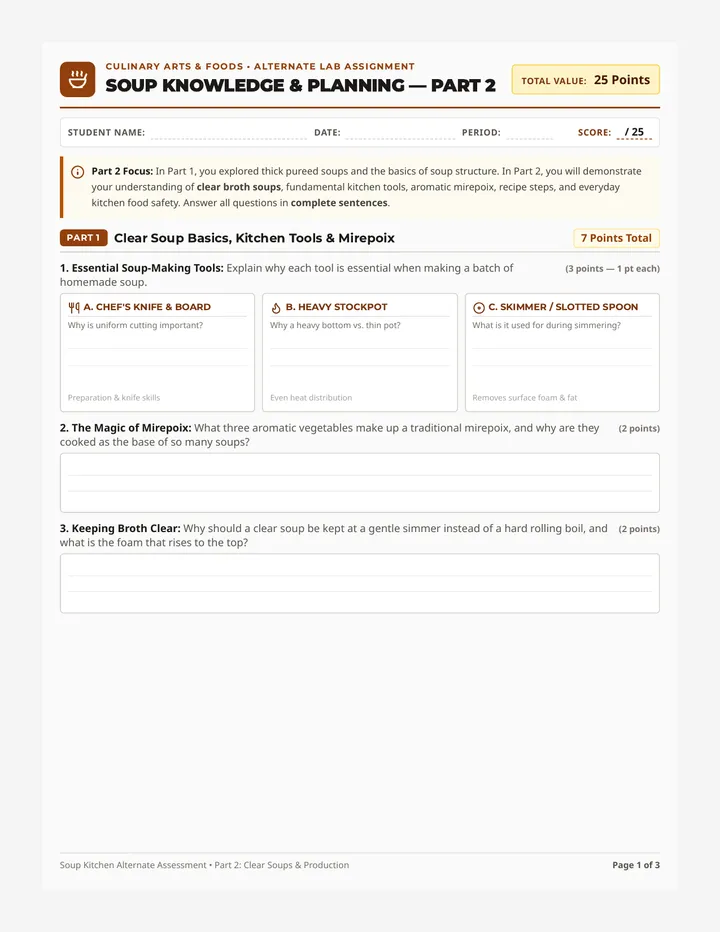
1. Explain the culinary purpose of sweating mirepoix versus browning/caramelizing for a clear chicken noodle soup:
2. State the target simmering temperature range (°F) for soup and explain why a hard, rolling boil damages broth clarity:
B. Hand Tools & Straining Mechanics (4 pts):
1. Why must stock be skimmed with a ladle during simmering?
2. When should a chef select a Chinois over a standard colander?
C. Immersion Blender (Burr Mixer) Standard Operating Procedure (8 pts):
Write 4 sequential safety and operational steps to purée a 3-gallon pot of hot vegetable soup using an immersion blender:
1. Pre-Use Inspection & Cord Path:
2. Submersion Depth Rule:
3. Speed Activation & Angle:
4. Power Shutdown & Extraction:
20 Points (7169.D1.1, 7169.D1.2)
A. HACCP Two-Stage Cooling Action Plan (10 pts): Mandatory CCP
You must cool 5 gallons of potato leek soup at 180°F. Complete the official cooling log and methods:
Stage 1 Target:
135°F to 70°F in max:
Stage 2 Target:
70°F to 41°F in max:
Maximum Pan Depth:
Shallow hotel pans:
Name two rapid physical cooling tools:
B. Culinary Troubleshooting (6 pts):
A cook adds heavy cream to a hot velouté soup and it separates into grainy curds. Explain the chemical cause and how to repair the emulsion:
C. 3-Compartment Sink Protocol (4 pts):
List the 3 sink basins in proper order and state the knife sanitation safety rule:
Basin 1:
Basin 2:
Basin 3:
Knife Rule:
Summative Practical Replacement Score
Station 1 (20) + Station 2 (20) + Station 3 (20) + Station 4 (20) = 80 Points
Part 2 Score
/ 80
Total Exam (Pt 1 + Pt 2)
/ 100
Soup Mastery Assessment • Part 2 Simulated Practical Exam Completed Total Summative Value: 100 Points (Part 1: 20 pts + Part 2: 80 pts)
• Sanitizer & Knives (4 pts): Quat sanitizer = 200–400 ppm. Knives must be hand-washed, sanitized, and immediately dried with a towel (never air-dried in a rack or left in a sink).
• Carrot Small Dice SOP (10 pts • 2.5 pts/step):
1. Peel, trim ends, cut into 2″ segments, slice thin slice off bottom to create flat base.
2. Square into a block; slice lengthwise into uniform 1/4″ thick planks.
3. Stack planks and slice lengthwise into 1/4″ × 1/4″ × 2″ batonnet sticks.
4. Gather batonnets and cross-cut at 1/4″ intervals into uniform 1/4″ cubes.
Station 2: Commercial Bases & Scaling (20 pts):
• Base Label Audit (8 pts): Base B is culinary grade because real meat/juices are the first ingredient rather than salt and hydrolyzed fillers (4 pts). Base A carries extreme salinity risk; if soup simmers and reduces, water evaporates while sodium concentrates, ruining flavor balance (4 pts).
• Reconstitution Scaling Math (12 pts):
• 4 gallons × 4 quarts/gal = 16 Quarts (3 pts).
• 16 quarts × 0.75 oz/qt = 12.0 Ounces paste (3 pts).
• 12.0 oz / 16 oz/lb = 0.75 Pounds paste (3 pts).
• Restoring Gelatin Body (3 pts): Bloom and dissolve unflavored powdered gelatin, add gelatin-rich scratch stock reduction, or simmer with gelatinous bones.
Soup Mastery Assessment Teacher Key • Page 1 of 2 Stations 3 & 4 Solutions & Standards Rubric →
Equipment SOPs, HACCP Staging (40 Pts) & Master Culinary Competency Scale
Part 2 Total: 80 Pts
20 Pts Each
Station 3: Equipment & Cooking (20 pts):
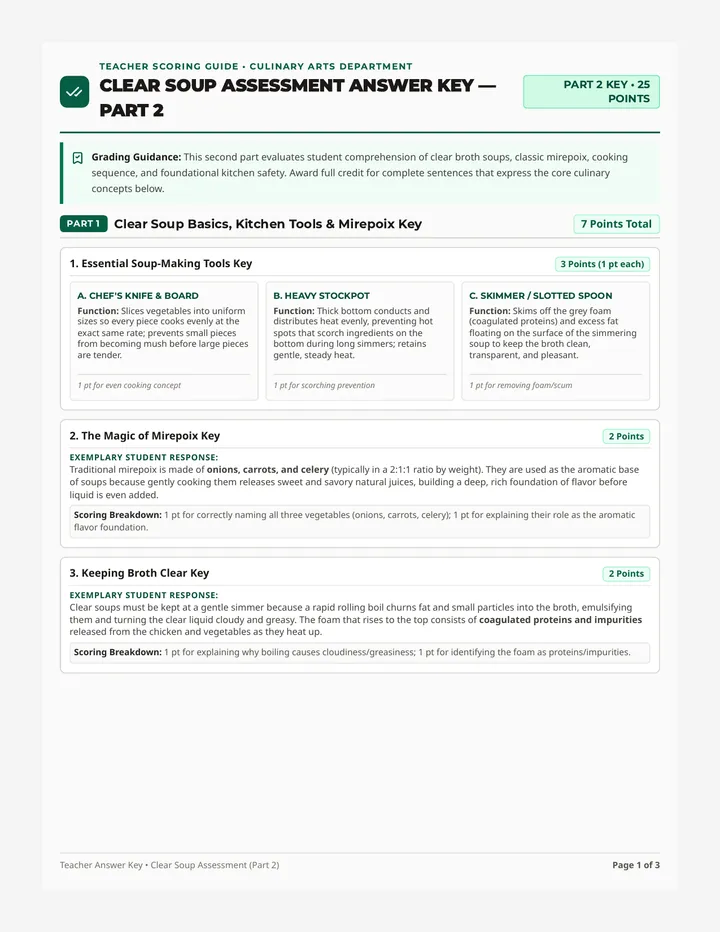
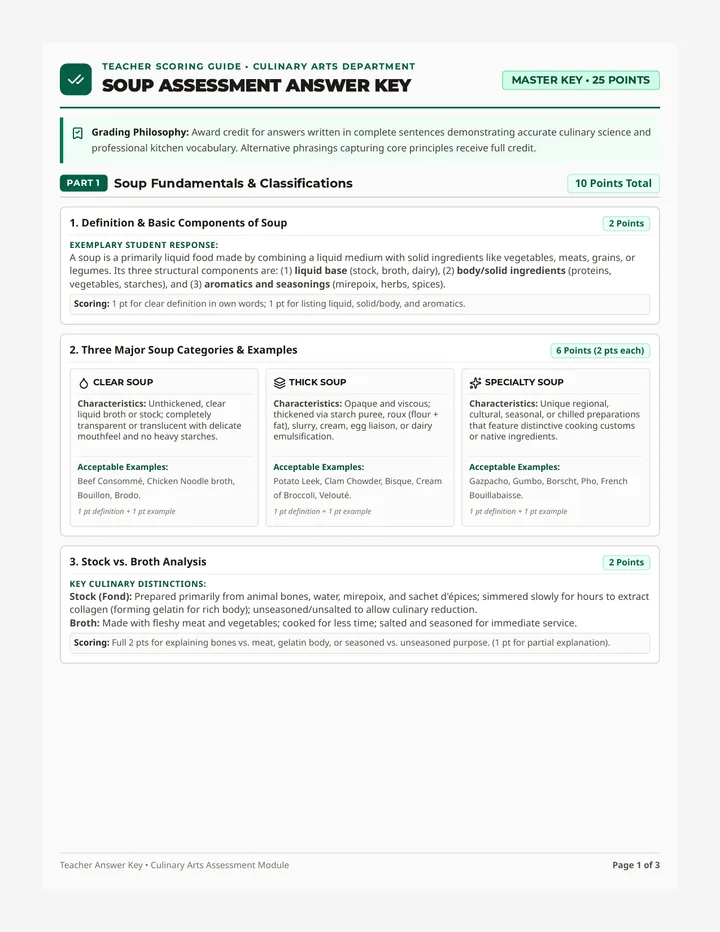
• Sweating vs. Browning (4 pts): Sweating softens vegetables and releases aromatics in fat without color; browning caramelizes sugars, darkening broth and adding roasted bitter notes inappropriate for clear soups.
• Simmering & Skimming (4 pts): Simmer at 185°–200°F. A hard rolling boil emulsifies fat and coagulated protein into the liquid, permanently clouding it. Ladle skimming removes impurities.
• Chinois vs. Colander (4 pts): Chinois has conical ultra-fine mesh to filter fine particles, creating a silky texture; colander only strains large chunks.
• Immersion Blender 4-Step SOP (8 pts • 2 pts/step):
1. Inspect cord, keep clear of burners; lock immersion shaft tight.
2. Submerge blade head completely below liquid surface before powering on.
3. Start at low speed; hold at slight angle to create vortex without splashing.
4. Turn motor completely OFF before lifting blade out of hot liquid.
Station 4: HACCP Cooling & Sanitation (20 pts):
• Two-Stage Cooling Protocol (10 pts):
• Stage 1: 135°F to 70°F in ≤ 2 hours (3 pts).
• Stage 2: 70°F to 41°F in ≤ 4 hours (6 hrs total) (3 pts).
• Max Pan Depth: ≤ 2 inches in shallow pans (2 pts).
• Cooling Tools: Ice paddles/wands, ice-water bath, blast chiller (2 pts).
• Culinary Troubleshooting (6 pts): Curdling is caused by thermal shock or boiling dairy without tempering (3 pts). Repair by whisking in fresh warm roux liaison off heat, immersion blending, or tempering in cold cream (3 pts).
• 3-Compartment Sink Protocol (4 pts): Basin 1: Wash (110°F+ soapy water); Basin 2: Rinse (clean warm water); Basin 3: Sanitize (hot water or chemical solution). Knife rule: Never drop or submerge knives in soapy water; wash immediately by hand.
CTE Culinary Competency
| Standard | Exemplary (90–100%) | Proficient (80–89%) | Developing / Needs Remediation (<80%) |
|---|---|---|---|
| 7169.D1.1 Knife, Equipment, Sanitation | Flawless 4-step small dice SOP; perfect immersion blender protocol; exact HACCP 2-stage cooling times/temps; knife safety prioritized. | Minor omission in cutting step or immersion protocol; correctly identifies 135°→70°→41°F cooling curve. | Unsafe cutting or blender procedure; fails critical 2-stage cooling time/temp parameters; ignores knife sanitation. |
| 7169.D1.2 Stocks & Soups Prep | Accurately defines all soup categories; explains sweating vs browning; correctly diagnoses and repairs broken emulsion. | Classifies soups correctly; understands simmer temp (185–200°F); general explanation of emulsion fix. | Confuses basic soup types (consommé vs bisque); unaware of why hard boiling damages broth clarity. |
| 7169.D1.3 & 13 Bases & Ingredients | 100% mathematical accuracy on 4-gallon scaling; audits ingredient labels; exact 50/25/25 mirepoix ratios calculated. | Scaling math correct within minor decimal rounding; recognizes real meat base advantage; mirepoix math accurate. | Major calculation errors in reconstitution; unable to distinguish quality bases from salt fillers; incorrect mirepoix ratios. |
Final Assessment Composite Formula: Part 1 Written Theory (20 Pts) + Part 2 Practical Simulation (80 Pts) = 100 Total Summative Pts
A: 90–100 | B: 80–89 | C: 70–79 | Remediation: <70
Soup Mastery Assessment Teacher Guide • Complete Master Key Standards: 7169.D1.1, 7169.D1.2, 7169.D1.3, 7169.D1.13 • Total Value: 100 Points