Lenny.com
Explore
Create
ActivitiesNewMathEnglish Language ArtsScience & EngineeringSocial StudiesGlobal LanguagesHealth & Physical EducationSpecial EducationCounseling & Life SkillsArts & CreativityESL
Lenny.com
Lenny.com
Explore
Create
ActivitiesNewMathEnglish Language ArtsScience & EngineeringSocial StudiesGlobal LanguagesHealth & Physical EducationSpecial EducationCounseling & Life SkillsArts & CreativityESL
Lenny.com
Lenny.com

Solutions

Lenny for EducatorsLenny for SchoolsLenny for Districts

Product

ExploreSign inCreateSupportAbout

Resources

Getting startedMTSS Acceleration Program

© 2026 Lenny Learning Inc.

TermsPrivacyAccessibility
LinkedInInstagramX
Lenny
Health & Physical EducationMovement Skills and ConceptsBody ControlLocomotor SkillsNon-Locomotor SkillsFine Motor SkillsManipulative SkillsBalance and CoordinationSpatial AwarenessMovement PatternsRhythmic Activities and DanceRhythm and TimingDance BasicsIndividual and Dual SportsGymnastics and TumblingTrack and FieldRacket SportsSelf-Defense and Martial ArtsTeam SportsCooperative GamesSportsmanshipTeam CommunicationBasketball SkillsSoccer SkillsVolleyball SkillsFootball SkillsGame StrategiesFitness and Physical ActivityCardio FitnessFlexibility and StretchingMuscular Strength and EnduranceSetting Fitness GoalsHealthy HabitsHygiene PracticesSleep and RestPhysical Activity HabitsHydrationInjury PreventionBody Awareness and Self-CareDisease PreventionHealth Decision-MakingHelp-Seeking and Self-AdvocacyMental HealthMental Health BasicsEmotional AwarenessStress ManagementCoping StrategiesMindfulness PracticesBreathing and Relaxation TechniquesMeditation BasicsResilience and PerseveranceHealthy RelationshipsSocial and Emotional SkillsHelp-Seeking and Support SystemsDigital WellbeingNutritionNutrition BasicsFood GroupsBalanced MealsHealthy Eating HabitsReading Food LabelsPersonal SafetyRecognizing Unsafe SituationsHuman and Child TraffickingStranger DangerPersonal BoundariesFire and Water SafetyEmergency ResponseConflict Resolution BasicsInternet and Social Media SafetySafe Personal RelationshipsSubstance AwarenessTobacco AwarenessAlcohol AwarenessCannabis AwarenessOpioid AwarenessStimulant AwarenessPrescription Drug AwarenessRefusing Peer PressureOutdoor and Adventure ActivitiesOutdoor Recreation SafetyHiking and OrienteeringTeam Building Activities

On Ramp

A robust 2-week introductory curriculum sequence detailing strength training benefits, basic muscle anatomy, how muscles produce movement, movement patterns, compound vs. isolation exercises, and essential resistance training vocabulary.

RDRebecca Del Nigro
Weight Training and Wellness

A comprehensive 2-week introductory unit covering why people strength train, major muscle anatomy, how muscles produce movement, movement patterns, compound vs. isolation lifts, and key resistance training vocabulary.

On Ramp

A robust 2-week introductory curriculum sequence detailing strength training benefits, basic muscle anatomy, how muscles produce movement, movement patterns, compound vs. isolation exercises, and essential resistance training vocabulary.

RDRebecca Del Nigro

WEIGHT TRAINING & WELLNESS TEACHER GUIDE PAGE 1 // DAILY TIMELINE

ANSWER KEYS // WORKBOOK PAGES 1-2

VOCABULARY & GOAL SOLUTIONS

PAGES 1 & 2 KEYS

Page 1: Concept Application Key

Text Prescription: "Goblet Squats: 3 × 10 @ 40 lbs, 90s rest"

  • First Blank: 3 sets
  • Second Blank: 10 reps
  • Third Blank: 40 pounds
  • Fourth Blank: 90s (or 1.5 minutes) between those sets

Page 2: RPE & Technical Failure Scoring

Explain the critical distinction between physical burnout and **Technical Failure**:

"A lifter has reached technical failure when they can no longer execute another repetition under proper biomechanical alignment. If a squat's torso collapses forward or back arch collapses, the set is complete at that threshold, even if the student's legs are capable of shoving the load up awkwardly."

  • RPE 10: No reps left in reserve. Form is at its maximum stable threshold.
  • RPE 8: Highly challenging. 2 safe repetitions left before form breaks.

Workbook Page 2: SMART Goal Rubric

Verify that student statements are fully completed and scientifically sound. Do not award full points for vague entries like "I want to lift heavy". Use this rubric:

Scoring ItemValueRequired Standard
1. Exercise Selection25 ptsMust be a concrete, trackable lift (e.g. Back Squat, Push-up, Row).
2. Specific Target Load25 ptsMust include specific numeric volume (e.g. 50 lbs, 15 reps).
3. Realistic Target RPE25 ptsMust fall between RPE 7 and RPE 9 (safe sub-maximal effort).
4. Complete Statement25 ptsSynthesized cleanly into the provided formula block.

WEIGHT TRAINING & WELLNESS TEACHER GUIDE PAGE 2 // PAGES 1-2 KEYS

ANSWER KEYS // WORKBOOK PAGE 3

ANATOMY & CONTRACTION SOLUTIONS

PAGE 3 SOLUTIONS

Page 3: Skeleton Fill-In-The-Blanks Answers

1. Muscles are anchored to skeletal bones via fibrous tissues called tendons.

2. During the lowering phase of a barbell squat, the quadriceps are contracting eccentrically to control the descent.

Coaching Note: Tendons transfer mechanical pull force. Ligaments attach bone-to-bone. Ensure students do not confuse the two! The eccentric phase is where the muscle lengthens under tension, often causing the highest microscopic damage (inducing hypertrophy and soreness). Slowing down the eccentric tempo (e.g. a 3-second descent) is highly effective for building joint control.

Muscle Pulling & Agonist/Antagonist Pairs

Why can muscles only pull?

Skeletal muscle tissue functions strictly via shortening contraction (myosin filaments pulling actin filaments closer together). This sliding action pulls the muscle tendon, which subsequently pulls the bone. A muscle possesses no internal biological mechanism to actively push.

Coordinated Antagonistic Pairs:

Because a muscle cannot push, joint movement must be governed by reciprocal pairs of muscles. The Agonist acts as the prime driver shortening to cause the action, while the Antagonist must slowly relax and lengthen to control and allow the movement.

Squat Knee Extension Agonist: Quadriceps (Shorten)
Antagonist: Hamstrings (Lengthen)

Elbow Flexion (Bicep Curl) Agonist: Biceps Brachii (Shorten)
Antagonist: Triceps Brachii (Lengthen)

WEIGHT TRAINING & WELLNESS TEACHER GUIDE PAGE 3 // PAGE 3 ANSWERS

ANSWER KEYS // WORKBOOK PAGE 4

SORTING LAB CLASSIFICATION KEYS

PAGE 4 SORTING LAB

Page 4 Sorting Lab: Official Classification Matrix

ExercisePattern TypeType (Compound/Isolation)Primary Muscle Targeted
1. Goblet SquatSquat PatternCompoundQuadriceps (Anterior)
2. Bicep CurlPull PatternIsolationBiceps Brachii (Arms)
3. Romanian DeadliftHinge PatternCompoundHamstrings & Glutes (Posterior)
4. Bench PressPush PatternCompoundPectorals (Anterior Chain)
5. Lat PulldownPull PatternCompoundLatissimus Dorsi (Posterior)
6. Leg ExtensionSquat (or Knee Extension)IsolationQuadriceps (Anterior)

Compound vs. Isolation Coaching Notes

Use the sorting lab to drive critical discussions on energy efficiency and workout planning. For instance:

  • Energy Sequencing: Always schedule heavy Compound Exercises first in a workout session when neuromuscular pathways are fully fresh. Scheduling isolation lifts first (like bicep curls before pull-ups) pre-fatigues helper muscles, causing technical failure to occur prematurely on your main compound movement.
  • CNS Load: Compound lifts recruit massive muscle volumes, placing massive systemic stress on the Central Nervous System. Explain to students why they will require longer rests (90s - 3 minutes) on squats compared to curls (60s).

WEIGHT TRAINING & WELLNESS TEACHER GUIDE PAGE 4 // PAGES 4 KEYS

ANSWER KEYS // WORKBOOK PAGE 5

FORM CHECKLISTS & ASSESSMENT GUIDES

PAGE 5 SOLUTIONS

Page 5: Form Assessment Standards

Verify that peer checklists are graded on actual physical execution parameters:

  • Heels Flat in Squat: If heels elevate or student shifts weight onto their toes, they must check "No" and write cue: "Drive weight back through the mid-foot / heels."
  • Hip Crease Parallel: The pelvic crease must descend at least parallel to the knee joint line. If student stops shallow, cue: "Reduce load and sink deeper into the pocket."
  • Flat Spine in Hinge: If the lumbar spine rounds even slightly, student must check "No" and cue immediately: "Push hips backward, pinch shoulder blades together, and brace core."

Page 5: Scenario - Stopping at Technical Failure

Expected Student Answer Focus:

If a lifter reaches RPE 10 and their spine begins to round under load, the spotter should immediately intervene verbally or physically to end the set. Because the spine is under axial compression, rounding transfers that force into destructive shear force across the lumbar vertebral discs, risking instant disc herniation. Safety dictates stopping the set at **technical failure** (form degradation), rather than pushing to absolute physical collapse.

Workbook Page 6 Final Evaluation Protocol

When grading the student's 10-Day workbook for the final 100-point course mark, use this professional rubric distribution:

  • Workbook Completion (50%): Pages 1-5 completely filled out with accurate definitions, skeleton notes, sorting lab values, and clear responses.
  • 10-Day Logging Accuracy (30%): Complete tracking of all days 3-10 on Page 6, detailing lifts, volume metrics, water targets, and sleep metrics.
  • Safety & Teamwork (20%): Active, safe behavior during the gym floor labs, including proper spotter communication and supportive coaching.

WEIGHT TRAINING & WELLNESS TEACHER GUIDE PAGE 5 // PAGES 5 KEYS

  • 🚫 9. Failure: Point in a set where form degrades and cannot complete a rep.
  • Understanding RPE

    We use Rate of Perceived Exertion (RPE) to regulate training load without risking injury.

    "RPE 10 is absolute Technical Failure. Safety dictates stopping a set when your technique breaks, not when your muscles physically collapse."

    WEIGHT TRAINING & WELLNESS // DAY 2 SLIDE 04


    MINI-UNIT // GOAL FORMULATION VAGUE VS. SMART FITNESS TARGETS

    Writing Your Goal

    To progress in 10 days, we must create target benchmarks that are specific, measurable, realistic, and bound to our timeline.

    SMART Goal Formula: "By Day 10, I will improve [Exercise] by moving [Target Load] for [Target Sets] at an RPE of [Target RPE]."

    Vague vs. SMART

    🚫 VAGUE GOAL

    "I want to squat heavy and get strong."

    ✓ SMART GOAL

    "By Day 10, I will improve my Goblet Squat by moving 50 lbs for 3 sets of 10 reps at an RPE of 8."

    WEIGHT TRAINING & WELLNESS // DAY 2 SLIDE 05


    ANATOMY ANTERIOR VS. POSTERIOR CHAINS

    The Anterior Chain (Front)

    • Pectorals (Chest): Main drivers for horizontal pushing.
    • Deltoids (Shoulders): Controls overhead press ranges.
    • Quadriceps (Thigh Front): Extends knees (Squats).
    • Rectus Abdominis (Abs): Stabilizes spinal alignment.

    The Posterior Chain (Back)

    • Latissimus Dorsi (Lats): Large back muscles; pulling actions.
    • Gluteus Maximus (Glutes): Controls hip extension and power.
    • Hamstrings (Thigh Back): Flexes knees and extends hips (Hinges).
    • Erector Spinae (Spine): Keeps back neutral under bar loads.

    WEIGHT TRAINING & WELLNESS // DAY 3 SLIDE 06


    BIOMECHANICS HOW MUSCLES MOVE BONES

    The Pull Principle

    Muscles are attached to bones by fibrous tissues called tendons. When muscle fibers contract, they ONLY pull on the bone. They cannot push.

    Joint movements require reciprocal pairs: the agonist contracts while the antagonist relaxes under control.

    Three Contraction Types

    • 💪 1. Concentric Contraction: Muscle shortens under tension (e.g. lifting the bar in a row).
    • 🔄 2. Eccentric Contraction: Muscle lengthens under tension (e.g. lowering the bar under control).
    • 🧘 3. Isometric Contraction: Muscle length remains static under tension (e.g. holding a core plank).

    WEIGHT TRAINING & WELLNESS // DAY 3 SLIDE 07


    PROGRAM DESIGN COMPOUND VS. ISOLATION

    Compound Exercises

    Movements recruiting **multiple joints** and **multiple muscle groups** simultaneously.

    • High nervous system stimulation & structural growth signal
    • Move maximum load and build functional coordination
    • Examples: Squat, Bench Press, Romanian Deadlift, Pull-ups

    Isolation Exercises

    Movements targeting a **single joint** and isolating a **single muscle group**.

    • Precise targeting of muscle links or physical weak spots
    • Very low central nervous system (CNS) systemic fatigue
    • Examples: Bicep Curls, Leg Extensions, Calf Raises

    WEIGHT TRAINING & WELLNESS // DAY 4 SLIDE 08


    PROGRAM DESIGN THE 4 PRIMARY MOVEMENT PATTERNS

    1. Squat

    Knee-dominant pattern with vertical torso orientation. Focus: Quadriceps.

    Goblet / Back Squat

    2. Hinge

    Hip-dominant pattern. Hips slide straight back. Focus: Glutes & Hamstrings.

    Romanian Deadlift

    3. Push

    Pressing loads horizontally or vertically away from body. Focus: Chest & Shoulders.

    Bench / Overhead Press

    4. Pull

    Pulling loads horizontally or vertically toward body. Focus: Latissimus & Back.

    Rows / Lat Pulldown

    WEIGHT TRAINING & WELLNESS // DAY 4 SLIDE 09


    SAFETY PRIMER GOLDEN RULES & SPOTTER ROLES

    Core safety markers

    • 🔒 Secure the Bar: Weight clips/collars must be used on every barbell set.
    • 🧹 Clear Area: Platforms must be 100% free of bags, bottles, or loose plates.
    • 🗣️ Communication: agree on liftoff counts and a distinct "help" cue before lifting.

    How to Spot

    Spotting is an active duty of vigilance. Never look at your phone or turn your head while partner is lifting.

    "On squats, spotter stands ready to cup the lifter's HIPS. On bench press, use an ALTERNATED MIXED GRIP over the barbell."

    WEIGHT TRAINING & WELLNESS // DAY 5 SLIDE 10


    PRACTICAL LAB EXECUTING THE CHECKLISTS

    How We Coach Form

    Use the checklists on Page 5. Lift an empty barbell or PVC pipe. Partner A performs 5 focus reps; Partner B assesses form metrics.

    Give physical coaching cues, e.g., "Drive knees out" or "Keep your back flat".

    Tracking Your 10-Day Log

    • Movement Pattern: Classify the exercise pattern.
    • Volume details: Track sets, reps, and actual load.
    • Intensity scale: Record subjective effort via RPE.
    • Lifestyle inputs: Log daily water (oz) and sleep (hrs).

    WEIGHT TRAINING & WELLNESS // WEEK 2 SLIDE 11


    UNIT CONCLUSION DAY 10 PROGRESS & SIGN-OFF

    The 10-Day Review

    True physical progression requires tracking consistency. At the end of Day 10, review your logs and reflections. Compare your baseline and final performance stats.

    "A successful weight training habit is not about lifting as much as possible. It is about consistent movement quality over time."

    Graduation Requirements

    • Workbook Completion: Pages 1-5 filled out fully.
    • 10-Day Log: Complete record of lifts, loads, RPE, sleep & water.
    • Teamwork Check: Safety and spotting verified in practice.
    • Post Reflection: Completed Page 6 statement.

    WEIGHT TRAINING & WELLNESS // DAY 10 SLIDE 12
    You might also like

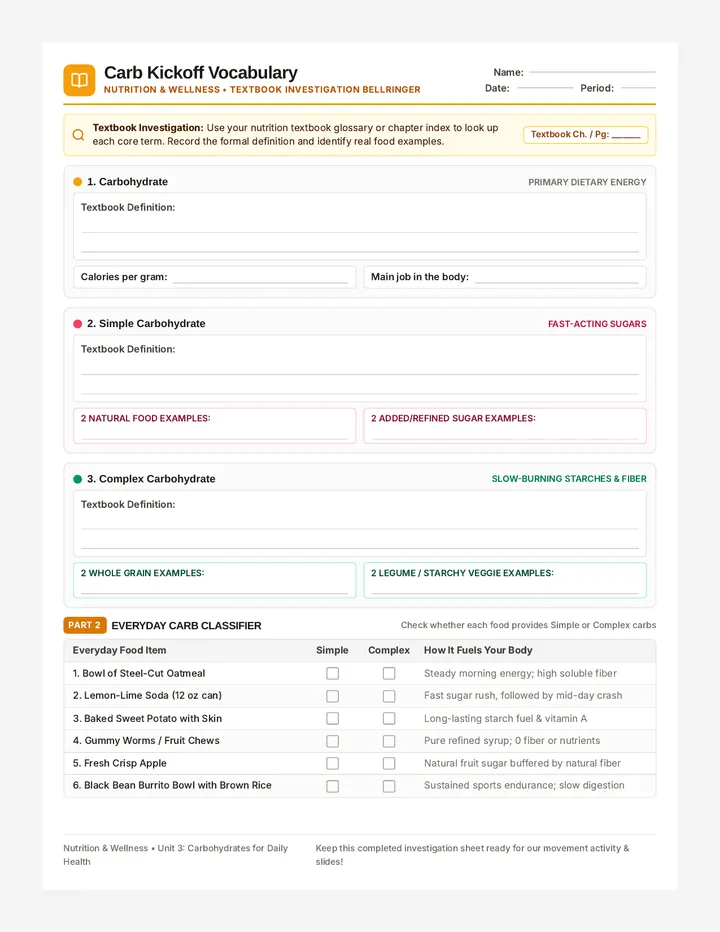
    Carb Kickoff Vocabulary Worksheet

    Smart Fuel Blueprint

    A dynamic high school nutrition and wellness unit examining macronutrient fuel, protein synthesis, food label literacy, and practical meal strategies for athletic stamina and everyday focus.

    J

    Jennifer.Leber

    7
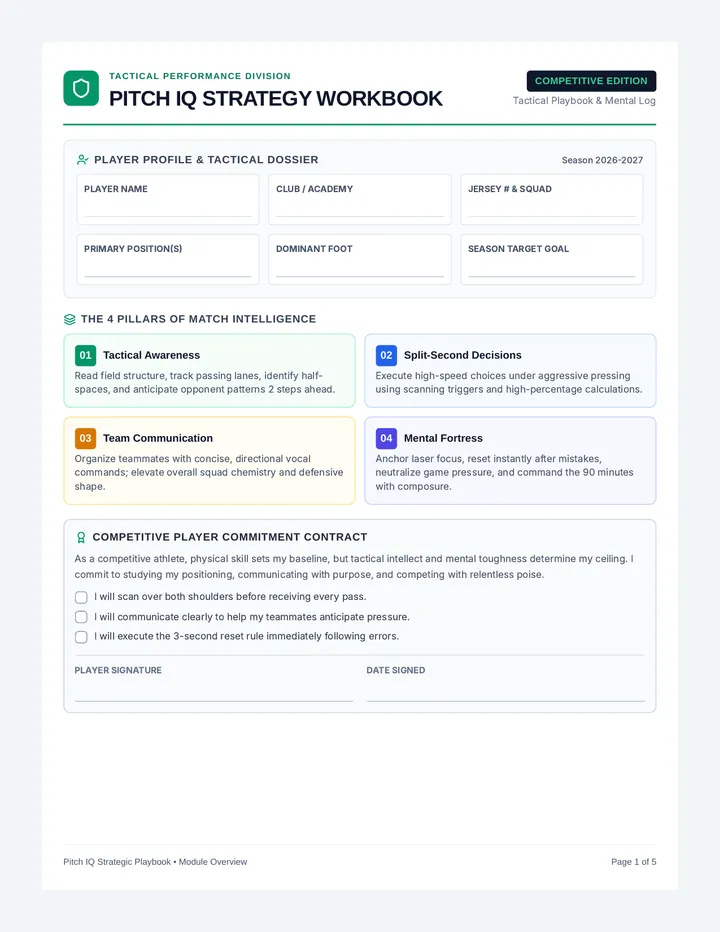
    Pitch IQ Strategy Workbook

    Pitch IQ Mastery

    A comprehensive tactical and mental performance module for competitive youth soccer players, featuring in-depth strategy workbooks and field-ready tactical drill sheets.

    T

    temetropolis

    2
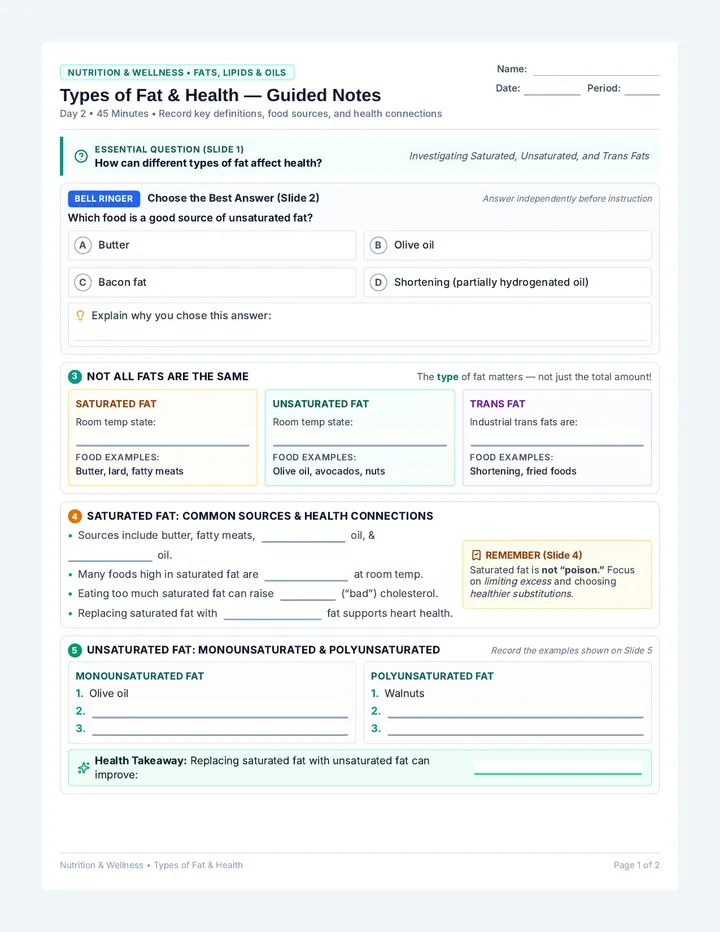
    Types of Fat Guided Notes

    Types of Fat Guided Notes

    Updated two-page guided notes handout closely following the slide presentation with enlarged blanks and writing spaces for student handwriting, expanded interactive sections for slides 1-10, and the exit ticket completely removed.

    J

    Jennifer.Leber

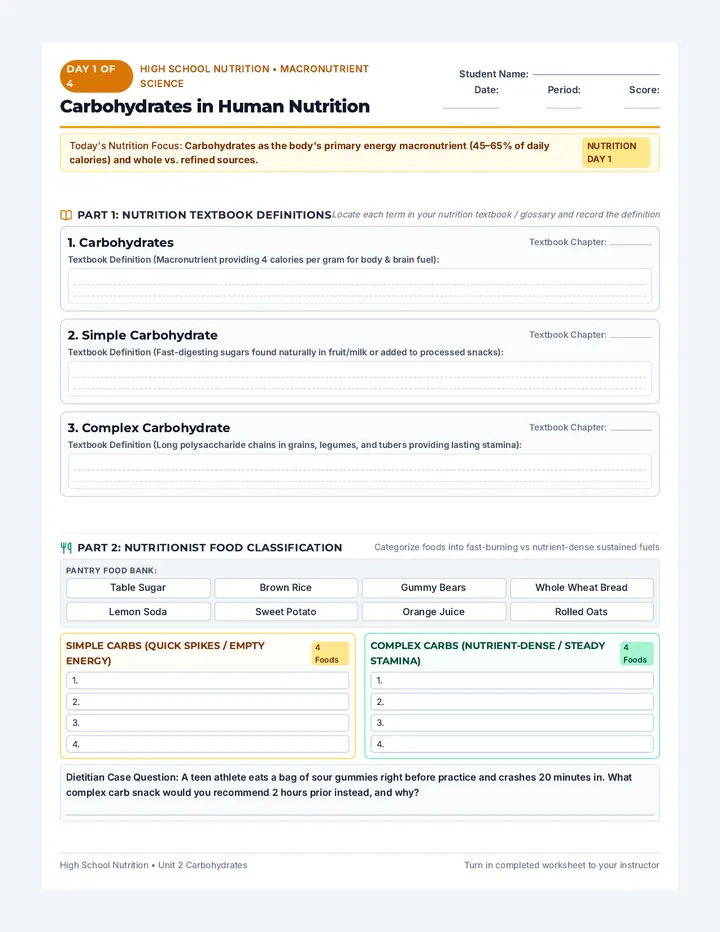
    Day 1 Foundations Worksheet

    Carb Masters Nutrition

    A comprehensive 4-day nutrition curriculum exploring dietary carbohydrates, digestion mechanics, fiber benefits, insulin homeostasis, and glycemic meal planning.

    J

    Jennifer.Leber

    16
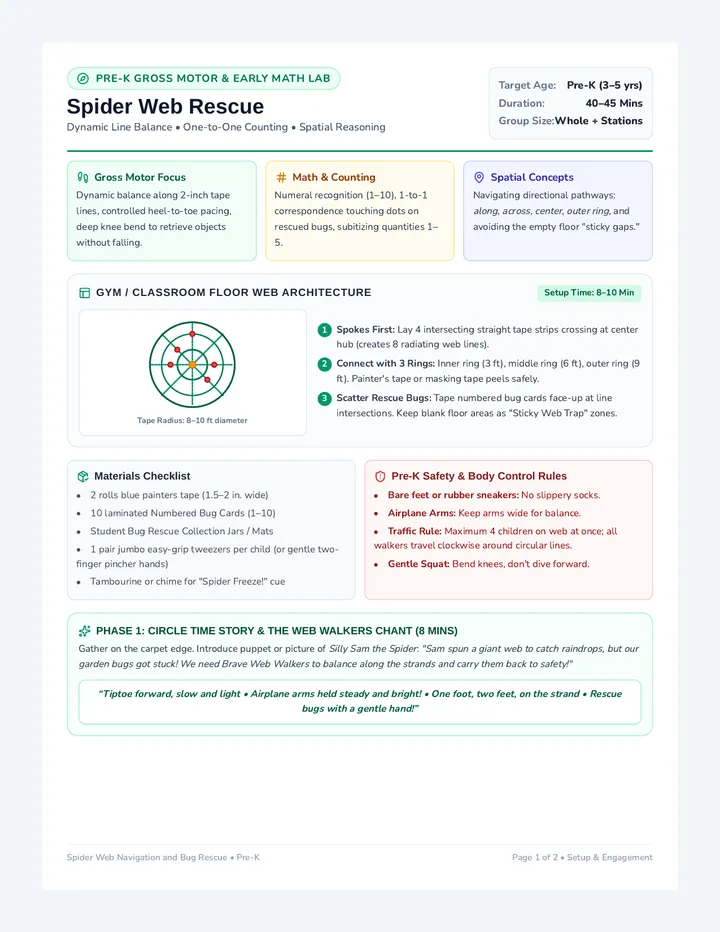
    Web Rescue Lesson Plan

    Spider Web Rescue

    A dynamic Pre-K gross-motor and early numeracy lesson where young learners navigate floor-tape web lines to rescue trapped numbered insects, building balance, core stability, spatial awareness, and one-to-one correspondence.

    SP

    Sav Per

    4
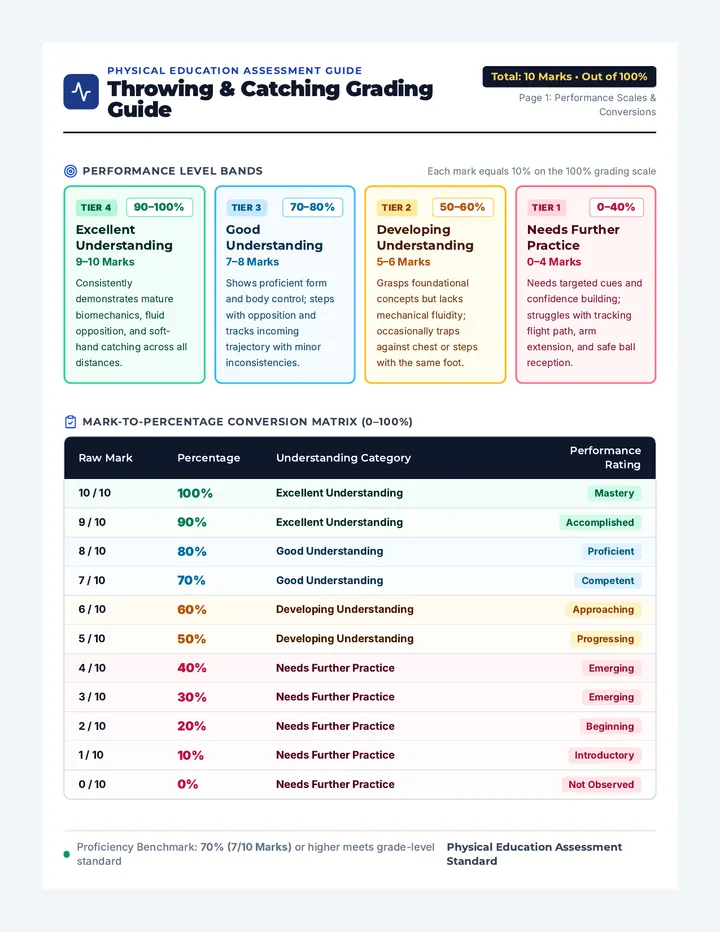
    Throw Catch Grading Guide

    Throw Catch Grading Guide

    A streamlined 2-page grading guide for Throwing & Catching Assessment featuring a clean mark-to-percentage conversion table out of 100% across the four performance bands, technical rubric criteria, and an observation tracker.

    KA

    Kashif Anthony

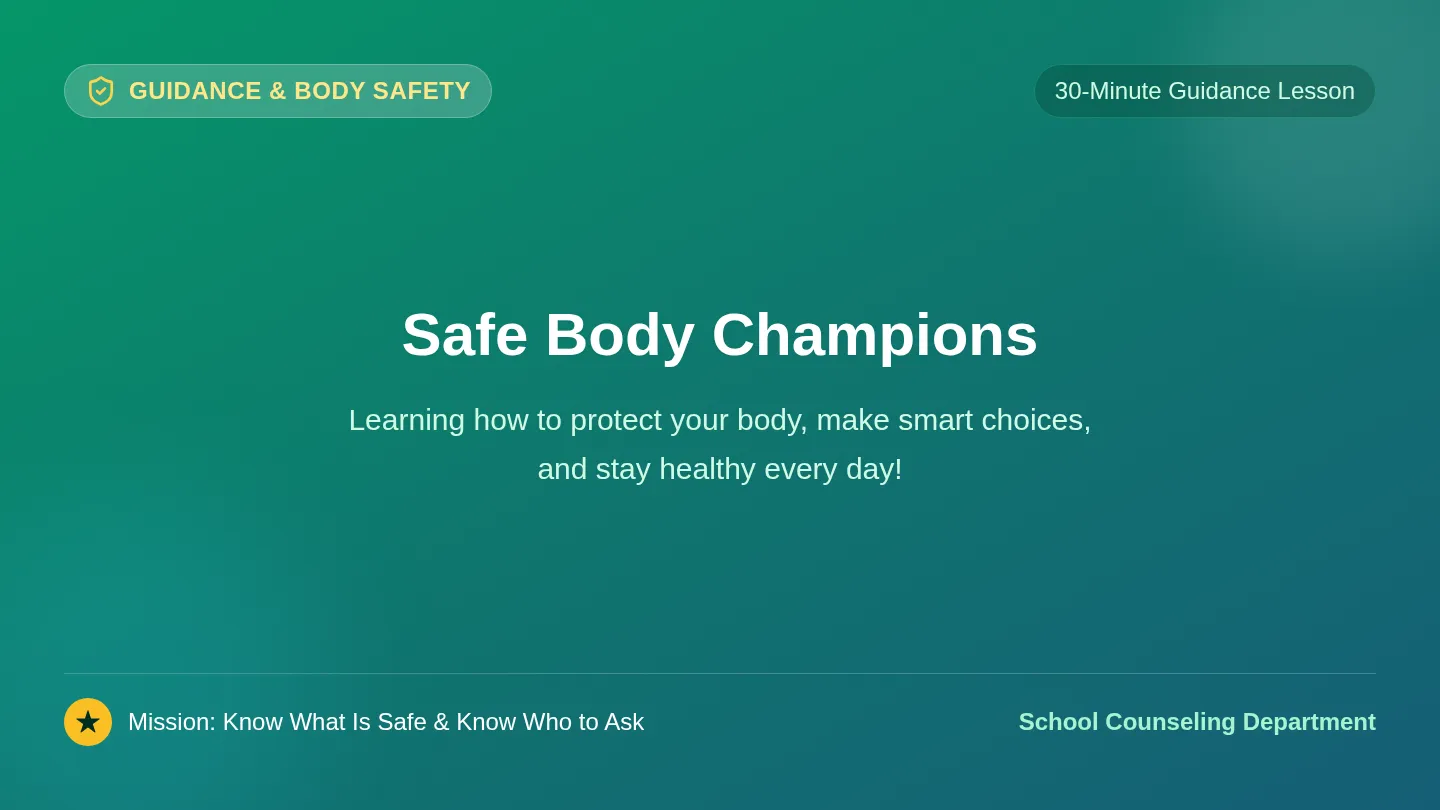
    Safe Body Champions Slides

    Body Safety Champions

    A bilingual drug awareness and medicine safety guidance program for 2nd and 3rd grade elementary students, featuring complete classroom materials in both English and Spanish.

    V

    vsifuentes

    8
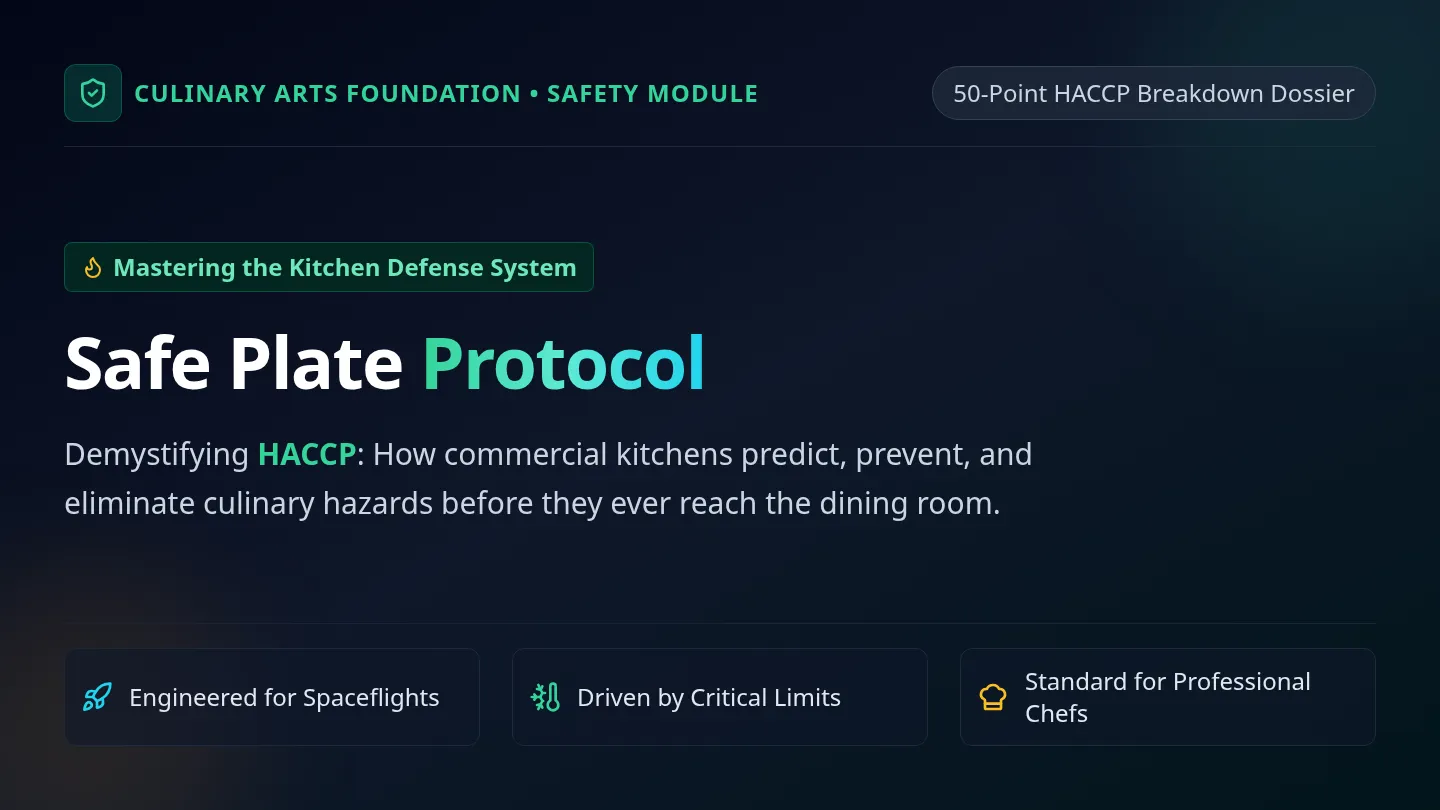
    Safe Plate Protocol Slides

    Safe Plate Protocol

    A foundational culinary arts lesson introducing freshman students to Hazard Analysis Critical Control Point (HACCP) principles. Through a visual slide presentation and an investigative research worksheet, students examine kitchen safety protocols, hazard categories, and critical control points.

    B

    Bonnie.Gomez

    2
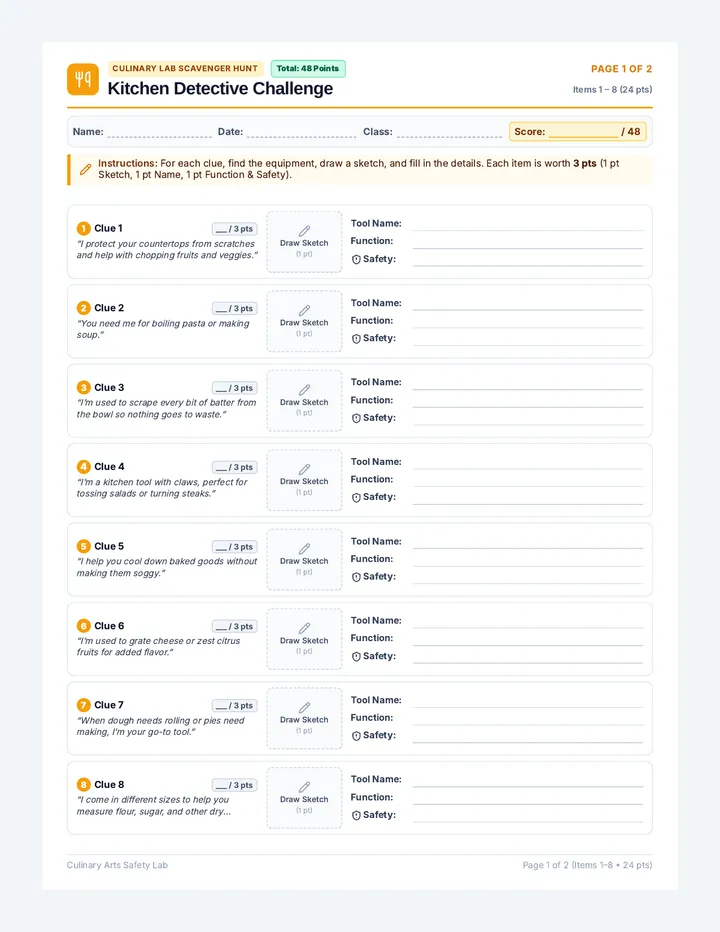
    Kitchen Detective Scavenger Worksheet

    Kitchen Detective Scavenger Worksheet

    A compact two-page culinary lab scavenger hunt worksheet worth 48 points, featuring all 16 equipment clues, dedicated sketch drawing frames, and write-in sections for tool names, functions, and safety tips.

    B

    Bonnie.Gomez

    Food Fuel Slides

    Nutri Power Academy

    A comprehensive two-session 6th grade health sequence covering food groups, essential nutrients, balanced plate design, and decoding nutrition facts labels for informed everyday choices.

    BM

    Brian Millea

    6
    Glow Germs Slides

    Glow Germ Detectives

    A fast-paced 30-minute 5th-grade health and microbiology lesson using UV glow lotion and powder to reveal how invisible microbes spread and where standard washing fails. Students conduct a contact transmission test, evaluate washing techniques under blacklight, and practice proper scrubbing protocols.

    AA

    Amanda Azevedo

    3
    Fentanyl Facts Slides

    Fentanyl Facts Slides

    A comprehensive, high-impact educational slide deck on fentanyl awareness, counterfeit pills, overdose signs, Naloxone (Narcan) administration, and youth decision-making.

    KP

    Kerri Parker