Heartbeat Detectives Sub Plan HEARTBEAT DETECTIVES
Lesson 1 Substitute Teacher Plan & Script
Setting: Regular Classroom
Duration: 45-50 Mins
Equipment: None (Pencils only)
Sub Quick-Start: This lesson runs entirely at student desks. Students will learn how to find their pulse, calculate Beats Per Minute (BPM), participate in a quiet standing/seated cardio circuit, and track heart rate changes on their worksheet.
Phase 1 (10 min) Warm-Up & Pulse
Phase 2 (15 min) Desk Cardio Circuit
Phase 3 (15 min) Worksheet Math & Log
Phase 4 (5 min) Cool-Down & Debrief
Step-by-Step Teacher Script & Directives
Step 1: Introduction & Locating the Radial Pulse (8 Mins)
Resting Baseline
Say: "Welcome class! Today we are Heartbeat Detectives. Your heart is an amazing muscular pump. Place two fingers—your index and middle finger—on the thumb side of your wrist. Do not use your thumb, because your thumb has its own pulse. When you feel a gentle tap-tap rhythm, give me a thumbs up."
Teacher Action: Model finding the pulse on your wrist. When ready, tell students: "Count your beats silently for 10 seconds starting now... STOP." Instruct them to multiply that number by 6 to find their resting BPM and record it on Section A of their worksheet.
Step 2: Classroom-Safe Desk Aerobic Circuit (15 Mins)
Quiet Movement
Say: "We are going to complete four quiet desk-side exercises for 45 seconds each with 15 seconds rest. Stay in your personal bubble behind your chair. Move quietly so we respect neighboring classrooms!"
1. Silent Shadow Boxing: Light seated or standing jab-cross punches focusing on controlled breathing.
2. Desk Side-Steps: Two light steps right, two steps left behind chair, staying low in athletic stance.
3. High-Knee Marching: Quiet knee raises to hip level while pumping arms softly.
4. Speed-Bag Circles: Rotate fists in tight circular patterns overhead at high cadence.
Desk Move Masters • PE Unit Page 1 of 2
Circuit Protocol & Classroom Management
Lesson 1 Facilitation
Step 3: Active Pulse Check & Worksheet Completion (15 Mins)
Data Collection
Say: "Freeze right where you are! Instantly find your wrist pulse. Ready... Count! (Wait 10 seconds)... STOP! Multiply that number by 6 and record your Active Heart Rate in Section B of your worksheet."
Have students return to seated positions and complete the math calculations, graph analysis, and cardiovascular health questions on their handout.
Step 4: Cool-Down & Heart Rate Recovery Debrief (5 Mins)
Wrap-Up
Say: "Inhale deeply as you raise your arms overhead for 4 seconds, and exhale slowly for 4 seconds. As your breathing slows, your heart rate recovers. Why did our hearts beat faster during the circuit? Because our working muscles demanded fresh oxygen!"
Noise & Space Guidelines
Keep all feet grounded (no jumping or stomping).
Maintain an arm's-length distance from desks and peers.
Use whisper level 1 during circuit transitions.
Provide chair-seated options for students with mobility restrictions.
Expected Worksheet Answers
Pulse Formula: 10-sec count × 6 = Beats Per Minute (BPM).
Cardio Definition: The ability of the heart and lungs to supply oxygen during exercise.
Recovery Fact: A fitter heart returns to resting baseline faster.
Substitute Quick Troubleshooting
Can't find wrist pulse? Have student gently place two fingers on the carotid artery on the side of their neck just under their jawline.
Class getting too loud? Call a "Silent Pulse Check" freeze immediately. Have everyone place fingers on wrist in total silence for 15 seconds.
Desk Move Masters • Lesson 1 Sub Guide Page 2 of 2
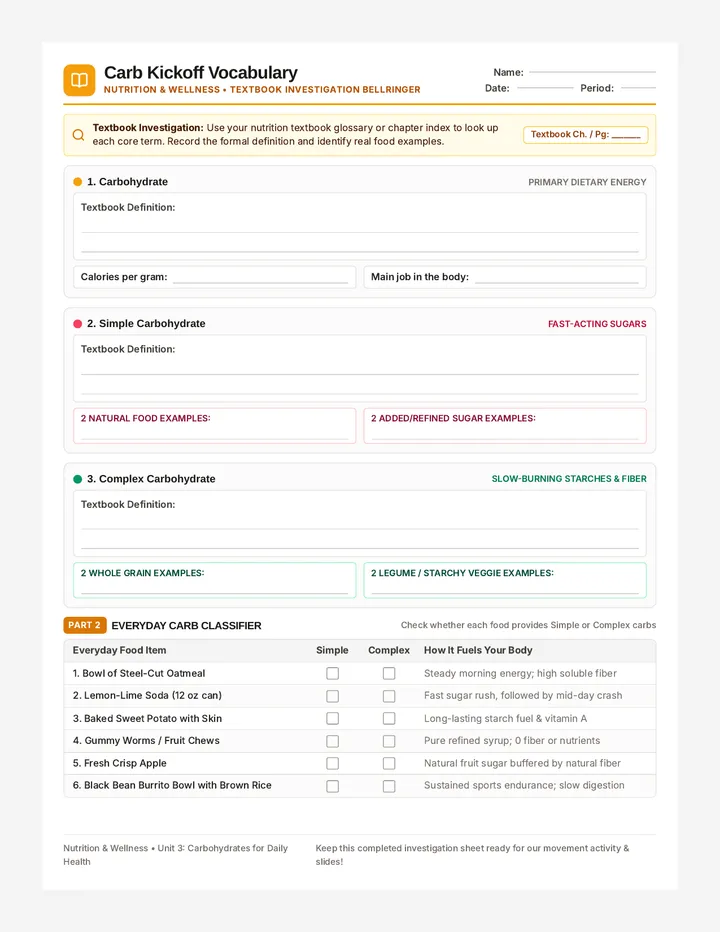
Heartbeat Detectives Worksheet HEARTBEAT DETECTIVES
Cardiovascular Investigation & Pulse Tracker
Name: ___________________
Date: _________
Period: _____
Mission: Measure your heart's response to exercise and discover why cardiovascular endurance matters! Formula: 10s Beats × 6 = BPM
Part 1: Heart Rate Investigation Log
Activity State 10-Second Count Beats Per Minute (BPM) 1. Resting (Seated quietly) _____ beats _____ × 6 = _____ BPM 2. Active (Post-Desk Circuit) _____ beats _____ × 6 = _____ BPM 3. Recovery (2 Mins Post-Circuit) _____ beats _____ × 6 = _____ BPM
Part 2: Exercise Intensity Check
Rate of Perceived Exertion (RPE):
Circle how hard your body was working during the circuit:
1-2
3-4
5-6
7-8
9-10
Physical Clues of Aerobic Work:
Check all physical responses you felt:
[ ] Faster breathing [ ] Feeling warmer [ ] Thumping chest [ ] Leg muscle burn
Part 3: Detective Analysis & Concept Questions
1. Why did your heart rate increase when you started doing the desk exercises?
2. What is the difference between aerobic exercise and anaerobic exercise ?
3. Why does an athlete with high cardiovascular endurance usually have a lower resting heart rate?
Desk Move Masters • Unit 1 Cardiovascular Investigation Sheet
Desk Strength Sub Plan DESK STRENGTH CHAMPIONS
Lesson 2 Substitute Teacher Plan & Script
Setting: Classroom Desks
Focus: Muscular Strength & Endurance
Equipment: None
Sub Quick-Start: Today's lesson uses bodyweight resistance exercises that can be performed silently using chairs and desk edges. Students explore the difference between muscular strength and endurance, complete 3 rounds of a 4-station circuit, and complete their muscle mapping worksheet.
Phase 1 (8 min) Concept Intro
Phase 2 (10 min) Form Demonstration
Phase 3 (18 min) Strength Circuit
Phase 4 (10 min) Worksheet & Cool-Down
Word-for-Word Teacher Script
1. Introduction to Strength vs. Endurance (8 Mins)
Concept Teach
Say: "Welcome champions! Today we are working on muscular fitness. Muscular Strength is the maximum force your muscles can produce in one effort—like lifting a heavy backpack once. Muscular Endurance is how long your muscles can repeat an action without getting tired—like carrying that backpack across the school. Today we build both using our own body weight!"
2. Form & Safety Demonstration (10 Mins)
Technique First
Demonstrate these 4 safe classroom bodyweight movements:
A. Chair Hover-Squats (Legs/Glutes):
Stand in front of chair. Lower hips back until lightly touching chair seat, pause 1 second, press through heels to stand.
B. Desk / Wall Incline Push-Ups (Chest/Arms):
Hands shoulder-width on desk edge or wall. Keep body in a straight plank line. Lower chest with control, push back up.
C. Seated Knee Tucks (Core/Abs):
Sit on front edge of chair, hold chair sides. Lift both knees toward chest while bracing core, lower gently without slamming feet.
D. Standing Calf Raises (Calves/Ankles):
Stand behind chair, light fingertips on chair back for balance. Rise high onto toes, hold 2 seconds, lower slowly.
Desk Move Masters • PE Unit Page 1 of 2
Circuit Facilitation & Management Notes
Lesson 2 Guide
3. Conducting the 3-Round Circuit (18 Mins)
Say: "We will do 3 rounds total. In each round, we do 40 seconds of focused movement followed by 20 seconds of rest. Keep your movements controlled—slow and steady builds stronger muscles than rushing!"
Timing Sequence:
Desk Strength Worksheet DESK STRENGTH CHAMPIONS
Muscular Strength & Endurance Lab
Name: ___________________
Date: _________
Period: _____
Muscular Strength:
The amount of force a muscle can produce in a single maximum effort.
Muscular Endurance:
The ability of a muscle to repeat contractions over time without fatiguing.
Part 1: Match the Exercise to the Primary Muscle Group
Desk Exercise:
1. Chair Hover-Squats Match: [ ___ ]
2. Desk Incline Push-Ups Match: [ ___ ]
3. Seated Knee Tucks Match: [ ___ ]
4. Standing Calf Raises Match: [ ___ ]
Target Muscle Group Bank:
A. Abdominals (Core) - trunk stabilization
B. Gastrocnemius (Calves) - ankle extension
C. Quadriceps & Gluteals - thigh & hip power
D. Pectorals & Triceps - chest & arm push
Part 2: 3-Round Circuit Rep & Fatigue Tracker
Station Movement Round 1 (Reps) Round 2 (Reps) Round 3 (Reps) Chair Hover-Squats _______ reps _______ reps _______ reps Desk Incline Push-Ups _______ reps _______ reps _______ reps Seated Knee Tucks _______ reps _______ reps _______ reps Standing Calf Raises _______ reps _______ reps _______ reps
Part 3: Form & Recovery Analysis
1. Did your number of repetitions increase, decrease, or stay the same by Round 3? Explain what caused this change in your muscles.
2. Why is maintaining strict, slow form better for building muscular strength than rushing through fast, sloppy repetitions?
Desk Move Masters • Unit 2 Muscular Fitness Tracker Sheet
Flexibility Ninjas Sub Plan FLEXIBILITY NINJAS
Lesson 3 Substitute Teacher Plan & Script
Setting: Desk & Seated Area
Focus: Flexibility & Posture Ergonomics
Equipment: None
Sub Quick-Start: This lesson is calm, controlled, and quiet. Students learn why joint mobility prevents injury and enhances athletic performance, perform a full 5-stretch seated and standing mobility sequence, and audit their daily desk posture.
Phase 1 (8 min) Flexibility Intro
Phase 2 (18 min) Ninja Stretch Flow
Phase 3 (15 min) Posture Audit & Sheet
Phase 4 (5 min) Mindful Breath Exit
Word-for-Word Teacher Script
1. Flexibility & Range of Motion Concept (8 Mins)
Concept Teach
Say: "Greetings, Flexibility Ninjas! Flexibility is the ability of your joints to move freely through their full range of motion. When you sit at a desk or look at screens all day, your neck, shoulders, and hips tighten up. Today we will unlock our mobility with smooth, quiet stretches."
Teaching Tip: Remind students that stretching should feel like gentle tension, never sharp pain or bouncing.
2. The 5-Move Ninja Desk Stretch Routine (18 Mins)
Guided Movement
Guide students through each stretch holding for 20-30 seconds per side:
1. Seated Figure-Four / Pigeon:
Cross right ankle over left knee. Keep spine straight, gently lean chest forward. Stretches outer glutes and hips.
2. Seated Spinal Twist:
Sit tall, place left hand on right knee and look over right shoulder. Hold, breathe, then switch sides.
3. Overhead Side Reach:
Interlock fingers overhead, reach up tall, then gently bend torso to the right, opening the ribcage and lats.
4. Desk Chest & Shoulder Opener:
Stand behind chair, place hands on chair back, step back and gently lower chest toward floor with flat back.
Desk Move Masters • PE Unit Page 1 of 2
Posture Audit & Classroom Management
Lesson 3 Guide
3. Posture Audit & Ergonomics Check (15 Mins)
Say: "Now look down at your seating position. Are your feet flat on the floor? Are your shoulders rolled back? Is your lower back supported? Let's complete the Posture Audit on Part 1 of your worksheet."
4. Wrap-Up & Daily Habit Commitment (5 Mins)
Say: "Who can name one stretch we can do every single day when we feel tired or stiff during class? Remember, flexibility improves posture, prevents back pain, and keeps your body agile!"
Flexibility Ninjas Worksheet FLEXIBILITY NINJAS
Joint Mobility & Posture Ergonomics
Name: ___________________
Date: _________
Period: _____
Part 1: Classroom Desk Posture Audit
Check Your Current Desk Alignment:
[ ] Feet flat on the floor (not wrapped around chair legs) [ ] Knees bent at roughly a 90-degree angle [ ] Lower back resting against backrest [ ] Shoulders relaxed down and back (not hunched) [ ] Head balanced over neck (no forward "tech neck")
Posture Score:
Count your checked boxes above:
_____ / 5 Checks
5/5 = Ninja Master • 3-4/5 = Getting Agile • 1-2/5 = Stiff Sloucher
Part 2: 4-Stretch Mobility Self-Assessment
Desk Stretch Target Area Mobility Rating (1-5) 1. Seated Figure-Four Hips & Glutes 1 2 3 4 5 2. Seated Torso Twist Spine & Lower Back 1 2 3 4 5 3. Overhead Side Reach Lats & Ribcage 1 2 3 4 5 4. Desk Chest Opener Chest & Anterior Shoulders 1 2 3 4 5
*Scale: 1 = Very Tight / Restricted • 5 = Very Loose / High Flexibility
Part 3: Flexibility & Joint Health Reflection
1. Explain how regular daily stretching can help prevent injuries in sports and daily physical activities.
2. Describe one physical cue you will use during class this week to remind yourself to fix poor posture.
Desk Move Masters • Unit 3 Flexibility & Posture Sheet
Mindful Motion Sub Plan MINDFUL MOTION
Lesson 4 Substitute Teacher Plan & Script
Setting: Silent Desk Space
Focus: Balance & Isometric Control
Noise Level: Level 0 (Silent)
Sub Quick-Start: This is a zero-noise, hyper-focused lesson. Students engage in static balance tests, isometric muscle holds (contracting muscles without moving joints), and diaphragmatic box breathing to regulate heart rate and nervous system arousal.
Phase 1 (6 min) Mindful Breath
Phase 2 (16 min) Balance Challenges
Phase 3 (14 min) Isometric Holds
Phase 4 (9 min) Reflection Sheet
Word-for-Word Teacher Script
1. Box Breathing Warm-Up (6 Mins)
Silent Reset
Say: "Sit tall with both feet on the floor and close your eyes. We will practice Box Breathing: inhale through your nose for 4 counts, hold for 4, exhale through your mouth for 4, and hold empty for 4. Let's do 4 cycles together in total silence."
2. Single-Leg Desk Balance Trials (16 Mins)
Proprioception
Say: "Stand directly behind your chair with light fingertips on the chair back for safety. When I say start, lift one foot off the floor and find a stationary focal point on the wall. Hold steady for up to 30 seconds."
Trial 1 & 2: Eyes Open
Test right leg for 30s, then left leg for 30s. Students record seconds held on worksheet.
Trial 3 & 4: Eyes Closed (Hard!)
Keep fingertips hovering 1 inch over chair for quick stabilization if balance is lost.
Desk Move Masters • PE Unit Page 1 of 2
Isometric Holds & Facilitator Guidelines
Lesson 4 Guide
3. Isometric Desk Strength Challenges (14 Mins)
Say: "An isometric contraction happens when your muscles flex with maximum effort, but your joints do not move at all! Let's test two powerful isometric holds."
A. The Palm Press (Pectorals/Arms):
Bring palms together in front of chest (prayer position). Press hands together as hard as possible for 15 seconds. Repeat 3 times.
B. Seated Desk Core Press (Abdominals):
Sit tall, place palms flat on top of desk. Push down firmly while bracing core and breathing. Hold for 15 seconds. Repeat 3 times.
4. Reflection Sheet & Calming Wrap-Up (9 Mins)
Say: "Notice how still and focused our classroom feels right now. Complete your Mindful Motion Worksheet to analyze your balance results and reflect on how breathing affects your focus."
Mindful Motion Worksheet MINDFUL MOTION
Balance, Isometrics & Breathwork Lab
Name: ___________________
Date: _________
Period: _____
Part 1: Single-Leg Balance Challenge Log (Max 30 Seconds)
Condition Right Leg Hold Time Left Leg Hold Time Eyes Open (Focal Point Fixed) _______ seconds _______ seconds Eyes Closed (Sensory Challenge) _______ seconds _______ seconds
Part 2: Isometric Muscle Activation Check
A. The Palm Press (15s Hold):
Where did you feel muscle tension?
[ ] Chest / Pectorals [ ] Shoulders / Deltoids [ ] Forearms & Palms
B. Desk Core Press (15s Hold):
Where did you feel muscle tension?
[ ] Upper & Lower Abdominals [ ] Lats / Back [ ] Triceps
Part 3: Mindful Breath & Focus Reflection
Box Breathing Flow: Inhale (4s) → Hold (4s) → Exhale (4s) → Hold Empty (4s) 4 Cycles Completed
1. Why was balancing on one leg significantly harder with your eyes closed? What senses does your brain use to stay upright?
2. How did you feel before vs. after the 4 cycles of Box Breathing? When is a good time to use this technique during the school day?
Desk Move Masters • Unit 4 Mindful Motion Lab Sheet
Fitness Architects Sub Plan FITNESS ARCHITECTS
Lesson 5 Substitute Teacher Plan & Script
Setting: Classroom Desks
Focus: Culminating Workout Synthesis
Equipment: Pencils & Handouts
Sub Quick-Start: Today is the grand finale! Students combine what they learned this week (Cardiovascular endurance, Muscular strength, Flexibility, and Mindful balance) to design, test, and evaluate their own personal 4-exercise desk workout routine.
Phase 1 (7 min) Unit Review
Phase 2 (15 min) Design Blueprint
Phase 3 (18 min) Test Run Circuit
Phase 4 (5 min) Unit Celebration
Word-for-Word Teacher Script
1. Unit Synthesis & Mission Launch (7 Mins)
Review
Say: "Welcome, Fitness Architects! This week we mastered four key components of fitness right at our desks: Cardio, Strength, Flexibility, and Mindful Balance. Today, you are the trainers. You will engineer a custom 4-station desk circuit containing one movement from each fitness category!"
2. Workout Architecture Rules (15 Mins)
Design Phase
Guide students to complete Part 1 & Part 2 of their Blueprint worksheet:
Station 1: Cardio Blast
Shadow boxing, seated sprints, speed bag, or high knees (30-45 seconds).
Station 2: Muscular Strength
Chair hover-squats, desk push-ups, knee tucks, or calf raises (10-15 reps).
Station 3: Joint Mobility / Stretch
Seated pigeon, torso twist, side reach, or chest opener (20-30s hold).
Station 4: Mindful Balance / Isometrics
Flamingo balance, palm press, or seated core press (15-30s hold).
Desk Move Masters • PE Unit Page 1 of 2
Test-Run Protocol & Sub Completion Guide
Lesson 5 Guide
3. Test-Running the Workouts (18 Mins)
Say: "Now that your workout blueprint is written, it is time for the official test run! Stand behind your chair. When I start the master classroom timer, you will perform your 4 custom stations in sequence."
Classroom Master Timer:
4. Final Unit Debrief & Celebration (5 Mins)
Say: "Congratulations Desk Move Masters! You have proven that you do not need a giant gym or heavy weights to improve your cardiovascular fitness, muscular strength, flexibility, and focus. Give yourselves a quiet round of applause!"
Fitness Architects Worksheet FITNESS ARCHITECTS
Custom Desk Workout Blueprint
Name: ___________________
Date: _________
Period: _____
Part 1: Engineer Your 4-Station Desk Circuit
Fitness Category Your Chosen Desk Exercise Prescription Station 1: Cardiovascular Exercise Name:
Key Form Cue:
| _______ seconds
Exercise Name:
Target Muscle:
| _______ reps
Stretch Name:
Target Joint / Area:
| _______ seconds
Balance / Isometric Move:
Focus Strategy:
| _______ seconds
Part 2: Test-Run Performance & Evaluation
Workout Flow Rating:
How smoothly did your circuit transition between movements?
1
2
3
4
5
Classroom Safety Check:
[ ] Completely silent and safe for desk space [ ] Required zero gym equipment [ ] Kept proper personal distance from desks
Part 3: Unit Master Reflection
What is one key takeaway you learned this week about staying physically active and healthy without equipment?
Desk Move Masters • Unit 5 Workout Architect Blueprint Sheet
Hoop Words Activity BASKETBALL BRAIN CHALLENGE
Word Search & Word Scramble Activity
Name: ___________________
Date: _________
Period: _____
Part 1: Court Word Search
Find all 10 words hidden →, ↓, or ↘
S W I S H K T R A V E L B Q D R I B B L E Z P F A P A S S G H O O P I M S X L A Y U P C V R V K K D E F E N S E W E O T E M C O U R T J Y B T Q T R E B O U N D A O N L B G H J K L M P S U X Z A S S I S T F W D N C V L T Y U I O P L M D K J L N A I S M I T H P H Q F A S T B R E A K W P Z
Official Word Bank (10 Words):
[ ] BASKETBALL [ ] DRIBBLE [ ] REBOUND [ ] ASSIST [ ] DEFENSE [ ] LAYUP [ ] PIVOT [ ] TRAVEL [ ] SWISH [ ] FASTBREAK
Trivia Clue: Can you find the secret horizontal word in Row 10 naming the inventor of basketball? (Hint: 9 letters)
Part 2: Basketball Word Scramble
Unscramble each term using the clue
1. E D U O R N B 7 Letters
Clue: Snatching the ball out of the air after a missed shot.
Answer:
2. F S U O L 5 Letters
Clue: Illegal physical contact called by the referee.
Answer:
3. R C T U O 5 Letters
Clue: The hardwood rectangular playing area.
Answer:
4. E E H E R F T R O W 9 Letters (2 words)
Clue: An uncontested 1-point shot awarded after a penalty.
Answer:
5. H O P C A M I N 8 Letters
Clue: The title given to the winning team of a tournament.
Answer:
6. E E M P I R R E T 9 Letters
Clue: The shooting zone outside the key and 3-point line.
Answer:
Desk Move Masters • Classroom PE Sports Smarts Basketball Printable Challenge Sheet
Hoop Smarts Sub Plan HOOP SMARTS SUB PLAN & KEY
Teacher Facilitation Guide & Master Answer Key
Setting: Classroom Desks
Type: Sports Literacy / Rainy Day PE
Target Time: 35-45 Minutes
Substitute Instructions: Hand out the "Hoop Words Activity" printable sheet. Students work independently or in pairs to locate the 10 basketball terms in the letter grid and unscramble the basketball vocabulary words using the context clues.
Part 1: Word Search Coordinate Solution Key
1. BASKETBALL: Column 1 (Leftmost Col), Rows 2 to 11 ↓ (Vertical)
2. SWISH: Row 1, Columns 1 to 5 → (Horizontal)
3. TRAVEL: Row 1, Columns 7 to 12 → (Horizontal)
4. DRIBBLE: Row 2, Columns 3 to 9 → (Horizontal)
5. PASS: Row 3, Columns 2 to 5 → (Horizontal)
6. HOOP: Row 3, Columns 7 to 10 → (Horizontal)
7. PIVOT: Column 11, Rows 2 to 6 ↓ (Vertical)
8. LAYUP: Row 4, Columns 3 to 7 → (Horizontal)
9. DEFENSE: Row 5, Columns 2 to 8 → (Horizontal)
10. REBOUND: Row 7, Columns 2 to 8 → (Horizontal)
11. ASSIST: Row 9, Columns 2 to 7 → (Horizontal)
12. FASTBREAK: Row 12, Columns 1 to 9 → (Horizontal)
Secret Trivia Answer: NAISMITH (James Naismith, inventor of basketball in 1891) is found horizontally in Row 11, Columns 3 to 10.
Part 2: Word Scramble Master Answer Key
Scrambled Prompt Unscrambled Word Key Rule & Definition 1. E D U O R N B REBOUND Gaining possession of the ball after a missed field goal or free throw. 2. F S U O L FOULS Violations resulting from illegal personal contact with an opponent. 3. R C T U O COURT The rectangular playing area measuring 94 × 50 feet (regulation size). 4. E E H E R F T R O W FREE THROW An unhindered shot worth 1 point taken from behind the free throw line (15 ft). 5. H O P C A M I N CHAMPION The victor or title-holder in a league or tournament bracket.