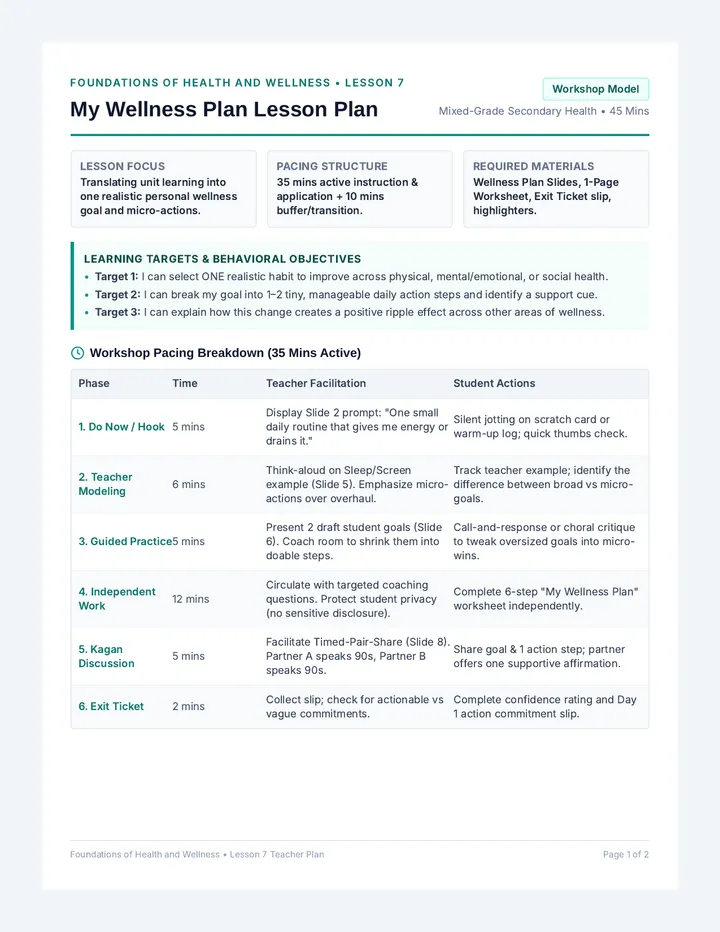
Unmasking Truth Lesson Plan Unmasking the Truth
Lesson Plan: Understanding Alcohol Abuse
Teacher Resource
Duration
45 Minutes
Audience
9th Grade (Tier 1)
Approach
Interactive Activity & Case Studies
Why This Matters
Understanding the impact of alcohol on the body and mind is crucial for making healthy choices and resisting peer pressure. By unmasking the myths, students are equipped with facts that empower them to navigate social situations safely.
Learning Objective
Educate 9th graders on the realities and consequences of alcohol abuse to empower informed decisions and promote long-term health.
Preparation (10 mins)
Review lesson plan details and slide deck transitions.
Prepare copies of the Warm Up Activity Guide and Cool Down Reflection Sheet .
Print the Interactive Case Study Handouts for group work.
Familiarize yourself with the Activity Assessment Rubric for real-time evaluation.
Instructional Sequence
1
Warm-Up Activity
5 Minutes
Goal: Spark interest and surface existing perceptions.
Begin with a brief discussion on common perceptions about alcohol using the Warm Up Activity Guide .
Encourage students to share initial thoughts on the effects of alcohol in a non-judgmental "safe zone."
2
Main Instruction & Activity
30 Minutes
Goal: Deepen knowledge and apply it to real scenarios.
Direct Instruction (10m): Present the Alcohol Abuse Overview Slide Deck to introduce key facts, dispel myths, and explain physiological/mental impacts.Group Activity (20m): Facilitate the Interactive Group Activity . Groups will examine case studies to identify consequences and alternative decisions.Utilize the Rubric: Activity Assessment to guide your observation and evaluation of student discussions.
3
Cool Down & Reflection
10 Minutes
Goal: Consolidate learning and internalize personal takeaways.
Conduct a brief reflective class discussion about the case study outcomes.
Distribute the Cool Down Reflection Sheet for individual written reflection.
Summarize key insights and answer any lingering questions before dismissal.
Required Materials Checklist
Slide Deck: Alcohol Abuse Overview
Rubric: Activity Assessment
Warm Up Activity Guide
Cool Down Reflection Sheets
Group Activity Case Studies
Alcohol Truth Slides Health & Wellness Series
UNMASKING
THE TRUTH
Understanding Alcohol Abuse & Empowering Healthy Decisions
9th Grade Health • Lesson 1
What is Alcohol Abuse?
The Definition: The harmful use of alcohol that negatively affects physical health, mental well-being, and social relationships.
The Progression: It often starts with social drinking but can lead to dependency and addiction.
The Reality: Approximately 1 in 10 teens report engaging in risky drinking behaviors.
Did You Know?
"Abuse" isn't just about how much someone drinks, but how the drinking affects their life.
Physical Effects
Coordination
Impaired motor skills, slowed reaction times, and loss of balance.
Organ Damage
Severe liver damage, heart strain, and weakened immune system.
Safety Risks
Increased risk of accidents, alcohol poisoning, and physical injuries.
Mental Effects
Cognitive Impact
Slowed thinking, blackouts, and severely impaired judgment/decision-making.
Emotional Regulation
Unpredictable mood swings, irritability, and emotional instability.
Mental Health Risks
Alcohol is a depressant . While it might feel like an "escape," it significantly increases the long-term risk of:
• Clinical Depression
• Chronic Anxiety
• Personality Changes
Myths vs. Facts
Myth
"A little alcohol is harmless."
Fact
Even moderate drinking can have long-term consequences on health, brain development, and behavior—especially in teenagers.
Myth
"Only adults have alcohol problems."
Fact
Teenagers can and do experience serious addiction, dependency, and health issues linked to alcohol abuse.
Recap & Discuss
Clarifications
Are there any parts of the physical or mental effects that surprised you? Do you have any questions before the activity?
Next Steps
We are now transitioning into our Group Case Study Analysis .
"Apply the facts to unmask the truth in real stories."
Alcohol Activity Rubric OFFICIAL EVALUATION
Case Study Assessment Rubric
Activity: Unmasking the Truth Group Work
Protocol ID
#902-ALC-TRUTH
This rubric evaluates student performance during the interactive group activity focusing on alcohol abuse scenarios. Focus areas include critical thinking, application of physiological facts, and collaborative problem-solving.
Criteria 4 - Exceeds 3 - Meets 2 - Approaches 1 - Below
Student Engagement
Active participation and contribution to group dialogue.
| Actively leads or participates in all discussions; contributes highly thoughtful, relevant comments. | Participates in most discussions with relevant comments; stays focused on task. | Participates occasionally; comments may be surface-level or require prompting. | Rarely participates; disengaged from group tasks or requires constant redirection. |
|
Critical Thinking
Analysis of consequences and myth identification.
| Provides insightful, complex analysis of case studies; identifies subtle misconceptions. | Demonstrates clear understanding; provides logical responses to scenario prompts. | Shows basic analysis but relies on general comments; misses deeper implications. | Minimal evidence of analysis; responses are repetitive or lack logical depth. |
|
Application of Knowledge
Linking physiological/mental facts to the scenario.
| Seamlessly connects lesson content (brain/liver/mood) to the specific behaviors in the case. | Applies lesson content with accuracy; makes clear connections between facts and scenario. | Applies some content sporadically; accuracy in physiological effects is limited. | Struggles to link lesson facts to the case; explanations are mostly inaccurate. |
|
Collaboration & Communication
Teamwork dynamics and clarity of sharing ideas.
| Exceptional teamwork; ensures all voices are heard; communicates findings with high clarity. | Collaborates effectively; communicates clearly with group members and class. | Occasional friction or disengagement; communication is inconsistent. | Poor collaboration; dominates or withdraws from group; ideas are unclear. |
Final Assessment Score
/ 16
14 - 16 Exemplary
11 - 13 Proficient
8 - 10 Emerging
Evaluator Comments
Evaluator Signature: _______________________ Date: _________
Truth Starter Teacher Guide Warm-Up Activity Guide
Teacher Instructions: Opening Protocol
Objective
The goal of this warm-up is to spark engagement and surface existing perceptions about alcohol in a low-stakes environment. This allows for the correction of misconceptions later in the lesson.
Instructional Steps (5 Minutes)
01
Introduction (1 Minute)
Welcome the class and introduce the theme "Unmasking the Truth." Clarify that this is a Judgment-Free Zone where all initial thoughts and observations are valid.
02
Investigation Prompts (3 Minutes)
Ask students to respond to the following prompts (either mentally, in notes, or with a partner):
"When you hear the word 'alcohol' or 'drinking,' what is the first image or thought that comes to mind?"
"What are some common 'facts' or beliefs you've heard from social media, movies, or peers?"
"If someone drinks too much, how do you think it physically changes them in that moment?"
03
Debrief (1 Minute)
Invite 2-3 volunteers to share. Avoid correcting them yet. Instead, respond with: "Interesting perspective. Let's see if our investigation today supports or challenges that."
Field Notes: Facilitation Tips
• Validate Feelings: Acknowledge that alcohol is a complex topic often glamorized or demonized; aim for the middle ground of factual reality.
• Spot Myths Early: If a student says "Wine is healthy for your heart," make a mental note to address that specific myth during the slide deck.
• Keep it Moving: This is a warm-up, not a deep dive. Ensure the pace stays brisk to leave time for the case studies.
Module: Alcohol Awareness Lesson 1: Unmasking the Truth Teacher Resource #WRM-01
Alcohol Truth Reflection Sheet Debrief & Reflection
Post-Investigation Summary
Student Name
Date
"Now that we've analyzed the facts and worked through real scenarios, it's time to solidify your own findings. Use this sheet to document your takeaways from today's lesson."
1 What is one key fact or concept you learned about alcohol abuse today?
2 How did the lesson change or deepen your understanding of alcohol's effects on the body and mind?
3 Identify a myth about alcohol that you heard before today. What is the actual truth behind it?
The Myth
The Reality
4 How can you apply what you learned today to make healthier choices in social situations?
5 What questions do you still have about alcohol abuse or its effects?
CONFIDENTIAL PERSONAL REFLECTION • UNMASKING THE TRUTH SERIES
Alcohol Case Studies Activity Confidential Case Files
Task Force: 9th Grade Health
Interactive Case Studies
Analyzing the Real-Life Consequences of Alcohol Abuse
Instructions for Group Analysis
1. Form Groups: Organize into teams of 3-4 students.
2. Review: Carefully read your assigned case study together.
3. Discuss: Identify key facts, misconceptions, and physiological impacts.
4. Solve: Answer the critical questions to determine alternative outcomes.
5. Present: Prepare a 2-minute summary of your findings for the class.
Case #001
The Weekend Party Scramble
Alex (15) is at a party where several older students are drinking. Alex doesn't usually drink, but a friend says, "It's just a couple of beers, it helps you relax and talk to people." After three drinks, Alex starts feeling dizzy and tries to walk to the kitchen. Along the way, Alex bumps into a table, breaking an expensive vase and tripping over a chair, resulting in a sprained ankle. Alex’s speech is slurred when trying to apologize to the host.
Physical Effects Noted: Loss of coordination, slurred speech, physical injury (sprain).
The Myth Involved: "Alcohol helps you relax/socialize without consequences."
Case #002
The Study Escape
Jordan (16) has been feeling overwhelmed with school and family pressure. Jordan starts taking sips of a parent's liquor cabinet every night to "numb the stress." Jordan believes it helps with sleep. However, over the last two weeks, Jordan has become increasingly irritable, has had three major arguments with parents, and failed a math test because of "brain fog" and inability to focus during the exam. Jordan now feels more anxious than before starting to drink.
Mental Effects Noted: Irritability, brain fog/poor focus, increased anxiety, mood swings.
The Myth Involved: "Alcohol is a good way to cope with stress or sleep problems."
Investigation Prompts
Apply your knowledge to the case study your group was assigned.
1. Immediate & Long-Term Consequences
Identify the direct physical/social outcomes in the story. What might happen if this behavior continues for a year?
2. Brain & Body Impact
How did alcohol specifically impair this person's judgment or physical abilities? Use facts from today's lesson.
3. The Turning Point
At what point could the individual have made a different choice? What would that choice have looked like?
"Unmasking the Truth" Activity Sheet • Team Case Analysis Protocol