Sportsmanship Superpower Lesson Plan The Sportsmanship Superpower
Lesson Plan
SESSION 1
Objective
Students will be able to define good sportsmanship and identify examples of it in different contexts.
Time
15 Minutes
Why This Matters
"Understanding good sportsmanship helps students build positive relationships, handle competition gracefully, and create a more enjoyable environment for everyone. It teaches respect, empathy, and fair play."
Prep (5 Mins)
Review the Sportsmanship Superpower Slides .
Print/cut the Good Sportsmanship Charades cards.
Prepare cards for the Sportsmanship Sort activity.
Review the Sportsmanship Superpower Script .
Step-by-Step Instructions
3m
Warm-Up: Good Sportsmanship Charades
Begin by engaging students with a quick game of Charades to get them thinking about actions related to sportsmanship. (Slide 2)
5m
Introduction to Good Sportsmanship
Use the Slide Deck and Script to define good sportsmanship and discuss why it's important. (Slides 3-5)
5m
Activity: Sportsmanship Sort
Distribute the Sort cards. Have students sort actions into 'Good Sportsmanship' or 'Bad Sportsmanship' categories. Discuss choices as a class. (Slide 6)
2m
Cool-Down: Thumbs Up, Thumbs Down
Conclude with a quick check. Present scenarios; students show thumbs up for good sportsmanship and thumbs down for bad. (Slide 7)
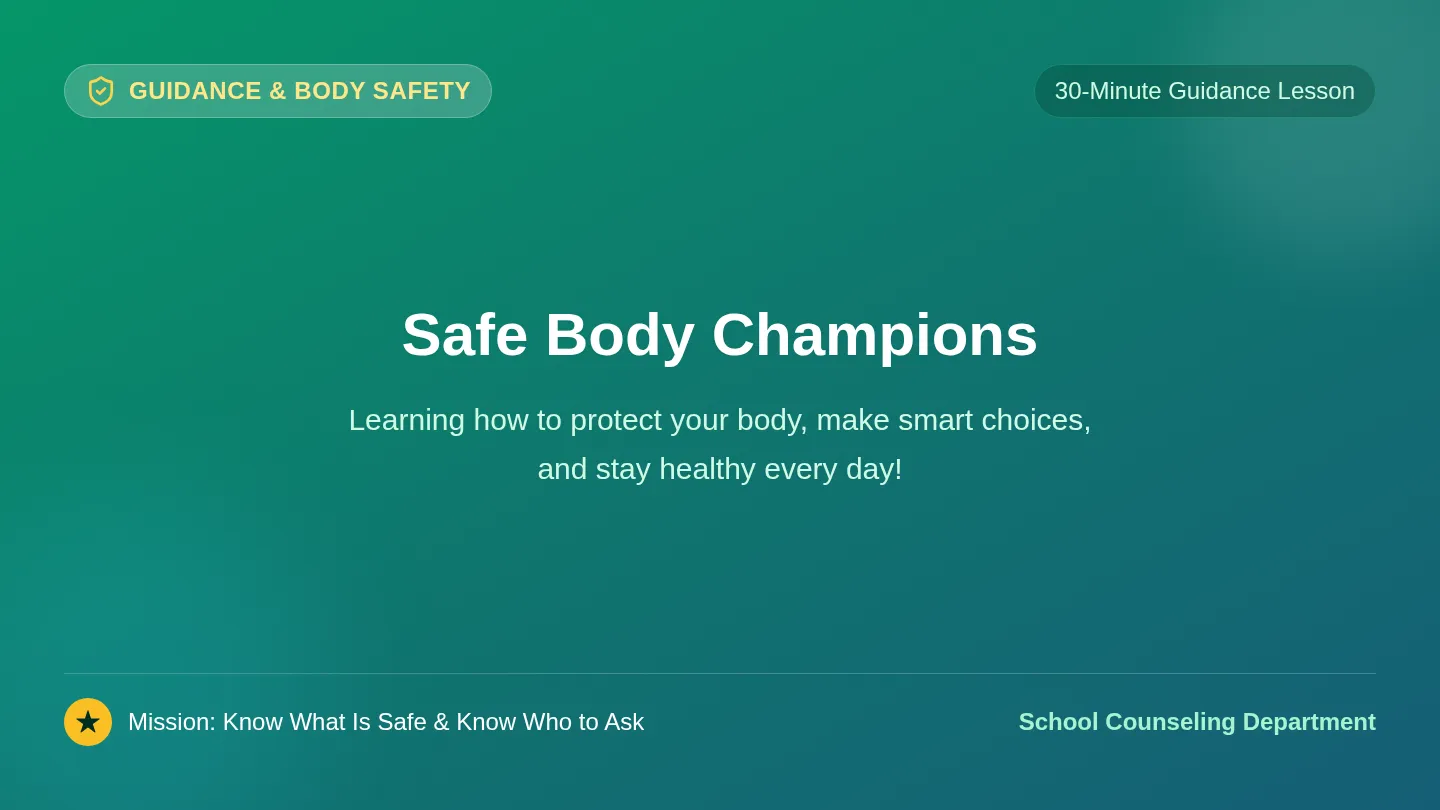
Sportsmanship Superpower Slides Be A Super Teammate!
Learning how to play fair and be kind!
Teacher Slide 1
Warm-Up: Sportsmanship Charades!
Let's act it out!
1
One person acts out a sportsmanship action.
2
Others guess if it's GOOD or BAD sportsmanship!
3
Guess what the action is!
What is Good Sportsmanship?
It's how we act when we play games or work with others.
It means being respectful, fair, and kind, no matter what happens!
Why is it important?
Makes games fun!
For everyone playing.
Shows respect!
To teammates and opponents.
Helps you learn!
From wins and losses.
Great Friend!
Makes you an awesome person!
Good Sportsmanship Looks Like...
Shaking hands with opponents
Cheering for your teammates
Saying "Good game!" even if you lose
Following the rules
Encouraging others
Happy for others when they win
Activity: Sportsmanship Sort!
Is it good sportsmanship or bad sportsmanship?
Work with your group to sort the actions into two piles!
Cool-Down: Thumbs Up, Thumbs Down!
GOOD
BAD
No talking! Just show me your thumb!
Good Sportsmanship Charades Guide Good Sportsmanship Charades
Warm-Up Activity Guide
How to Play
The teacher calls on one student at a time to act out a sportsmanship action from the list below. The rest of the class must guess the action and then decide if it shows GOOD or BAD sportsmanship.
Actions to Act Out:
Cheering for a teammate
Complaining about a call
Helping an opponent up
Throwing a game piece in frustration
Saying "Good game!"
Ignoring someone who needs help
Sharing equipment
"Ask: How does this action make others feel? Would it make the game more or less fun?"
Sportsmanship Superpower Script Teacher Script
Lesson 1: What is Good Sportsmanship?
Display Slide Deck throughout the lesson.
Warm-Up: Charades (Slide 2)
Say to students:
"Good morning, second graders! Today, we're going to talk about something super important that makes all our games and activities more fun: good sportsmanship! To get us started, let's play a quick game of charades. I'll act out some actions, and you guess what I'm doing and if it's good sportsmanship or bad sportsmanship. Ready?"
Lead activity for 3 minutes. Use the "Good Sportsmanship Charades" guide for actions.
Intro to Good Sportsmanship (Slides 3-5)
"Great job! You already have some fantastic ideas. So, what is good sportsmanship? (Pause for student responses). You got it! Good sportsmanship is how we act when we play games or work with others. It means being respectful, fair, and kind, no matter what happens in a game or activity."
"Think about it: have you ever played a game where someone was a really good sport? How did that make you feel? (Pause for responses). What about when someone was not such a good sport? How did that feel?"
"Good sportsmanship is important for so many reasons! It makes games fun for everyone . It shows respect to our teammates and even to the other team. It helps you learn from your wins and your losses, and it definitely makes you a great friend and a great person overall."
Sportsmanship Sort (Slide 6)
"Now it's your turn to be sportsmanship detectives! I'm going to give each group a set of cards with different actions on them. Your job is to sort them into two piles: 'Good Sportsmanship' or 'Bad Sportsmanship' . Talk with your group and decide together. We'll share our ideas in a few minutes."
Distribute cards. Circulate for 3-4 minutes, then facilitate a group discussion on 1-2 examples.
Thumbs Up, Down (Slide 7)
"You all did a fantastic job today thinking about good sportsmanship! For our cool-down, we're going to do 'Thumbs Up, Thumbs Down'. I'll read a situation, and you show me a thumbs up if it's good sportsmanship, and a thumbs down if it's bad sportsmanship. No talking, just show me your thumb!"
Read scenarios. Check for 100% participation and understanding.
"Excellent work today, everyone! Remember to practice being a super teammate and a good sport in everything you do!"
Sportsmanship Sort Activity Sportsmanship Sort
Team Activity Cards
Instructions: Cut out the action cards below. Work with your group to sort each action into one of two categories: Good Sportsmanship or Bad Sportsmanship.
Card 1
Complaining loudly when you lose.
Card 2
Shaking hands after a game.
Card 3
Cheering for a teammate who makes a mistake.
Card 4
Blaming others for a loss.
Card 5
Helping an opponent who falls down.
Card 6
Making fun of another team.
Card 7
Celebrating politely.
Card 8
Throwing a game controller.
Card 9
Saying "Good effort!" to everyone.
Card 10
Refusing to share equipment.
Practice being a Super Teammate!
Thumbs Up Thumbs Down Scenarios Thumbs Up, Thumbs Down
Cool-Down Scenarios
Teacher Instructions
Listen to each scenario below. Have students show a thumbs up 👍 if it shows good sportsmanship, and a thumbs down 👎 if it shows bad sportsmanship.
1
Your team loses a game, and you say, "Good game!" to the other team.
2
You miss a shot, and you throw your hands up in frustration.
3
Your friend makes a great play, and you high-five them.
4
Someone on the other team scores, and you boo them.
5
You accidentally trip someone, and you help them up and say sorry.
6
You always want to be the winner and get mad when you don't.
Winning and Losing Lesson Plan Winning and Losing Gracefully
Lesson Plan
SESSION 2
Objective
Students will learn strategies for handling wins and losses with respect and kindness.
Time
15 Minutes
Why This Matters
"Learning to win and lose gracefully helps students develop resilience, empathy, and a positive attitude towards competition. It reduces conflict and promotes a more supportive environment."
Prep (5 Mins)
Review the Winning and Losing Gracefully Slides .
Print the How Did You Feel? warm-up page.
Prepare Win or Lose Scenarios for group discussion.
Review the Winning and Losing Script .
Step-by-Step Instructions
3m
Warm-Up: How Did You Feel?
Ask students to recall a time they won or lost a game and how they felt. (Slide 2)
4m
Discuss Winning Gracefully
Discuss what it means to win gracefully. Focus on being humble and respectful. (Slides 3-4)
4m
Discuss Losing Gracefully
Discuss what it means to lose gracefully. Emphasize resilience and positive attitudes. (Slides 5-6)
3m
Activity: Win or Lose Scenarios
Groups discuss how a good sport would react to specific situations. (Slide 7)
1m
Cool-Down: One Word Reflection
Students share one word describing how they will act next time. (Slide 8)
Winning and Losing Slides Winning & Losing Like a Champion!
Being a super teammate, no matter what!
Warm-Up: How Did You Feel?
Think about it...
When you WON a game. How did you feel?
Think about it...
When you LOST a game. How did you feel?
Winning Gracefully
When you win, it feels great! But a good sport remembers:
Winning Gracefully Looks Like...
Shaking hands with opponents
Clapping for everyone
Saying, "You played really well!"
Being thankful for the game
Losing Gracefully
Sometimes we lose, and that's okay! A good sport knows:
Losing Gracefully Looks Like...
Shaking hands with the winners
Saying, "That was a fun game!"
Thinking about what to do better
Encouraging your teammates
Activity: Win or Lose Scenarios!
What would a good sport do? Discuss with your group!
Cool-Down
In one word, how will you try to act next time you win or lose?
How Did You Feel Warm Up How Did You Feel?
Warm-Up Journal
Name:
Date:
Think about a time you played a game. Answer the questions below to explore your feelings!
1
When you WON...
How did it feel? What did you do?
2
When you LOST...
How did it feel? What did you do?
Be ready to share your feelings with the class!
Winning and Losing Script Teacher Script
Lesson 2: Winning and Losing Gracefully
Display Slide Deck throughout the lesson.
Warm-Up: How Did You Feel? (Slide 2)
"Hi, everyone! Yesterday, we talked about what good sportsmanship is. Today, we're going to dive deeper into how we can be good sports, especially when we win and when we lose. Let's start with a warm-up!"
"Think about a game you played, maybe at recess or with your family. First, think about a time you won . How did that feel? What did you do after you won? (Allow a few students to share)."
"Now, think about a time you lost a game. How did that feel? What did you do when you lost? (Allow a few students to share)."
"It's okay to feel happy when you win and a little disappointed when you lose. Those are normal feelings! Today, we're going to learn how to handle those feelings and act like a super teammate, no matter the outcome."
Winning Gracefully (Slides 3-4)
"So, when you win, it feels awesome, right? But even when we win, good sportsmanship is important. Winning gracefully means celebrating your success without making others feel bad. It means being humble and respectful."
"Think about it: how does it feel when someone brags after they win? (Pause for responses). It doesn't feel very good, does it? So, we want to make sure we make everyone feel good, even when we're super excited about winning."
Losing Gracefully (Slides 5-6)
"Now, let's talk about losing. Losing can be tough, but a good sport knows how to lose gracefully. It means not getting angry or blaming others. It means not making excuses. Instead, it's a chance to learn from the game and try your best next time!"
"Remember, it's not about whether you win or lose; it's about how you play the game and how you treat others."
Activity: Win or Lose Scenarios (Slide 7)
"Now, let's put our good sportsmanship brains to work! I'm going to give you some scenarios, and in your small groups, I want you to discuss: What would a good sport do in this situation? How would they act if they won, or if they lost?"
Distribute scenario pages. Give groups 2-3 minutes to discuss.
Cool-Down: One Word Reflection (Slide 8)
"To wrap up, I want everyone to think of one word that describes how you will try to act next time you win or lose a game. It could be 'kind,' 'fair,' 'resilient,' 'calm.' Think of your word and be ready to share it!"
Win or Lose Scenarios Activity Win or Lose Scenarios
Instructions: Read each scenario with your group. Discuss what a GOOD SPORT would do in each situation, whether they win or lose.
Scenario 1: The Board Game Blowout
"Your team is playing a board game, and you are winning by a lot! The other team looks a little sad."
What does a good sport do?
Scenario 2: The Close Race
"You are running a race at recess, and you almost win, but your friend crosses the finish line just before you do."
What does a good sport do?
Scenario 3: The Untied Score
"Your class is playing a team game, and the other team scores the winning point in the last second. Your team loses."
What does a good sport do?
Scenario 4: The Perfect Pitch
"You are playing catch, and you throw the ball perfectly to your teammate, helping them get a point. They are very excited!"
What does a good sport do?
Scenario 5: The Missed Goal
"Your team is playing soccer, and you have a chance to score, but you accidentally kick the ball in the wrong direction."
What does a good sport do?
One Word Reflection Cool Down One Word Reflection
Cool-Down Activity
Think about today's lesson. In ONE WORD , how will you try to act next time you win or lose a game?
My Word Is:
Why did you choose this word?
Champion Communication Lesson Plan Communicating Like a Champion
Lesson Plan
SESSION 3
Objective
Students will learn to use positive and clear communication with teammates and opponents during games.
Time
15 Minutes
Why This Matters
"Effective communication fosters teamwork, prevents misunderstandings, and builds a more positive and inclusive environment for everyone."
Prep (5 Mins)
Review the Communicating Like a Champion Slides .
Prepare instructions for the Silent Challenge .
Print/prepare the Say This, Not That prompts.
Review the Communication Champion Script .
Step-by-Step Instructions
3m
Warm-Up: Silent Challenge
Students try to complete a simple task without speaking. (Slide 2)
4m
Introduction to Communication
Define clear and kind communication. Discuss why talking effectively is important. (Slides 3-4)
4m
Positive vs. Negative Communication
Distinguish between positive and negative communication with examples. (Slides 5-6)
3m
Activity: Say This, Not That
Rephrase negative statements into positive communication. (Slide 7)
1m
Cool-Down: Communication Check-In
Name one way they can communicate better next time. (Slide 8)
Champion Communication Slides Communicating Like a Champion!
Using our words to be super teammates!
Warm-Up: Silent Challenge!
Can you work together without using words?
What is Communication?
It's how we share our ideas and feelings with others using our words, faces, and bodies.
Why is it Important?
Everyone Understands!
Helps everyone know the plan.
Stronger Teamwork!
Working together is easier.
Prevents Arguments!
Solving problems with words.
Fair and Fun!
Keeps the game going.
Positive Communication
Clear, kind, and helpful words!
"Great pass!"
"I need help!"
"Let's try again!"
"Good try!"
Negative Communication
Words that hurt teamwork!
"You're bad at this!"
"It's your fault we lost!"
"I hate this game!"
Say This, Not That!
Let's turn grumpy words into helpful words!
Cool-Down
What's one way you can communicate BETTER in your next game?
Silent Challenge Warm Up Silent Challenge
Teacher Guide
Give students a simple task to complete in small groups. The Catch: They must complete it without speaking any words!
Choose one task:
Organize pencils from shortest to longest.
Line up in order of birthdays (month/day).
Arrange yourselves to spell out "FUN".
Question 1
Was it easy or hard?
Question 2
Why was it difficult?
Question 3
How did you feel?
Communication is a team superpower!
Champion Communication Script Teacher Script
Lesson 3: Communicating Like a Champion
Display Slide Deck throughout the lesson.
Warm-Up: Silent Challenge (Slide 2)
"Good morning, everyone! Today, we're going to talk about how we use our words to be super teammates and good sports. To start, let's try a 'Silent Challenge'!"
"I'm going to give each table a simple task, and your mission is to complete it without saying a single word . You can use gestures, pointing, or facial expressions, but no talking! Let's see how you do!"
Give groups a task (e.g., organize pencils). Allow 1-2 mins.
"Alright, stop! How did that feel? Was it easy or hard? Why was it hard?"
Introduction to Communication (Slides 3-4)
"So, what is communication? It's how we share our ideas and feelings. When we play games, good communication is like a superpower!"
"It helps everyone understand. It makes teamwork stronger. It prevents arguments. And most importantly, it keeps games fair and fun!"
Positive vs. Negative (Slides 5-6)
"We want to be champions of positive communication ! These are clear, kind, and helpful words. Instead of just running for the ball, you could say, 'I'm open!' or 'Pass it here!'"
"But sometimes, we might use negative communication. Words like 'You're bad at this!' or 'It's your fault!' make people want to stop playing. We don't want that!"
Activity: Say This, Not That (Slide 7)
"Now it's time to practice being communication champions! I'm going to give you some 'grumpy' or 'unhelpful' things someone might say. In your groups, your job is to change it into something a super teammate would say."
Distribute activity pages. Allow 3 mins to discuss.
Say This Not That Activity Say This, Not That!
Communication Training
NOT THAT:
"You always mess up!"
SAY THIS INSTEAD:
NOT THAT:
"Give me the ball! I'm better!"
SAY THIS INSTEAD:
NOT THAT:
"This game is stupid!"
SAY THIS INSTEAD:
NOT THAT:
"It's your fault!"
SAY THIS INSTEAD:
NOT THAT:
(Saying nothing, just trying to take their turn)
SAY THIS INSTEAD:
Communication Check In Cool Down Communication Check-In
Goal Setting
My Communication Goal
Think about one way you can communicate BETTER in your next game or activity. Write it down below:
Why this helps
How will this goal help you be a SUPER TEAMMATE ?
"Your words have power!"
Supportive Teammate Lesson Plan Being a Supportive Teammate
Lesson Plan
SESSION 4
Objective
Students will understand the importance of supporting their teammates and actively practice offering encouragement.
Time
15 Minutes
Why This Matters
"Encouraging and supporting teammates builds a stronger, more positive team environment, boosts confidence, and helps everyone feel valued."
Prep (5 Mins)
Review the Supportive Teammate Slides .
Prepare Pass the Praise warm-up prompts.
Have small slips of paper/cards for Encouragement Cards .
Review the Supportive Teammate Script .
Step-by-Step Instructions
3m
Warm-Up: Pass the Praise
Students quickly give compliments or encouragement to a neighbor. (Slide 2)
4m
Introduction to Team Support
Discuss what being supportive means: helping, cheering, and encouraging. (Slides 3-4)
4m
Why Support Matters
Explain the benefits: confidence, fun, and stronger teams. (Slides 5-6)
3m
Activity: Encouragement Cards
Students write or draw a message for a classmate. (Slide 7)
1m
Cool-Down: My Supportive Action
Think of one specific supportive action to take today. (Slide 8)
Supportive Teammate Slides Teamwork Makes the Dream Work!
Helping and cheering for our friends!
Warm-Up: Pass the Praise!
Quickly give a compliment or a word of encouragement to a classmate next to you!
What's a Supportive Teammate?
Someone who helps, encourages, and cheers for others on their team, no matter what!
Why is it Important?
Builds Confidence!
Uplifts everyone.
More Fun!
And less scary.
Strong Team!
Working together is easier.
Shows Care!
About your friends.
Support Looks Like...
Saying "Good try!" when someone makes a mistake.
Helping a friend understand the rules.
Clapping when a teammate does well.
Sharing the ball or equipment.
Your Words Have Power!
Imagine your friend is feeling down after a mistake. What could you say to make them feel better?
"You've Got This!"
"Nice Try!"
Activity: Encouragement Cards!
Write or draw a message to encourage a classmate!
Cool-Down
What's one way you will SUPPORT a teammate today?
Pass the Praise Warm Up Pass the Praise
Teacher Instructions
Everyone will quickly give a compliment or a word of encouragement to a classmate sitting next to them. Make sure it is specific and kind !
Example starters:
"I like how you always share your crayons!"
"You did a great job helping me with that math problem!"
"You have such a creative idea for drawing!"
"How did it feel to give praise? How did it feel to receive it?"
Supportive Teammate Script Teacher Script
Lesson 4: Being a Supportive Teammate
Display Slide Deck throughout the lesson.
Warm-Up: Pass the Praise (Slide 2)
"Good morning, future champions! Today, we're going to focus on an amazing part of sportsmanship: being a supportive teammate! It means helping and cheering for our friends!"
"To get us started, let's do a quick 'Pass the Praise' warm-up. Everyone, turn to the person next to you and quickly give them a kind compliment. Make it specific and genuine!"
What's a Supportive Teammate? (Slides 3-4)
"A supportive teammate helps, encourages, and cheers for others on their team, no matter what! It's about being a friend and a helper."
"Being supportive builds confidence. If someone makes a mistake, and you say, 'Good try! You'll get it next time!' it helps them feel better and want to keep trying."
Why Support Matters (Slides 5-6)
"Your words have so much power! Imagine your friend is feeling down after a mistake. If you say, 'Don't worry, we all make mistakes! You've got this!' how will that change things? It lifts them up!"
Activity: Encouragement Cards (Slide 7)
"Now, you're going to get a chance to be super encouragers! Write or draw a message of encouragement for a classmate. Think about something specific you like about them as a teammate or a friend."
Distribute index cards or slips. Read a few aloud after 3 mins.
Encouragement Cards Activity Encouragement Card
My Message:
To:
From:
Encouragement Card
My Message:
To:
From:
Cut cards out along the bold lines. Give them to a classmate to brighten their day!
My Supportive Action Cool Down My Supportive Action
Daily Challenge
What is ONE SPECIFIC WAY you will try to support a teammate or friend today?
How do you think this will make them feel?
Fair Play Lesson Plan Fair Play and Following Rules
Lesson Plan
SESSION 5
Objective
Students will understand the importance of following rules and playing fairly in all games and activities.
Time
15 Minutes
Why This Matters
"Fair play and rule-following ensure that games are safe, enjoyable, and equitable for everyone. It teaches integrity and respect."
Prep (5 Mins)
Review the Fair Play Slides .
Prepare prompts for Rules, Rules, Rules! warm-up.
Prepare chart paper for the Classroom Game Rules activity.
Review the Fair Play Script .
Step-by-Step Instructions
3m
Warm-Up: Rules, Rules, Rules!
Ask students about rules in favorite games and why they are important. (Slide 2)
4m
Introduction to Fair Play
Define fair play and discuss why rules are essential for every game. (Slides 3-4)
4m
Consequences of Not Following Rules
Discuss what happens when rules aren't followed and the importance of honesty. (Slides 5-6)
3m
Activity: Our Classroom Game Rules
As a class, create rules for a hypothetical game, emphasizing fairness. (Slide 7)
1m
Cool-Down: Fair Play Pledge
Students make a personal pledge to always play fairly. (Slide 8)
Fair Play Slides Final Playing by the Rules!
Being a super teammate means playing fair!
Rules, Rules, Rules!
What are the rules of your favorite game?
Why do we need them?
What is Fair Play?
Playing fairly means everyone follows the rules so the game is fun and honest for ALL players!
Why Do We Need Rules?
Keeps Everyone Safe!
Makes Games Fair!
Know what to do!
Prevents Arguments!
What Happens Without Rules?
Imagine playing a game where some people cheat...
It's not fair!
It's not fun!
Someone might get hurt!
People get angry or quit!
Honesty is Key!
Being honest, even when no one is watching.
Don't Cheat
Call your fouls
Be Truthful
Activity: Our Classroom Game Rules!
Let's create some fair rules for a new classroom game!
Cool-Down: Fair Play Pledge!
"I promise to always play fairly and follow the rules."
Rules Warm Up Activity Rules, Rules, Rules!
1
Think about your favorite game to play. What are 2-3 important rules of that game?
2
Why do we need those rules? What would happen if there were no rules?
"Be ready to share your ideas with the class!"
Fair Play Script Teacher Script
Lesson 5: Fair Play and Following Rules
Display Slide Deck throughout the lesson.
Warm-Up: Rules, Rules, Rules! (Slide 2)
"Good morning, everyone! We've learned so much about being a super teammate this week. Today, we're going to wrap up our series by talking about something super important for every game: fair play and following rules!"
"Let's start by thinking about your favorite game. What are 2 or 3 important rules for that game? (Allow students to share.) Why do we need those rules?"
Introduction to Fair Play (Slides 3-4)
"Fair play means everyone follows the rules so the game is fun and honest for ALL players! It's like a promise we all make to each other. It keeps everyone safe, it makes games truly fair, and it helps everyone know what to do."
Honesty and Consequences (Slides 5-6)
"Fair play also means being honest, even when no one is watching. If you accidentally step out of bounds, a good sport might call out their own mistake. Honesty is a huge part of being a good sport!"
Activity: Classroom Game Rules (Slide 7)
"We're going to invent a super simple classroom game right now. But before we play, we need to create some fair rules for it. As a class, let's come up with a name and two or three simple rules."
Facilitate discussion. Write rules on chart paper or the board.
Cool-Down: Fair Play Pledge (Slide 8)
"You all have become sportsmanship experts! SILENTLY make a personal pledge in your mind. Show me a big thumbs up if you promise to always be a fair player and follow the rules!"
Classroom Game Rules Activity Our Classroom Game Rules
Activity Template
Our New Game Name:
Our Fair Play Rules:
1
2
3
Why are these rules important? Fair Play Pledge Cool Down Final Fair Play Pledge
I, (Superhero Name)
...pledge to always try my best to play fairly and follow the rules in every game and activity.
I will also try to:
Be honest (even when no one is watching).
Respect the rules (even if I don't like them).
Help others understand the rules.
My Super Signature:
Hero Date: