Mirroring Moves Slides Mirroring Moves
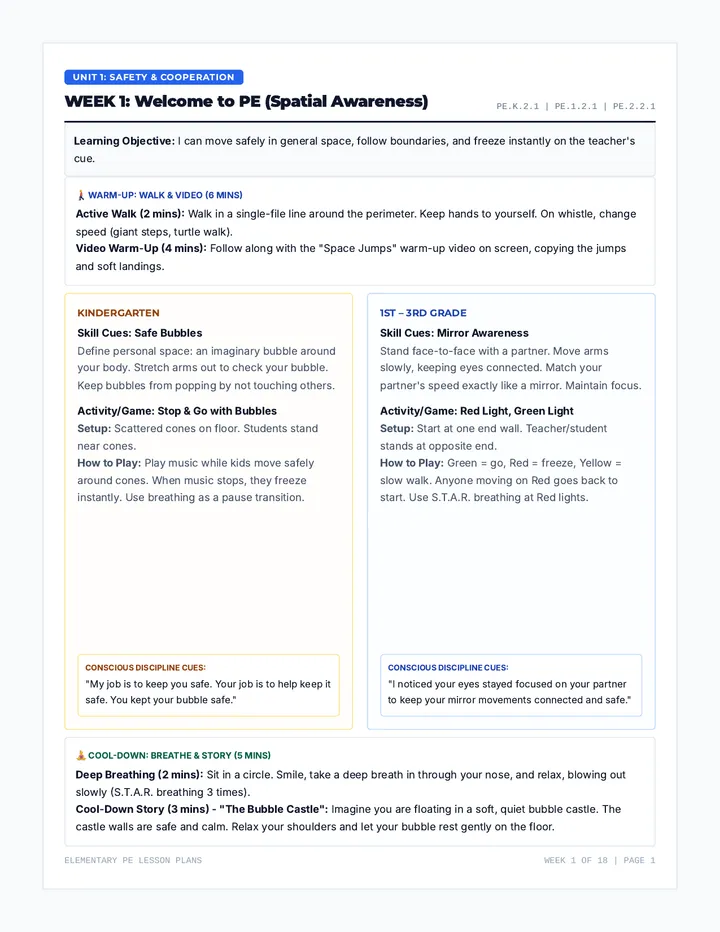
Can you do exactly what I do?
Magic Mirror!
ME
YOU
I am looking in a mirror, but the mirror is YOU !
Can you do exactly what I do?
How to Mirror
Watch Closely
Use your "detective eyes" to see every move.
Copy Exactly
Try to move at the same time and same way!
Let's Try It!
WAVE
BIG SMILE
WIGGLE
Follow the leader...
Mirror Master Teacher Guide Mirror Master
Teacher Facilitation Guide | Lesson 1
Choreography 101
Learning Goal
Students will develop observation skills and movement control by exactly replicating the physical actions of a leader. This builds the foundational skill of reproducing movement phrases .
The Hook
"I am looking in a mirror, but the mirror is YOU! Can you do exactly what I do? If I scratch my nose, the mirror scratches its nose. If I wiggle my toes, the mirror wiggles its toes!"
Materials
Mirroring Moves Slides
Open floor space
Handheld mirror (optional prop)
Workshop Flow
1
The Face-Off (5 mins)
Start with facial expressions and small hand movements while seated in a circle. This focuses their attention on details.
Puff out cheeks
Touch ears
Big blink / Small blink
2
Whole Body Reflection (10 mins)
Transition to standing. Move slowly! The key to mirroring for Pre-K is slow, deliberate movement .
Tip: Avoid jumping or spinning initially. Focus on arms, weight shifts, and levels (high/low).
3
Peer Pairs (10 mins)
Assign partners. One is the 'Mover' and one is the 'Mirror'. Use a bell or music cue to swap roles. Circulate to ensure students are moving slowly enough for their partner to follow.
Look & Listen For...
Successful Mirroring
Matching the speed of the leader.
Maintaining eye contact or visual tracking.
Copying the shape of the movement accurately.
Questions to Ask
"What part of your body did I move first?"
"Was that a fast move or a slow move?"
"How did you know when I was going to stop?"
Mirror Me Coloring Sheet Mirror Me!
Color the move you liked best today.
Name:
Date:
We learned to copy moves exactly! Which one was your favorite?
The Wave
Reach High
Kitty Wiggle
My Own Move
Draw a circle around your favorite one!
Repeating Rhythms Slides Steady Repeat Beats
Doing the same move again... and again... and again!
The Broken Record
Let's see if we can get our bodies to act like a broken record that repeats the same move over and over!
The Heartbeat of Dance
BEAT
REPEAT
One move for every beat. Thump, Thump, Thump!
Repeat Challenge!
Clap
Stamp
Jump
Steady Beat Teacher Guide Steady Beat Guide
Rhythmic Repetition | Lesson 2
Core Concept
Repetition is the foundation of choreography. By isolating a single movement and repeating it in time with a beat, students learn to maintain a consistent physical rhythm.
The Goal
"Can you keep your body moving like a ticking clock? One move, every tick."
Teacher Toolkit
Metronome or Drum
Steady 4/4 Music
Activity Cards
Activity Sequence
1
The Heartbeat (Body Percussion)
Have students feel their pulse or tap their chest to a slow drum beat. Connect the physical sensation of a heartbeat to the concept of a "steady beat."
2
The "One-Move" Loop
Show an activity card (e.g., CLAP). Use a drum beat. Start slow: Clap... (wait)... Clap... (wait). Speed up gradually. Challenge: "Don't let your clap be late!"
3
Broken Record Freeze
Play music. Students repeat their move. When the music stops, they must freeze mid-move. This tests their motor control and timing.
Simpler (Support)
Focus only on seated movements (clapping, tapping knees). Use a very slow tempo (60 BPM).
Challenging (Extend)
Incorporate a 180-degree turn with the move, or change levels (High Clap, Low Clap) while maintaining the beat.
Repeat the Beat Activity Cards Repeat Cards
Cut these out for movement practice!
CLAP
STOMP
WIGGLE
JUMP
Teacher: Hold these up as visual cues during the "Broken Record" activity.
Movement Sandwich Slides Movement Sandwich
Bread, Cheese, Bread, Cheese... A-B-A-B!
MOVE A
MOVE B
What is a Pattern?
A pattern is a secret rule for what comes next!
A
B
A
B
?
What comes next?
The Pattern Game
CLAP (A)
STOMP (B)
Pattern: Clap Stomp Clap Stomp
Let's Build It!
Pick two moves.
Make a sandwich!
Layer 1
Layer 2
Layer 3
Pattern Builder Teacher Guide Pattern Builder
Building A-B Patterns | Lesson 3
A-B-A-B
Cognitive Shift
Students move from simple repetition to alternating sequences . This requires movement memory and the ability to anticipate the "next" move in a series.
The Hook
"We are going to make a movement sandwich: bread, cheese, bread, cheese. Bread is our first move, and cheese is our second. What happens if we put two breads together? The sandwich breaks! We must alternate!"
Sequence Skills
Pattern recognition
Sequential memory
Anticipatory moving
The "Sandwich" Method
1
Visual Setup
Lay two different colored scarves or spots on the floor (Red, Blue, Red, Blue). Walk through the pattern: "Red move, Blue move, Red move, Blue move."
2
Layering the Sandwich
Assign a movement to each color. Red = Jump, Blue = Clap. Perform together as a class. "Jump... Clap... Jump... Clap..."
3
The "Missing Layer" Challenge
Perform the pattern but stop before the last move. Ask: "What layer is missing from our sandwich?" Students must perform the correct move to finish the sequence.
Success Indicators
• Can identifying the 'A' and 'B' moves
• Transitioning smoothly between different moves
• Maintaining the alternating rhythm
Movement Pattern Worksheet Pattern Maker
Finish the movement sandwich!
Artist:
Look at the patterns. Draw or color the move that comes next!
Pattern #1: Hands & Feet
Clap
Stomp
Clap
?
Pattern #2: High & Low
Reach
Crouch
Reach
?
Design Your Own Pattern!
A
B
A
B
Color them in to make your sandwich!
Dance Code Slides The Dance Code
Can you remember a secret 3-step sequence?
1
2
3
Secret Code #1
SPIN
JUMP
POSE
Repeat after me: Spin, Jump, Pose!
Memory Challenge
"I can remember 3 moves in a row!"
Build Your Code
1
First Move
2
Second Move
3
Third Move
Secret Code Teacher Guide Secret Code Master
Three-Step Sequences | Lesson 4
The Challenge
Transitioning from A-B patterns (alternating 2 moves) to a linear sequence of 3 different moves. This builds complex movement memory and sequential thinking.
The Hook
"Can you remember a secret code made of three dance moves? If you get one wrong, the 'vault' won't open! Let's practice our secret codes."
Vocabulary
First
Number 1
Middle
Number 2
Last
Number 3
Sequence Workshop
1
The Teacher's Code
Demonstrate a 3-step code: Wiggle -> Spin -> Sit . Use a drum beat for each move. Repeat it 3 times together. Then, stop performing and see if they can do it by themselves.
2
Code Breakers
Have a student come up and "invent" a code of 3 moves. The rest of the class are "Code Breakers" who must watch and repeat it exactly.
Common Stumbling Blocks
Mixing up the middle and end:
Remind them: "Number 2 is in the middle, Number 3 is the big finish!"
Moving too fast:
Use a "Pause" hand signal between each move to help them separate the three steps.
My Dance Code Journal My Dance Code
Confidential Studio Notes
Draw your 3-move code!
1
First
2
Middle
3
Last
Choreographer:
Date:
Teacher Check:
Loop De Loop Slides Loop De Loop
Doing our dance over... and over... and over!
1
2
3
What is a Loop?
START
AGAIN!
When we finish our 3 moves, we don't stop! We go back to Move #1 and start again.
The 3-Loop Rule
1
First Time
2
Second Time
3
Final Time!
STAMINA! FOCUS! DANCE!
Showtime!
Perform your secret code 3 times in a row without stopping.
Wait for the beat...
GO!
Motif Master Teacher Guide Motif Master
Performance & Looping | Lesson 5
Final Mastery
The culmination of the sequence. Students integrate rhythm, sequencing, and memory to perform a motif (a repeatable movement phrase) three times in a row.
The Hook
"Now that we know our dance code, let's see if we can do it three times without stopping! It's like a roller coaster that goes loop-de-loop!"
Performance Pillars
Stamina
Focus
Rhythm
The Performance Workshop
1
Recall & Review
Students open their "Dance Code Journals" from Lesson 4. Give them 2 minutes to practice their individual 3-step sequence quietly at their spot.
2
The 3-Loop Practice
Teach the "reset" position (hands on knees or pose). Perform the class code from Lesson 4, but add a 2-count pause between each loop. Gradually remove the pause.
3
Mini-Showcase
Split the class in half. One half sits and watches (the audience), the other half performs their 3-loop sequence. Swap. Focus on "finishing strong" after the third loop.
Performance Observation
Mastery Look-Fors
• Restarts exactly at Move 1 after Move 3
• Maintains movement quality for all 3 loops
• Stops after the 3rd loop (didn't lose count)
Discussion Prompts
• "How did you know when you were finished?"
• "Which loop was the easiest to remember?"
• "What did your body feel like after 3 loops?"
Performance Loop Checklist Looping Legend
Performance Checklist
Dancer:
Did I do my 3 loops?
1
Loop One
2
Loop Two
3
Loop Three
How did your body feel?
Happy
Fast
Tired