Shield Tactics Slides
Shield Tactics
Session 1.1: Refusal Skills
Interactive Presentation
Master the Art of Saying No
Equipping yourself with biological, social, and tactical frameworks to navigate peer pressure like an absolute pro.
Activity Alert: Get your Guided Notes ready!
Slide 1 of 6
Section 1: The Social Environment
The Pressure Spectrum
Spoken Pressure
Direct verbal statements designed to influence your choices instantly.
- • Rejection: "If you don't do this, you can't hang out."
- • Put-downs: "Don't be a baby, everyone does it."
- • Reasoning: "Vaping is just flavored water anyway."
Unspoken Pressure
Subtle cues or social dynamics where nobody says anything directly.
- • The Crowd: Seeing an entire group participating.
- • Social Media: Curated posts glorifying behaviors.
- • Isolation: Feeling left out if you choose differently.
💡 Fact: Over 80% of teenage peer pressure is unspoken social mimicking!
Slide 2 of 6
Section 2: Tactical Defense
The 5 Refusal Shields
Deploying Your Social Defense System
Having a structured toolkit means you never have to scramble for words in high-pressure situations.
1
Direct No
Simple, honest, and firm refusal.
2
The Out
A bulletproof external excuse.
3
The Pivot
Propose a different activity.
4
Reverse
Flip pressure back on them.
5
The Exit
Safely leave the environment.
📝 Notes Check: Write down all five shield names on your guide sheet.
Slide 3 of 6
Section 2: Tactical Defense
Tactics In Action
Shield 1: Direct No
Clear & unapologetic. Best when you want absolute certainty.
"No thanks, I don't drink/vape."
Shield 2: The Out
Shift blame to an external force (parents, sports, jobs).
"My coach does drug tests tomorrow."
Shield 3: The Pivot
Changes the subject by offering a better option.
"Nah, let's play video games instead."
Shield 4: Reverse
Puts pressure back onto the person asking.
"Why are you so worried about what I do?"
Shield 5: The Exit
Physical withdrawal when pressure escalates.
"I've got to run, my ride is here."
💡 Pro-Tip: Practice saying these aloud so they feel natural in the moment.
Slide 4 of 6
Section 3: Field Simulation
Deploy the Shield
Scenario #1: Tyler's Garage Hangout
"You're in Tyler's garage. Someone pulls out a vape or container and says, 'Everyone is doing it tonight, don't be boring.' Everyone turns and looks directly at you."
The Context: Tyler is your good friend, but two of the other people are seniors whom you don't know well.
Your Challenge
Pick two different Shields to handle this pressure. Write down your custom script on your guide sheet.
✓ Practice script A
✓ Practice script B
👥 Partner Work: Share your responses with your neighbor. Do they sound realistic?
Slide 5 of 6
Section 4: Integration
Reflect & Debrief
Why "The Out"?
Why does shifting the blame to an external rule or parent make it much easier for peers to accept your "No"?
Flip the Script
How does asking "Why do you care so much if I participate?" defuse the social dynamic of pressure?
True Connection
What is the primary indicator that a friend is a "healthy presence" rather than a pressuring presence?
🛡️ You have successfully programmed your defense framework!
Slide 6 of 6
Shield Tactics Notes
Active Learning Guide
SHIELD TACTICS
LESSON 1.1
Refusal Skills & Peer Pressure
Student Name:
Class Period:
Date:
1 Part I: Understanding the Pressure Spectrum
Peer pressure is the social that influences us to act, think, or feel in a certain way to align with others.
Spoken Pressure
- Rejection: "If you don't do this, you can't with us."
- Put-downs: "Don't be a , everyone is trying it."
- Reasoning: Giving a scientifically incorrect for doing something.
Unspoken Pressure
- The Crowd: Simply seeing an entire group in a behavior.
- Social Media: Curated feeds that risky actions.
- Isolation: The internal fear of being out if you say no.
2 Part II: The 5 Refusal Shields
Fill in the name and description of each tactical shield as presented by your teacher.
SHIELD 1
Name:
Definition: A clean, firm and straightforward .
SHIELD 2
Name:
Definition: Shifting blame to an boundary (parents, coach, rules).
SHIELD 3
Name:
Definition: Proposing an activity to change the subject.
SHIELD 4
Name:
Definition: Turning the social back onto the pressurer.
SHIELD 5
Name:
Definition: Safely and physically from the environment.
Shield Tactics Lesson Handout Page 1 of 2
Shield Application & Reflection
Phase 2
Part III: Scenario Challenge
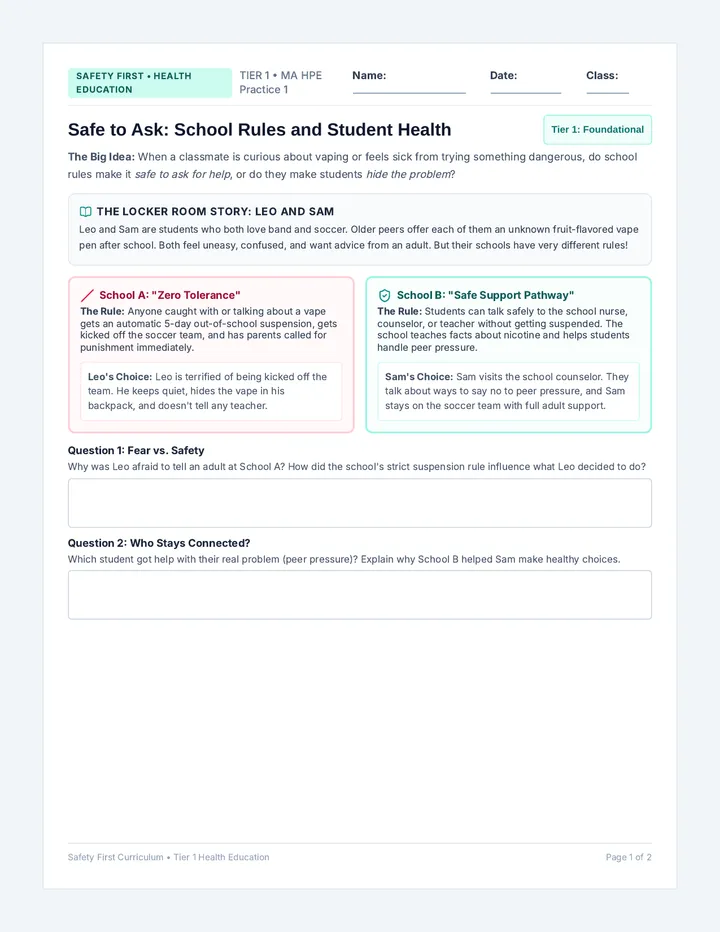
Situation: You are hanging out in your friend Tyler's garage. Someone you do not know well pulls out a vape, passes it around, and looks directly at you, saying, "Everyone's doing it tonight, don't be boring." All eyes are on you.
Select two different Shields you learned on Page 1. Write the Shield Name, and write out exactly what you would say in this realistic dialogue exchange.
Strategy Choice A:
Your Exact Script:
Strategy Choice B:
Your Exact Script:
Part IV: Personal Integration
1. Why is shifting the blame to an external boundary (like parents or a sports team) highly effective in preventing social conflict?
Shield Tactics Teacher Guide
Teacher Support Document
TEACHER GUIDE
SHIELD TACTICS
Pacing & Answer Key
Instructional Overview
This lesson equips students with proactive mental and verbal templates ("Shields") to decline substances and social pressure without damaging friendships. By mastering multiple refusal pathways, students gain practical agency in high-stress social situations.
Suggested Lesson Pacing (45 Minutes)
5 Min Hook & Slide 1
15 Min Presentation (Slides 2-4)
15 Min Activity (Slide 5)
10 Min Debrief (Slide 6)
Guided Notes Answer Key
Part I: The Pressure Spectrum
• Peer pressure definition blank: influence (or pressure)
• Spoken pressure blanks: 1. hang out | 2. baby | 3. excuse (or argument/reason)
• Unspoken pressure blanks: 1. participating (or engaging) | 2. glorify (or showcase) | 3. left out
Part II: The 5 Refusal Shields
- Shield 1 Name: Direct No. Blank: refusal
- Shield 2 Name: The Out. Blank: external
- Shield 3 Name: The Pivot / Alternative. Blank: alternative
- Shield 4 Name: Reverse Pressure. Blank: focus/spotlight
- Shield 5 Name: The Exit / Safe Move. Blank: withdrawing/leaving
Evaluation & Facilitation Tips
Key Criteria: Look for scripts that sound natural. Stiff, formal language often fails in real life. Emphasize body language (firm posture, looking eye-to-eye) during roleplay execution.
Common Student Pitfalls:
Being overly aggressive (triggers escalation) or overly apologetic (indicates weakness/indecision).
Best Practice Coaching:
Encourage students to practice with physical head shaking and normal tone. Shifting blame to strict parents is the easiest shield.
Shield Tactics Instructor Support Guide Page 1 of 1