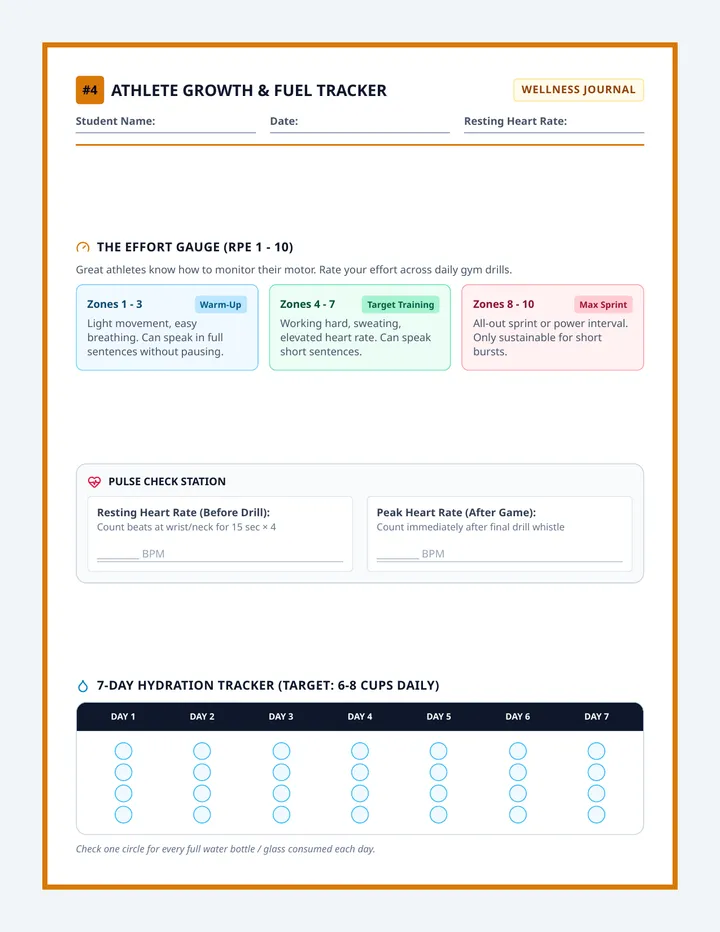
An investigative nutrition and energy balance lesson for 7th and 8th graders examining how macronutrients power adolescent growth, sports exertion, and cognitive focus. Students decode nutrition facts labels, evaluate snack trade-offs, and engineer customized daily fueling plates.
• Physiological Effect: Sustained glucose delivery, active muscle repair, sharp alertness through 5:00 PM.
Question: What fuels your afternoon practice or study session? You are the biochemical engineer!
Project Blueprint
The Teen Performance Plate
50% PLATE
Color & Fiber
Dark leafy greens, berries, carrots, bell peppers. Packed with antioxidants to reduce athletic inflammation and regulate digestion.
25% PLATE
Smart Carbs
Brown rice, quinoa, sweet potatoes, whole grain pasta. Fills the glycogen fuel tank without triggering insulin crashes.
25% PLATE
Lean Protein
Eggs, poultry, fish, beans, tofu. Provides essential amino acids for growth spurts and muscle recovery.
Hydration: Half your body weight in ounces of water daily! Mission: Launch Your Fuel Blueprint!
Total Calories (kcal)
Total Added Sugar (g)
Sugar in Teaspoons
(Formula: Total Sugar Grams ÷ 4)
Fiber & Protein Total (g)
Investigation Phase: Label Forensic Audit Page 1 of 2
Part 2: Biochemical Analysis & Performance Impact
Adolescent Energy Modeling
1. The Serving Size Trap: Why is listing 2.5 servings on Snack A deceptive to a hungry middle schooler? Calculate the total calories and sodium actually consumed if the entire bag is eaten during a 10-minute passing period.
2. Teaspoon Sugar Reality: The American Heart Association recommends that adolescents consume no more than 6 teaspoons (24g) of added sugar per day. How does one full can of Snack C compare to this daily threshold? What happens to excess sugar in the liver?
3. The 3:00 PM Athletic & Academic Prediction: Compare what happens inside the body of a student who consumes Snack A versus Snack B at 1:30 PM. Explain their energy, focus, and physical endurance during 3:00 PM soccer tryouts or a math exam. (Use the terms: glycemic spike, insulin, sustained glycogen, and fiber/protein digestion).
4. The Smart Fuel Swap Challenge: Choose an ultra-processed snack you or your classmates commonly eat at school. Engineer a high-performance alternative that provides equal convenience but delivers sustained physical and mental power.
Current Ultra-Processed Snack
Name snack, package calories, and primary crash risk:
High-Performance Fuel Swap
Name replacement, dominant macronutrients, and benefit:
Key Check: Did you explain the role of dietary fiber and protein in steadying blood sugar? Lab Complete • Submit to Teacher
Step 4: Metabolic Justification: Explain how your 24-hour plan prevents the notorious afternoon crash and directly supports adolescent growth spurts (hormones, bone remodeling, muscle recovery).
Project Grading Rubric (For Teacher Use)
Plate Balance (25%) Strictly adheres to 50% fiber/color, 25% complex carbs, and 25% lean protein proportions.
Nutrient Timing (25%) Pre-training fuel provides fast glycogen; post-workout and dinner optimize amino acid recovery.