Energy Engine Teacher Guide Energy Engine
Lesson 1: Sprinting vs. Pacing
TRACK & FIELD UNIT
GRADE 4
Learning Objectives
Identify the physical sensations of sprinting (anaerobic) vs. pacing (aerobic).
Define pacing as energy conservation over time.
Monitor heart rate changes between high-intensity and steady-state exercise.
The Hook: "Sprint for 5?"
"Can you sprint at your absolute maximum speed for five whole minutes? We're going to try running at different speeds to see how our bodies react and find our 'Forever Pace'."
Activity Flow
01
The Burst (50m Sprint)
Students run 50 meters as fast as possible. Immediately stop and check: How do your legs feel? How fast is your breath? (High Intensity/Anaerobic)
02
The Cruise (400m Jog)
Students run one full lap (or 3 minutes) at a 'conversation pace.' Check again: Can you talk while running? How is your energy holding up? (Pacing/Aerobic)
03
Heart Rate Lab
Use the Heart Rate Tracker worksheet to compare pulses after both activities. Discuss why we can't sprint forever.
Vocabulary
SPRINT:
Short distance, maximum speed, uses energy quickly.
PACE:
The steady speed you choose to manage energy over a long distance.
AEROBIC:
Exercise with oxygen; "With Breath."
Teacher Note
Watch for students who try to 'race' during the 400m jog. Emphasize that the goal of pacing is not to finish first, but to finish with energy still in the tank. Use the "Talk Test": if they can't say a full sentence, they are going too fast.
Safety
Ensure proper warm-up (dynamic stretching) before the 50m sprint to prevent muscle strain. Remind students to hydrate.
Debrief Questions
"When you were sprinting, what happened to your breathing compared to when you were jogging?"
"If you were running a race across the whole city, which speed would you choose? Why?"
Energy Engine Slides Energy Engine
Sprinting vs. Pacing
Lesson 01
The Big Question
"Can you sprint as fast as possible for 5 whole minutes?"
Talk to your partner: Why or why not?
Two Ways to Run
Sprinting
100% Speed
Short Distance
"Out of Breath"
Pacing
Steady Speed
Long Distance
"Forever Pace"
The Talk Test
"If you can say a full sentence while running, you've found a good pace!"
"I like running with my friends today!"
✅ GOOD PACE
"I... can't... breathe..."
❌ TOO FAST
Heart Rate Lab Worksheet Heart Rate Lab
Sprint vs. Pace Investigation
Name:
Date:
The Experiment
How does your body react to different speeds? We are going to measure your heart rate (pulses per minute) after two different types of running.
The Burst
50-Meter Sprint
My Pulse (Beats per Min):
How did you feel?
Out of breath
Legs heavy/tired
Fast heart rate
The Cruise
400-Meter Jog (Steady Pace)
My Pulse (Beats per Min):
How did you feel?
Can still talk
Breathing is steady
Have more energy
The Lab Report
1. Which run made your heart beat faster? Why do you think that happened?
2. If you had to run for 10 minutes without stopping, which speed would you choose? Why?
Challenge Check:
Did you pass the Talk Test during "The Cruise"? (Yes / No)
Running Rhythm Slides Running Rhythm
Breathing & Cadence
Lesson 02
The Beat of the Feet
LEFT
One
RIGHT
Two
"Running is like a song. Your feet are the drum!"
The 2:2 Breath Pattern
INHALE
Take a breath in for
2 STEPS
EXHALE
Let a breath out for
2 STEPS
Ready to try?
IN
IN
OUT
OUT
"Keep your head up, shoulders relaxed, and breathe with the beat."
Tempo Trainer Teacher Guide Tempo Trainer
Lesson 2: Rhythm & Breathing
Track & Field Unit
Grade 4
Instructional Goals
Maintain a consistent cadence (steps per minute) while running.
Synchronize breathing with footfalls using a 2:2 ratio.
Identify how a steady rhythm reduces fatigue during distance running.
The Drumbeat Activity
How it works:
Have students stand in place. Start a steady beat using a drum, metronome, or rhythmic music (approx. 150-160 BPM).
Marching: Students march in place to the beat. Every beat is a footstep.
The In/Out Chant: While marching, lead the class in a chant: "In-In-Out-Out." (Inhale for 2 beats, exhale for 2 beats).
Lap Practice: Transition from marching to a slow jog around the track/gym, maintaining the exact same foot-to-breath rhythm.
Teaching Cues
Body Posture
"Head high, eyes on the horizon. Don't look at your feet!"
Shoulder Check
"Drop your shoulders. Relax your hands like you're holding a potato chip."
Fix It!
The Problem:
Students "gasping" or breathing too shallowly.
The Fix:
"Belly breath! Imagine your stomach is a balloon filling up on the 'In' beats."
The Problem:
Students running on their toes (too bouncy).
The Fix:
"Soft landings. Be as quiet as a cat on every step."
Teacher Note
The 2:2 ratio is a standard starting point. Some students may prefer a 3:3 ratio (slower breathing) for very slow paces. Encourage them to find the "rhythmic zone" where they don't have to think about breathing anymore.
Success Criteria
Students can complete 3 laps without breaking their breathing rhythm or stopping to walk.
Whistle Warrior Slides Whistle Warriors
Interval Training & recovery
Lesson 03
Your Energy Gears
Gear 1
WALK
Recovery
Gear 2
JOG
Steady Pace
Gear 3
RUN
Speed Play
Speed Play
"FARTLEK"
"Fartlek is a Swedish word that means Speed Play. It's like a game where we change our speed over and over!"
Game Rules
1
The Sound
Listen for the whistle! 1 blow means switch to Gear 2. 2 blows means switch to Gear 3!
2
The Goal
Keep moving the entire time. No stopping! Use Gear 1 (Walking) only when told to recover.
Whistle Warrior Teacher Guide Fartlek Fun
Lesson 3: Whistle Warriors
Track & Field Unit
Grade 4
Energy Management
Switch between three different "gears" of speed based on external cues.
Practice active recovery (walking/jogging) without stopping movement entirely.
Experience how alternating intensity builds heart strength.
The Game: Whistle Warriors
Whistle Code:
1 LONG BLAST
GEAR 1: WALK
Focus on breathing.
1 SHORT BLAST
GEAR 2: JOG
Forever Pace.
2 SHORT BLASTS
GEAR 3: RUN
Fast, but not a 50m sprint.
3 SHORT BLASTS
ALL OUT SPRINT!
Last 10 seconds only.
Sample Interval Flow (10 Min)
0:00 - 2:00 Warm Up Jog (Gear 2)
2:00 - 3:00 Power Walk (Gear 1)
3:00 - 5:00 Interval Play (Alternating 2 & 3 every 30s)
5:00 - 7:00 Sustained Jog (Gear 2)
7:00 - 10:00 Final Push & Cool Down
"Fartlek" Fact
Swedish distance runners in the 1930s invented this to make training more fun and less predictable. It's meant to be "unstructured" speed play.
Teacher Note
The whistle keeps them on their toes. If you see students walking when they should be jogging, give a quick "Whistle Warrior" call-out. The goal is zero walking unless it's a designated Gear 1 recovery.
Cool Down
Never stop abruptly after Gear 3. Always bring them back down to Gear 2, then Gear 1, then a slow walk to allow the heart rate to lower safely.
Goal Getter Slides Goal Getters
Tracking Laps & Building Grit
Lesson 04
Smart Goals
"A goal is a plan to do something better than you did before."
Today's Mission:
Find your baseline!
Baseline Run
Run for 8 minutes
Maintain a steady pace
Count your own laps
Hitting "The Wall"
Your Brain says:
"I'M TIRED!
LET'S STOP!"
Your Willpower says:
"CHOP IT UP!
ONE MORE LAP!"
Mental Strategy: Use "Positive Self-Talk" to keep going.
Your Mental Mantras
"I am a
pacing machine."
"Relax your
shoulders."
"Breath in,
breath out."
"Just one
more corner."
Personal Best Goal Sheet My Personal Best
Lesson 4: Lap Tracking & Goals
Name:
Date:
Today's Mission
Run for 8 minutes at your "Forever Pace." Count how many laps you complete. This is your baseline!
Lap Tally
Mark a tally ( | ) for every full lap you finish.
Final Total
Laps Completed
The Goal Getter Plan
1. How did you handle "The Wall" during your run? Did you use a mental mantra?
Baseline Score:
Total laps today
My SMART Goal:
Laps for the Final Challenge
Teacher Signature / High Five:
Lap Logistics Teacher Guide Lap Logistics
Lesson 4: Tracking & Grit
Track & Field Unit
Grade 4
Mastery Focus
Establish a baseline endurance level through an 8-minute timed run.
Set a Specific, Measurable goal (SMART) for the culminating run.
Apply mental resilience strategies ("Mantras") when physical fatigue occurs.
Organizing the Baseline Run
Setup Options:
Partner Tally: Split the class into Group A and Group B. Group A runs for 8 minutes while Group B tallies their laps. Then switch. This ensures accuracy and allows for peer encouragement.
Lap Cards: Give students a rubber band or a popsicle stick for every lap completed. They count their total at the end of the 8 minutes.
Building Resilience
Introduce the concept of "The Wall"—the moment the brain wants to stop before the body needs to. Practice these strategies during the 8-minute run:
Segmentation
"Just make it to the next orange cone. Okay, now the next one."
Positive Mantras
Repeating a short phrase like "Strong legs, steady breath" to stay focused.
SMART Goals
Encourage students to set a goal that is 1 lap higher than their baseline. This is challenging but achievable.
Teacher Note
Some students may feel discouraged if they have fewer laps than peers. Emphasize that "Personal Best" means beating yourself , not your neighbor. Praise "effort and grit" over total distance.
Safety
If a student looks distressed or has extremely red skin, instruct them to transition to a Gear 1 walk immediately.
Finish Strong Slides Finish Strong
The Ultimate Pacing Challenge
Lesson 05
Finishing Strong
THE WRONG WAY
Sprint too fast at the start, then walk at the end because you're exhausted.
THE POWER WAY
Steady pace in the middle, then use your extra energy to finish with speed!
The Secret Weapon
NEGATIVE SPLITS
"A Negative Split means running the second half of your race Faster than the first half."
LAP 1: STEADY
LAP 2: STRONGER
Victory Lap!
"You've learned to breathe. You've found your rhythm. You've built your grit. Now, go show off your pacing power!"
MIND
Stay positive
LUNGS
2:2 Rhythm
FEET
Steady Cadence
Challenge Day Coordinator Guide Challenge Day
Lesson 5: The Pacing Challenge
Track & Field Unit
Grade 4
Culminating Goals
Demonstrate even pacing or a negative split throughout the timed run.
Apply all learned techniques: 2:2 breathing, rhythmic cadence, and mental mantras.
Meet or exceed personal SMART goals set in Lesson 4.
The Final Run (10-12 Minutes)
Assessment Setup:
The objective is consistency . Use a "Pacing Rubric" rather than just a lap count. A student who runs 8 laps at a perfectly steady pace is more successful today than one who sprints 5 laps and walks 5 laps.
First 5 Minutes
"The Steady State." Focus on rhythm and breath.
Last 5 Minutes
"The Finish Strong." Attempt a negative split.
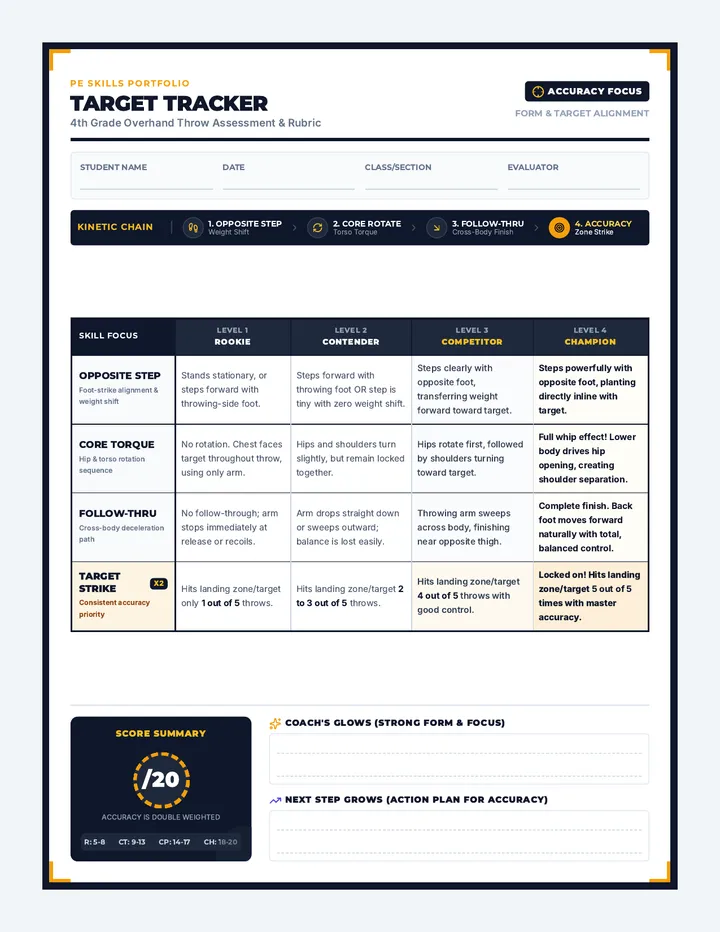
Assessment Rubric
Score Pacing Criteria 4: Elite Maintains perfect rhythm; negative split (Faster 2nd half). 3: Strong Maintains even pace throughout; no walking. 2: Developing Slight fade in speed; 1-2 brief walking breaks. 1: Novice Sprints early; walks majority of the second half.
Victory Speech
"Today is not a race against each other. It's a race against the clock and your own brain. Prove that YOU are the boss of your energy!"
Awards
Consider giving out small stickers or ribbons for categories like "Most Consistent Pace," "Best Negative Split," and "The Grit Award."
Teacher Note
Encourage the "rest" group to cheer loudly. A high-energy environment helps students push through "The Wall" in the final minutes.
Pacing Champ Exit Ticket Pacing Champ
End-of-Unit Reflection
Building Endurance
GRADE 4
Warrior Name:
Date of Glory:
Final Results
Final Lap Total:
Did I hit my goal?
YES
ALMOST
My Favorite Gear:
Walk
Jog
Run
What was your most helpful mental mantra today?
How did the 2:2 breathing rhythm help you keep your pace?
What is one thing you are proud of from this unit?
Certified Pacing Power Expert