Hola Amigos Teacher Guide Teacher Facilitation Guide
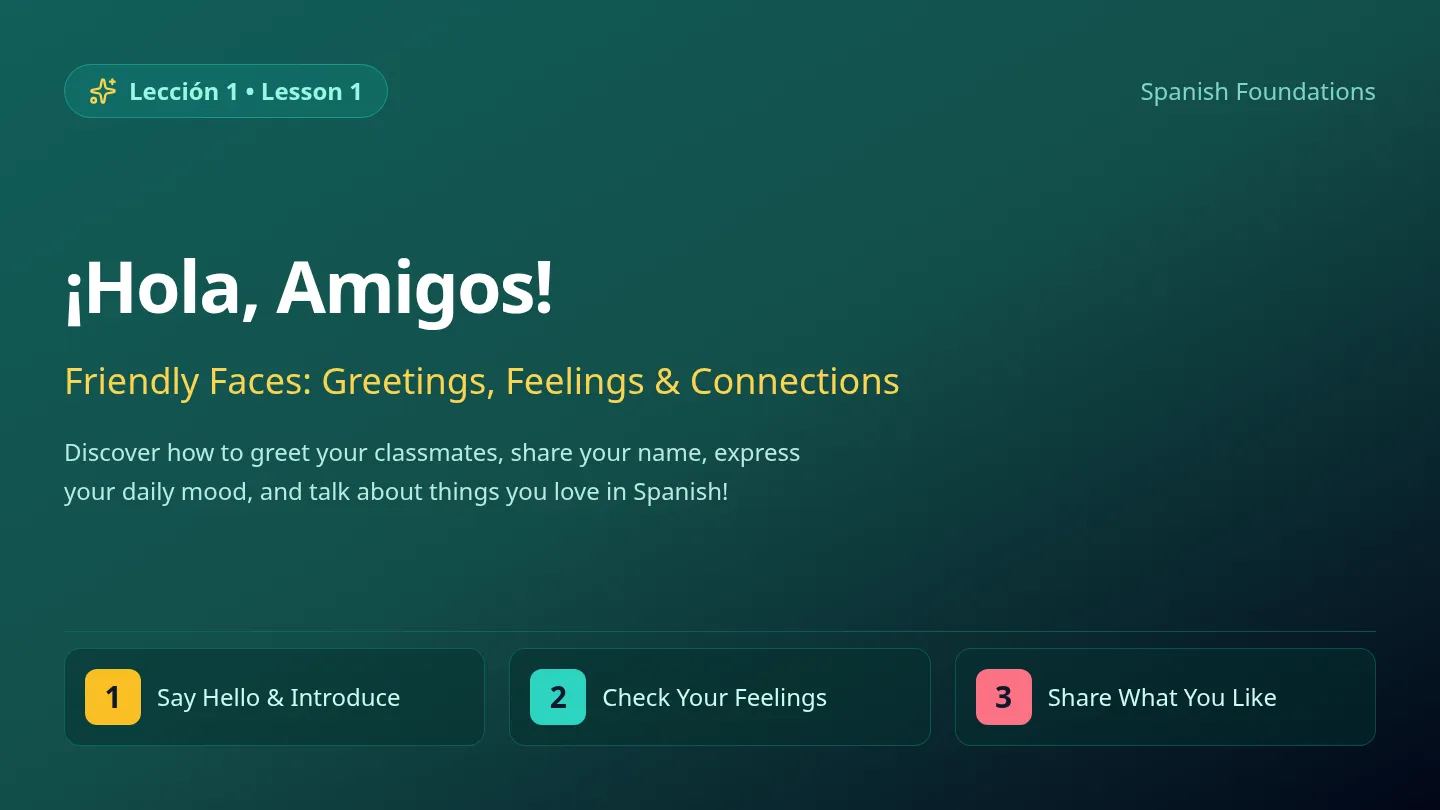
¡Hola Amigos!
Introductory Spanish • Novice-Low/Mid • Absolute Beginners
Lesson 1 of 1
Duration
60 Minutes
Focus Phrases
¡Hola! / ¿Cómo te llamas? / Me llamo...
Key Materials
Vocabulary Cards, Student Worksheet
Learning Objectives
Students can greet peers and teachers using three appropriate times of day (Buenos días, Buenas tardes, Buenas noches).
Students can ask a peer's name (¿Cómo te llamas?) and state their own (Me llamo...).
Students can ask and express basic feelings (¿Cómo estás? / Estoy bien, mal, así así) with matching physical gestures.
Lesson Timeline & Steps
1. Warm-Up & Physical Hook (TPR)
10 Mins
Begin with active physical movement. Stand in a circle. Model high energy. Introduce ¡Hola! with a giant wave. Introduce ¡Adiós! with a walking gesture.
Teacher Script: "¡Hola clase! (Wave enthusiastically and signal students to copy). When I say ¡Hola!, everyone wave and repeat! Now... ¡Adiós! (Wave goodbye and step backward)."
2. Input: Greetings & Times of Day
15 Mins
Use the classroom window or digital slide to demonstrate the sun's positions. Associate physical anchors with the three greetings:
Buenos días: Buenas tardes: Buenas noches:
Theme: ¡Hola Amigos! Lesson Bundle Page 1 of 2
Lesson Timeline (Continued) ¡Hola Amigos!
3. Input & Interaction: Introductions
15 Mins
Use a puppet or a ball to model a mock conversation. Toss a soft ball to a student to prompt them.
Question: ¿Cómo te llamas? (Point to student with questioning look)
Answer: Me llamo [Nombre]. (Point to self proudly)
Follow-up: ¿Cómo estás? (Shrug shoulders with open hands)
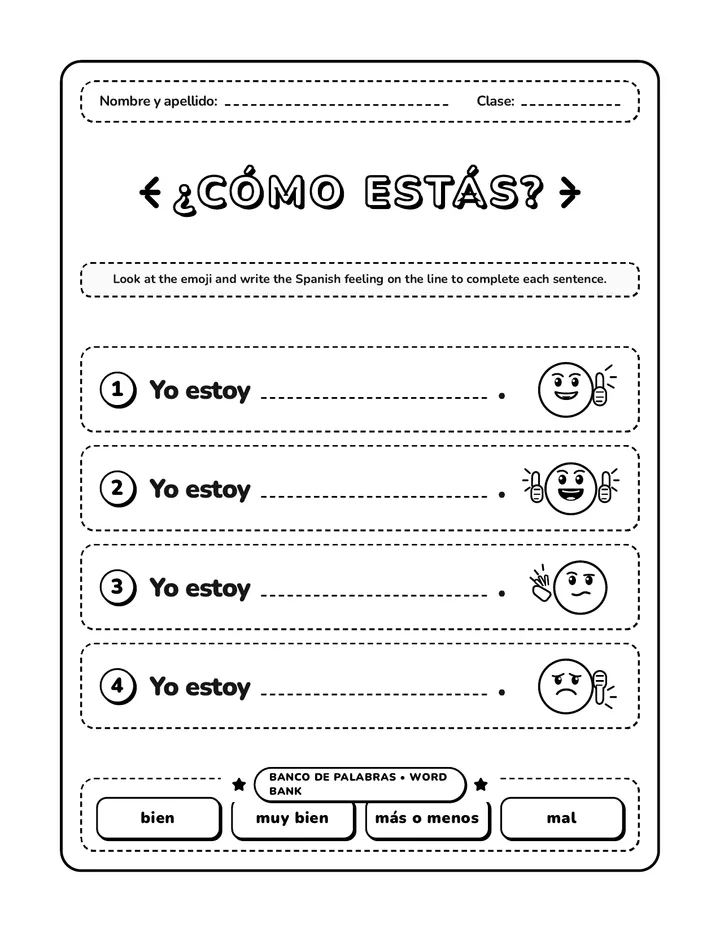
Estoy bien 😊 Estoy así así 😐 Estoy mal 😞
4. Collaborative Application (Worksheet)
15 Mins
Distribute the ¡Hola Amigos! Worksheet . First, students complete the independent matching and tracing sections. Then, prompt them to stand up and find 3 different classmates to interview using the dialogue structure.
Interview Task Setup: Students must write their partner's name and draw a smiley/neutral/sad face depending on how their partner answers "¿Cómo estás?".
5. Fun Exit Ticket Challenge
5 Mins
Before exiting the classroom, each student must high-five the teacher, choose one greeting (e.g., Buenas tardes), and answer ¿Cómo te llamas? with their name in a full sentence.
Support / Modification
Provide visual sentence starters on the whiteboard. Allow struggling students to point to emoji cards to represent feelings while attempting to repeat the pronunciation.
Extension Challenge
Advanced students can add "¿Y tú?" (And you?) to their dialogue or introduce a classmate to the teacher: "Se llama [Name]."
Instructional Tip: "The 90% Rule"
Strive to speak 90% in Spanish during the vocabulary introductions. Use tone of voice, exaggerated facial expressions, and rapid hand gestures to make the target language fully comprehensible without resorting to immediate English translations.
Theme: ¡Hola Amigos! Lesson Bundle Page 2 of 2
Hola Amigos Worksheet ¡Hola Amigos!
Worksheet
Nombre:
Fecha:
1 Part 1: Match the Greeting! / ¡Une los saludos!
Draw a line connecting each Spanish greeting to its matching English meaning.
¡Hola!
Buenos días
Buenas tardes
Buenas noches
¡Adiós!
Good afternoon
Goodbye
Good night
Hello
Good morning
2 Part 2: What time is it? / ¿Qué hora es?
Look at the icons. Write the matching Spanish greeting underneath.
🌅
Morning (8:00 AM)
☀️
Afternoon (2:00 PM)
🌙
Night (9:00 PM)
Unit: ¡Hola Amigos! Page 1 of 2
Part 3 & 4: Application ¡Hola Amigos!
3 Part 3: Complete the Chat / Completa la conversación
Fill in the missing words from the box to complete the introduction!
bien llamas llamo Hola
Mateo:
¡
! ¿Cómo te
?
Sofía:
Me
Sofía. ¿Cómo estás?
Mateo:
Estoy
, ¡gracias!
4 Part 4: Meet My Classmates / Conoce a mis amigos
Stand up! Ask 3 classmates their name and how they are feeling in Spanish. Write their name, and circle their feeling icon!
Amigo's Name Feeling Response (Circle One)
😊 Bien 😐 Así así 😞 Mal
|
|
|
😊 Bien 😐 Así así 😞 Mal
|
|
|
😊 Bien 😐 Así así 😞 Mal
|
Unit: ¡Hola Amigos! Page 2 of 2
Hola Amigos Vocabulary Cards Printable Resource
Tarjetas de Vocabulario
Cut along the dashed lines to make your own flashcards!
👋 Greeting
¡Hola!
[oh-lah]
Hello / Hi
🚶♂️👋 Greeting
¡Adiós!
[ah-dyohs]
Goodbye
🌅 Morning
Buenos días
[bweh-nohs dee-ahs]
Good Morning
☀️ Afternoon
Buenas tardes
[bweh-nahs tahr-dehs]
Good Afternoon
❓ Question
¿Cómo te llamas?
[coh-moh teh yah-mahs]
What is your name?
🗣️ Answer
Me llamo...
[meh yah-moh]
My name is...
Unit: ¡Hola Amigos! Page 1 of 1
Hola Amigos Slides Amigo Academy • Nivel 1 Lección de Introducción
¡Bienvenidos! Welcome!
¡Hola Amigos!
Let's learn how to greet people, introduce ourselves, and express our feelings in Spanish!
👋 Ready to start? ¡Vamos!
Slide 1 of 6
🌅 Saludos (Greetings)
Vocabulario
🌅
Buenos días
[bweh-nohs dee-ahs]
Good Morning
☀️
Buenas tardes
[bweh-nahs tahr-dehs]
Good Afternoon
🌙
Buenas noches
[bweh-nahs no-chehs]
Good Night
Pro-tip: Match the actions to the times of day! Slide 2 of 6
🗣️ Introducciones (Introductions)
Speaking
The Question:
¿Cómo te llamas?
[coh-moh teh yah-mahs]
Meaning: "What is your name?"
The Answer:
Me llamo...
[meh yah-moh...]
Meaning: "My name is [Name]"
Practice: Turn to a partner and ask: "¿Cómo te llamas?" Slide 3 of 6
❓😊 ¿Cómo estás? (How are you?)
Feelings
To reply, use the magic phrase: "Estoy..." (I am...)
😊
Estoy bien
I am doing well!
😐
Estoy así así
I am so-so / okay.
😞
Estoy mal
I am doing badly.
Check-in: Make sure to match your face to the feeling word! Slide 4 of 6
🎮 ¡Vamos a Jugar! (Let's Play!)
Practice Game
The "Amigo Handshake" Challenge
Stand up and move carefully around the room. When the music stops, find the closest partner and perform the dialogue:
Give a Spanish greeting (e.g., ¡Buenos días!)
Ask: ¿Cómo te llamas?
Answer: Me llamo [Name]. ¿Y tú?
Ask: ¿Cómo estás?
Quick Cheat-Sheet:
A: ¡Hola! ¿Cómo te llamas?
B: ¡Hola! Me llamo [Nombre]. ¿Y tú?
A: Me llamo [Nombre]. ¿Cómo estás?
B: Estoy bien, gracias. ¿Y tú?
Be enthusiastic and polite! ¡Mucho gusto! Slide 5 of 6
🏆 Desafío de Salida (Exit Challenge)
Wrap-Up
Before you leave today...
Make sure you can answer these three questions with your teacher or a classmate:
Contando Amigos Teacher Guide Teacher Facilitation Guide
¡Contando Amigos!
Introductory Spanish • Novice-Low/Mid • Numbers 1-10 & Age
Lesson 2 of 2
Duration
60 Minutes
Focus Phrases
¿Cuántos años tienes? / Tengo... años
Key Materials
Numbers Slides, Birthday Poll Worksheet
Learning Objectives
Students can confidently count from 1 to 10 in Spanish (uno, dos, tres...) with clapping rhythms.
Students can ask a peer how old they are (¿Cuántos años tienes?) and answer with their own age (Tengo... años).
Students can interpret and answer questions about quantity using ¿Cuántos? / ¿Cuántas? (How many?).
Lesson Timeline & Steps
1. Warm-Up: Clap-Count 1-10
10 Mins
Stand in a circle. Introduce numbers 1-10 by clapping once for each number. Speed up the rhythm gradually. Use hand signals to indicate counting up and counting down.
Teacher Script: "¡Uno! (Clap) ¡Dos! (Clap twice)... Now, let's try backwards! ¡Diez! ¡Nueve! ¡Ocho! Let's see who can count the fastest!"
2. Input: Numbers & Counting Items
15 Mins
Project the Lesson 2 slides. Show slide groups of items (e.g., 3 apples, 7 balloons). Introduce the question ¿Cuántos hay? (How many are there?). Have students choral chant the count as you point.
1-5: uno, dos, tres, cuatro, cinco.6-10: seis, siete, ocho, nueve, diez.
Theme: Amigo Academy Lesson Bundle Page 1 of 2
Lesson Timeline (Continued) Contando Amigos
3. Input & TPR: Asking Age
15 Mins
Teach the phrase ¿Cuántos años tienes? by gesturing like you are holding candles on an imaginary cake. Respond with Tengo... años while holding up fingers for the age number.
Question: ¿Cuántos años tienes? [coh-ahn-tohs ah-nyohs tyee-eh-nehs]
Answer: Tengo ________ años. [tehn-goh ... ah-nyohs]
Important Pronunciation Note: Ensure students pronounce the "ñ" in "años" correctly. Tell them it makes an "ny" sound (like cany on), otherwise they are saying a different word!
4. Collaborative Survey Activity
15 Mins
Distribute the ¡Contando Amigos! Worksheet . For Part 4, students must walk around, ask three different peers ¿Cuántos años tienes?, and write their ages in Spanish words (e.g., "ocho" or "nueve").
Contando Amigos Worksheet ¡Contando Amigos!
Worksheet
Nombre:
Fecha:
1 Part 1: Match the Numbers! / ¡Une los números!
Draw a line from the digit to its matching Spanish word.
1
3
5
8
10
ocho
uno
diez
cinco
tres
2 Part 2: How many are there? / ¿Cuántos hay?
Count the objects in each box and write the Spanish number name underneath.
🎈🎈🎈🎈
Balloons
🎂🎂
Cakes
🕯️🕯️🕯️🕯️🕯️🕯️
Candles
Unit: Amigo Academy Page 1 of 2
Part 3 & 4: Age Interview Contando Amigos
3 Part 3: Share Your Age! / Comparte tu edad
Fill in the blanks with your own information. Draw the correct number of candles on your birthday cake!
The Question:
¿Cuántos años tienes?
Your Answer:
Tengo
años.
[Draw your candles here!]
🎂
4 Part 4: Class Birthday Survey / Encuesta de cumpleaños
Stand up and find 3 classmates. Ask them their age in Spanish, and record their name and age word below.
Amigo's Name How old are they? (Write Spanish Word)
Tengo
años.
|
|
|
Tengo
años.
|
|
|
Tengo
años.
|
Unit: Amigo Academy Page 2 of 2
Contando Amigos Vocabulary Cards Printable Resource
Tarjetas de Vocabulario
Cut along the dashed lines to make your own flashcards!
🖐️ Numbers
uno • dos • tres • cuatro • cinco
[1, 2, 3, 4, 5]
Numbers 1 - 5
🖐️🤚 Numbers
seis • siete • ocho • nueve • diez
[6, 7, 8, 9, 10]
Numbers 6 - 10
🎂❓ Question
¿Cuántos años tienes?
[coh-ahn-tohs ah-nyohs tyee-eh-nehs]
How old are you?
🎂🗣️ Answer
Tengo... años
[tehn-goh ... ah-nyohs]
I am... years old
🎈❓ Question
¿Cuántos hay?
[coo-ahn-tohs eye]
How many are there?
🎉🥳 Phrase
¡Feliz cumpleaños!
[feh-leez coom-pleh-ah-nyohs]
Happy Birthday!
Unit: Amigo Academy Page 1 of 1
Contando Amigos Slides Amigo Academy • Nivel 1 Lección 2: Números y Edad
¡A Contar! Let's Count!
¡Contando Amigos!
Let's learn numbers 1 to 10 and how to share and ask about ages in Spanish!
🎈 Ready to start? ¡Vamos!
Slide 1 of 6
🖐️ Números 1 - 5 (Numbers 1-5)
Vocabulario
1
uno
[oo-noh]
☝️
2
dos
[dohs]
✌️
3
tres
[trehs]
🤟
4
cuatro
[cwah-troh]
🖖
5
cinco
[seen-coh]
🖐️
Hold up your fingers and repeat! ¡Excelente! Slide 2 of 6
🖐️🤚 Números 6 - 10 (Numbers 6-10)
Vocabulario
6
seis
[sayss]
👍🖐️
7
siete
[syee-teh]
✌️🖐️
8
ocho
[oh-choh]
🤟🖐️
9
nueve
[nweh-beh]
🖖🖐️
10
diez
[dyehs]
🖐️🤚
Let's count backward from 10 to 1! ¡Despacio! Slide 3 of 6
🎂❓ ¿Cuántos años tienes? (Asking Age)
Speaking
How to ask:
¿Cuántos años tienes?
[coh-ahn-tohs ah-nyohs tyee-eh-nehs]
"How old are you?" (Literally: "How many years do you have?")
How to answer:
Tengo _____ años.
[tehn-goh ... ah-nyohs]
"I am _____ years old." (Add your Spanish number in the blank!)
Careful with the "ñ" in "años"! Practice making the canyon sound. Slide 4 of 6
🎮❓ ¿Cuántos hay? (Count-and-Call Game)
Practice Challenge
Group A
🎈🎈🎈🎈🎈
¿Cuántos hay?
¡cinco!
Group B
🎂🎂🎂
¿Cuántos hay?
¡tres!
Group C
🕯️🕯️🕯️🕯️🕯️🕯️🕯️
¿Cuántos hay?
¡siete!
Teacher Tip: Point to any object group and ask: "¿Cuántos hay?" Slide 5 of 6
📋 Encuesta de Cumpleaños (Class Age Poll)
En la Clase Teacher Guide Teacher Facilitation Guide
¡En la Clase!
Introductory Spanish • Novice-Low/Mid • Objects & Requests
Lesson 3 of 3
Duration
60 Minutes
Focus Request
¿Puedo ir al baño? / Necesito...
Key Materials
Classroom Slides, Object Label Cards
Learning Objectives
Students can identify and name four basic classroom objects in Spanish (el lápiz, el libro, el papel, la mesa).
Students can ask politely to leave the room or request assistance (¿Puedo ir al baño? / ¿Puedo tomar agua? / Necesito ayuda).
Students can respond physically to commands like señala, toca, abre (point, touch, open).
Lesson Timeline & Steps
1. Warm-Up: "Señala el Objeto" (TPR)
10 Mins
Begin by teaching the command Señala (Point to) with dramatic body language. Model pointing to your own desk and objects. Prompt students to point around the room.
Teacher Script: "¡Señala la puerta! (Point to the door dramatically). Point and repeat: ¡La puerta! Good. Ahora... ¡Señala el libro! (Hold up a book and point to it)."
2. Input: Classroom Vocabulary
15 Mins
Introduce four main classroom nouns. Use actual objects in your hands to model, shaking them or tapping them to build a strong physical memory:
el lápiz (pencil) ✏️el papel (paper) 📄el libro (book) 📖la mesa (table) 📥
Theme: Amigo Academy Lesson Bundle Page 1 of 2
Lesson Timeline (Continued) En la Clase
3. Input & TPR: Survival Phrases
15 Mins
Transition to classroom request expressions. This is extremely powerful for classroom management as it allows immersion to continue. Model with hand-raising gestures.
Bathroom Request: ¿Puedo ir al baño? (Cross fingers or hold up hand)
Water Request: ¿Puedo tomar agua? (Mimic drinking from a cup)
Help Request: Necesito ayuda. (Put hand on chin looking puzzled)
4. Labeling & Interactive Work
15 Mins
Distribute the ¡En la Clase! Worksheet . For Part 4, have students act out a mini role-play in pairs. One student plays the teacher and another plays a student requesting water or a pencil in Spanish.
5. "Ticket Out the Door" Ritual
En la Clase Worksheet ¡En la Clase!
Worksheet
Nombre:
Fecha:
1 Part 1: Classroom Objects / Objetos de la clase
Draw a line from the Spanish word to its matching emoji and English name.
el lápiz
el papel
el libro
la mesa
📖 the book
✏️ the pencil
📥 the table
📄 the paper
2 Part 2: Practice Writing! / ¡Practica la escritura!
Trace the dotted Spanish word, then write it by yourself on the line.
✏️ Pencil
el lápiz
📖 Book
el libro
📄 Paper
el papel
📥 Table
la mesa
Unit: Amigo Academy Page 1 of 2
Part 3 & 4: Requests En la Clase
3 Part 3: Classroom Survival Requests / Frases de supervivencia
Connect the Spanish request with its correct English translation.
¿Puedo ir al baño?
¿Puedo tomar agua?
Necesito ayuda.
"I need help."
"May I go to the bathroom?"
"May I get a drink of water?"
4 Part 4: What do you say? / ¿Qué dices?
Look at the situations below. Fill in the dialogue bubble with the correct Spanish survival phrase.
Scenario A: You are very thirsty
🥵🥤
¡Tengo sed!
Your Request:
Scenario B: You have a hard question
🤔❔
¡No entiendo!
Your Request:
Unit: Amigo Academy Page 2 of 2
En la Clase Vocabulary Cards Printable Resource
Tarjetas de Vocabulario
Cut along the dashed lines to make your own flashcards!
✏️ Object
el lápiz
[ehl lah-pees]
The Pencil
📖 Object
el libro
[ehl lee-broh]
The Book
📄 Object
el papel
[ehl pah-pehl]
The Paper
🧻❓ Request
¿Puedo ir al baño?
[pweh-doh eer ahl bah-nyoh]
May I go to the bathroom?
🥤❓ Request
¿Puedo tomar agua?
[pweh-doh toh-mahr ah-gwah]
May I get a drink of water?
🙋♂️❓ Request
Necesito ayuda
[neh-seh-see-toh ah-yoo-dah]
I need help
Unit: Amigo Academy Page 1 of 1
En la Clase Slides Amigo Academy • Nivel 1 Lección 3: Objetos y Frases
¡En la clase! Inside the Class!
¡En la Clase!
Let's learn how to name key objects in Spanish and ask for what we need during our school day!
✏️ Ready to start? ¡Vamos!
Slide 1 of 6
📖✏️ Objetos de la Clase (Classroom Objects)
Vocabulario
✏️
el lápiz
[ehl lah-pees]
the pencil
📖
el libro
[ehl lee-broh]
the book
📄
el papel
[ehl pah-pehl]
the paper
📥
la mesa
[lah meh-sah]
the table
When I say: "Señala...", point to that object in the room! Slide 2 of 6
🧻🥤 Frases de Salida (Requests to Leave)
Survival Requests
Bathroom Request: 🧻
¿Puedo ir al baño?
[pweh-doh eer ahl bah-nyoh]
Meaning: "May I go to the bathroom?"
Water Request: 🥤
¿Puedo tomar agua?
[pweh-doh toh-mahr ah-gwah]
Meaning: "May I get a drink of water?"
Act out the gestures! Cross your fingers for restroom, mimic a cup for water. Slide 3 of 6
🙋♂️❓ Frases de Ayuda (Requests for Help)
Help
If you are stuck, say: 🙋♂️
Necesito ayuda.
[neh-seh-see-toh ah-yoo-dah]
Meaning: "I need help."
💡 Pro tip: Combine it! "Necesito un lápiz" = I need a pencil.
Raise your hand high and practice declaring: "Necesito ayuda, por favor!" Slide 4 of 6
🎮❓ ¿Qué falta? (What is Missing?)
Active Game
How to Play:
The teacher places a pencil (lápiz), paper (papel), and book (libro) on the table. Close your eyes! The teacher hides one object.
Open your eyes and call out the missing Spanish object name!
Score points!
No pencil? ¡Falta el lápiz! ✏️
No book? ¡Falta el libro! 📖
No paper? ¡Falta el papel! 📄
Play multiple rounds to build lightning-fast recognition! Slide 5 of 6
🏆👑 ¡Español 100%! (Immersion Power)
Your Promise
From Now On...
You have the power to speak Spanish to get what you need! Whenever you need to use the restroom, get water, or ask for help, use your magic words:
Pintando Amigos Teacher Guide Teacher Facilitation Guide
¡Pintando Amigos!
Introductory Spanish • Novice-Low/Mid • Colors & Descriptions
Lesson 4 of 4
Duration
60 Minutes
Focus Phrase
¿De qué color es...? / Es de color...
Key Materials
Color Cards, Crayons/Colored Pencils
Learning Objectives
Students can identify and name four core colors in Spanish (rojo, azul, amarillo, verde).
Students can understand and apply basic descriptive word order in noun-adjective combinations (e.g., el libro azul rather than "el azul libro").
Students can respond correctly to the question ¿De qué color es? (What color is it?).
Lesson Timeline & Steps
1. Warm-Up: "Toca el Color" Game
10 Mins
Students stand up. Introduce the command Toca (Touch). Call out a color in Spanish (e.g., "Toca azul!"). Students must quickly find and touch something in the classroom that is that color (clothing, binder, poster).
Teacher Script: "¡Clase, de pie! Stand up! When I say a color, run gently and touch it! ¡Toca... rojo! (Model touching a red marker. Praise students who touch red items)."
2. Input: Key Colors & Pronunciation
15 Mins
Project the colors slide. Model pronunciation with high energy. Associate objects with each color to reinforce memory:
rojo [rroh-hoh]
azul [ah-sool]
amarillo [ah-mah-ree-yoh]
verde [behr-deh]
Theme: Amigo Academy Lesson Bundle Page 1 of 2
Lesson Timeline (Continued) Pintando Amigos
3. Input & Structure: Noun-Adjective Order
15 Mins
Highlight the structural difference between English and Spanish word order. Spanish puts the descriptive color adjective *after* the noun. Use visual cards to illustrate:
English Order: blue book
Spanish Order: el libro azul
Choral Drill: Hold up different colored classroom objects (e.g. red pencil, green book). Lead a fast-paced repeat drill: "El lápiz rojo", "El libro verde", "El papel amarillo".
4. Collaborative Color Hunt
15 Mins
Distribute the ¡Pintando Amigos! Worksheet . For Part 4, students must walk around, work in pairs, find three items in the classroom that match specified colors, and write their Spanish names down.
5. Wrap-up & Color Check
5 Mins
Pintando Amigos Worksheet ¡Pintando Amigos!
Worksheet
Nombre:
Fecha:
1 Part 1: Match the Colors / Une los colores
Draw a line connecting the Spanish color word to its English meaning.
rojo
azul
amarillo
verde
Yellow 💛
Green 💚
Red ❤️
Blue 💙
2 Part 2: Read and Color / Lee y colorea
Read the Spanish noun phrase below each item. Color the object according to the color mentioned!
📖
el libro azul
(Color the book blue)
✏️
el lápiz amarillo
(Color the pencil yellow)
📄
el papel rojo
(Color the paper red)
📥
la mesa verde
(Color the table green)
Unit: Amigo Academy Page 1 of 2
Part 3 & 4: Descriptions Pintando Amigos
3 Part 3: Word Order Detective / Detectiva del orden
Remember, in Spanish, adjectives (colors) come AFTER the noun. Circle the correct Spanish translation for each English phrase. (All choices are styled identically to ensure no visual hinting).
1. "the blue pencil"
A) el azul lápiz
B) el lápiz azul
2. "the red book"
A) el libro rojo
B) el rojo libro
4 Part 4: Classroom Color Hunt / Búsqueda de colores
Look around your classroom. Find one object for each color, ask a partner to verify, and write down the object name (e.g. lápiz, libro, papel) in the space below.
Target Color What object did you find? (Write its name) rojo
|
|
|
azul
|
|
|
verde
|
|
Unit: Amigo Academy Page 2 of 2
Pintando Amigos Vocabulary Cards Printable Resource
Tarjetas de Vocabulario
Cut along the dashed lines to make your own flashcards!
🔴 Color
rojo
[rroh-hoh]
Red
🔵 Color
azul
[ah-sool]
Blue
🟡 Color
amarillo
[ah-mah-ree-yoh]
Yellow
🟢 Color
verde
[behr-deh]
Green
🎨 Noun
el color
[ehl coh-lohr]
The Color
🎨❓ Question
¿De qué color es?
[deh keh coh-lohr ehs]
What color is it?
Unit: Amigo Academy Page 1 of 1
Pintando Amigos Slides Amigo Academy • Nivel 1 Lección 4: Colores y Estructura
¡Pintando! Let's Paint!
¡Pintando Amigos!
Let's learn our favorite colors and how to describe objects in Spanish!
🎨 Ready to paint? ¡Vamos!
Slide 1 of 6
🔴🔵 Colores Brillantes (Bright Colors - Part 1)
Vocabulario
❤️
Red
rojo
[rroh-hoh]
💙
Blue
azul
[ah-sool]
Look around! Touch something rojo or azul! Slide 2 of 6
💛💚 Colores Brillantes (Bright Colors - Part 2)
Vocabulario
💛
Yellow
amarillo
[ah-mah-ree-yoh]
💚
Green
verde
[behr-deh]
Hold up a green or yellow crayon and shout its Spanish name! Slide 3 of 6
🔍🧭 El Orden Secreto (Word Order Secrets)
Grammar
English Way:
We say: blue book
(Color comes before the object)
Spanish Way:
We say: el libro azul
(Color comes after the object!)
Formula: [Object] + [Color]! Let's practice. Slide 4 of 6
🎮❓ ¿De qué color es? (Color Detective Game)
Practice Game
✏️💛
What is it?
el lápiz amarillo
📖❤️
What is it?
el libro rojo
📥💚
What is it?
la mesa verde
Teacher Tip: Point to any object on the slide and ask: "¿De qué color es?" Slide 5 of 6
📋🎨 Búsqueda de Colores (Classroom Color Hunt)
Mission
Color Hunt Mission:
Let's work in pairs! Grab your worksheets and explore the classroom. Find things that match your secret colors:
Step 1: Find an object with a partner.
Step 2: Point and ask: ¿De qué color es?
Step 3: Confirm together and write down its name in Spanish!
¡Pintando el mundo en español! You're ready! 🎨✨ Slide 6 of 6
Bailando Amigos Teacher Guide Teacher Facilitation Guide
¡Bailando Amigos!
Introductory Spanish • Novice-Low/Mid • Body Parts & Movement
Lesson 5 of 5
Duration
60 Minutes
Action Verbs
¡Toca! (Touch) / ¡Mueve! (Move)
Key Materials
Movement Slides, Cut-out Label Cards
Learning Objectives
Students can identify and name four major body parts in Spanish (la cabeza, los hombros, las manos, los pies).
Students can follow physical movement commands using verbs toca (touch) and mueve (shake/move).
Students can actively play a target-language version of Simon Says (Simón Dice) without needing English translation.
Lesson Timeline & Steps
1. Warm-Up: Action Commands (TPR)
10 Mins
Begin with instant physical movement. Teach ¡Toca! (Touch) and ¡Mueve! (Move/Shake) with highly exaggerated gestures. Shake your hands vigorously when saying "Mueve" and tap your head when saying "Toca".
Teacher Script: "¡Clase, de pie! Stand up! ¡Toca! (Tap your head). Repeat: ¡Toca! ¡Mueve! (Shake hands violently). Repeat: ¡Mueve! Perfect! Now do it fast!"
2. Input: Four Core Body Parts
15 Mins
Introduce four main body nouns. Stand up and touch each body part dramatically. Have students repeat each word in a choral drill while holding that part of their body:
la cabeza [lah cah-beh-sah] (head)
los hombros [lohs ohm-brohs] (shoulders)
las manos [lahs mah-nohs] (hands)
los pies [lohs pyehs] (feet)
Theme: Amigo Academy Lesson Bundle Page 1 of 2
Lesson Timeline (Continued) Bailando Amigos
3. Interaction: "Simón Dice" Game
15 Mins
Introduce the game rules for Simón Dice (Simon Says). Explain that if you say "Simón dice: toca la cabeza", they must touch it. If you just say "toca la cabeza" without "Simón dice", they must stay perfectly still!
Valid Action: "Simón dice: ¡Toca los hombros!" (Students touch shoulders)
Trap Action: "¡Mueve las manos!" (Students must NOT move)
Teaching Tip: Go slow initially, then speed up rapidly. Trick students by performing the wrong action yourself (e.g. saying "Toca los pies" while touching your head).
4. Labeling & Interactive Work
15 Mins
Distribute the ¡Bailando Amigos! Worksheet . First, students complete the label matching. Then, have them work in pairs to perform a "Reflex Speed Game" (Part 4) on their worksheets.
Bailando Amigos Worksheet ¡Bailando Amigos!
Worksheet
Nombre:
Fecha:
1 Part 1: Label the Body! / Etiqueta el cuerpo
Draw a line connecting the Spanish word to the correct part of the student's body.
la cabeza
los hombros
las manos
los pies
😊
Amigo
2 Part 2: Action Check! / Comandos de acción
Look at the icons. Write the matching action command underneath from the box.
Toca la cabeza Mueve las manos
👋🌀
Shake Hands
👇🧑
Touch Head
Unit: Amigo Academy Page 1 of 2
Part 3 & 4: Simon Says Challenge Bailando Amigos
3 Part 3: Simon Says Detective / Detective de "Simón dice"
Do you follow the command? Circle the correct answer. Remember: Only move if Simón says! (Options have identical styling for fair challenge).
1. Command: "Simón dice: toca la cabeza."
A) Touch your head! / ¡Toca la cabeza!
B) Freeze! Don't move! / ¡Quédate quieto!
2. Command: "Mueve los pies."
A) Freeze! Don't move! / ¡Quédate quieto!
B) Move your feet! / ¡Mueve los pies!
4 Part 4: Reflex Speed Game Scoreboard / Tabla de velocidad
Play with a partner! When the teacher calls out a body part in Spanish, try to touch it first. Tick the box for whoever wins each round!
Round # Called Spanish Word My Winner Box Amigo's Winner Box Round 1 la cabeza
|
| Round 2 | los hombros |
|
|
| Round 3 | las manos |
|
|
| Round 4 | los pies |
|
|
Unit: Amigo Academy Page 2 of 2
Bailando Amigos Vocabulary Cards Printable Resource
Tarjetas de Vocabulario
Cut along the dashed lines to make your own flashcards!
🧑 Body Part
la cabeza
[lah cah-beh-sah]
The Head
💪 Body Part
los hombros
[lohs ohm-brohs]
The Shoulders
👐 Body Part
las manos
[lahs mah-nohs]
The Hands
👣 Body Part
los pies
[lohs pyehs]
The Feet
👇 Command
¡Toca!
[toh-cah]
Touch!
🌀 Command
¡Mueve!
[mweh-beh]
Move / Shake!
Unit: Amigo Academy Page 1 of 1
Bailando Amigos Slides Amigo Academy • Nivel 1 Lección 5: Cuerpo y Movimiento
¡A Moverse! Let's Move!
¡Bailando Amigos!
Let's learn key body parts in Spanish and practice moving to energetic active games!
💃🏃♂️ Ready to move? ¡Vamos!
Slide 1 of 6
🧑💪 Cabeza y Hombros (Head & Shoulders)
Vocabulario
🧑
The Head
la cabeza
[lah cah-beh-sah]
💪
The Shoulders
los hombros
[lohs ohm-brohs]
Stand up and point! ¡Toca la cabeza! ¡Toca los hombros! Slide 2 of 6
👐👣 Manos y Pies (Hands & Feet)
Vocabulario
👐
The Hands
las manos
[lahs mah-nohs]
👣
The Feet
los pies
[lohs pyehs]
Wiggle your fingers and stomp your feet! ¡Excelente! Slide 3 of 6
🏃♂️⚡ Verbos de Acción (Action Verbs)
Commands
Touch Command: 👇
¡Toca...!
[toh-cah]
"Touch your..." (Combined with any body noun!)
Move Command: 🌀
¡Mueve...!
[mweh-beh]
"Move / Shake your..." (Combined with hands or feet!)
Get ready for a challenge! Listen closely to the teacher's command. Slide 4 of 6
🎮👑 ¡Simón Dice! (Simon Says!)
Active Practice
How to Play:
The teacher calls out body movements. Listen for the magic trigger phrase: "Simón dice..."
If you hear "Simón dice", perform the action. If you don't hear it, freeze! Don't move!
Practice Rounds:
✔️ Valid: "Simón dice: ¡Toca la cabeza!"
✔️ Valid: "Simón dice: ¡Mueve las manos!"
❌ Trap! "¡Toca los hombros!" (Don't move!)
Who can stay in the game the longest? Let's find out! Slide 5 of 6
🎶🎵 La Canción de Despedida (Rhythmic Finale)
Song
Let's Sing and Move!
Sing to the tune of "Head, Shoulders, Knees, and Toes" in Spanish:
Cabeza, hombros, rodillas, pies,
rodillas, pies... 👣
¡Increíble trabajo en todo el curso, amigos! 🎉🏆 Slide 6 of 6