First Connections Slides Lesson 1 • ASL Basics • Visual Language
Silent Sparks Sequence
First Connections
Master essential greetings, expressions of courtesy, and people signs in American Sign Language.
Culture Key
Maintain steady eye contact. Looking away breaks conversational connection.
Signing Space
Stay in your signing bubble: from top of the head down to the waist.
Facial Grammar
Facial expressions provide the grammatical tone and emotion to your hands.
Focus Vocabulary: Hello, Goodbye, Please, Thank You, Friend, Teacher, Family Slide 1 of 5
Greetings
Hello & Goodbye
Opening & Closing
HELLO Dominant Hand
Handshape: Open flat hand (B-handshape)
Location: Forehead near temple
Movement: Crisp salute outward away from the face
Facial Cue: Warm smile, open friendly eyes
GOODBYE Dominant Hand
Handshape: Open 4-fingers or flat hand
Location: Chest to shoulder height
Movement: Gentle wave bending fingers downward twice
Facial Cue: Pleasant departure smile and nod
Practice drill: Turn to a peer, sign HELLO, then sign GOODBYE. Slide 2 of 5
Politeness
Please & Thank You
Key Distinction
PLEASE Chest Location
Handshape: Flat hand, fingers together
Location: Center of chest
Movement: Circular rubbing motion clockwise 2 times
Tip: Rubs the heart to show polite sincerity
THANK YOU Chin Location
Handshape: Flat hand, fingertips start at chin
Location: Lower lip and chin
Movement: Moves forward and out toward the other person
Tip: Do not touch chest—release outward directly
Crucial difference: PLEASE circles on chest; THANK YOU starts on chin and moves forward! Slide 3 of 5
People Signs
Friend, Teacher & Family
Relational Signs
FRIEND
Hooked X-Hands
Shape: Index finger hooks
Motion: Hook fingers one way, then flip and hook the other way
🤝 Represents two linked buddies
TEACHER
Teach + Person
Shape: Flattened O-hands at temples push out twice
Person: Both flat hands drop down sides
🎓 Knowledge passed to others
FAMILY
Circle F-Hands
Shape: 'F' handshapes (thumb & index touch)
Motion: Circle outward until pinkies meet
⭕ A complete circle of unity
Notice: The person marker suffix is used on many ASL career titles! Slide 4 of 5
Practice Challenge
Silent Conversation Drill
Voice Off!
Partner Dialogue
Signer A: HELLO! FRIEND PLEASE?
Signer B: HELLO! YES, FRIEND!
Signer A: THANK YOU! FAMILY GOODBYE!
Signer B: GOODBYE TEACHER!
Quality Checklist
Direct eye contact maintained throughout
Hands stayed within personal signing box
Distinct movement for please vs thank you
Zero vocal whispering during the exchange
👉 Repeat twice, switching roles each time!
Silent Sparks • Lesson 1 Direct Instruction Slide 5 of 5
First Connections Practice Sheet ASL Foundations • Lesson 1
First Connections Practice Sheet
Name:
Date:
Deaf Etiquette Rule: Keep eye contact during conversation. In ASL, breaking eye contact is like walking away mid-sentence!
1 Sign Mechanics Matching
Write the letter of the correct movement description next to each target sign.
1. HELLO
2. THANK YOU
3. FRIEND
4. FAMILY
A. Hooked index fingers link together, flip, and hook again.
B. Flat hand touches chin and moves forward toward person.
C. 'F' handshapes circle outward from thumbs to pinkies.
D. Open flat hand touches forehead/temple, then salutes outward.
2 Precision Check: PLEASE vs. THANK YOU
Beginners often mix up these two polite signs. Fill in the specific parameter differences.
Sign: PLEASE Starting Location
Location on body:
Hand motion pattern:
Sign: THANK YOU Starting Location
Location on body:
Hand motion pattern:
3 Silent Dialogue & Compound Analysis
A. The sign for TEACHER is a compound sign made of two parts. Identify the two actions that form this sign:
B. Partner Dialogue: Write out the exact signs your pair will use to introduce yourselves and say farewell politely:
Peer Practice Check: HELLO / GOODBYE PLEASE / THANK YOU FRIEND / TEACHER / FAMILY
Partner Initials: ________
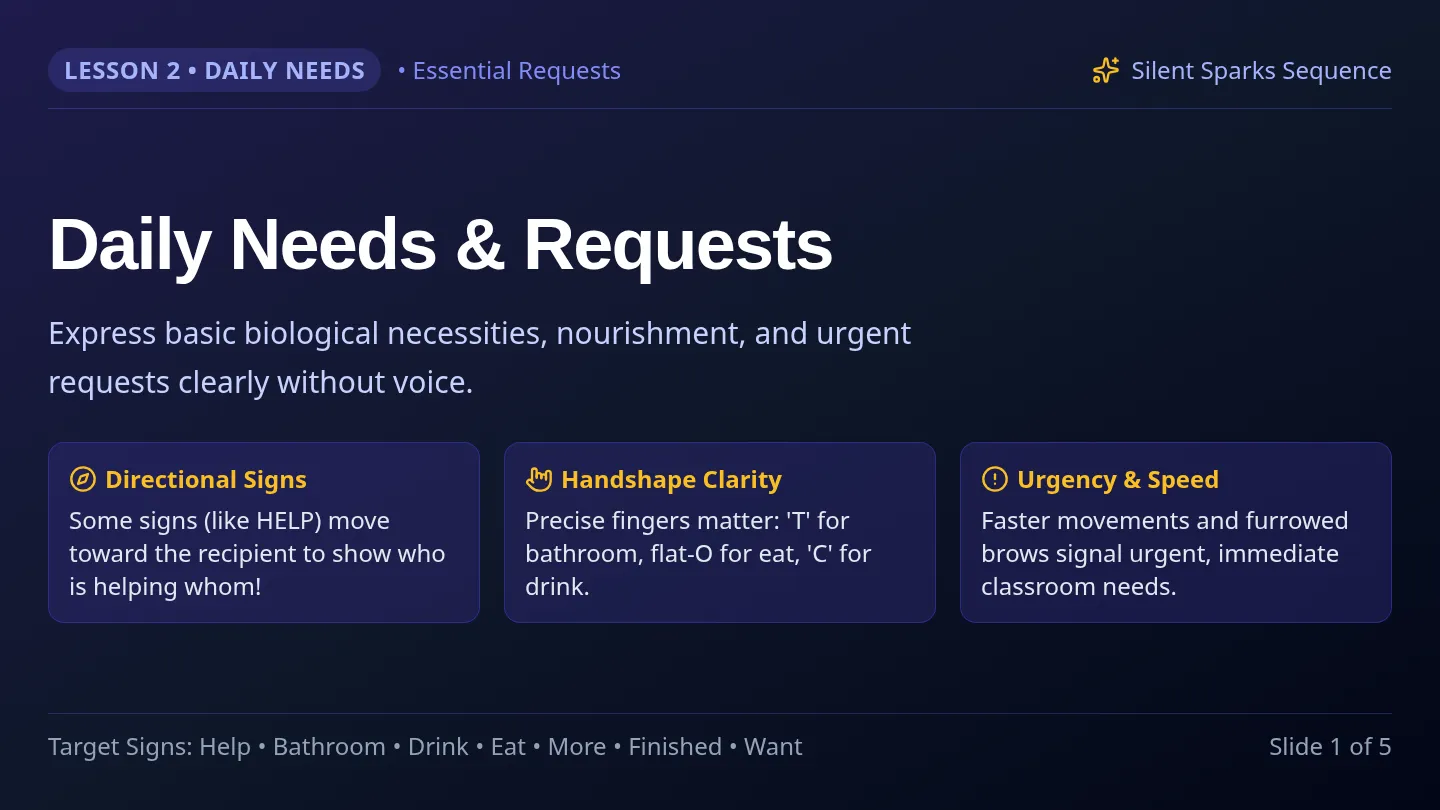
Daily Needs Slides Lesson 2 • Daily Needs • Essential Requests
Silent Sparks Sequence
Daily Needs & Requests
Express basic biological necessities, nourishment, and urgent requests clearly without voice.
Directional Signs
Some signs (like HELP) move toward the recipient to show who is helping whom!
Handshape Clarity
Precise fingers matter: 'T' for bathroom, flat-O for eat, 'C' for drink.
Urgency & Speed
Faster movements and furrowed brows signal urgent, immediate classroom needs.
Target Signs: Help • Bathroom • Drink • Eat • More • Finished • Want Slide 1 of 5
Basic Needs
Eat, Drink & Bathroom
Biological Essentials
EAT / FOOD
Squished-O Shape
Fingers: Fingertips touch thumb tip
Action: Tap fingertips to lips twice
🍎 Mimics bringing food to the mouth
DRINK
C-Handshape
Fingers: Hand forms a cup shape ('C')
Action: Tilt hand back toward mouth once
🥤 Mimics holding a glass to take a sip
BATHROOM
T-Handshape
Fingers: Thumb pokes between index and middle ('T')
Action: Shake hand gently side to side twice
🚻 Stands for 'Toilet'—standard school sign
Tip: Single tap EAT is "eat" (verb); double tap is often "food" (noun). Slide 2 of 5
Requests
Help & Want
Direction & Desire
HELP Directional Sign
Setup: Dominant 'A' fist resting upright on flat non-dominant palm
Movement: Both hands lift upward together
Directionality: Move toward yourself for "help me" ; move toward partner for "help you"
WANT Claw Handshape
Setup: Both hands open in loose claw shapes palms facing upward
Movement: Pull hands back toward your body while curling fingers
Meaning: Pulling something you desire directly toward you
Key insight: Moving HELP toward the teacher means "Please help me!" Slide 3 of 5
Completion & Quantity
More & Finished
Pacing Words
MORE Both Hands
Daily Needs Practice Sheet ASL Foundations • Lesson 2
Daily Needs Practice Sheet
Name:
Date:
Grammar Note (Directionality): The sign HELP changes meaning based on the path of motion: moving toward you means "help me" ; moving toward a peer means "help you" !
1 Signs & Mechanics Matching
Match each daily sign to its correct physical execution description.
1. BATHROOM
2. FINISHED
3. MORE
4. WANT
A. Open 5-hands facing chest flick outward and turn downward.
B. Flat-O shapes tap together repeatedly at fingertips.
C. 'T' handshape gently shakes side-to-side twice at shoulder level.
D. Claw hands pull toward chest while curling fingers inward.
2 Directional Sign Analysis: The Power of HELP
Explain in your own words how the movement path alters the subject and object of the sign.
"YOU HELP ME" Incoming Motion
Starting and ending positions:
Expected facial expression:
"I HELP YOU" Outgoing Motion
Starting and ending positions:
Expected facial expression:
3 Real Classroom Scenario Signing
Scenario A: You are completely finished with your quiz and need a drink of water. What ASL signs would you produce?
Scenario B: A partner is struggling to open their art supply box. What 2-3 signs do you sign to politely offer assistance?
Signing Mastery Check: EAT / DRINK BATHROOM HELP / WANT / FINISHED
Teacher Verification: ________
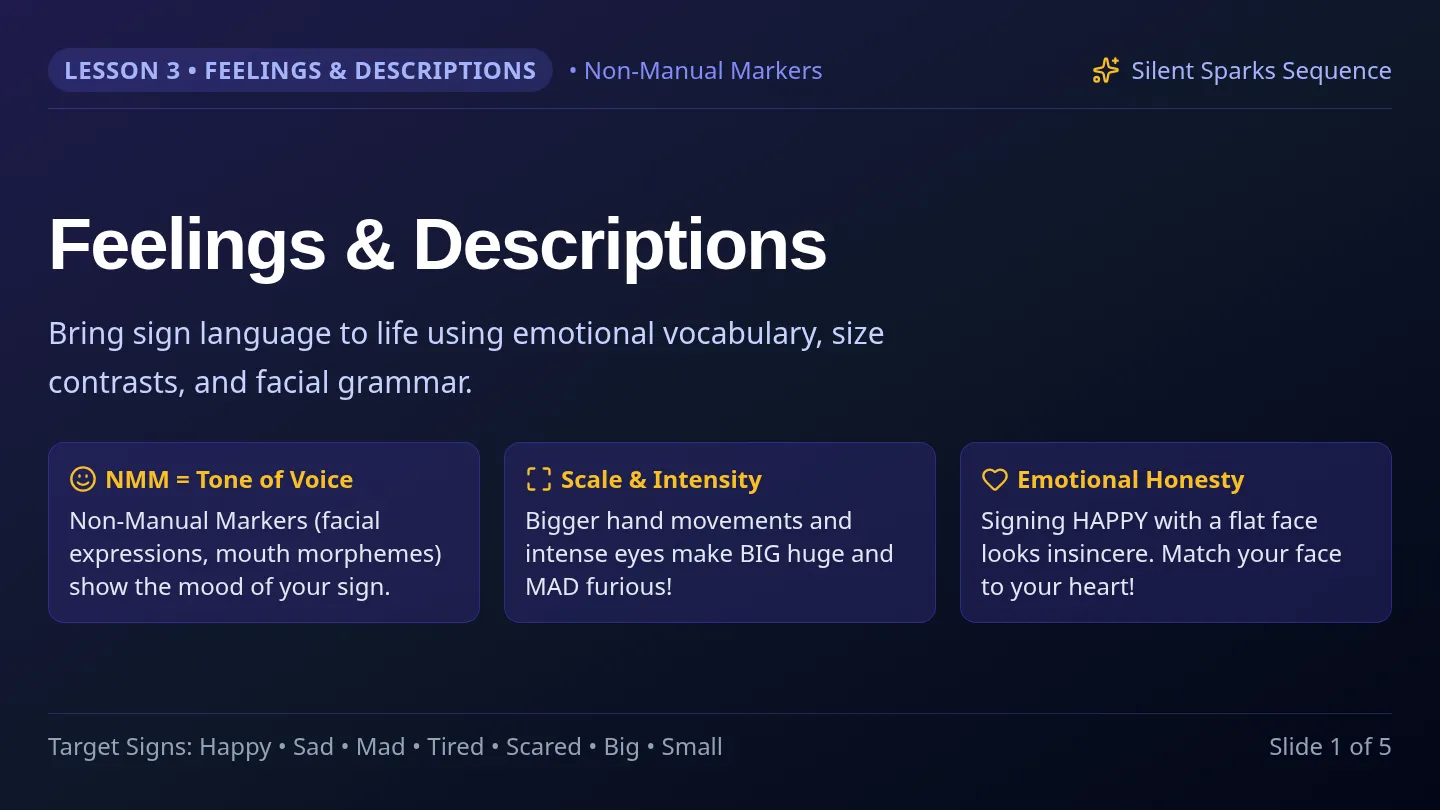
Big Feelings Slides Lesson 3 • Feelings & Descriptions • Non-Manual Markers
Silent Sparks Sequence
Feelings & Descriptions
Bring sign language to life using emotional vocabulary, size contrasts, and facial grammar.
NMM = Tone of Voice
Non-Manual Markers (facial expressions, mouth morphemes) show the mood of your sign.
Scale & Intensity
Bigger hand movements and intense eyes make BIG huge and MAD furious!
Emotional Honesty
Signing HAPPY with a flat face looks insincere. Match your face to your heart!
Target Signs: Happy • Sad • Mad • Tired • Scared • Big • Small Slide 1 of 5
Primary Emotions
Happy & Sad
Upward vs Downward
HAPPY Upward Motion
Handshape: Open flat hands against chest
Movement: Brush upward in repeated circular sweeps
Facial Marker: Wide genuine smile, raised eyebrows
Concept: Joy bubbling up from your chest
SAD Downward Motion
Handshape: Open 5-hands, palms facing inward toward face
Movement: Slowly drag hands downward along face
Facial Marker: Drooping eyelids, frown, head tilts slightly down
Concept: A heavy, sinking feeling
Notice the physical contrast: Happy moves UP; Sad drags DOWN. Slide 2 of 5
Complex Emotions
Mad, Tired & Scared
Intense States
MAD / ANGRY
Claw Handshape
Shape: Claw hand pulls outward from face
NMM: Furrowed brow, tight lips, intense glare
😡 Frustration boiling over
TIRED
Bent Hands
Shape: Fingertips on chest, wrists drop limp
NMM: Heavy sigh, slouching shoulders, weary eyes
😴 Energy draining away
SCARED
Chest Burst
Shape: Fists at chest snap open into 5-hands
NMM: Wide shocked eyes, gasped intake
😨 Sudden fright or startle
Facial expression is mandatory—it tells the observer just how intensely you feel! Slide 3 of 5
Spatial Descriptions
Big & Small
Big Feelings Practice Sheet ASL Foundations • Lesson 3
Big Feelings Practice Sheet
Name:
Date:
Linguistic Rule: Non-Manual Markers (NMMs) are not optional acting; they are ASL adverbs! Signing MAD with a blank face is like saying "I'm furious" in a calm whisper.
1 Emotion & Facial Grammar Matching
Match each emotion sign to its required facial expression and physical marker.
1. HAPPY
2. MAD
3. TIRED
4. SCARED
A. Furrowed brow, narrowed glare, claw hand pulling from face.
B. Wide smile, raised brows, repeated upward chest brushes.
C. Wide eyes, gasped intake, fists snap open into 5-hands.
D. Drooping eyelids, heavy sigh, bent hands drop limp on chest.
2 Mouth Morphemes: "CHA" vs. "OO"
ASL uses specific mouth shapes to define physical size and scale. Complete the chart below.
Sign: BIG (Morpheme: "CHA") Expanse
Handshape and movement arc:
How mouth and eyes alter magnitude:
Sign: SMALL (Morpheme: "OO") Compactness
Handshape and movement spacing:
How pursed lips alter magnitude:
3 Expressive Scenario Translation
Sentence 1: "My teacher is happy today because the test is finished." Write the signs and non-manual cues you will use:
Sentence 2: "My friend is tired and wants a small break." Write the signs and non-manual cues you will use:
Peer Facial Review: HAPPY / SAD MAD / SCARED / TIRED BIG / SMALL (CHA & OO)
Peer Evaluator: ________
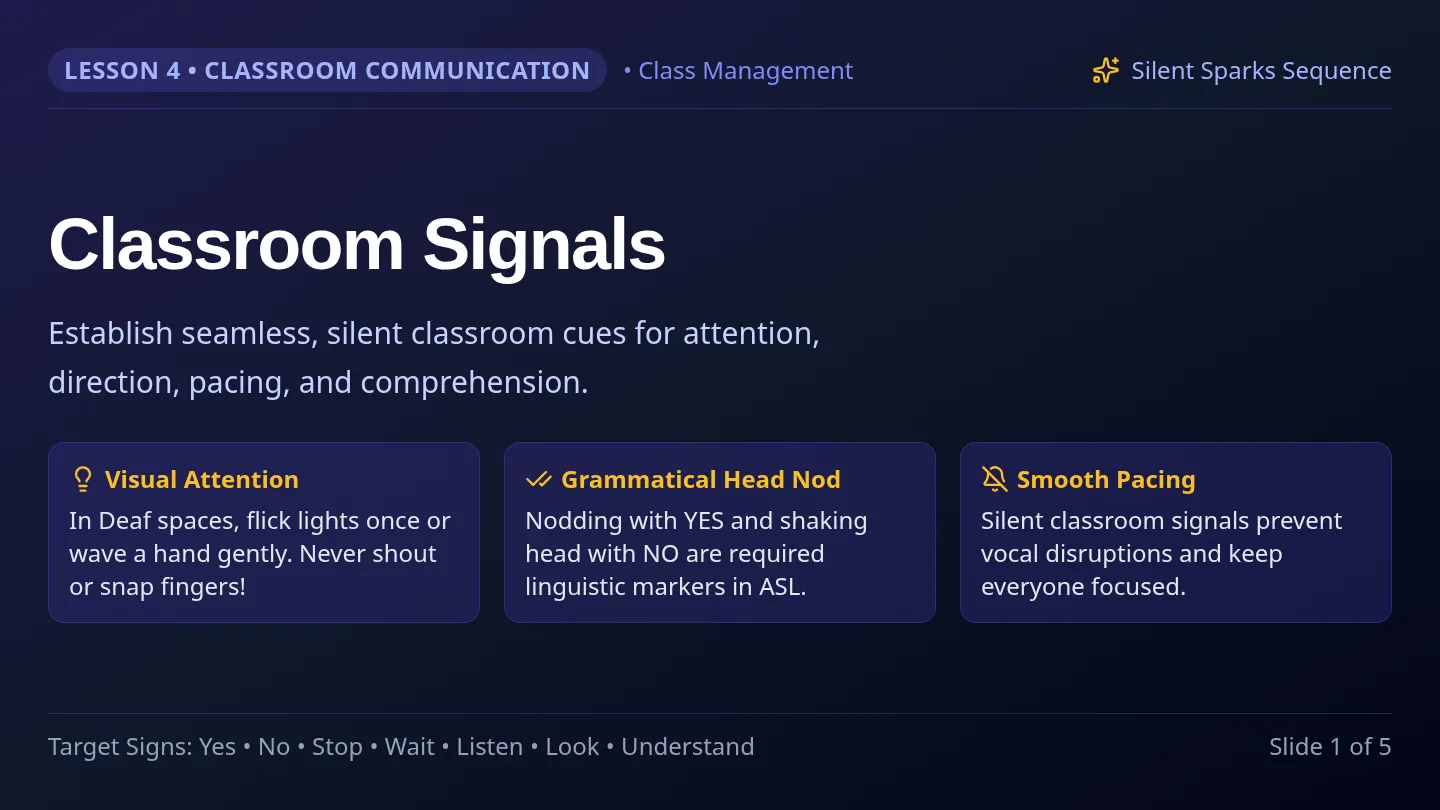
Class Signals Slides Lesson 4 • Classroom Communication • Class Management
Silent Sparks Sequence
Classroom Signals
Establish seamless, silent classroom cues for attention, direction, pacing, and comprehension.
Visual Attention
In Deaf spaces, flick lights once or wave a hand gently. Never shout or snap fingers!
Grammatical Head Nod
Nodding with YES and shaking head with NO are required linguistic markers in ASL.
Smooth Pacing
Silent classroom signals prevent vocal disruptions and keep everyone focused.
Target Signs: Yes • No • Stop • Wait • Listen • Look • Understand Slide 1 of 5
Responses
Yes & No
Grammatical Affirmatives
YES S-Handshape
Handshape: Closed fist ('S' handshape)
Movement: Fist nods up and down at wrist like a head nodding
Non-Manual Rule: Must nod your actual head simultaneously
Tip: Fist literally represents a nodding head!
NO Snap Handshape
Handshape: Index and middle fingers extended together
Movement: Snap down onto the thumb firmly once or twice
Non-Manual Rule: Shake your head side-to-side with a firm brow
Tip: Mimics lips closing sharply together
Crucial: Shaking your head while signing NO is mandatory ASL grammar! Slide 2 of 5
Classroom Control
Stop & Wait
Boundary Signals
STOP Chop Motion
Setup: Non-dominant hand flat palm up at chest level
Action: Dominant flat hand brings pinky edge down in a sharp chop
Meaning: An instant, definitive physical boundary
Class Use: Pause activity immediately
WAIT Wiggle Fingers
Setup: Both hands held open with palms facing upward/inward
Action: Wiggle fingers continuously in place
Meaning: Patient pause; hold on a moment
Class Use: Teacher queueing questions or turns
Practice drill: Teacher signs STOP, then WAIT, then prompts a student. Slide 3 of 5
Perception & Cognition
Listen, Look & Understand
Class Signals Practice Sheet ASL Foundations • Lesson 4
Class Signals Practice Sheet
Name:
Date:
Cultural Attention Getting: In Deaf classrooms, get someone's attention by gently tapping their shoulder, waving in their peripheral vision, or flicking the overhead lights. Never shout, stomp aggressively, or snap fingers!
1 Classroom Signals Matching
Match each classroom sign to its accurate physical handshape and movement.
1. STOP
2. WAIT
3. LOOK
4. UNDERSTAND
A. Fist near temple flicks index finger straight up like a bulb turning on.
B. Flat hand chops firmly down onto the open palm of the opposite hand.
C. V-hand fingertips start near eyes and push outward toward target.
D. Both open hands hold palms up while fingers wiggle continuously.
2 Grammatical Affirmatives & Negatives
Describe the simultaneous head movement and hand motion required for each response.
Sign: YES Affirmation
Handshape & wrist movement:
Required head movement:
Sign: NO Negation
Fingers & snapping action:
Required head movement:
3 Silent Class Communication Scenarios
Prompt 1: The teacher is at the board and signs: "STOP • LOOK ME • LISTEN". What should every student do?
Prompt 2: The teacher signs "YOU UNDERSTAND?" with eyebrows raised. Write what you sign if you DO understand, and if you DO NOT understand:
Cumulative Unit Check: Greetings (L1) Needs (L2) Feelings (L3) Signals (L4)
Mastery Verified: ________