Develops advanced character recognition and grammatical fluency through authentic texts like short stories and news summaries. Builds comprehension of nuanced cultural expressions and complex sentence structures.
A comprehensive program for teaching phonological awareness to secondary ELLs, focusing on multisyllabic academic vocabulary and phoneme manipulation.
This sequence bridges the gap between classroom character learning and real-world application for graduate-level learners. By analyzing authentic artifacts like signage, menus, and business cards, students develop the 'environmental literacy' needed to navigate Mandarin-speaking urban and professional spaces.
A specialized sequence for graduate students to master the formal register of Chinese news media. The course covers headline syntax, economic reporting logic, passive structures in incident reports, bias in editorials, and cross-regional news synthesis.
An advanced exploration of Mandarin character structure for graduate students, focusing on the semantic and phonetic logic of HSK 3-4 vocabulary to facilitate rapid lexicon expansion and academic reading skills.
A 5-lesson sequence for 8th Grade Intermediate Mandarin students focused on navigating simplified news, technology vocabulary, and informational text structures in modern Chinese media.
This intermediate Mandarin Chinese sequence focuses on identifying and analyzing complex sentence structures (sequential, concessive, causal, conditional, and simultaneous) to improve reading fluency and logical comprehension in 8th-grade students.
A comprehensive 5-lesson sequence for intermediate Mandarin students to compare the daily lives and educational systems of Chinese and American middle schoolers through authentic-style reading materials.
This 8th-grade Intermediate Mandarin sequence focuses on reading and interpreting practical travel information, from geographic descriptions and weather forecasts to train schedules and attraction brochures. Students develop functional literacy skills to navigate real-world logistical documents in a Chinese-speaking environment.
An intermediate Mandarin Chinese reading sequence for 8th graders that explores traditional folktales and Chengyu. Students analyze narrative structures, use context clues to decode characters, and connect moral lessons to Chinese cultural values.
A project-based sequence for 7th-grade students focusing on interpreting authentic Mandarin Chinese texts, including street signs, menus, stylized fonts, and digital interfaces. Students apply character recognition skills to real-world survival scenarios and create a final travel guide.
A 5-lesson sequence for 7th-grade Mandarin students focusing on the logic of compound words, from simple bigrams to complex idioms (chengyu). Students act as 'Character Architects,' deconstructing and rebuilding vocabulary to master intermediate HSK 3 concepts.
This inquiry-based sequence demystifies the structure of semantic-phonetic characters, which make up the vast majority of the Chinese writing system. Students move from rote memorization to analytical decoding by identifying the 'meaning' component (radical) and the 'sound' component (phonetic) within intermediate-level characters.
Third lesson in the sequence, focusing on identifying and dividing the VC/CV (closed syllable) pattern in academic vocabulary.
Second lesson in the sequence, focusing on identifying and manipulating primary word stress in academic vocabulary.
A comprehensive scope and sequence for teaching phonological awareness to secondary ELLs, focusing on multisyllabic academic vocabulary and phoneme manipulation.
A collection of invitation forms in multiple languages for the English Language Growth Recognition Ceremony, ensuring all families can participate and celebrate student success.
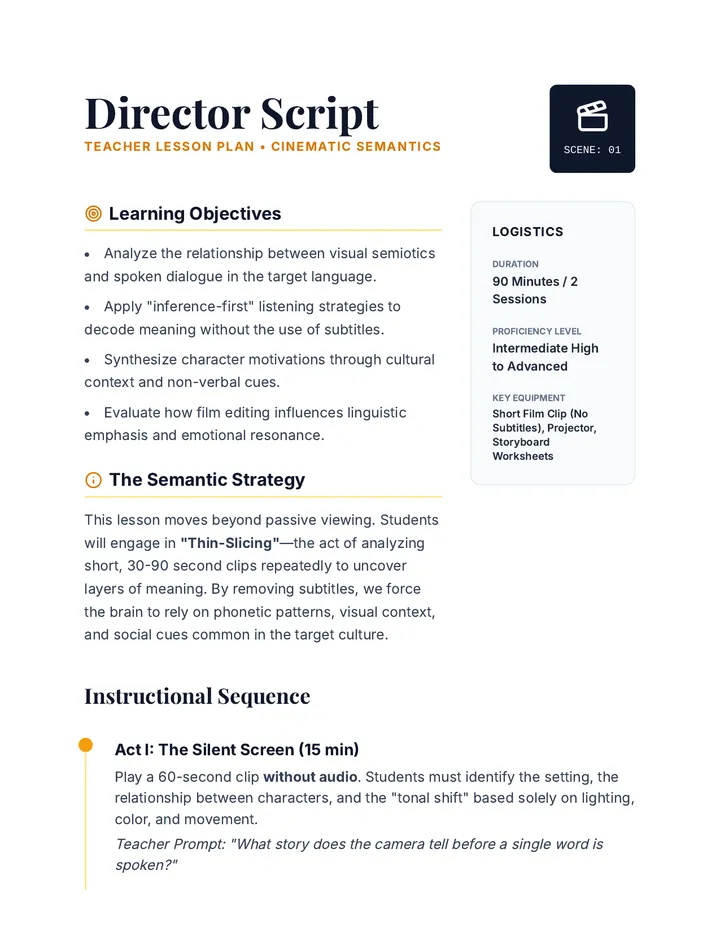
A comprehensive framework for foreign language educators to guide students through deep linguistic and cultural analysis of film, focusing on visual storytelling and advanced listening strategies.

A culminating project where students perform a comprehensive text audit of a specific visual environment, documenting and explaining character functions.
Students practice skimming techniques using newspaper headlines and social media trends to identify proper nouns and high-impact verbs.
This lesson explores the structure of Chinese names and professional titles on business cards to navigate social and professional hierarchies.
Learners analyze authentic menus and receipts to identify food categories and payment terminology, focusing on radical recognition for dietary choices.
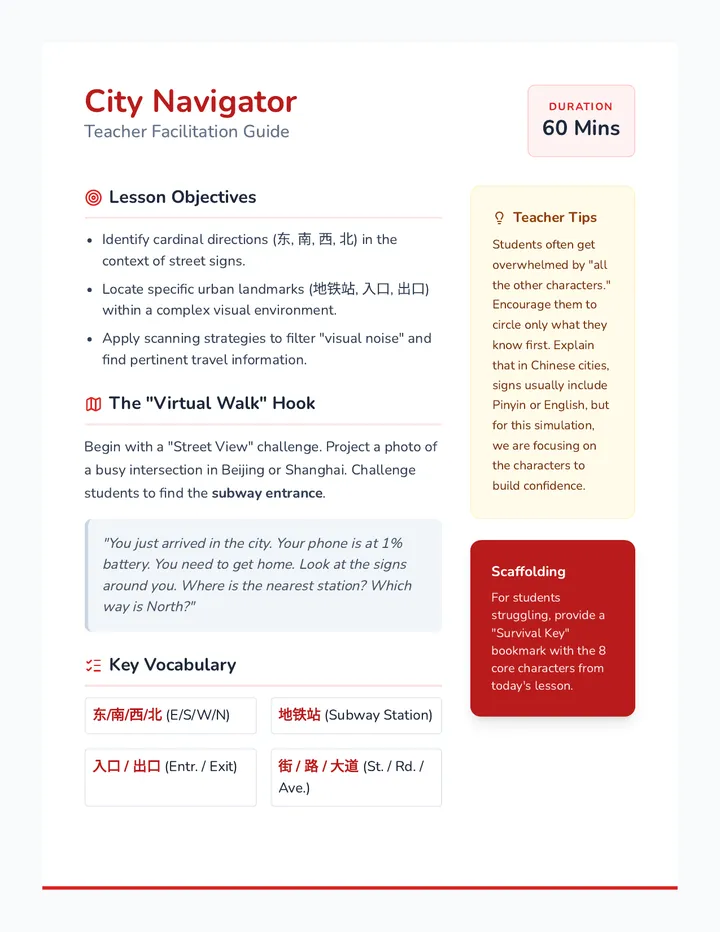
Students simulate navigating a Chinese city by decoding street signs, subway maps, and safety warnings. The lesson emphasizes spotting keywords amidst visual noise.
A culminating simulation where students synthesize information from multiple regional sources to create a professional executive summary of a current event.
Develops critical reading skills to identify subjective language, rhetorical questions, and ideological framing within Chinese editorial and opinion pieces.
Printable assets for Lesson 3, including a Syllable Surgeon word list and a group practice surgery mat with a surgical checklist. Revised for contrast and balance.
Student practice sheet for Lesson 3: Closed Door Divide, featuring VC/CV syllable division exercises and application to science vocabulary. Revised for layout and single-page fit.
Teacher facilitation guide for Lesson 3: Closed Door Divide, focusing on identifying and dividing VC/CV syllable patterns in academic vocabulary. Revised for layout.
Printable assets for Lesson 2, including stress comparison cards for rubber band practice and a 'Stress Mountain' anchor chart visual.
Student practice sheet for Lesson 2: Stress Search, featuring word stress identification exercises and noun/verb stress shift analysis. Revised for casing uniformity and layout.
Teacher facilitation guide for Lesson 2: Stress Search, focusing on identifying primary word stress using kinesthetic rubber band stretching.
Printable assets for Lesson 1, including vocabulary cards and syllable sorting mats. Revised for page-break compliance and asset separation.
Student practice sheet for Lesson 1, featuring instructions for the chin drop method and syllable counting exercises. Revised to fit on a single page.
Teacher facilitation guide for Lesson 1: The Academic Beat, focusing on oral syllable segmentation using the chin drop method. Revised for layout and font size.
A comprehensive reference chart of academic prefixes, roots, and suffixes for secondary ELLs, including meanings and Tier 2/3 vocabulary examples.
A comprehensive inventory chart of physical and digital materials required for each of the 30 Multisyllabic Mastery lessons, designed as a teacher preparation checklist.
A 4-page comprehensive student reference guide for secondary ELLs, covering syllable division patterns, word stress, morphology, and phoneme manipulation strategies with professional visuals.