Sophisticated syntax, formal registers, and classical Chinese influences for complex composition. Develops skills in argumentative essays, professional correspondence, and stylistic nuance.
A comprehensive framework for foreign language educators to guide students through deep linguistic and cultural analysis of film, focusing on visual storytelling and advanced listening strategies.

The sequence concludes with a formal debate where students synthesize learned vocabulary and rhetorical structures to argue for or against specific social policy proposals.
A workshop focused on integrating Chengyu (idioms) and advanced conjunctions to strengthen persuasive arguments and demonstrate cultural erudition in public debate.
Students explore the lexicon of environmental science and government policy, focusing on sustainable development, carbon neutrality, and pollution metrics through policy analysis.
Focusing on demographic trends and the 'aging society,' this lesson introduces terminology for healthcare policy, pension systems, and the 'silver economy' using statistical analysis.
Students examine the vocabulary surrounding China's rapid urbanization and the household registration (hukou) system, focusing on socioeconomic terminology and academic reading comprehension.
A culminating simulation where students synthesize information from multiple regional sources to create a professional executive summary of a current event.
Develops critical reading skills to identify subjective language, rhetorical questions, and ideological framing within Chinese editorial and opinion pieces.
Analyzes the specific usage of 'ba' and 'bei' structures in formal reports of crime, accidents, and legal proceedings to clarify agency and impact.
Explores formal logical connectors (shumianyu) used in financial and economic journalism to express causation, concession, and sequential logic.
Focuses on the high-density syntax of Chinese news headlines, teaching students to decode abbreviations and expand compressed phrases into full grammatical structures.
Students synthesize their skills by producing a short, handwritten professional bio or cover letter. They then digitize this text, ensuring perfect character selection, effectively bridging their handwriting and digital typing skills.
A professional assessment rubric titled 'Critical Cut Rubric' for educators to evaluate student film analysis across visual, linguistic, and cultural dimensions.
An advanced graphic organizer titled 'Storyboard Scribe' where students map critical film frames, transcribe dialogue, and perform deep semantic analysis.
A student-facing worksheet titled 'Scene Spotlight' used for deconstructing film clips in three stages: visual narrative, linguistic anchors, and cultural synthesis.
A visually striking slide deck for instruction on 'Cinematic Semantics', guiding students through visual-first analysis, auditory processing, and thin-slicing techniques.
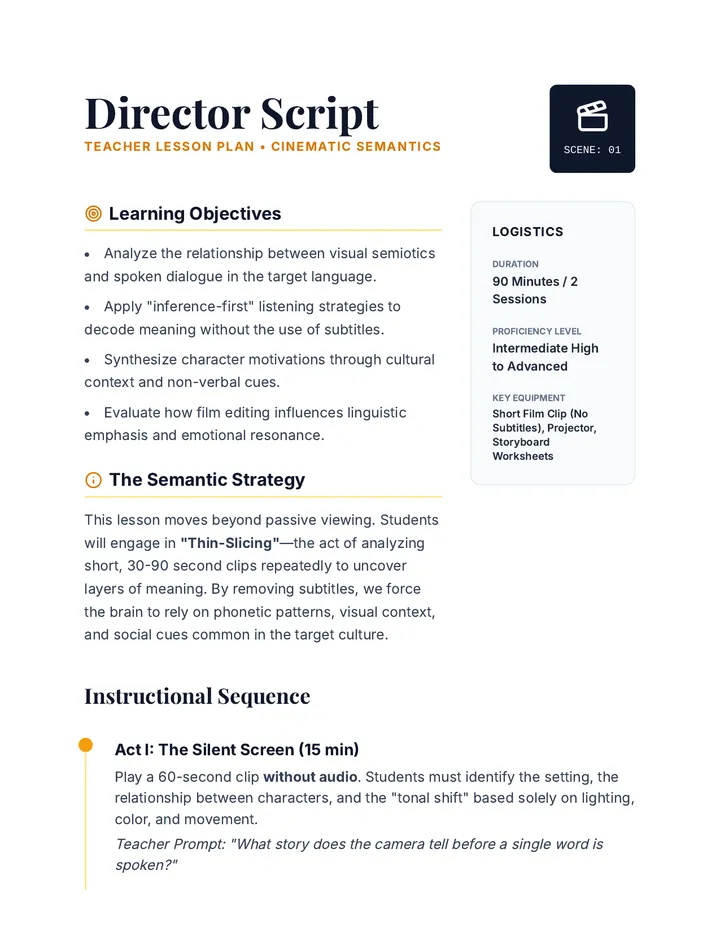
A detailed lesson plan for educators titled 'Director Script' that provides a pedagogical framework for analyzing film in the foreign language classroom through three 'Acts' of deconstruction.
Facilitator guide for the final structured debate, including a suggested script for the moderator, classroom management tips, and differentiation strategies.
Detailed evaluation rubric for the final social policy debate, focusing on language accuracy, logic, rhetoric, and teamwork.
Debate preparation toolkit for Lesson 5, guiding students through argument mapping, rhetorical planning, and anticipating counter-arguments.
Visual presentation for Lesson 5, outlining the structured debate format, potential social policy topics, and evaluation criteria for the final assessment.
Facilitator guide for Lesson 4, including pedagogical strategies for using idioms in debate, classroom activity instructions, and common student error alerts.
Worksheet for Lesson 4 featuring idiom mastery cards, rhetorical refinement exercises, and a writing workshop for logical connectives.
Visual presentation for Lesson 4, focusing on powerful idioms (chengyu) and rhetorical strategies for academic and public debate in Mandarin.
This advanced Mandarin Chinese sequence for graduate students focuses on analyzing contemporary social issues through the lens of sophisticated rhetoric and four-character idioms (chengyu). Students explore urbanization, demographic shifts, and environmental policy to build a high-level academic vocabulary and persuasive argumentation skills.
A specialized sequence for graduate students to master the formal register of Chinese news media. The course covers headline syntax, economic reporting logic, passive structures in incident reports, bias in editorials, and cross-regional news synthesis.
A sequence for graduate students focusing on advanced Mandarin narrative techniques, rhetorical strategies, and descriptive mastery to bridge the gap between functional language and expressive fluency.
A comprehensive series for graduate students to master formal Mandarin communication within Chinese corporate environments. This sequence covers hierarchical protocol, negotiation tactics, the cultural nuances of 'face', formal written registers, and high-stakes meeting facilitation.
A graduate-level sequence focused on the mechanics of Mandarin character production, bridging the gap between traditional handwriting discipline and modern digital input efficiency. Students refine stroke order, spatial balance, and digital literacy through workshops and professional projects.
A graduate-level sequence exploring the subtle nuances of Mandarin Chinese synonyms. Students analyze emotional coloring, register, fixed collocations, academic precision, and the art of brevity to achieve advanced proficiency in character selection.
This advanced Mandarin course explores the linguistic structure, historical origins, and modern rhetorical applications of Chengyu (four-character idioms). Students transition from rote memorization to sophisticated deployment of classical allusions in academic and professional contexts.
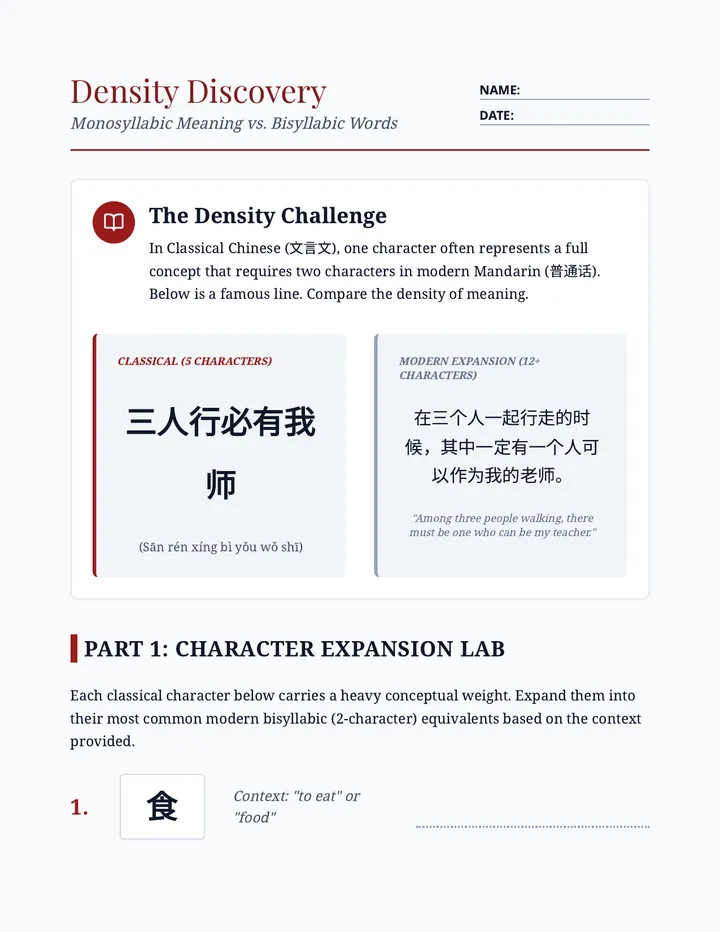
An advanced Mandarin Chinese sequence for graduate students focusing on the formal written register (Shumianyu). Students master monosyllabic roots, formal connectors, business/legal lexicon, and newspaper headline compression to achieve professional-level literacy.
A graduate-level sequence exploring the philological evolution of Chinese characters, from Oracle Bone script to modern academic vocabulary, focusing on etymological logic to deepen semantic understanding.
This advanced Mandarin Chinese sequence explores the aesthetic and expressive potential of Chinese characters in literature. Students analyze sensory imagery, rhythmic cadences, and symbolic naming to understand how masters of modern prose and poetry evoke emotion through precise character selection.
This sequence explores how digital media reshapes the usage, memory, and form of Chinese characters, covering character amnesia, internet slang, and linguistic resistance. It is designed for undergraduate students of advanced Mandarin.
An advanced exploration of Mandarin Chinese morphology, focusing on how characters combine as bound and free morphemes to form complex vocabulary. Students will master word formation logic, quasi-affixes, and abbreviation strategies to decode unfamiliar terms and create neologisms.