Fundamental Pinyin pronunciation, tone accuracy, and essential daily greetings. Develops foundational conversational skills through self-introductions and basic sentence patterns for common social interactions.
Printable assets for Lesson 3, including a Syllable Surgeon word list and a group practice surgery mat with a surgical checklist. Revised for contrast and balance.
Student practice sheet for Lesson 3: Closed Door Divide, featuring VC/CV syllable division exercises and application to science vocabulary. Revised for layout and single-page fit.
Teacher facilitation guide for Lesson 3: Closed Door Divide, focusing on identifying and dividing VC/CV syllable patterns in academic vocabulary. Revised for layout.
Printable assets for Lesson 2, including stress comparison cards for rubber band practice and a 'Stress Mountain' anchor chart visual.
Student practice sheet for Lesson 2: Stress Search, featuring word stress identification exercises and noun/verb stress shift analysis. Revised for casing uniformity and layout.
Teacher facilitation guide for Lesson 2: Stress Search, focusing on identifying primary word stress using kinesthetic rubber band stretching.
Printable assets for Lesson 1, including vocabulary cards and syllable sorting mats. Revised for page-break compliance and asset separation.
Student practice sheet for Lesson 1, featuring instructions for the chin drop method and syllable counting exercises. Revised to fit on a single page.
Teacher facilitation guide for Lesson 1: The Academic Beat, focusing on oral syllable segmentation using the chin drop method. Revised for layout and font size.
A comprehensive reference chart of academic prefixes, roots, and suffixes for secondary ELLs, including meanings and Tier 2/3 vocabulary examples.
A comprehensive inventory chart of physical and digital materials required for each of the 30 Multisyllabic Mastery lessons, designed as a teacher preparation checklist.
A 4-page comprehensive student reference guide for secondary ELLs, covering syllable division patterns, word stress, morphology, and phoneme manipulation strategies with professional visuals.
Third lesson in the sequence, focusing on identifying and dividing the VC/CV (closed syllable) pattern in academic vocabulary.
Second lesson in the sequence, focusing on identifying and manipulating primary word stress in academic vocabulary.
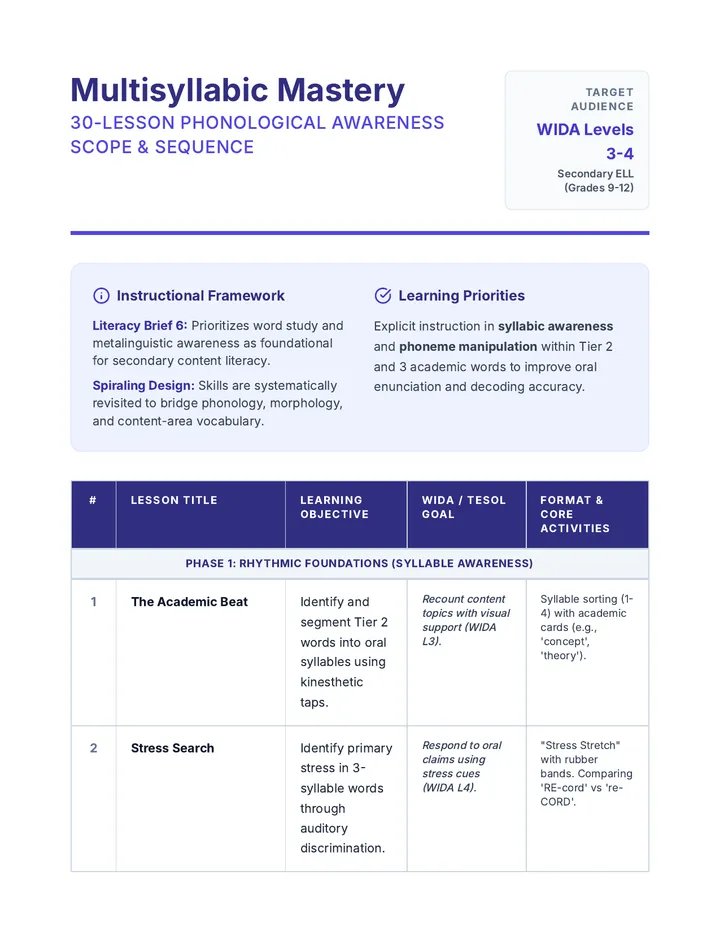
A comprehensive scope and sequence for teaching phonological awareness to secondary ELLs, focusing on multisyllabic academic vocabulary and phoneme manipulation.
Foundational lessons designed to establish common learning routines (PASAPORTE, REISE, TABI) and introduce the philosophy of cultural empathy and language acquisition.
The final unit showcase where students present their cultural research and linguistic progress.
A comprehensive program for teaching phonological awareness to secondary ELLs, focusing on multisyllabic academic vocabulary and phoneme manipulation.
A comprehensive introductory unit for 8th-grade Spanish, focusing on global geography, essential communication, and rich cultural traditions through a 'Cultural Passport' lens.
A sequence focused on leveraging digital translation tools for language self-assessment and speech improvement. Students learn to use Google Translate not just for translation, but as a 'mirror' for their own pronunciation, grammar, and fluency.
A high-energy Mandarin Chinese sequence for Pre-K students using the Total Physical Response (TPR) method. Students learn to respond to physical commands and action verbs through games and movement, building direct meaning without translation.
A foundational Mandarin Chinese sequence for Pre-K students focused on identifying family members. Students learn vocabulary for parents, siblings, and grandparents through interactive games, songs, and visual inquiry.
A Pre-K sequence focused on teaching basic Mandarin greetings and social etiquette through play, puppets, and a final tea party synthesis. Students learn phrases for hello, goodbye, thank you, and sorry in a culturally immersive environment.
A 5-lesson sequence for Pre-K students to learn basic self-introduction in Mandarin Chinese, covering name, gender, age, and personal preferences using simple sentence patterns.
A foundational sequence for Pre-K learners to explore the four tones of Mandarin Chinese through auditory play, physical movement, and vocal exploration. Students learn to associate pitch changes with meaning using relatable sounds like questioning 'Huh?' or firm 'No!' gestures.
A physical and auditory introduction to the four Mandarin tones for Pre-K learners, using movement, animal analogies, and games to make pitch concrete.
A project-based sequence for 7th graders to master basic Mandarin characters through their school environment. Students progress from naming individual objects to designing and labeling a complete classroom layout.
A foundational sequence for 5th graders to master Mandarin Chinese sentence structure using high-frequency verbs and pronouns through a 'Flipped' and 'Simulation' approach.
This sequence introduces Kindergarten students to Mandarin Chinese characters for numbers 1-10 through visual mnemonics, hand gestures, and playful simulations. Students progress from simple horizontal lines to complex symbols, culminating in a classroom shop and Bingo game to reinforce character recognition.