Presentación Visual Mundo Abierto Mundo Abierto
UNIDAD DE INTRODUCCIÓN AL ESPAÑOL
Explorando 21 Países y una Cultura Global
1. El Mundo Hispano
Maestros del Mapa
¿Dónde es oficial el español?
España (Europa)
México (N. América)
Centroamérica (7)
Sudamérica (9)
Guinea Ecuatorial
Caribe (3)
¿Sabías qué?
¡Estados Unidos tiene la **segunda mayor** población de hispanohablantes en el mundo—superando a la propia España!
Proyecto: Maravillas del Mundo
Muestra tu viaje por el mundo hispanohablante. ¿Qué te pareció más hermoso? ¿Qué te sorprendió más?
¡Buen Viaje! • ¡Adelante!
Map Masters Lesson Slides Map Masters
Mission 01: The Chosen Land
Finding Our Place
Global Spanish
Discovery Map
ESPAÑA
LAS AMÉRICAS (19 Countries)
G.E.
3 Continents • 21 Nations
Fact Check:
"Spanish is the second most spoken native language on the planet, with half a billion voices."
Discussion:
Why do you think Spanish traveled to so many different continents?
Acción: Photo Detectives
Talk
Modern Cities
Example: Buenos Aires
The Andes Sierra
Example: Peru / Ecuador
Prompt: Which landscape would you prefer to explore and why?
Salida: Mission Log
"I have chosen _____________________ because its geography is _____________________."
¡BUEN VIAJE!
Map Masters Teacher Guide Teacher Facilitation Guide
Lesson 1: Map Masters • 45 Minute Mission
Instructional Pacing
05m
Enfoque
15m
Entrada
20m
Acción
05m
Salida
00-05m: The Hook (Enfoque)
Display the "Photo A vs. Photo B" slide. Script: "Welcome explorers! One image shows modern Spain, the other the ancient Andes. Both speak Spanish. Discuss with your partner: How does the environment change how a culture looks and feels?"
05-20m: Discovery (Entrada)
Use the "21 Nations" slide. Direct Instruction: Spanish spans 3 continents. Introduce the 4 major regions. Action: Students use the high-contrast map on their Activity Sheet to identify and color the major regions as you call them out.
20-40m: Mission Launch (Acción)
Guide students to Part II of the sheet. Facilitation: "Browse the photo gallery cards. Select your Mission Location. You must identify 3 landscape traits (e.g., mountains, beach, jungle) to use in your final PBA project."
40-45m: Confirmation (Salida)
Check for understanding. Check: Can they name the only Spanish-speaking country in Africa? (Equatorial Guinea). Collect or stamp their "Mission Logs."
Differentiation & Scaffolding
Support:
Provide a "Picture Word Bank" with Spanish geography terms (e.g., image of a jungle labeled selva ).
Challenge:
Ask students to research one famous mountain peak or river in their chosen country to add detail.
© 2026 Mundo Abierto • Lesson 1 Facilitation Manual
Map Masters Activity Sheet v2 Mission Map 01: Map Masters
Phase 1: Location Discovery
Explorador:
Fecha:
I. Mapping the 21
Listen & Label
ESPAÑA
Europe
19 NATIONS
The Americas
G.E.
Africa
Connect your location to the correct region above.
II. Mission Selection
PBA Prep
Selected Destination (Country):
Capital City:
Landmark Sketch
III. Landscape Analysis
Identify 3 Key Geography Traits for your PBA Project:
1
2
3
Phase 1 Mission Entry Complete?
SÍ
NO
Guía del Maestro Map Masters (ES) Guía de Facilitación para el Maestro
Lección 1: Map Masters • Misión de 45 Minutos
Cronograma de Clase (Pacing)
05m
Enfoque
15m
Entrada
20m
Acción
05m
Salida
00-05m: El Gancho (Enfoque)
Guion: "¡Bienvenidos exploradores! El español no es solo un idioma, es una conexión entre continentes. Miren estas dos imágenes. Una es una ciudad de alta tecnología en Europa; la otra es un pico de montaña antiguo en Sudamérica. Ambas son 'españolas'. ¿Cómo es posible? Discutan con su compañero."
05-20m: Descubrimiento (Entrada)
Instrucción Directa: El español se habla oficialmente en 21 países en 3 continentes. Presente las 4 regiones principales: España, México/Caribe, Centroamérica y Sudamérica. Acción: Los estudiantes colorean las regiones en su hoja de actividades mientras usted las menciona.
20-40m: Lanzamiento de Misión (Acción)
Facilitación: Naveguen por las tarjetas de la galería de fotos. Elijan su Ubicación de Misión para el proyecto final. Deben identificar 3 rasgos del paisaje (ej. montañas, playa, selva) para usarlos en su proyecto final de Evaluación Basada en Proyectos (PBA).
40-45m: Confirmación (Salida)
Verificación: ¿Pueden nombrar el único país hispanohablante en África? (Guinea Ecuatorial). Los estudiantes completan su diario de misión en la diapositiva final.
Diferenciación y Apoyo
Soporte (Apoyo):
Proporcione un banco de palabras visual con términos de geografía en español (ej. montaña, playa, selva, ciudad).
Desafío (Extensión):
Pida a los estudiantes que investiguen un "falso cognado" geográfico o una característica única de su país elegido.
© 2026 Mundo Abierto • Manual del Maestro - Lección 1
Map Masters Lesson Slides v2 Map Masters
Mission 01: The Chosen Land
Finding Our Place
The 21 Nations
Select One
GLOBAL REACH
Caribbean
Cuba
R. Dominicana
Puerto Rico
N. & C. AMERICA
México
Guatemala
El Salvador
Honduras
Nicaragua
Costa Rica
Panamá
SOUTH AMERICA
Colombia
Venezuela
Ecuador
Perú
Bolivia
Paraguay
Chile
Argentina
Uruguay
Acción: Photo Detectives
Talk
Compare Landmarks
The Andes (Snow & Peak)
VS.
The Caribbean (Sun & Sand)
Mission Focus
Think about your chosen country. Is it cold or hot? Arid or lush? This defines your final project's style!
Discuss: "How does the landscape of a country change what people eat or wear?"
Salida: Mission Log
"I have chosen _____________ because its geography is _____________."
¡BUEN VIAJE!
Hola Harmony Lesson Slides Hola Harmony
Mission 02: Polite Intros
Connecting through Respect
Enfoque: Principal or Peer?
Hook
Option A: Formal
"Good morning, Professor."
Option B: Informal
"Hey! What's up?"
Discuss: When do you switch your style?
Entrada: The "Respect" Code
Input
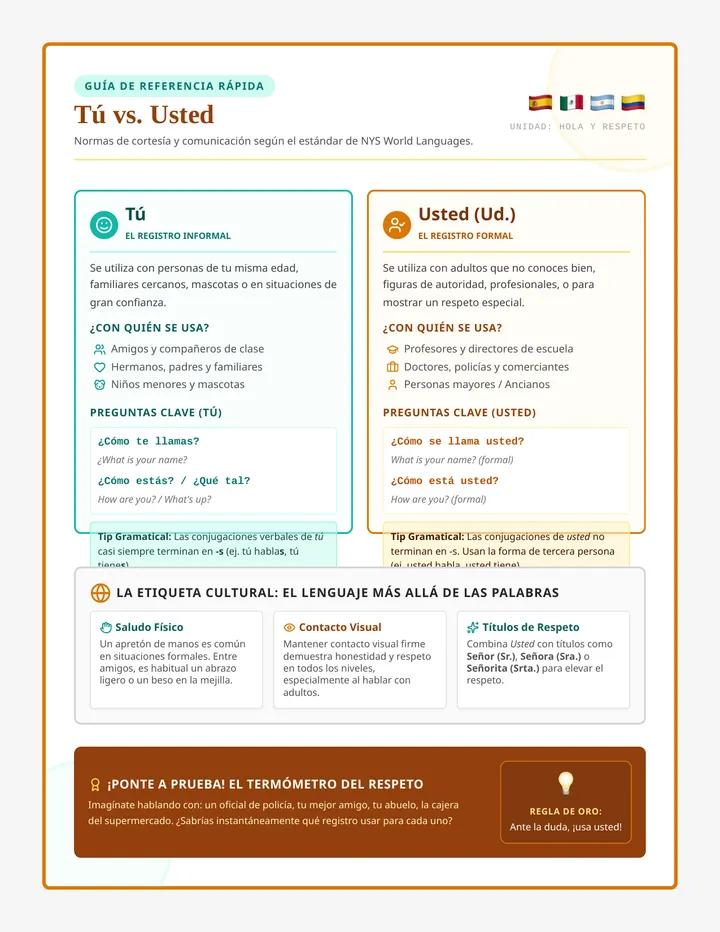
TÚ
Informal
Friends, family, pets, and people younger than you.
¿Cómo estás?
USTED
Formal
Strangers, elders, teachers, and people in authority.
¿Cómo está usted?
Acción: Welcome Scripts
Talk
PBA Mission Step:
1 Pick your project location context.
2 Draft 3 lines of a welcome dialogue.
3 Practice your pronunciation!
Partner Drill:
Salida: First Draft
"One greeting I will use for my mission is _____________."
Next Mission: Numbers!
Hola Harmony Teacher Guide (EN) Teacher Facilitation Guide
Lesson 2: Hola Harmony • 45 Minute Mission
Instructional Pacing
05m
Enfoque
15m
Entrada
20m
Acción
05m
Salida
00-05m: Social Cues (Enfoque)
Display Slide 2. Script: "Explorers, social navigation is as important as map navigation. Look at these two scenarios (Handshake vs. Wave). Which one requires a handshake? Which one a simple wave? Discuss with your partner how greetings change based on respect."
05-20m: The Register Code (Entrada)
Use Slide 3. Introduce the concept of Tú vs. Usted .Key Point: Most Spanish-speaking cultures have distinct 'formal' and 'informal' grammar levels.Vocabulary: ¡Hola!, ¿Cómo estás?, ¿Cómo está usted?, Buenos días, Mucho gusto. Activity: Quick drill—shout out a persona (e.g., "The President!", "Your Puppy!") and have students hold up a 'T' (Tú) or 'U' (Usted) hand sign.
20-40m: Dialogue Draft (Acción)
Direct students to their Activity Sheet .Community Welcome Skit or Travel Snapshot .Circulate: Listen for the distinction between estás and está . Provide immediate corrective feedback on pronunciation.
40-45m: Review (Salida)
Students write one formal greeting and one informal farewell. Check for Understanding: Why would we use Usted with a shopkeeper we just met? (Respect, distance, strangers).
Differentiation & Scaffolding
Support:
Provide a sentence starter sheet with 'fill-in-the-blank' dialogue templates for the welcome skit.
Challenge:
Ask students to research one regional-specific greeting (e.g., ¿Qué onda? in Mexico vs. ¿Qué tal? in Spain).
© 2026 Mundo Abierto • Lesson 2 Facilitation Manual
Hola Harmony Activity Sheet v2 Mission Prep 02
Phase 1: Polite Intros
Explorador:
Fecha:
I. Choose Your Register
Tú vs. Usted
1. Su mejor amigo (Best friend)
□ Tú □ Usted
2. La directora (Principal)
□ Tú □ Usted
3. Un policía (Police officer)
□ Tú □ Usted
4. Su abuela (Grandmother)
□ Tú □ Usted
II. Welcome Dialogue
PBA Mission Task
Draft 3 lines of dialogue to welcome a guest to your country:
A:
B:
A:
Mission Prep Draft Complete?
SÍ
NO
Sound Squad Lesson Slides Sound Squad
Mission 03: Phonetic Power
The Music of Spanish
Enfoque: The Rhythm Match
Hook
English Sound
"H"
As in "Hello"
Spanish "H"
Silent
As in "Hola"
Discuss: Why is pronunciation the key to culture?
Entrada: Special Guests
Input
Ñ
"ny" sound
Like "Canyon"
LL
"y" sound
Like "Yes"
RR
Trill
Rolled Tongue
Acción: Spelling Duel
Talk
Your Mission:
1 Partner A says a common Spanish name.
2 Partner B spells it in Spanish letter names.
3 Switch and repeat!
Names to Duel:
Salida: Sound Check
"One Spanish letter sound that is different from English is _____________."
Next Mission: Numbers 0-100!
Sound Squad Lesson Slides v2 Sound Squad
Mission 03: Phonics Lab
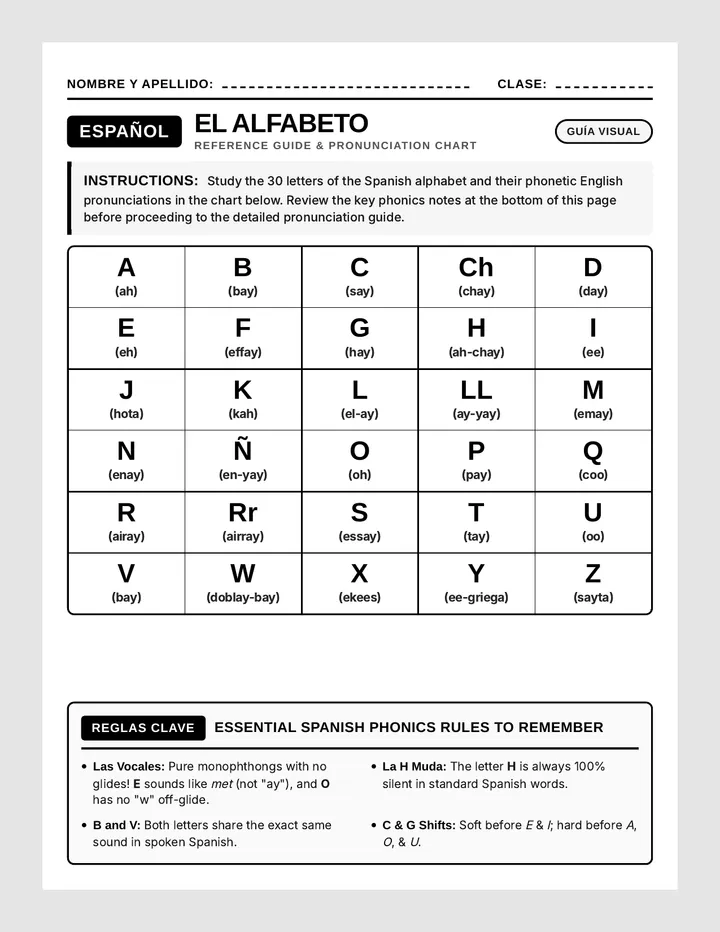
Mastering the Spanish Alphabet
El Alfabeto
Phonetics
A
ah
B
be
C
ce
D
de
E
eh
F
efe
G
ge
H
MUTE
I
ee
J
hota
L
ele
M
eme
N
ene
Ñ
enye
O
oh
P
pe
Q
cu
R
ere
S
ese
T
te
U
oo
V
uve
X
equis
Y
i-griega
Z
zeta
The "Extra" Sounds
Specialists
Ñ
Enye
Like "Cany on"
LL
Elle
Like "Y ellow"
RR
Erre
The "Rolling R"
CH
Che
Like "Ch ocolate"
Acción: Duel Key
Talk
Practice Word List:
1. Hola (h-mute)
2. Perro (rr)
3. Llama (ll)
4. Niño (ñ)
5. Gracias (g-c)
Battle Ready?
Partner A spells, Partner B writes. Check the spelling against this list!
Salida: Mission Check
Listen as Profe spells 3 mystery names.
Next Mission: Numbers!
Sound Squad Teacher Guide (EN) v2 Teacher Facilitation Guide
Lesson 3: Sound Squad • 45 Minute Mission
Instructional Pacing
05m
Enfoque
15m
Entrada
20m
Acción
05m
Salida
00-05m: The Rhythm (Enfoque)
Display Slide 2. Script: "Sound Squad, attention! Spanish is musical. Listen to this alphabet chant. Clap every time you hear a sound that doesn't exist in English."
05-20m: The Lab (Entrada)
Instruction: Introduce Special Guests (Ñ, LL, RR, CH).Vowels: ah, eh, ee, oh, oo.Echo Drill: Teacher says letter name; students repeat words like Mañana or Perro .
20-40m: Spelling Duel (Acción)
Pairs: Student A spells their name or country; Student B writes in the Activity Sheet grid. Swap. Management: Every 5 minutes, call "Battle Switch!" to keep the energy high.
40-45m: Dictation (Salida)
Spell 3 words for recording: 1. M-E-X-I-C-O , 2. P-E-R-U , 3. E-S-P-A-Ñ-A .
Differentiation & Support
Support:
Alphabet cheat sheets with English phonetics (e.g., J = jota).
Challenge:
Silent 'H' rule words: Hijo , Hacer , Huevo .
© 2026 Mundo Abierto • Lesson 3 Facilitation Guide
Sound Squad Teacher Guide (EN) Teacher Facilitation Guide
Lesson 3: Sound Squad • 45 Minute Mission
Instructional Pacing
05m
Enfoque
15m
Entrada
20m
Acción
05m
Salida
00-05m: Phonic Shifting (Enfoque)
Display Slide 2. Script: "Explorers, every language has its own heartbeat or rhythm. Sometimes a letter looks the same but sounds completely different—or doesn't sound at all! Look at the letter 'H'. Why do we say 'Hello' with a breath but 'Hola' with silence? Discuss with your partner why consistent sounds matter in a language."
05-20m: The Alphabet Code (Entrada)
Use Slide 3. Introduce the Spanish Alphabet .Key Point: Spanish is phonetic—it sounds exactly like it looks.The 'Special Guests': Highlight Ñ (enye), LL (eye), and RR (erre).Drill: Model the sounds and have students echo. Use the "Alphabet Chant" (A-B-C... in Spanish names: Ah, Beh, Ceh...).
20-40m: Spelling Duel (Acción)
Direct students to their Activity Sheets .Activity: Partners take turns spelling common names.Guidance: "Partner A, say the name Guillermo. Partner B, spell it out: G-U-I-L-L-E-R-M-O using Spanish letter names."Challenge: See if anyone can roll their R's for the 'RR' in Rodrigo.
40-45m: Sound Check (Salida)
Students complete the "Salida" on the slide. Verfication: Can they produce the 'ñ' sound correctly in the word 'Español'?
Differentiation & Scaffolding
Support:
Provide a phonetic "cheat sheet" (e.g., A = ah, E = eh) for students to reference during the spelling duel.
Challenge:
Ask students to spell their own names, including middle or last names, using only Spanish letter names.
© 2026 Mundo Abierto • Lesson 3 Facilitation Manual
Guía del Maestro Sound Squad (ES) Guía de Facilitación para el Maestro
Lección 3: Sound Squad • Misión de 45 Minutos
Cronograma de Clase
05m
Enfoque
15m
Entrada
20m
Acción
05m
Salida
00-05m: Cambio Fonético (Enfoque)
Guion: "¡Exploradores! Cada idioma tiene su propio ritmo. A veces una letra se ve igual pero suena diferente. Miren la 'H'. ¿Por qué decimos 'Hello' con aire pero 'Hola' en silencio? Discutan por qué los sonidos constantes son importantes."
05-20m: El Código del Alfabeto (Entrada)
Instrucción Directa: El español es fonético: suena exactamente como se escribe. Presente los 'Invitados Especiales': Ñ, LL, RR. Acción: Modele los sonidos y haga que los estudiantes repitan el canto del alfabeto.
20-40m: Duelo de Deletreo (Acción)
Facilitación: Los compañeros se turnan para deletrear nombres comunes usando los nombres de las letras en español (ej. Guillermo: Ge-u-i-elle-e-erre-eme-o). Fomente que intenten vibrar la lengua para la 'RR'.
40-45m: Verificación (Salida)
Verificación: ¿Pueden producir el sonido 'ñ' correctamente en la palabra 'Español'? Los estudiantes completan su boleto de salida.
Diferenciación y Apoyo
Soporte:
Proporcione una guía fonética visual (ej. A = ah, E = eh) para referencia durante el duelo de deletreo.
Desafío:
Pida a los estudiantes que deletreen sus nombres completos usando solo los nombres de las letras en español.
© 2026 Mundo Abierto • Manual del Maestro - Lección 3
Guía del Maestro Sound Squad (ES) v2 Guía de Facilitación para el Maestro
Lección 3: Sound Squad • Misión de 45 Minutos
Cronograma de Clase (Pacing)
05m
Enfoque
15m
Entrada
20m
Acción
05m
Salida
00-05m: El Ritmo (Enfoque)
Guion: "¡Sound Squad, atención! El español es un idioma musical. Escuchen este canto rítmico. Aplaudan cada vez que escuchen un sonido que no existe en inglés."
05-20m: Fonética (Entrada)
Instrucción Directa: Las vocales (ah, eh, ee, oh, oo) son constantes. Presente Ñ, LL, RR. Use Slide 3 para ejemplos visuales.
20-40m: Duelo de Deletreo (Acción)
En parejas, un estudiante deletrea un país o nombre propio y el otro escribe. Use la lista en Slide 4 como referencia para los estudiantes.
40-45m: Dictado (Salida)
Clave del Dictado: 1. MÉXICO, 2. PERÚ, 3. ESPAÑA.
Apoyo Pedagógico
Apoyo:
Hojas de referencia con sonidos fonéticos simplificados para cada letra.
Desafío:
Uso de la 'h' muda y distinción entre 'b' y 'v' en deletreo avanzado.
© 2026 Mundo Abierto • Guía del Maestro - Lección 3
Sound Squad Activity Sheet Mission Map 03
Activity: Sound Squad Duel
Explorador:
Fecha:
I. Phonics Reference
Special Guests
Ñ
Enye
Sound: "ny"
LL
Elle
Sound: "y"
RR
Erre
Sound: Trill
II. Spelling Duel
Active Talk
Spell these names to your partner using the Spanish letter names:
1. GUILLERMO
2. RODRIGO
3. IÑIGO
4. ELENA
5. CARLOS
YOUR NAME
Phonetic Power Complete?
SÍ
NO
Sound Squad Activity Sheet v2 Mission Prep 03
Phase 1: Sound Squad Lab
Explorador:
Fecha:
I. The Sound Core
Trace & Say
A
E
I
O
U
Practice the constant Spanish vowel sounds:
(AH)(EH)(EE)(OH)(OO)
II. The Spelling Duel
Mission Prep
Spell your destination country out loud. Partner writes it here:
Did your partner get the unique sounds correct?
III. Salida: Dictation Check
Write the names the Profe spells out loud:
1
2
3
Sound Squad Lab Training Complete?
SÍ
NO
Sound Squad Lesson Slides v2 Sound Squad
Mission 03: Phonics Lab
Mastering the Spanish Alphabet
El Alfabeto
Phonetics
A
ah
B
be
C
ce
D
de
E
eh
F
efe
G
ge
H
mute
I
ee
J
jota
K
ka
L
ele
M
eme
N
ene
Ñ
enye
O
oh
P
pe
Q
cu
R
ere
S
ese
T
te
U
oo
V
uve
W
uve-doble
X
equis
Y
i-griega
Z
zeta
Acción: Duel Key
Talk
Word Bank:
1. Hola (Silent H)
2. Perro (Trilled RR)
3. Llama (Y sound LL)
4. Niño (NY sound Ñ)
5. Gracias (Soft C)
Battle Ready?
Partner A spells, Partner B writes.
Teacher Example Writing Zone
Number Ninjas Lesson Slides Number Ninjas
Mission 04: Counting Context
The Value of Language
Enfoque: The Price is Right
Hook
A Ticket in Spain
€ 15,00
"Quince Euros"
A Taco in Mexico
$ 45,00
"Cuarenta y cinco pesos"
Discuss: How much do items cost in your chosen country?
Entrada: Numeric Patterns
Input
The First 15
Unique names. Memorize these like a code! (Uno to Quince)
The "Y" Bridge
After 30, we use "Y" (And).Treinta y uno Cuarenta y dos
The Tens
Diez, Veinte, Treinta, Cuarenta, Cincuenta...
Acción: Shopkeepers
Talk
PBA Prep:
1 Identify 5 items for your Menu or Flyer.
2 Assign a realistic local price.
3 Practice saying: "¿Cuánto cuesta?"
Partner Drill:
Salida: Price Tag
"One item on my mission project is ________________ and it costs _____________."
Next Mission: The Calendar!
Number Ninjas Lesson Slides v2 Number Ninjas
Mission 04: The Global Vault
Counting from 0 to 100
Level 1: 0-20
Input
0-5
cero, uno, dos, tres, cuatro, cinco
6-10
seis, siete, ocho, nueve, diez
11-15
once, doce, trece, catorce, quince
16-20
dieciséis, diecisiete... veinte
"11-15 are unique! Memorize these first to unlock the vault."
Level 2: 30-100
Input
30
treinta
40
cuarenta
50
cincuenta
60
sesenta
70
setenta
80
ochenta
90
noventa
100
CIEN
The "Y" Code (31-99):
Treinta
y
dos
=
32
The Marketplace
Currencies
Money Talk:
El Peso: Mexico, Arg, Col...
El Euro: España
El Dólar: US, Ecuador, Panama
"Local currency makes your project authentic."
Acción: Lotería
Game
1. Fill your 5x5 grid with random numbers (0-100).
Listen For:
"Sesenta y cinco... Ochenta y dos..."
5x5 Grid Layout
GRATIS
Number Ninjas Teacher Guide (EN) v2 Teacher Facilitation Guide
Lesson 4: Number Ninjas • 45 Minute Mission
Instructional Pacing
05m
Enfoque
15m
Entrada
20m
Acción
05m
Salida
00-05m: Currency Check (Enfoque)
Display Slide 2. "Ninjas, today we enter the global marketplace. Look at these prices for a taco and a drink. Spanish speakers use Pesos and Euros. Why do numbers matter in a project about travel or food?"
05-20m: The 0-100 Vault (Entrada)
Use Slide 3. Teach the counting patterns.Core Numbers: 0-15 (Unique names). 16-19 (Dieci + number).Tens: veinte, treinta, cuarenta... cien.The "Y" Rule: Explain that 21 is *veintiuno* (merged) while 31 is *treinta y uno* (separated).
20-40m: Lotería / PBA Prep (Acción)
Students fill their grid on the Activity Sheet.The Game: Call numbers randomly. Students cross them out.PBA Link: After the game, students must assign 5 currency prices for their chosen project (e.g., flight price for Snapshot, entree price for Menu).
40-45m: Market Check (Salida)
Call out 3 random prices (e.g., "setenta y dos pesos"). Students write the digits (72) in their mission log.
Differentiation & Support
Support:
Provide a number reference chart (0-100) for the Lotería game to reduce processing load.
Challenge:
Have advanced students calculate "Total Price" for a 3-item order in their target currency.
© 2026 Mundo Abierto • Lesson 4 Facilitation Guide
Number Ninjas Teacher Guide (EN) Teacher Facilitation Guide
Lesson 4: Number Ninjas • 45 Minute Mission
Instructional Pacing
05m
Enfoque
15m
Entrada
20m
Acción
05m
Salida
00-05m: Currency Check (Enfoque)
Display Slide 2. Script: "Ninjas, numbers are the bridge to trade. Look at these items from Spain and Mexico. What do you notice about the prices? Discuss with your partner: Is a burger that costs '45' expensive or cheap? It depends on the currency!"
05-20m: The Number Grid (Entrada)
Use Slide 3. Teach 0-100 focusing on patterns.Phase 1: 0-15 (The unique names).Phase 2: 16-29 (The Dieci- and Veinti- contractions).Phase 3: 30-100 (The y bridge: Treinta y uno ).Activity: Rapid Fire Count—clap once for every '10' (Diez, Veinte...).
20-40m: Price Matching (Acción)
Direct students to their Activity Sheets .Activity: Assign prices to 5 project items.Student Talk: Partners ask "¿Cuánto cuesta?" and the other responds in full Spanish numbers.Circulate: Ensure they are using the y correctly in numbers like 45 (cuarenta y cinco ).
40-45m: Review (Salida)
Students complete their Mission Logs. Verification: Can they identify the number "75" (setenta y cinco ) if you call it out?
Differentiation & Scaffolding
Support:
Provide a "Tens Chart" (10, 20, 30...) to help students build larger numbers with the y bridge.
Challenge:
Ask students to calculate a "Total Price" for three items in Spanish.
© 2026 Mundo Abierto • Lesson 4 Facilitation Manual
Guía del Maestro Number Ninjas (ES) Guía de Facilitación para el Maestro
Lección 4: Number Ninjas • Misión de 45 Minutos
Cronograma de Clase (Pacing)
05m
Enfoque
15m
Entrada
20m
Acción
05m
Salida
00-05m: El Mercado (Enfoque)
Guion: "¡Ninjas! Hoy entramos al mercado global. Miren los precios. Los hispanohablantes usan Pesos y Euros. ¿Por qué son importantes los números al viajar o comer?"
05-20m: Los Números 0-100 (Entrada)
Enseñe los patrones:Decenas: veinte, treinta, cuarenta, cincuenta, sesenta, setenta, ochenta, noventa, cien.La Regla de la "Y": Del 31 al 99 se usa "y" (ej. sesenta y siete).
20-40m: Lotería y PBA (Acción)
Llenar cuadrícula de Lotería (Bingo).PBA: Asignar precios reales (moneda local) para 3 elementos de su proyecto final.
40-45m: Verificación (Salida)
Dictado de precios: "setenta y cinco pesos", "noventa y un euros".
Apoyo Pedagógico
Apoyo:
Tabla de referencia numérica visual para el juego de Lotería.
Desafío:
Realizar cálculos de suma total en la moneda elegida.
© 2026 Mundo Abierto • Guía del Maestro - Lección 4
Guía del Maestro Number Ninjas (ES) Guía de Facilitación para el Maestro
Lección 4: Number Ninjas • Misión de 45 Minutos
Cronograma de Clase
05m
Enfoque
15m
Entrada
20m
Acción
05m
Salida
00-05m: Verificación de Moneda (Enfoque)
Guion: "¡Ninjas! Los números son el puente para el comercio. Miren estos precios de España y México. ¿Qué notan? Discutan: ¿Un taco que cuesta '45' es caro o barato? ¡Depende de la moneda!"
05-20m: La Cuadrícula de Números (Entrada)
Instrucción Directa: Enseñe del 0 al 100 enfocándose en patrones: los primeros 15, las contracciones del 20 (veinti-), y el puente 'y' a partir del 30.
20-40m: Emparejamiento de Precios (Acción)
Facilitación: Asignen precios a 5 artículos de su proyecto. Los estudiantes practican preguntar '¿Cuánto cuesta?' y responder en español completo.
40-45m: Verificación (Salida)
Verificación: ¿Pueden identificar el número '75' (setenta y cinco) si lo digo en voz alta? Completen sus diarios de misión.
Diferenciación y Apoyo
Soporte:
Proporcione una tabla de decenas (10, 20, 30...) para ayudar a construir números más grandes.
Desafío:
Pida a los estudiantes que calculen un 'Precio Total' para tres artículos en español.
© 2026 Mundo Abierto • Manual del Maestro - Lección 4
Number Ninjas Activity Sheet v2 Mission Prep 04
Phase 2: The Global Vault
Explorador:
Fecha:
I. Number Foundations
Base 10
10
diez
20
veinte
30
treinta
100
cien
II. Lotería Grid
Bingo 0-100
GRATIS
III. PBA: Market Entry
3 Mission Items
List 3 items and their local currency price:
Item 1: ____________________
PRICE:$
Item 2: ____________________
PRICE:$
Item 3: ____________________
PRICE:$
The Global Vault Mission Complete?
SÍ
NO
Number Ninjas Activity Sheet Mission Map 04
Activity: Price Point Prep
Explorador:
Fecha:
I. Number Patterns
Input Task
Write the Spanish name for these key numbers:
15:
20:
31:
50:
II. Price Match
PBA Task
List 4 items for your project and their cost in local currency:
Item 1 Name:
Cost (in Spanish):
Item 2 Name:
Cost (in Spanish):
Item 3 Name:
Cost (in Spanish):
Item 4 Name:
Cost (in Spanish):
Price Point Draft Complete?
SÍ
NO
Calendar Crew Lesson Slides Calendar Crew
Mission 05: Scheduling Life
Navigating the Year
Enfoque: Spot the Change
Hook
Standard US
Starts on Sunday
Mundo Hispano
Starts on Monday
"Lunes"
Discuss: Why would a week start on Monday?
Entrada: The Cycle
Input
Verano
Summer
Otoño
Fall
Invierno
Winter
Primavera
Spring
"When it is winter in Spain, it is summer in Argentina!"
Acción: Schedule a Party
Talk
Mission Prep:
1 Pick a holiday for your project.
2 Find the date and month in Spanish.
3 Practice saying: "La fiesta es el..."
Partner Drill:
Salida: Calendar Check
"The date of my project mission event is _____________."
Next Mission: The Weather!
Calendar Crew Teacher Guide (EN) Teacher Facilitation Guide
Lesson 5: Calendar Crew • 45 Minute Mission
Instructional Pacing
05m
Enfoque
15m
Entrada
20m
Acción
05m
Salida
00-05m: Calendar Clues (Enfoque)
Display Slide 2. Script: "Crew, time is felt differently everywhere. In many Spanish-speaking countries, the calendar doesn't start on Sunday—it starts on Lunes (Monday). Why do you think that is? Discuss with your partner how this small change affects your work week."
05-20m: The Cycle of Time (Entrada)
Use Slide 3. Teach Days, Months, and Seasons .Key Point: Days and Months are not capitalized in Spanish (lunes, enero ).Hemisphere Flip: Highlight that seasons are opposite in the Southern Hemisphere (e.g., Chile's Christmas is in Summer).Activity: Rapid Fire Seasons—shout out a month and have students point North (US season) or South (opposite season).
20-40m: Event Scheduling (Acción)
Direct students to their Activity Sheets .Activity: Students schedule one event (Fiesta, Trip, or Meal) for their project mission.Student Talk: Partners ask "¿Cuándo es?" and respond with the date: "Es el [Número] de [Mes]." Circulate: Ensure they are using the correct date format: Day + Month.
40-45m: Review (Salida)
Students complete their Mission Logs. Verification: Can they say today's date in full Spanish?
Differentiation & Scaffolding
Support:
Provide a visual calendar with the months and days labeled to assist with spelling and order.
Challenge:
Ask students to explain how they would pack differently for a trip to Argentina in July vs. a trip to Spain in July.
© 2026 Mundo Abierto • Lesson 5 Facilitation Manual
Guía del Maestro Calendar Crew (ES) Guía de Facilitación para el Maestro
Lección 5: Calendar Crew • Misión de 45 Minutos
Cronograma de Clase
05m
Enfoque
15m
Entrada
20m
Acción
05m
Salida
00-05m: Pistas del Calendario (Enfoque)
Guion: "¡Equipo! El tiempo se siente diferente en todas partes. En el mundo hispano, la semana empieza el Lunes. ¿Por qué creen que es así? Discutan cómo esto afecta su semana laboral."
05-20m: El Ciclo del Tiempo (Entrada)
Instrucción Directa: Enseñe los días, meses y estaciones. Punto clave: no se usan mayúsculas para días y meses en español. Explique la diferencia de estaciones entre hemisferios.
20-40m: Programación de Eventos (Acción)
Facilitación: Los estudiantes programan un evento para su misión. Practican preguntar '¿Cuándo es?' y responden con el formato de fecha: 'Es el [Día] de [Mes]'.
40-45m: Verificación (Salida)
Verificación: ¿Pueden decir la fecha de hoy completa en español? Los estudiantes completan su boleto de salida.
Diferenciación y Apoyo
Soporte:
Proporcione un calendario visual con los nombres de los meses para ayudar con la ortografía.
Desafío:
Pida a los estudiantes que expliquen qué empacarían para un viaje a Chile en Julio vs. España en Julio.
© 2026 Mundo Abierto • Manual del Maestro - Lección 5
Calendar Crew Activity Sheet Mission Map 05
Activity: Date Design
Explorador:
Fecha:
I. Days of the Week
Input Task
Fill in the missing days (Start with Monday!):
LUNES
MIÉRCOLES
VIERNES
DOMINGO
II. Event Schedule
PBA Task
Choose a specific holiday or event for your mission project:
Mission Event Name:
Day (el [Número]):
Month (de [Mes]):
Formula: "El evento es el [Día] de [Mes]."
Date Design Complete?
SÍ
NO
Climate Check Lesson Slides Climate Check
Mission 06: Regional Weather
The Spirit of the Skies
Enfoque: The Celsius Scale
Hook
A Hot Day in Madrid
38° C
"Is that freezing or boiling?"
Winter in Chile
4° C
In Celsius, 0° is Freezing
Entrada: Weather Talk
Input
Hace calor It's hot
Hace frío It's cold
Hace sol It's sunny
Está nublado It's cloudy
Llueve It rains
Nieva It snows
Acción: Forecast Skits
Talk
Your Mission:
1 Create a forecast for your mission city.
2 Use 2 weather terms and 1 temperature.
3 "Broadcast" it to your partner.
Partner Drill:
Salida: Climate Log
"In my project location, the typical weather is _____________."
Next Mission: Flavor Finders!
Climate Check Teacher Guide (EN) Teacher Facilitation Guide
Lesson 6: Climate Check • 45 Minute Mission
Instructional Pacing
05m
Enfoque
15m
Entrada
20m
Acción
05m
Salida
00-05m: The Hot/Cold Paradox (Enfoque)
Display Slide 2. Script: "Explorers, a number without a scale is a mystery. Look at these temperatures from Madrid and Chile. 38 degrees sounds like a cool day in Fahrenheit, but it's boiling in Celsius! Discuss with your partner why global explorers must master the Celsius scale."
05-20m: Weather Vocabulary (Entrada)
Use Slide 3. Introduce Weather Expressions .Key Point: Most weather uses the verb 'Hacer' (To make/do). Hace calor = It makes heat.The 'Hace' Exception: Note that 'Llueve' (It rains) and 'Nieva' (It snows) are their own verbs.Drill: Mimic gestures for each weather type (fan for heat, shiver for cold) and have students call out the phrase.
20-40m: Forecast Skits (Acción)
Direct students to their Activity Sheets .Activity: Partners create a 30-second weather broadcast for their chosen project city.Student Talk: One student is the "Reporter" and the other is the "Viewer." Switch.Circulate: Listen for the distinction between Hace sol and Está nublado .
40-45m: Review (Salida)
Students write today's weather in full Spanish. Verification: If I say "Nieva," what clothes should I wear?
Differentiation & Scaffolding
Support:
Provide icons alongside the Spanish phrases on a reference sheet to help visual learners during the skit.
Challenge:
Ask students to research the "Average High" and "Average Low" for their city in Celsius and include them in the broadcast.
© 2026 Mundo Abierto • Lesson 6 Facilitation Manual
Guía del Maestro Climate Check (ES) Guía de Facilitación para el Maestro
Lección 6: Climate Check • Misión de 45 Minutos
Cronograma de Clase
05m
Enfoque
15m
Entrada
20m
Acción
05m
Salida
00-05m: La Paradoja Frio/Calor (Enfoque)
Guion: "¡Exploradores! Un número sin escala es un misterio. Miren estas temperaturas de Madrid y Chile. 38 grados suena fresco en Fahrenheit, ¡pero es hirviendo en Celsius! Discutan por qué debemos dominar la escala Celsius."
05-20m: Vocabulario del Tiempo (Entrada)
Instrucción Directa: Introduzca expresiones del tiempo. Punto clave: la mayoría usa el verbo 'Hacer' (ej. Hace calor). Note las excepciones 'Llueve' y 'Nieva'.
20-40m: Reporte del Clima (Acción)
Facilitación: Los compañeros crean una transmisión del clima de 30 segundos para su ciudad elegida. Uno es el reportero y el otro el espectador.
40-45m: Verificación (Salida)
Verificación: Los estudiantes escriben el tiempo de hoy en español completo. Si digo 'Nieva', ¿qué ropa debo usar?
Diferenciación y Apoyo
Soporte:
Proporcione iconos junto a las frases en español en una hoja de referencia para los aprendices visuales.
Desafío:
Pida a los estudiantes que investiguen la temperatura máxima y mínima promedio de su ciudad.
© 2026 Mundo Abierto • Manual del Maestro - Lección 6
Climate Check Activity Sheet Mission Map 06
Activity: Climate Check Forecast
Explorador:
Fecha:
I. Weather Logic
Identify
Hace Sol
Llueve
Hace Frío
Nieva
II. Regional Forecast
PBA Task
Draft a 2-line forecast for your chosen project city:
Broadcast City & Country:
The Weather Script (e.g., "Hoy en Madrid, hace sol."):
Temperature (Celsius):
Climate Log Entry Complete?
SÍ
NO
Flavor Finders Lesson Slides Flavor Finders
Mission 07: Culinary Traditions
The Soul of the Table
Enfoque: Dinner at 10 PM?
Hook
Standard US
Dinner: 6:00 PM
Spain & Argentina
Dinner: 9:00 - 11:00 PM
"La Cena"
Discuss: Why is the midday meal (La Comida) the largest?
Entrada: Menu Pillars
Input
El Plato Principal
Main Course
La Bebida
Drink
El Postre
Dessert
"Sobremesa: The tradition of staying at the table to talk after eating."
Acción: Menu Masters
Talk
Mission Prep:
1 Select a signature dish for your mission location.
2 Research its key ingredients.
3 "Pitch" your menu to your partner.
Partner Drill:
Salida: Menu Log
"One authentic food from my project mission is _____________."
Next Mission: Rhythms!
Flavor Finders Teacher Guide (EN) Teacher Facilitation Guide
Lesson 7: Flavor Finders • 45 Minute Mission
Instructional Pacing
05m
Enfoque
15m
Entrada
20m
Acción
05m
Salida
00-05m: The Table Clock (Enfoque)
Display Slide 2. Script: "Flavor finders, the dinner plate is a mirror of culture. In Spain, dinner starts when you might be going to bed! Discuss with your partner: Why is the large midday meal (La Comida) better for social life than a large evening meal?"
05-20m: The Menu Logic (Entrada)
Use Slide 3. Introduce Culinary Categories & Customs .Key Point: Sobremesa —the non-negotiable hour of talking after the meal.Vocabulary: El Plato Principal, La Bebida, El Postre, La Cuenta (The Bill). Activity: Roleplay the "Sobremesa." Give pairs 1 minute to talk about their "day" without standing up from their seats.
20-40m: Menu Masters (Acción)
Direct students to their Activity Sheets .Activity: Design a mini-menu for their chosen country mission.Student Talk: One student acts as the "Chef" describing the special dish, and the other is the "Critic."Circulate: Ensure they are researching authentic dishes (e.g., Paella for Spain, Mofongo for Puerto Rico).
40-45m: Review (Salida)
Students complete their Mission Logs. Verification: Ask a student to define "Sobremesa" in their own words.
Differentiation & Scaffolding
Support:
Provide a set of "Food Cards" with pictures and Spanish names (Pollo, Arroz, Frijoles) to build their menu.
Challenge:
Ask students to find one "Indigenismos" food word (e.g., words from Nahuatl like chocolate or tomate ).
© 2026 Mundo Abierto • Lesson 7 Facilitation Manual
Guía del Maestro Flavor Finders (ES) Guía de Facilitación para el Maestro
Lección 7: Flavor Finders • Misión de 45 Minutos
Cronograma de Clase
05m
Enfoque
15m
Entrada
20m
Acción
05m
Salida
00-05m: El Reloj de la Mesa (Enfoque)
Guion: "¡Exploradores! En España, la cena empieza cuando muchos ya se van a dormir. Discutan: ¿Por qué la comida fuerte del mediodía es mejor para la vida social que una cena pesada?"
05-20m: Lógica del Menú (Entrada)
Instrucción Directa: Presente las categorías culinarias. Punto clave: 'Sobremesa'—la hora innegociable de charla después de comer.
20-40m: Maestros del Menú (Acción)
Facilitación: Diseñen un mini-menú para su país de misión. Practiquen presentar su 'plato estrella' a su compañero.
40-45m: Verificación (Salida)
Verificación: Los estudiantes completan su diario de misión. ¿Pueden definir 'Sobremesa' en sus propias palabras?
Diferenciación y Apoyo
Soporte:
Proporcione tarjetas con imágenes y nombres de alimentos (ej. arroz, pollo) para construir su menú.
Desafío:
Pida a los estudiantes que investiguen un 'indigenismo' culinario (ej. palabras de origen náhuatl como chocolate).
© 2026 Mundo Abierto • Manual del Maestro - Lección 7
Flavor Finders Activity Sheet Mission Map 07
Activity: Culinary Design
Explorador:
Fecha:
I. Menu Pillars
Identify
Translate the menu headers for your project:
Drink:
Main Dish:
Dessert:
II. Signature Dish
PBA Task
Draft a description for your menu's "Plate of the House":
Name of the Dish:
Key Ingredient 1:
Key Ingredient 2:
Food Illustration
Flavor Profile Draft Complete?
SÍ
NO
Rhythm Rebels Lesson Slides Rhythm Rebels
Mission 08: Soundscapes
The Beat of the Heart
Enfoque: The Genre Map
Hook
Flamenco
Spain
Mariachi
Mexico
Salsa
Caribbean
Discuss: How does the music change the mood of a room?
Entrada: Lyric Detectives
Input
Listen for Cognates:
Musica
Ritmo
Instrumento
Guitarra
Danza
Voz
Acción: Clave & Echo
Talk
The Rhythmic Mission:
1 Partners create a 4-beat rhythm.
2 Perform it using claps or taps.
3 "Pitch" your project's music style.
Partner Drill:
Salida: Sound Log
"One traditional instrument I heard today is _____________."
Next Mission: Canvas Culture!
Rhythm Rebels Teacher Guide (EN) Teacher Facilitation Guide
Lesson 8: Rhythm Rebels • 45 Minute Mission
Instructional Pacing
05m
Enfoque
15m
Entrada
20m
Acción
05m
Salida
00-05m: Genre Identification (Enfoque)
Display Slide 2. Script: "Rebels, music is the voice of history. Look at these three icons: Flamenco, Mariachi, and Salsa. Each one comes from a very different land. Discuss with your partner: Which one feels like 'home' to you, and which feels like a 'new world'?"
05-20m: Cognate Hunting (Entrada)
Use Slide 3. Play a simple Spanish song (e.g., 'La Bamba').Key Point: You already know more Spanish than you think!Activity: Point out words like Musica, Ritmo, Danza on the slide.Drill: Students write down any word they 'hear' that sounds like English while the music plays.
20-40m: Rhythm Echo (Acción)
Direct students to their Activity Sheets .Activity: Partners create a simple 4-beat rhythm (claps, snaps, stomps).Student Talk: One student "performs" and the other "reflects" on the mood (Excited? Calm? Fierce?).Circulate: Ensure they connect their rhythm to their chosen project country (e.g., a fast beat for a city project).
40-45m: Sound Check (Salida)
Students complete their Sound Logs. Verification: Ask them to name one instrument common in Hispanic music (Guitarra, Maracas, Trumpet).
Differentiation & Scaffolding
Support:
Provide a printed lyric sheet with the cognates already highlighted for students with processing needs.
Challenge:
Ask students to find the difference between a 'Guitarra' and a 'Vihuela' (used in Mariachi).
© 2026 Mundo Abierto • Lesson 8 Facilitation Manual
Guía del Maestro Rhythm Rebels (ES) Guía de Facilitación para el Maestro
Lección 8: Rhythm Rebels • Misión de 45 Minutos
Cronograma de Clase
05m
Enfoque
15m
Entrada
20m
Acción
05m
Salida
00-05m: Identificación de Géneros (Enfoque)
Guion: "¡Rebeldes! La música es la voz de la historia. Miren estos tres iconos: Flamenco, Mariachi y Salsa. Cada uno viene de una tierra diferente. Discutan: ¿Cuál les hace sentir 'en casa'?"
05-20m: Cazadores de Cognados (Entrada)
Instrucción Directa: ¡Ya saben más español de lo que creen! Punto clave: Las palabras como 'Musica' y 'Ritmo' son casi iguales al inglés.
20-40m: Eco Rítmico (Acción)
Facilitación: Los compañeros crean un ritmo de 4 tiempos (aplausos, toques). Fomente que conecten el ritmo con su país de misión.
40-45m: Verificación (Salida)
Verificación: Los estudiantes completan su diario de sonidos. Nombren un instrumento común en la música hispana.
Diferenciación y Apoyo
Soporte:
Proporcione una letra impresa con los cognados ya resaltados.
Desafío:
Pida a los estudiantes que busquen la diferencia entre una 'Guitarra' y una 'Vihuela'.
© 2026 Mundo Abierto • Manual del Maestro - Lección 8
Rhythm Rebels Activity Sheet Mission Map 08
Activity: Rhythm Rebels Echo
Explorador:
Fecha:
I. Sound Cognates
Identify
Identify 4 music words that sound like English:
II. Mission Sound
PBA Task
What style of music represents your project mission city?
Musical Genre:
One Key Instrument:
Describe the Mood (Adjectives):
Mission Sound Profile Complete?
SÍ
NO
Canvas Culture Lesson Slides Canvas Culture
Mission 09: Artistic Symbols
Seeing the Unseen
Enfoque: The Cubist Lens
Hook
Picasso's Vision
"Art is the lie that enables us to realize the truth."
Symbol Spotting
Hidden Meanings
"Bull, Candle, Bird."
Entrada: Visual Vocab
Input
El Toro
The Bull (Strength/Chaos)
El Caballo
The Horse (The People)
La Vela
The Candle (Hope/Truth)
Acción: Modern Muralists
Talk
Symbolic Mission:
1 Select a theme for your Culture Display.
2 Choose 1 animal or object symbol.
3 "Pitch" its meaning to your partner.
Partner Drill:
Salida: Art Log
"One symbol in my project mission represents _____________."
Next Mission: Fiesta Feast!
Canvas Culture Teacher Guide (EN) Teacher Facilitation Guide
Lesson 9: Canvas Culture • 45 Minute Mission
Instructional Pacing
05m
Enfoque
15m
Entrada
20m
Acción
05m
Salida
00-05m: Seeing Differently (Enfoque)
Display Slide 2. Script: "Artists, art is not just a picture—it's a code. Picasso said art enables us to realize the truth. Look at the icons of the box and the eye. Discuss with your partner: Why would an artist hide a bird or a candle in a painting? What are they trying to 'say' without words?"
05-20m: The Symbolic Dictionary (Entrada)
Use Slide 3. Introduce Hispanic Artistic Symbols .Key Point: Symbols bridge language gaps. Everyone understands a bull represents strength.Vocabulary: El Toro, El Caballo, La Vela, El Mural. Activity: Quick Match—shout out a concept (e.g., "The People!") and have students point to the correct symbol on the slide.
20-40m: Symbol Selection (Acción)
Direct students to their Activity Sheets .Activity: Students select one symbol for their Culture Feature project.Student Talk: Partners explain their symbol choice using the phrase "Mi símbolo es [Símbolo] porque..." Circulate: Ensure they are connecting the symbol to the *meaning* (e.g., a candle for hope in a holiday project).
40-45m: Review (Salida)
Students complete their Art Logs. Verification: Ask a student to name one famous Spanish artist mentioned today (Picasso).
Differentiation & Scaffolding
Support:
Provide a "Symbol Menu" with sketches and 1-word meanings to help students choose their project icon.
Challenge:
Ask students to find one contemporary muralist from Mexico (e.g., Diego Rivera) and compare their style to Picasso's.
© 2026 Mundo Abierto • Lesson 9 Facilitation Manual
Guía del Maestro Canvas Culture (ES) Guía de Facilitación para el Maestro
Lección 9: Canvas Culture • Misión de 45 Minutos
Cronograma de Clase
05m
Enfoque
15m
Entrada
20m
Acción
05m
Salida
00-05m: Ver Diferente (Enfoque)
Guion: "¡Artistas! El arte es un código. Picasso decía que el arte nos ayuda a realizar la verdad. Discutan: ¿Por qué un artista escondería un pájaro o una vela? ¿Qué intentan decir sin palabras?"
05-20m: Diccionario Simbólico (Entrada)
Instrucción Directa: Los símbolos superan las barreras del idioma. Introduzca: El Toro (fuerza), El Caballo (el pueblo), La Vela (esperanza).
20-40m: Selección de Símbolo (Acción)
Facilitación: Los estudiantes eligen un símbolo para su proyecto. Practican la frase: 'Mi símbolo es [Símbolo] porque...'
40-45m: Verificación (Salida)
Verificación: Los estudiantes completan su diario de arte. Nombren un artista famoso mencionado hoy.
Diferenciación y Apoyo
Soporte:
Proporcione un 'Menú de Símbolos' con bocetos para ayudar a elegir su icono.
Desafío:
Pida a los estudiantes que comparen el estilo de Picasso con el de los muralistas mexicanos.
© 2026 Mundo Abierto • Manual del Maestro - Lección 9
Canvas Culture Activity Sheet Mission Map 09
Activity: Artistic Symbolism
Explorador:
Fecha:
I. Visual Vocabulary
Identify
Identify 3 symbols commonly found in Spanish art:
Toro
Caballo
Vela
II. Project Symbol
PBA Task
Draft the symbolic centerpiece for your Culture Display:
Name of Your Symbol:
What does it represent? (Adjectives):
Symbol Sketch Area
Symbol Mastery Complete?
SÍ
NO
Fiesta Feast Lesson Slides Fiesta Feast
Mission 10: Holiday Heritage
The Colors of Celebration
Enfoque: Myth vs. Fact
Hook
The Myth
"Día de los Muertos is just Mexican Halloween."
The Fact
"It is a day of remembrance to honor ancestors with music and joy."
Discuss: Why is it important to learn the "Why" behind a holiday?
Entrada: Traditions
Input
🕯️
Las Ofrendas
Altars with photos and food.
🍇
Las 12 Uvas
Eating 12 grapes for New Year luck.
🤴
Los Tres Reyes
Gift giving on January 6th.
Acción: Comparison
Talk
Your Mission:
1 Pick one Hispanic holiday.
2 Compare it to a US holiday.
3 Use 2 Spanish words to describe it.
Partner Drill:
Salida: Fiesta Log
"One holiday tradition I will feature in my project is _____________."
Next Mission: Daily Routines!
Fiesta Feast Teacher Guide (EN) Teacher Facilitation Guide
Lesson 10: Fiesta Feast • 45 Minute Mission
Instructional Pacing
05m
Enfoque
15m
Entrada
20m
Acción
05m
Salida
00-05m: Deconstructing Myths (Enfoque)
Display Slide 2. Script: "Explorers, often we see another culture's holiday through our own lens. Many people think 'Día de los Muertos' is just a spooky day like Halloween. It's actually the opposite! Discuss with your partner: Why would a culture celebrate death with bright colors and sugar skulls instead of ghosts and scares?"
05-20m: Holiday Highlights (Entrada)
Use Slide 3. Introduce Oshougatsu (New Year), Día de los Reyes, and Las Ofrendas .Key Point: Holidays are about community and connection to the past.Vocabulary: La Fiesta, El Regalo, La Ofrenda, El Pastel. Activity: Quick Sort—place these 3 holidays in chronological order (Year-end, Jan 6, Nov 1/2).
20-40m: Comparison Chart (Acción)
Direct students to their Activity Sheets .Activity: Students create a mini-poster or chart comparing a Hispanic holiday to one from their own culture.Student Talk: Partners use "En [País], celebran..." to describe a unique ritual.Circulate: Ensure they use the correct calendar terms (dates/months) learned in Lesson 5.
40-45m: Review (Salida)
Students complete their Fiesta Logs. Verification: Ask a student to explain what an "Ofrenda" is for.
Differentiation & Scaffolding
Support:
Provide a Venn Diagram template with pre-filled English phrases to help students organize their comparison.
Challenge:
Ask students to research "Las Posadas" and explain the role of a piñata in that specific tradition.
© 2026 Mundo Abierto • Lesson 10 Facilitation Manual
Guía del Maestro Fiesta Feast (ES) Guía de Facilitación para el Maestro
Lección 10: Fiesta Feast • Misión de 45 Minutos
Cronograma de Clase
05m
Enfoque
15m
Entrada
20m
Acción
05m
Salida
00-05m: Desmontando Mitos (Enfoque)
Guion: "¡Exploradores! A veces vemos otras culturas a través de nuestros propios ojos. Muchos piensan que el Día de los Muertos es solo un 'Halloween mexicano'. Discutan con su compañero: ¿Por qué una cultura celebraría la muerte con colores brillantes y alegría en lugar de fantasmas y sustos?"
05-20m: Luces de la Fiesta (Entrada)
Instrucción Directa: Presente las tradiciones clave: Las Ofrendas, las 12 Uvas y los Reyes Magos. Punto clave: Los días festivos tratan sobre la comunidad y la conexión con el pasado.
20-40m: Tabla de Comparación (Acción)
Facilitación: Los estudiantes crean un gráfico comparando una fiesta hispana con una de su propia cultura. Deben usar al menos 2 palabras en español para describir los rituales.
40-45m: Verificación (Salida)
Verificación: Los estudiantes completan su diario de misión. ¿Pueden explicar para qué sirve una 'Ofrenda'?
Diferenciación y Apoyo
Soporte:
Proporcione una plantilla de diagrama de Venn con frases en inglés pre-llenadas para ayudar a organizar la comparación.
Desafío:
Pida a los estudiantes que investiguen el papel de la piñata en la tradición de 'Las Posadas'.
© 2026 Mundo Abierto • Manual del Maestro - Lección 10
Fiesta Feast Activity Sheet Mission Map 10
Activity: Holiday Comparison
Explorador:
Fecha:
I. Celebration Symbols
Identify
Match the ritual to the Spanish term:
🎁
El Regalo
🏮
La Ofrenda
🎊
La Fiesta
II. Holiday Bridge
PBA Task
Compare a Hispanic holiday to a holiday from your home culture:
US Holiday Traits:
Hispanic Holiday Traits:
What do they share?
Holiday Comparison Complete?
SÍ
NO
Routine Radar Lesson Slides Routine Radar
Mission 11: A Day in Life
Social Norms & Daily Rhythms
Enfoque: School Day Flip
Hook
Standard US
"Classes until 3:00 PM, then clubs/sports."
Mundo Hispano
"Going home for lunch at 2 PM—the day splits!"
"La Jornada Partida"
Entrada: Silent Language
Input
👋
Proximity
Standing closer while talking is a sign of trust.
🫂
Greetings
Hugs and cheek-kisses for everyone!
🙅
Formality
Addressing elders with 'Don' or 'Doña'.
Acción: Routine Compare
Talk
Your Mission:
1 Pick one time of day (Morning/Night).
2 Contrast the activities.
3 Use 'Primero' and 'Después'.
Partner Drill:
Salida: Routine Log
"One gesture or social norm I'll use in my welcome skit is _____________."
Final Mission: The Project!
Routine Radar Teacher Guide (EN) Teacher Facilitation Guide
Lesson 11: Routine Radar • 45 Minute Mission
Instructional Pacing
05m
Enfoque
15m
Entrada
20m
Acción
05m
Salida
00-05m: The Split Day (Enfoque)
Display Slide 2. Script: "Explorers, we all have routines, but they look different on the radar. In many Hispanic countries, school or work stops in the afternoon for 'La Jornada Partida'. You go home, eat with family, and then return. Discuss with your partner: Would you prefer one long block or two smaller blocks with a big lunch?"
05-20m: The Invisible Script (Entrada)
Use Slide 3. Introduce Proximity and Gestures .Key Point: Culture is what you do when you aren't thinking.Vocabulary: La Mañana, La Tarde, La Noche, Primero, Después. Activity: The Proximity Test—have students stand and talk. Gradually tell them to step 1 inch closer or further. Discuss where the "Comfort Zone" is in the US vs. Hispanic cultures.
20-40m: Daily Comparison (Acción)
Direct students to their Activity Sheets .Activity: Students map out their "Ideal Day" in their chosen country.Student Talk: Partners compare: "A las ocho, yo estudio. En España, ellos estudian..." Circulate: Listen for sequence words: Primero, Luego, Después, Finalmente.
40-45m: Review (Salida)
Students complete their Routine Logs. Verification: Ask them to demonstrate one gesture that is common in Hispanic greetings.
Differentiation & Scaffolding
Support:
Provide a "Time & Routine" word bank with images of daily tasks (eating, sleeping, school).
Challenge:
Ask students to research the "Siesta" tradition and explain its historical agricultural roots.
© 2026 Mundo Abierto • Lesson 11 Facilitation Manual
Guía del Maestro Routine Radar (ES) Guía de Facilitación para el Maestro
Lección 11: Routine Radar • Misión de 45 Minutos
Cronograma de Clase
05m
Enfoque
15m
Entrada
20m
Acción
05m
Salida
00-05m: El Día Dividido (Enfoque)
Guion: "¡Exploradores! Todos tenemos rutinas, pero en el radar se ven diferentes. En muchos países hispanos existe 'La Jornada Partida'. Discutan: ¿Preferirían un solo bloque escolar largo o dos bloques pequeños con un gran almuerzo en casa?"
05-20m: El Guion Invisible (Entrada)
Instrucción Directa: La cultura es lo que haces sin pensar. Introduzca: La Proximidad (espacio personal) y los Gestos. Enseñe vocabulario de secuencia: Primero, Luego, Después.
20-40m: Comparación de Rutinas (Acción)
Facilitación: Los estudiantes mapean su 'Día Ideal' en su país elegido. Practican comparar sus actividades diarias usando las palabras de secuencia.
40-45m: Verificación (Salida)
Verificación: Los estudiantes completan su diario de rutina. Pídales que demuestren un gesto común en los saludos hispanos.
Diferenciación y Apoyo
Soporte:
Proporcione un banco de palabras de 'Tiempo y Rutina' con imágenes de tareas diarias.
Desafío:
Pida a los estudiantes que investiguen el origen agrícola de la 'Siesta'.
© 2026 Mundo Abierto • Manual del Maestro - Lección 11
Routine Radar Activity Sheet Mission Map 11
Activity: Routine Radar
Explorador:
Fecha:
I. Morning Routine
Sequence
Number these morning tasks (1-4) in Spanish:
Me lavo la cara
Como el desayuno
Me despierto
Voy a la escuela
II. Social Navigation
PBA Task
Identify 2 social norms or gestures you will include in your project:
Norm 1 (e.g. Proximity, Handshake):
Norm 2 (e.g. Greeting slang, Politeness):
"How will this change your welcome skit or travel flyer?"
Routine Radar Complete?
SÍ
NO
Mundo Abierto Teacher Playbook Mundo Abierto
Teacher Planning Playbook
Introductory Spanish • 8th Grade
Instructional Routine
Every lesson in this unit follows the **"PASAPORTE"** routine to build predictability and safe participation:
Hook (5m)
Input (15m)
Talk (20m)
Exit (5m)
1. Map Masters: Geography
Learning Targets
• Locate 21 Spanish-speaking countries.
Success Criteria
• Label map accurately.
Hook: Photo collage of Madrid vs. Macchu Picchu. Guess the continent.
Talk: "Photo Analysis" - Categorize regions by geography clues (mountains vs. islands).
Exit: "Name 3 countries on 3 different continents."
2. Hola Harmony: Greetings
Learning Targets
• Use formal/informal greetings.
Success Criteria
• Choose Tú vs. Usted correctly.
Hook: Handshake vs. Besito video analysis.
Talk: "Greeting Role-Play" - Rotating scenarios (doctor, friend, elder).
Exit: Write 1 formal and 1 informal greeting.
3. Sound Squad: Phonetics
Learning Targets
• Pronounce alphabet sounds.
Success Criteria
• Pronounce LL, Ñ, and RR correctly.
Hook: Rhythm chant of the Spanish alphabet.
Talk: "Spelling Bee Duel" - Partners spell common Spanish names for each other.
Exit: "Spell your name out loud to a peer."
4. Number Ninjas: 0-100
Learning Targets
• Count to 100 with accuracy.
Success Criteria
• Win 2 lines in Spanish Bingo.
Hook: "The Price is Right" with international currency.
Talk: "Bingo Speed Round" - Rapid-fire number listening practice.
Exit: Write out the age of 3 family members in Spanish.
Mundo Abierto Visual Presentation Mundo Abierto
INTRODUCTORY SPANISH UNIT
Exploring 21 Countries & 1 Global Culture
1. The Spanish World
MAP MASTERS
Where is Spanish Official?
Spain (Europe)
Mexico (N. America)
Central America (7)
South America (9)
Equatorial Guinea
Caribbean (3)
Did you know?
The United States has the **second largest** population of Spanish speakers in the world—surpassing Spain itself!
Photo Challenge:
How does the geography of Chile differ from the geography of Mexico?
3. Sound Squad
PHONETICS
A
ah
B
be
C
ce
D
de
E
eh
F
efe
G
ge
H
hache
I
ee
J
jota
K
ka
L
ele
M
eme
N
ene
Ñ
enye
O
oh
P
pe
Q
cu
R
ere
RR
erre
S
ese
T
te
U
oo
V
uve
W
doble uve
X
equis
Y
i griega
Z
zeta
4, 5, & 6: Data & Detail
Foundation Building
Numbers
0-100: Counting, pricing, and age.
Calendar
Days, months, and birthdays.
Climate
Comparing weather in N/S hemispheres.
9. Canvas Culture
ART & SYMBOLISM
Pablo Picasso
"Every child is an artist. The problem is how to remain an artist once he grows up."
Cubism: New Perspectives
Guernica: Power of Symbols
Modernismo & Muralismo
Pasaporte Cultural Workbook Pasaporte Cultural
8th Grade Spanish Exploration
Explorador:
Fecha:
1. Photo Analysis
Geografía
Region A Details:
Describe climate, architecture, and people...
Region B Details:
Describe climate, architecture, and people...
Conclusion: Why is the Spanish-speaking world so diverse?
2. Greeting Dialogue
Comunicación
PARTNER A
REGISTER
□ Tú □ Usted
PARTNER B
Dialogue Script:
4. Lotería de Números
Matemáticas
Enter numbers 0-100. Check them off as you hear them!
Libre
7. Diseño de Menú
Cultura
Nombre del Plato:
Ingredientes Principales:
Visual Presentation
CERTIFICADO
Mi Reflexión Final
Think about your journey. What is the most important thing you've learned about being a global citizen?
Fin de la Unidad • Level 1 Intro
Guía de Planificación Mundo Abierto Guía de Planificación: Mundo Abierto
Manual del Maestro • Español 8° Grado
Introducción al Español
La Rutina "PASAPORTE"
Cada lección sigue esta estructura para fomentar la inmersión y la participación:
Enfoque (Hook)
Entrada (Input)
Acción (Talk)
Salida (Exit)
1. Map Masters: Geografía
Objetivos de Aprendizaje
• Localizar los 21 países hispanohablantes.
Criterios de Éxito
• Etiquetar el mapa con precisión.
Enfoque: Collage de fotos de Madrid vs. Machu Picchu. Adivina el continente.
Acción: "Análisis de Fotos" - Categorizar regiones por pistas geográficas.
Salida: "Nombra 3 países en 3 continentes diferentes."
2. Hola Harmony: Saludos
Objetivos de Aprendizaje
• Usar saludos formales e informales.
Criterios de Éxito
• Elegir correctamente entre Tú y Usted.
Enfoque: Video de Apretones de manos vs. Besitos.
Acción: "Juego de Rol de Saludos" - Escenarios: médico, amigo, anciano.
Salida: Escribe 1 saludo formal y 1 informal.
Continuación de la Unidad (Lecciones 3-12 traducidas en el currículo principal)
© 2026 Currículo Mundo Abierto • Fomentando la Competencia Cultural
Spanish PBA Lesson Playbook v2 Mundo Abierto: Mission Guide
Project-Based Learning • 8th Grade Spanish
Pathway to the Final Mission
This guide tracks your progress across four key preparation phases. Collect your mission stamps in the boxes provided as you complete each draft.
1. Snapshot
2. Welcome Skit
3. Culture Menu
4. Feature Display
Phase 1: Location & Identity
Stamp
Draft your primary greetings and select your target location.
Location & Openers:
Project Link:
• Snapshot: Title & intro text.Skit: First interaction dialogue.Menu: Place & Restaurant identity.
Phase 2: Prices & Data
Stamp
Assign numbers 0-100 (prices, dates, or ages) to your mission.
Number Drafts:
Project Link:
• Menu: Item costs in Pesos/Euros.Snapshot: Daily temperatures.Skit: Planning a date/time.
Phase 3: The Deep Context
Stamp
Draft your explanation of origins, symbolism, or traditions.
Culture Draft:
Project Link:
• Menu: "Why we eat this."Display: Symbolic analysis.Snapshot: Cultural highlight fact.
Phase 4: Presentation Mastery
Stamp
Refine your visuals or rehearse your live delivery.
Notes & Self-Check:
Checklist:
• Clear visuals/voice.Correct spelling/pronunciation.Authentic cultural tone.
© 2026 Mundo Abierto PBA Series • Purposeful Language Acquisition
Spanish Project Mission Brief v2 Unit Mission Brief
Choose Your Pathway to Mastery
As we explore the Spanish-speaking world, you will work toward one of these four missions. Each lesson will give you the "gear" you need to succeed.
Travel Snapshot
Flyer/Slide
Design a one-page "Snap" for a visitor. Include local greetings, weather, prices, and a must-see landmark.
Community Welcome
Live Skit
Perform a 2-minute welcome for a resident. Use polite expressions (Usted) and the community calendar.
Food & Culture Menu
Printed Menu
Design a 3-course menu. Include Spanish names, prices, and a description of one dish's origin.
Culture Feature
Exhibit
Create a poster about a holiday, artist, or dance. Use images and simple Spanish captions.
My Mission Selection:
Write your choice here...
Spanish PBA Mission Slides v2 Choose Your Mission
Mundo Abierto Final Projects
HOW WILL YOU SHOW WHAT YOU'VE LEARNED?
Mission Pathways
Travel & Community
Travel Snapshot
Design a visitor flyer. Include local greetings, weather data, and landmark prices.
Key Skills:
• Weather • Geography • Pricing
Welcome Skit
Perform a welcome scene. Use formal etiquette and the local community calendar.
Key Skills:
• Politeness • Calendar • Dialogue
Mission Pathways
Food & Art
Culture Menu
Design a menu. Include food names, prices, and the cultural origin of your dishes.
Key Skills:
• Food Vocab • Prices • Context
Culture Display
Create a visual exhibit. Explain symbols of an artist or holiday in simple Spanish.
Key Skills:
• Symbols • Descriptive Spanish
YOUR VOICE MATTERS
"Language is not just words—it is the bridge between you and the rest of the world."
¡VAMOS A EMPEZAR!
Guía de Misión Mundo Abierto Mundo Abierto: Guía de Misión
Aprendizaje Basado en Proyectos • 8° Grado
Camino a la Misión Final
Esta guía rastrea tu progreso a través de cuatro fases clave. Colecciona tus sellos de misión en los recuadros al completar cada borrador.
1. Instantánea
2. Drama de Bienvenida
3. Menú Cultural
4. Exhibición
Fase 1: Ubicación e Identidad
Sello
Redacta tus saludos principales y selecciona tu ubicación objetivo.
Ubicación y Saludos:
Conexión con el Proyecto:
• Instantánea: Título y texto de introducción.Drama: Primeras líneas de diálogo.Menú: Identidad del restaurante.
Fase 2: Precios y Datos
Sello
Asigna números del 0 al 100 (precios, fechas o edades) a tu misión.
Borrador de Números:
Conexión con el Proyecto:
• Menú: Costos en Pesos/Euros.Instantánea: Temperaturas diarias.Drama: Planificación de fechas.
© 2026 Serie PBA Mundo Abierto • Adquisición de Lenguaje con Propósito
Presentación de Misiones PBA Mundo Abierto Elige tu Misión
Proyectos Finales Mundo Abierto
¿CÓMO MOSTRARÁS LO QUE HAS APRENDIDO?
Vías de Misión
Instantánea
Diseña un folleto para un visitante. Incluye el clima, saludos locales y precios de lugares turísticos.
Habilidades: Geografía • Clima • Precios
Drama Escolar
Realiza una escena de bienvenida. Usa el respeto formal y el calendario comunitario local.
Habilidades: Cortesía • Calendario • Diálogo
World Wonders Lesson Slides World Wonders
Lesson 12: Mission Launch
Presenting Your Journey
Enfoque: The Big Picture
Hook
"One thing I used to think about the Spanish-speaking world was ___________________."
"Now, I know ___________________."
Share with your neighbor
Entrada: Mastery Check
Review
Must Haves:
Correct Greetings & Politeness.
Numbers (Prices or Dates).
Accurate Geography & Culture.
"Ready to show the world?"
Mission Accomplished
"The most rewarding part of this mission was ___________________."
¡BUEN VIAJE!
World Wonders Teacher Guide (EN) Teacher Facilitation Guide
Lesson 12: World Wonders • Final Mission
Instructional Pacing
05m
Enfoque
10m
Entrada
25m
Acción
05m
Salida
00-05m: Personal Reflection (Enfoque)
Display Slide 2. Script: "Explorers, we have reached the end of our first global mission. Think back to Day 1. What is one thing you believed about the Spanish-speaking world that you now realize was too simple? Discuss your evolution with your partner."
05-15m: Final Self-Check (Entrada)
Use Slide 3. Review the **Mastery Rubric**.Key Point: This is about communication over perfection .Teacher Prompt: "Check your work. Do you have a greeting? A price or date? An authentic cultural fact? If yes, you are ready to launch."
15-40m: Mission Launch (Acción)
Students present or finalize their projects.Gallery Walk: Half the class presents while the other half rotates. Use "Passport Feedback" cards (I liked... / I learned...).Teacher Action: Circulate and put the "Final Stamp" on student work that meets all unit targets.
40-45m: The Return (Salida)
Students write their final unit reflection. Closing Script: "Mission complete. You are no longer tourists—you are navigators. ¡Buen viaje!"
Differentiation & Scaffolding
Support:
Allow students to present in small groups or record their presentation privately if they have speaking anxiety.
Challenge:
Encourage students to conduct their 3-minute presentation entirely in the target language.
© 2026 Mundo Abierto • Lesson 12 Facilitation Manual
Guía del Maestro World Wonders (ES) Guía de Facilitación para el Maestro
Lección 12: World Wonders • Misión Final
Cronograma de Clase
05m
Enfoque
10m
Entrada
25m
Acción
05m
Salida
00-05m: Reflexión Personal (Enfoque)
Guion: "¡Exploradores! Hemos llegado al final. Piensen en el primer día. ¿Qué creían sobre el mundo hispano que ahora ven como algo más complejo? Compartan su evolución con su compañero."
05-15m: Verificación de Maestría (Entrada)
Instrucción Directa: Revisen su trabajo final. ¿Tienen un saludo? ¿Un precio o fecha? ¿Un dato cultural auténtico? Si es así, están listos para el lanzamiento.
15-40m: Lanzamiento de Misión (Acción)
Facilitación: Paseo por la Galería. La mitad de la clase presenta mientras la otra rota. Use tarjetas de 'Retroalimentación del Pasaporte' (Me gustó... / Aprendí...).
40-45m: El Regreso (Salida)
Guion de Cierre: "Misión cumplida. Ya no son turistas, son navegadores. ¡Buen viaje!"
Diferenciación y Apoyo
Soporte:
Permita que los estudiantes con ansiedad presenten en grupos pequeños o graben su presentación.
Desafío:
Anime a los estudiantes a realizar su presentación de 3 minutos íntegramente en español.
© 2026 Mundo Abierto • Manual del Maestro - Lección 12
World Wonders Activity Sheet Mission Map 12
Activity: Mission Debrief
Explorador:
Fecha:
I. Mission Audit
Self-Check
Verify your mission components:
Language: Formal/Informal Greetings used?
Numbers: Prices or Dates included?
Culture: Authentic landscape or tradition explained?
II. Final Log
Reflection
Reflect on your journey as a Cultural Navigator:
The most surprising thing I learned was...
How did I connect language to actual people today?
Mission Complete
"Language is the roadmap of a culture."
Präsentationsfolien Weltweite Wunder Weltweite Wunder
DEUTSCHE SPRACHE & KULTUR
Beginne deine Reise in Deutschland, Österreich & der Schweiz
Wo spricht man Deutsch?
D-A-CH Region
Hauptländer
Deutschland Germany
Österreich Austria
Die Schweiz Switzerland
Kartenanalyse
Deutschland hat die meisten Nachbarn in Europa!
Projekt: Weltwunder
Wähle einen Fokus: Deutschland, Österreich oder die Schweiz.
Inhalt: Alltag, Essen oder ein besonderer Feiertag.
Präsentation: Poster, Folien oder ein Live-Skit.
Viel Glück!
Karte Künstler Lesson Slides v2 Karte Künstler
Mission 01: The D-A-CH Region
Map Masters of Europe
Expose: The DACH Code
Input
D
Deutschland
Germany
A
Österreich
Austria
CH
Die Schweiz
Switzerland
Germany's 9 Neighbors
Geography
Denmark Poland Czechia Austria Swiss France Lux Belgium Holland
The Cultural Crossroads
"Because Germany shares so many borders, its culture is deeply connected to all of Europe."
Ende: Mission Log
"One major country where German is spoken is _____________."
Next Mission: Hallo Harmonie!
Karte Künstler Teacher Guide (EN) Teacher Facilitation Guide
Lesson 1: Karte Künstler • 45 Minute Mission
The REISE Routine Pacing
05m
Rallye
15m
Einblick
20m
Interaktion
02m
Sum.
03m
Ende
00-05m: European Icons (Rallye)
Script: "Welcome explorers! Germany, Austria, and Switzerland are the heart of Europe. Discuss with your partner: Why do you think people travel from all over the world to see these places?"
05-20m: The DACH Region (Einblick)
Introduce D-A-CH . Point out the 9 neighbors of Germany. Germany has the most borders of any European country! Use the "DACH Code" slide.
20-40m: Map Mystery (Interaktion)
German Prompt: "Wo ist Deutschland? Zeig mir die Schweiz."
Partners find the 3 DACH countries on their maps. Then, identify the 9 neighboring nations using the labels on their activity sheet.
40-45m: Review (Ende)
Students complete the "Ende" log. Check: Can they name the 3 countries that make up the DACH region? Verify before stamping passports.
Differentiation & Scaffolding
Support:
Provide a map with the first letter of each neighboring country as a hint (e.g., F for France).
Challenge:
Ask students to find the names of the neighbors in German (e.g., Frankreich, Polen, Dänemark).
© 2026 Weltweite Wunder • Lesson 1 Facilitation Manual
Lehrer-Planungsbuch Karte Künstler (DE) v2 Lehrer-Planungsbuch
Lektion 1: Karte Künstler • 45-Minuten-Mission
Die REISE-Routine (Zeitplan)
05m
Rallye
15m
Einblick
20m
Interaktion
02m
Zusammenf.
03m
Ende
00-05m: Ikonen Europas (Rallye)
Skript: "Willkommen, Entdecker! Deutschland, Österreich und die Schweiz sind das Herz Europas. Besprecht mit eurem Partner: Warum reisen Menschen aus aller Welt hierher? Welche Landschaften erwartet ihr?"
05-20m: Die Region DACH (Einblick)
Direkte Instruktion: Erklären Sie das D-A-CH-Kürzel. Deutsch ist eine Brücke zwischen Nord- und Südeuropa. Deutschland hat 9 Nachbarländer – mehr als jedes andere Land in Europa!
20-40m: Karten-Mysterium (Interaktion)
Facilitation: Die Schüler nutzen ihre Arbeitsblätter, um die DACH-Länder zu finden. Sie sollen auch mindestens 3 Nachbarländer identifizieren und farblich markieren.
40-45m: Abschluss (Ende)
Überprüfung: Können die Schüler das Wort 'Deutschland' korrekt aussprechen? Stempeln Sie die Reisepässe ab, wenn das Ziel erreicht ist.
Differenzierung und Unterstützung
Unterstützung:
Stellen Sie eine Karte mit den Anfangsbuchstaben der Nachbarländer als Hilfe zur Verfügung.
Herausforderung:
Bitten Sie die Schüler, ein Nachbarland zu nennen, das KEINE Monarchie ist.
© 2026 WELTWEITE WUNDER • LEHRERHANDBUCH - LEKTION 1
Karte Künstler Activity Sheet v2.1 Mission Map: Karte Künstler
Phase 1: European Discovery
Entdecker:
Datum:
I. Mapping the DACH
Global Discovery
Deutschland
Germany
Österreich
Austria
Schweiz
Switzerland
II. Mission Selection
Target Region:
Capital City:
Landmark Sketch Area
III. Regional Analysis
Identify 3 Key Geography Traits for your Project Mission:
1
2
3
Mission Entry Complete?
JA
NEIN
Lehrer-Planungsbuch Karte Künstler (DE) Lehrer-Planungsbuch
Lektion 1: Karte Künstler • 45-Minuten-Mission
Die REISE-Routine (Zeitplan)
05m
Rallye
15m
Einblick
20m
Interaktion
02m
Zusam.
03m
Ende
00-05m: Ikonen Europas (Rallye)
Skript: "Willkommen, Entdecker! Deutschland, Österreich und die Schweiz sind das Herz Europas. Warum reisen Menschen aus aller Welt hierher? Besprecht mit eurem Partner die Ikonen auf dem Bildschirm."
05-20m: Die Region DACH (Einblick)
Instruktion: Deutsch wird nicht nur in Deutschland gesprochen. Es ist eine Brücke zwischen Nord- und Südeuropa. Deutschland hat 9 Nachbarländer – mehr als jedes andere Land in Europa!
20-40m: Karten-Mysterium (Interaktion)
Facilitation: "Sucht die 3 DACH-Länder auf euren Karten. Zeigt mir Deutschland und Österreich!" Die Schüler identifizieren auch die 9 Nachbarn.
40-45m: Überprüfung (Ende)
Überprüfung: Können sie das CH-Kürzel für die Schweiz erklären? Stempelt die Reisepässe ab, wenn das Logbuch vollständig ist.
Differenzierung und Unterstützung
Unterstützung:
Stellen Sie eine Karte mit dem Anfangsbuchstaben jedes Nachbarlandes als Hilfe zur Verfügung.
Herausforderung:
Bitten Sie die Schüler, die Namen der Nachbarn auf Deutsch zu finden (z.B. Frankreich, Polen).
© 2026 WELTWEITE WUNDER • LEHRERHANDBUCH - LEKTION 1
Hallo Harmonie Lesson Slides Hallo Harmonie
Mission 02: Greeting Etiquette
Navigating Du vs. Sie
Rally: Formal or Casual?
Hook
The Professor
Handshake & Respect
The Best Friend
High Five or Wave
Discuss: Why does German care so much about titles?
Expose: The Respect Code
Input
DU
Informal
Friends, family, children, and pets.
Wie geht's?
SIE
Formal
Strangers, elders, and people in authority.
Wie geht es Ihnen?
Interact: Speed Greet
Talk
Your Mission:
1 Pick a persona card.
2 Decide: Du or Sie?
3 Greet your partner with the correct bow/handshake.
Partner Drill:
Ende: Register Check
"I would use the formal Sie when speaking to _____________."
Next Mission: The Alphabet!
Hallo Harmonie Teacher Guide (EN) v2 Teacher Facilitation Guide
Lesson 2: Hallo Harmonie • 45 Minute Mission
Instructional Pacing
05m
Rallye
10m
Einblick
25m
Interaktion
02m
Sum.
03m
Ende
00-05m: Formal vs. Casual (Rallye)
"Harmonizers, respect is the first word in German. In German, the whole language changes based on who you talk to! Discuss with your partner: Does your voice change when you talk to a principal vs a friend?"
05-15m: The Respect Code (Einblick)
Introduce Du vs. Sie . Du = Friends, family, children, pets. Sie = Strangers, elders, authority. Model the phrases: "Wie geht es Ihnen?" (Formal) vs "Wie geht's?" (Casual).
15-40m: Speed Greet (Interaktion)
Students greet peers using a "Secret Identity" role card. Listen for the long 'ee' sound in Sie . Encourage students to perform the physical cues: firm handshake and eye contact.
Teacher Observation Notes:
40-45m: Review (Ende)
Check for Understanding: "When do we switch from Du to Sie?" Verify their mission log entry before dismissal.
Differentiation & Scaffolding
Support:
Provide a reference card with color-coded phrases (Red = Formal, Yellow = Casual).
Challenge:
Students research the German "Handshake" etiquette—firmness and directness.
© 2026 Weltweite Wunder • Lesson 2 Facilitation Guide
Lehrer-Planungsbuch Hallo Harmonie (DE) v2 Lehrer-Planungsbuch: Hallo Harmonie
Lektion 2: Hallo Harmonie • 45-Minuten-Mission
Die REISE-Routine (Zeitplan)
05m
Rallye
10m
Einblick
25m
Interaktion
02m
Zusam.
03m
Ende
00-05m: Höflichkeit Zuerst (Rallye)
"Entdecker, Respekt ist das wichtigste Wort im Deutschen. Besprecht mit eurem Partner: Wie ändert sich eure Stimme, wenn ihr mit einem Lehrer sprecht?"
05-15m: Der Respekt-Code (Einblick)
Das Deutsche nutzt zwei Versionen von 'Du'. Du ist für Freunde und Familie; Sie ist für Fremde und Respektspersonen. Vokabeln: Guten Tag, Auf Wiedersehen, Wie geht es Ihnen?
15-40m: Schnelle Begrüßung (Interaktion)
Die Schüler grüßen ihre Mitschüler mit einer 'geheimen Identität'. Sie müssen entscheiden: Du oder Sie? Achten Sie auf die Aussprache von 'Sie'.
40-45m: Abschluss (Ende)
Die Schüler füllen ihr Logbuch aus. Wann wechseln wir von 'Du' zu 'Sie'?
Differenzierung
Unterstützung:
Farblich gekennzeichnete Referenzkarten (Rot für Formal, Gelb für Locker).
Herausforderung:
Recherchieren Sie die Bedeutung eines festen Händedrucks in Deutschland.
© 2026 Weltweite Wunder • LEHRERHANDBUCH - LEKTION 2
Hallo Harmonie Activity Sheet v2 Mission Map: Hallo Harmonie
Phase 1: Social Etiquette
Entdecker:
Datum:
I. Du or Sie?
Register Logic
Check the correct level of respect for each person:
1. Your little sister
□ Du □ Sie
2. A shopkeeper in Berlin
□ Du □ Sie
3. Your classmate (Partner)
□ Du □ Sie
4. Herr Müller (Your boss)
□ Du □ Sie
II. Greeting Draft
PBA Preparation
Draft 2 formal greeting lines for a project mission:
1:
2:
Help: "Guten Tag, wie geht es Ihnen?"
Greeting Etiquette Draft Complete?
JA
NEIN
Weltweite Wunder Teacher Playbook Weltweite Wunder
German Teacher Planning Playbook
Introductory German • 8th Grade
The "REISE" Routine
Each lesson follows the **REISE** (Journey) framework to ensure high student engagement and frequent target language talk:
Rally (Hook)
Expose (Input)
Interact (Talk)
Summarize
Exit
1. Karte Künstler: Geography
Learning Targets
• Identify the D-A-CH countries.
Success Criteria
• Label map of Central Europe.
Hook: Show photos of the Alps, the Baltic Coast, and Berlin. Guess the country.
Talk: "Map Mystery" - Partners use coordinate clues to find major German cities.
Exit: Name the 3 main German-speaking countries.
2. Hallo Harmonie: Greetings
Learning Targets
• Distinguish between Du and Sie.
Success Criteria
• Perform role-plays with proper register.
Hook: "To Handshake or Not?" Video of German business vs. casual etiquette.
Talk: "Speed Greeting" - Students rotate and greet peers using different personae (boss, friend).
Exit: Formal or Informal? (Teacher gives 5 scenarios).
3. Laut-Truppe: Alphabet
Learning Targets
• Pronounce Ä, Ö, Ü, and ß.
Success Criteria
• Pronounce umlauts correctly in words.
Hook: "The Umlaut Challenge" - Listen to minimal pairs (Schon vs Schön).
Talk: "Spelling Detectives" - Partner A spells a word; Partner B writes it down.
Exit: Spell your name in German letters.
4. Zahlen-Ninjas: Numbers
Learning Targets
• Count to 100.
Success Criteria
• Match 10 prices to items accurately.
Hook: "The Price is Right" using German catalog items.
Weltweite Wunder Visual Presentation Weltweite Wunder
German Language & Culture
Start your journey in Deutschland, Österreich, & der Schweiz
Where is German Spoken?
DACH Region
Top Countries
Deutschland Germany
Österreich Austria
Die Schweiz Switzerland
Denmark
NL GERMANY Poland
France Austria Czechia
9 Neighbors Challenge
Germany has the most neighbors in Europe!
Das Alphabet
Pronunciation Highlights
A
ah
B
be
C
tse
E
ay
I
ee
J
yot
W
ve
Ä
ay
Ö
er (rounded)
Ü
ew (rounded)
ß
ss (sharp S)
Kultur-Projekt: Weltwunder
Choose a focus: Germany, Austria, or Switzerland.
Include daily life, food, or a special holiday.
Presentation: Poster, Slides, or a Live Skit.
Viel Glück!
Kultur-Reisepass Workbook Kultur-Reisepass
Deutsch Unit 1 Explorer
Name:
Datum:
1. Land & Leute
Geografie
Region A Details:
Region B Details:
2. Hallo Harmonie
Dialog
Context: ____________
□ Du □ Sie
Partner: ____________
3. Laut-Truppe
Alphabet
Ä
Ö
Ü
ß
4. Zahlen-Bingo
Mathe
FREI
5. Kalender
Mein Geburtstag: __________
Lieblingsmonat: __________
6. Klima
Wetter heute: ____________
Temperatur: ____________
7. Gasthaus Menü
Name der Speise (Meal Name):
Zutaten (Ingredients):
Illustration
8. Rhythmus
Musik
Cognates (Words that look like English):
9. Kunst
Symbol Study:
10. Feste
Holiday Comparison:
Meine Reflexion
What is the most meaningful part of the German-speaking world you've explored?
Weltweite Wunder • Ende
Lehrer-Planungsbuch Weltweite Wunder Weltweite Wunder
Planungsbuch für Lehrer • Deutsch 8. Klasse
Einführung in die deutsche Sprache
Die "REISE"-Routine
Jede Lektion folgt dem REISE -Rahmen, um ein hohes Engagement zu gewährleisten:
Rallye (Hook)
Einblick (Input)
Interaktion (Talk)
Summary
Ende (Exit)
1. Karte Künstler: Geografie
Lernziele
• Die D-A-CH-Länder identifizieren.
Erfolgskriterien
• Karte von Mitteleuropa korrekt beschriften.
Rallye: Fotos von den Alpen, der Ostsee und Berlin zeigen. Land erraten.
Interaktion: "Karten-Rätsel" - Partner nutzen Koordinaten, um Städte zu finden.
Ende: Nenne die 3 deutschsprachigen Hauptländer.
2. Hallo Harmonie: Grüße
Lernziele
• Zwischen Du und Sie unterscheiden.
Erfolgskriterien
• Rollenspiele mit korrektem Register durchführen.
Rallye: Video über deutsche Geschäfts- vs. Freizeit-Etikette.
Interaktion: "Speed Greeting" - Grüße an verschiedene Personen (Chef, Freund).
Ende: Formell oder Informell? (Lehrer gibt 5 Szenarien vor).
© 2026 Weltweite Wunder • Exzellenz in der Sprachvermittlung
世界の発見 スライド (日本語版) 世界の発見
Sekai no Hakken
日本語と日本文化への入門
日本の地理
島のエクスプローラー
四つの大きな島
人口統計:
1億2500万人
狭い土地 • 大きな影響力
文字: 日本の三つの文字
文字の魔法
ひらがな
ひらがな
文法や助詞、日本固有の言葉に使います。
カタカナ
カタカナ
外来語や外国人の名前に使います。
漢字
漢字
概念や意味を表す文字です。
和食: 日本の食文化
和食
🍱
弁当
持ち運べるアート
🍵
お茶
緑茶の文化
🥢
箸
日本のカトラリー
最終プロジェクト: 未来
テーマを選択:アニメ、伝統料理、またはお祭り。
必須項目:挨拶と、ひらがなで自分の名前を書く。
振り返り:日本の日常生活で驚いたことは何ですか?
頑張って!
Sekai no Hakken Teacher Playbook Sekai no Hakken
Japanese Teacher Planning Playbook
Introductory Japanese • 8th Grade
The "TABI" Routine
Each lesson follows the TABI (Journey) framework to ensure cultural immersion and language acquisition:
Tune-In (Hook)
Acquire (Input)
Bridge (Talk)
Inspect (Exit)
1. Shima Explorers: Geography
Targets: Locate 4 main islands and map Japan globally.
Success: Label Honshu, Hokkaido, Kyushu, Shikoku; identify 2 climate zones.
Hook: Photo contrast of Snowy Sapporo vs. Tropical Naha.
Talk: Pair-share: "Which island would you live on and why?"
2. Reigi Rituals: Greetings
Targets: Basic greetings and bowing etiquette.
Success: Distinguish formal/informal bows; greet sensei vs. peer.
Hook: "Bowing Battle" video - Social cues in Japanese life.
Talk: Speed Greeting - Rotate through 5 social scenarios.
3. Moji Magic: Writing
Targets: Introduction to Hiragana, Katakana, and Kanji.
Success: Categorize text into 3 systems; write phonetic name.
Hook: Katakana decipher challenge (Western loan words).
Talk: "Trace & Tell" - Stroke order practice with partners.
4. Kazu Ninjas: Numbers 0-20
Targets: Counting 0-20; using Yen prices.
Success: Count fluently; understand price tags in Yen.
Hook: 100 Yen Shop virtual tour. What can you buy?
Talk: Shopkeeper Roleplay - Price inquiries and payment.
5. Toki Travelers: Calendar
Targets: Days, months, and the Japanese school year.
Success: Say birth month; contrast school start dates.
Hook: Cherry blossoms vs. First Day of School (April!).
Talk: "Birthday Lineup" - Organize by month in Japanese.
6. Kisetsu Winds: Weather
Targets: Weather terms and seasonal artistic connections.
Success: Link weather to 4 seasons; forecast today's sky.
Sekai no Hakken Visual Presentation Sekai no Hakken
Japanese Discovery
Introduction to Japanese Language & Culture
The Archipelago
SHIMA MASTERS
4 Main Islands
Hokkaido North
Honshu Mainland
Shikoku Smallest
Kyushu South
Population Check:
125,000,000
Small Space • Big Impact
Moji: The Scripts
THREE SYSTEMS
ひらがな
Hiragana
Grammar, particles, and native words.
カタカナ
Katakana
Foreign loan words and emphasis.
漢字
Kanji
Symbols representing complex ideas.
Project: Mirai
Focus on one: Anime History, Food Art, or a Holiday.
Include Japanese greetings and your name in Hiragana.
Reflect: What surprised you most about Japanese life?
Ganbatte! (Good Luck!)
Japanese Bunka Passport Workbook Bunka Passport
8. Japanese Explorer
Namae:
Hizuke (Date):
1. Island Discovery
Chiri
Hokkaido
Honshu
Kyushu
Honshu Note:
Hokkaido Note:
2. Reigi (Politeness)
Aisatsu
Casual
15° Eshaku
Formal
30° Keirei
Apology
45° Saikeirei
A: ___________________
B: ___________________
3. Hiragana Practice
Moji
Trace the vowels then try on your own!
あ
A
い
I
う
U
え
E
お
O
4. Kazu (Numbers)
Yen Price of Snack:
¥
5. Koyomi (Calendar)
My Birthday Month:
6. Seasonal Forecast
Today's Weather (Tenki):
Favorite Season (Kisetsu):
7. My Bento Box
Food Art
Sketch Your Balanced Meal
Bento Contents:
Unit Reflection
What surprised you most about Japanese daily life or language?
Sekai no Hakken • Final Stop
教師用指導ガイド 世界の発見 世界の発見 (Sekai no Hakken)
教師用指導ガイド • 日本語 8年生
日本語入門
「TABI」ルーティン
各レッスンは、没入感と習得を確実にするために、このフレームワークに従います:
T: 導入 (Hook)
A: 習得 (Input)
B: 交流 (Talk)
I: 確認 (Exit)
1. 島のエクスプローラー: 地理
学習目標
• 4つの主要な島を特定する。
成功基準
• 本州、北海道、九州、四国を正しく記入する。
導入: 雪の札幌 vs 南国の那覇の写真を比較。
交流: ペア活動「どの島に住みたい?」理由を共有。
確認: 「日本で一番大きな島の名前は何ですか?」
2. 礼儀の作法: 挨拶
学習目標
• 基本的な挨拶(おはよう、こんにちは)を使う。
成功基準
• 会釈、敬礼、最敬礼を使い分ける。
導入: 「角度が重要」お辞儀の深さによる意味の違いを学ぶ。
交流: 挨拶ロールプレイ(先生に会う、友達に会う)。
確認: 丁寧な挨拶とカジュアルな挨拶を一つずつ書く。
© 2026 世界の発見 カリキュラム • 文化の架け橋
The Cultural Navigator Guide The Cultural Navigator
Intro Lesson: Mindset & Philosophy
Lesson Goal
To shift perspective from "learning words" to "navigating cultures" and establish a "Safe-to-Fail" environment.
1. The Iceberg of Culture
Surface Culture (Visible)
Food, flags, festivals, holidays, music, dress, dance, language sounds.
Deep Culture (Invisible)
Communication styles, notions of time, rules of conduct, body language, concept of "self."
Deep-Sea Brainstorm
What "invisible" trait are you curious about?
2. The Growth Mindset
Language learning is 10% memory and 90% courage. We follow the 10-Second Rule : It is better to speak broken language for 10 seconds than to stay silent in perfect English.
Mistakes
Evidence that your brain is re-wiring. Celebrate them!
Empathy
Understanding why people do things is key.
Safety
This class is a lab. Test, fail, refine. No judgment.
The Navigator's Oath
I will prioritize connection over perfection .
I will approach customs with curiosity , not critique .
I will speak even when my voice shakes .
Navigator Signature:
© 2026 Foundations of Flight • Building the Global Mindset
Routine Roadmap Slides Routine Roadmap
How We Fly in This Class
Mastering the Unit Rhythms
The Unit Rhythm
PROCEDURES
Enfoque
"Tune-In / Rally"
The 5-minute brain wake-up. No mistakes here!
Entrada
"Acquire / Expose"
Downloading new info. Listening ears only.
Acción
"Interact / Bridge"
The most important part. Student talk time!
Salida
"Confirm / Inspect"
Show what you know. Quick data check.
Your Passport
RESOURCES
The Rules of the Book:
Use pencil (for easy refining).
Sketches are welcome (visual cues help!).
Keep it with you—it's your survival guide.
"This workbook is not a grade. It is a map of your progress."
Ready for Takeoff?
We start our first cultural mission tomorrow.
Rule #1
Be Curious
Rule #2
Be Courageous
Rule #3
Be Kind