Fundamental greetings, self-introductions, and high-frequency vocabulary for novice learners. Develops phonetic accuracy and basic conversational structures through practical prompts.
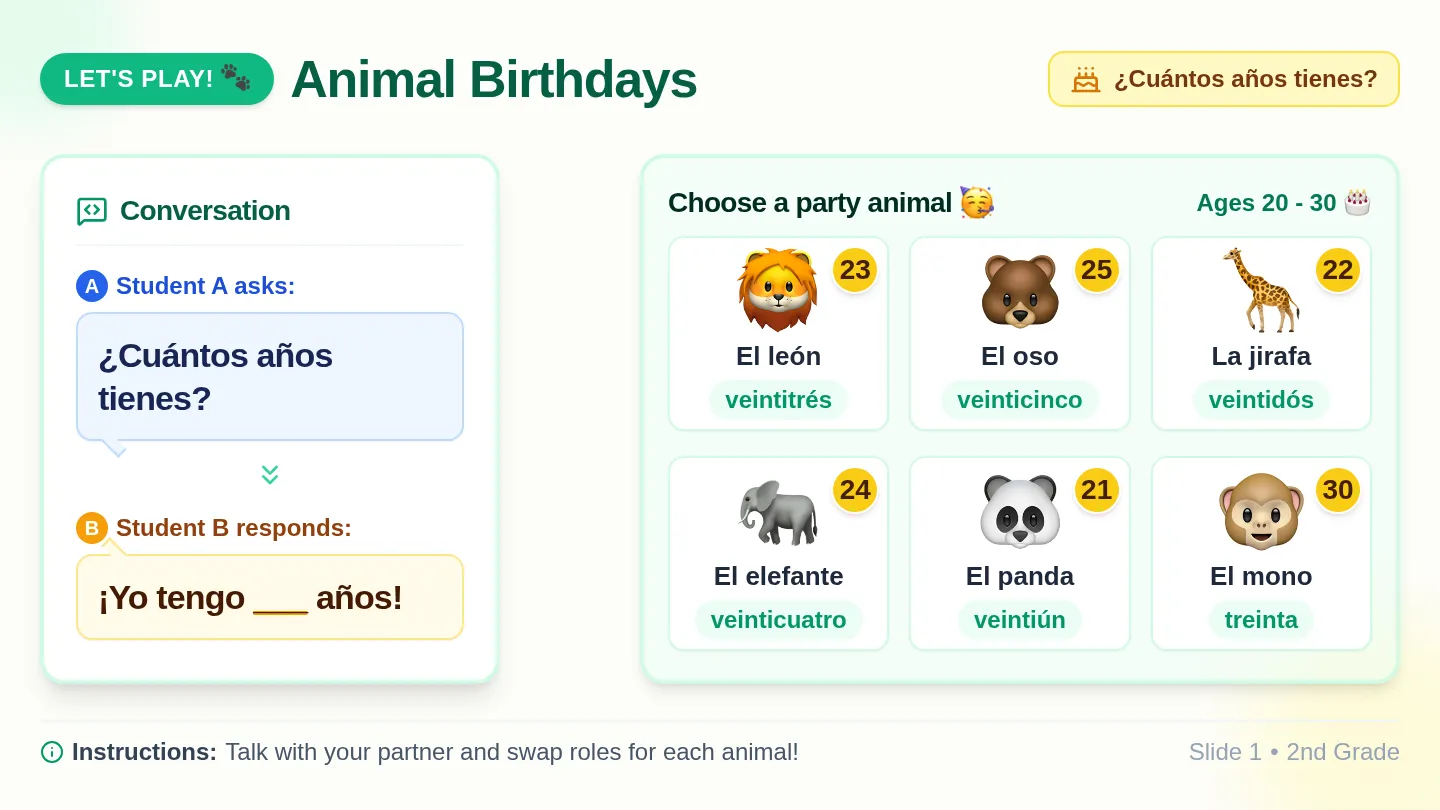
An updated two-slide deck for 2nd grade Spanish students. Slide 1 practices animal ages from 20-30, and Slide 2 instructs students to play a classroom mingle game using physical animal cards and a place-value finger system (e.g., 2 fingers on one hand and 5 on the other for 25).
A 2-page, large-print black-and-white exit ticket for 4th grade Spanish featuring expanded instructions, letter and digraph recognition questions, a Can-Do self-assessment, and a pronunciation challenge.
A two-page, black-and-white Spanish alphabet activity worksheet for 4th-grade novice low learners. Features large-font English instructions, an expanded combination word hunt on Page 1, and dedicated name spelling with partner speaking dialogue on Page 2.
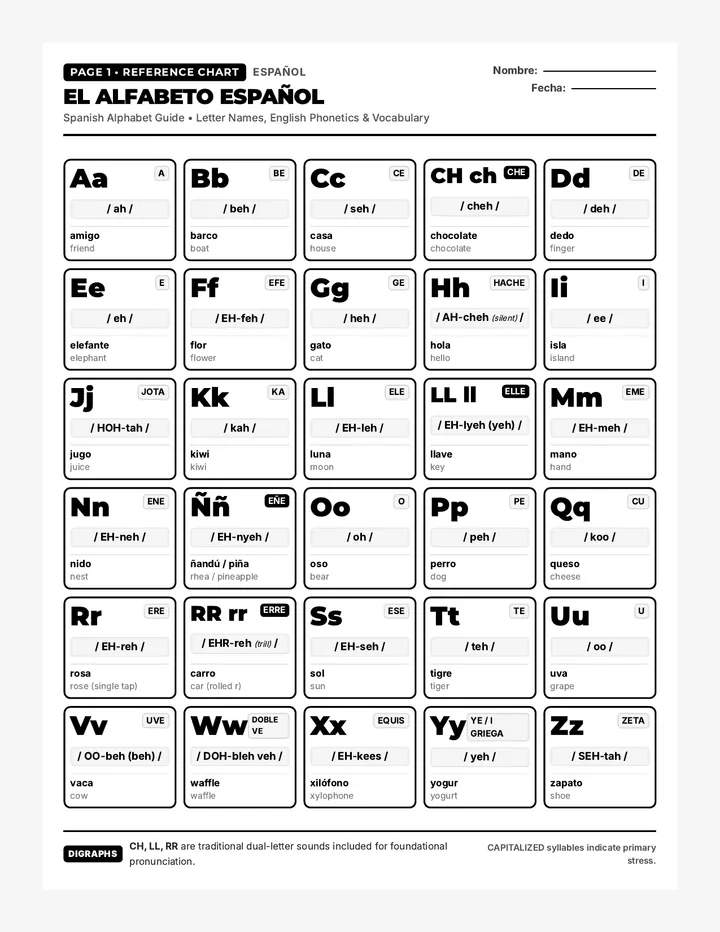
A complete two-page black-and-white alphabet reference set featuring both the Spanish alphabet (with traditional digraphs ch, ll, rr) and the English alphabet with phonetic pronunciation guides, letter names, and vocabulary examples.
A 3rd-grade black-and-white Spanish and SEL activity handout with large fonts, expanded dialogue writing spaces in Part 2, and identity prompts in Part 1.
A black-and-white Novice Low Do Now worksheet for 1st grade Spanish beginners, featuring visual vocabulary cards, picture-based multiple-choice circling, and large word-tracing practice for hola, adiós, miren, and escuchen.
A high-contrast, black-and-white 1-page Do Now warmup sheet for 4th grade Spanish learners, featuring larger fonts in question 3 choice boxes and the self-evaluation section, with English scaffolding and an extended name line.
A large-print, black-and-white Spanish early finisher worksheet featuring a full-width name line, personal introductory sentence frames, a favorite-color drawing box, a prior-knowledge recall section for 3 Spanish words/phrases, and a sentence-writing challenge.
A printable black-and-white exit ticket designed for 2nd-grade novice Spanish learners with large print. It assesses recognition of hola, adiós, ¿cómo te llamas?, and me llamo with English directions and student name fields.
A black-and-white print-ready exit ticket designed for 1st grade novice low Spanish learners. It features clear English directions, large accessible typography, a multiple-choice question for '¿Cómo te llamas?', and generous primary handwriting lines for students to write their name response.
A black-and-white, printable 3x3 Lotería Tic-Tac-Toe game board for novice-low Spanish students, featuring clear English instructions, large bold fonts, generous blank drawing and writing cells, a vocabulary word bank, and round tracking.
Diapositiva para estudiantes de nivel Novice Low en español que introduce 12 letras mayúsculas con su nombre en español, palabras ancla con cognados y una estructura de frase para la participación oral guiada.
A comprehensive introductory Spanish curriculum designed for 5th-grade students. Features highly structured lessons with focused active-learning centers spanning greetings, grammar, numbers, calendar, weather, nature, animals, and adjectives.
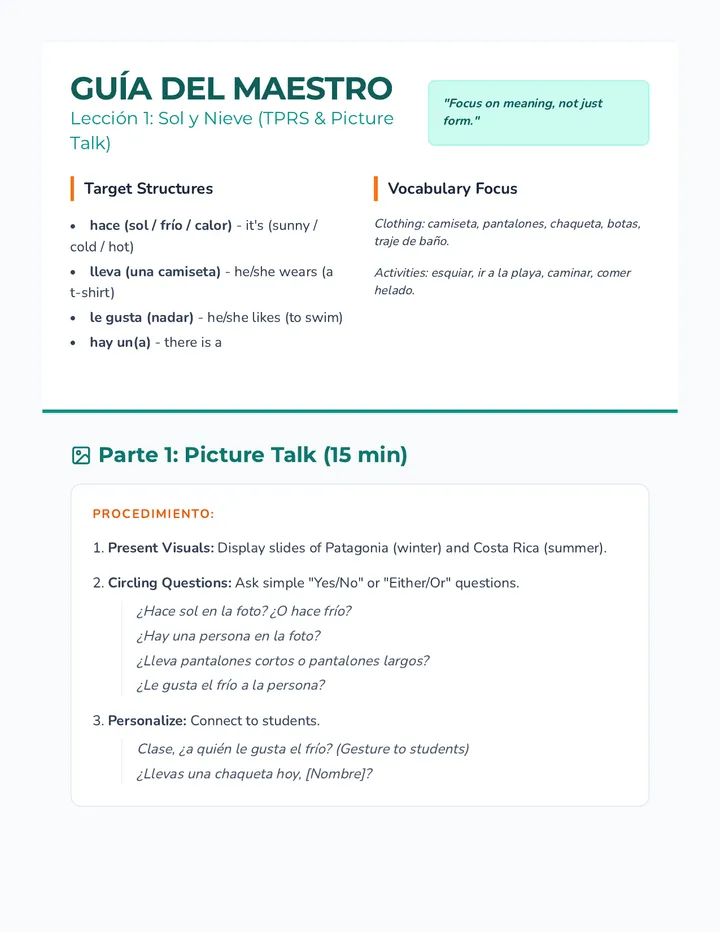
A two-part introductory Spanish sequence focusing on clothing, weather, and activities through Comprehensible Input (CI) strategies like TPRS and Picture Talk. Students explore cultural contexts and seasonal variations in the Spanish-speaking world while building basic communicative proficiency.
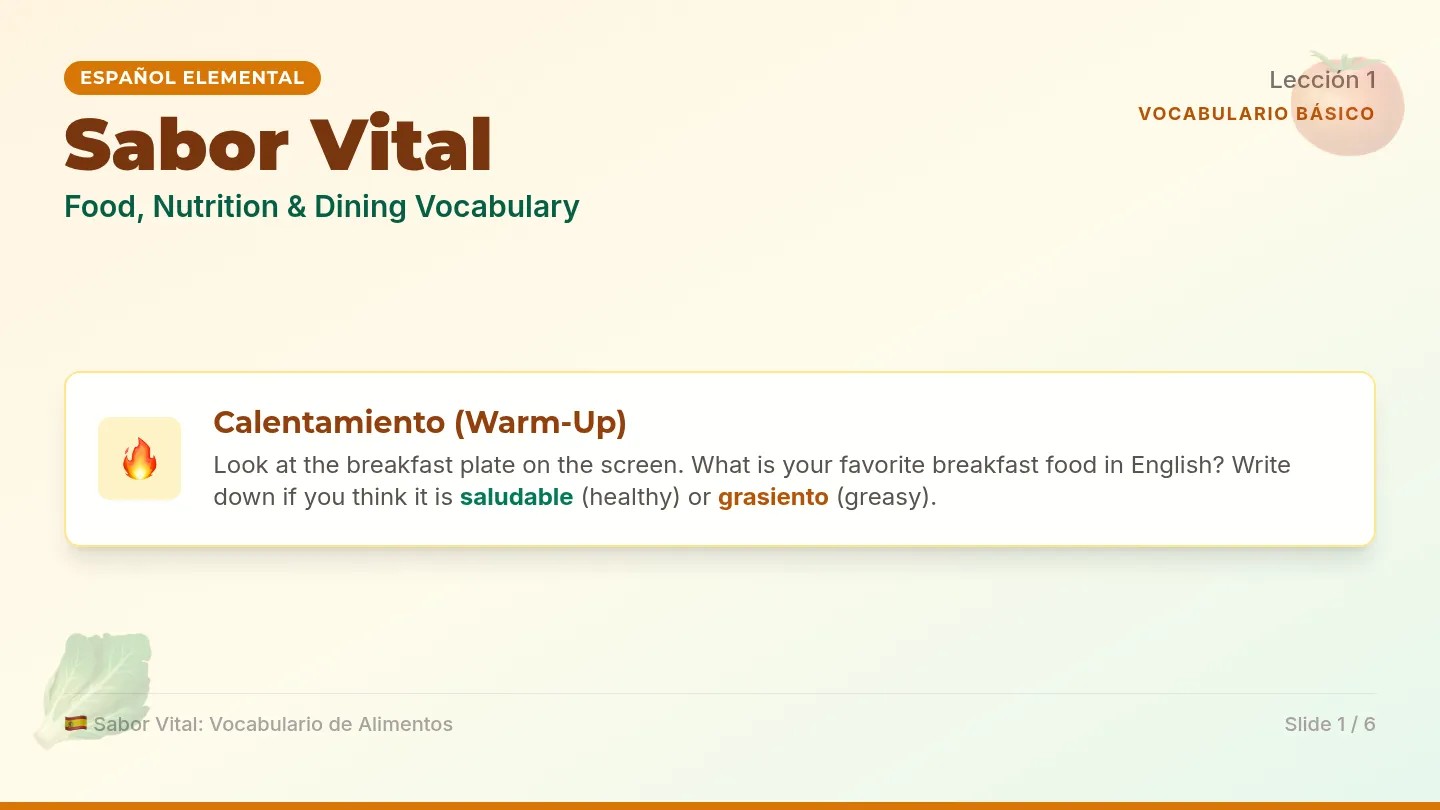
A beginner-level Spanish unit covering daily student life. It connects practical vocabulary for food and dining with descriptions of school schedules, classroom objects, and academic courses.
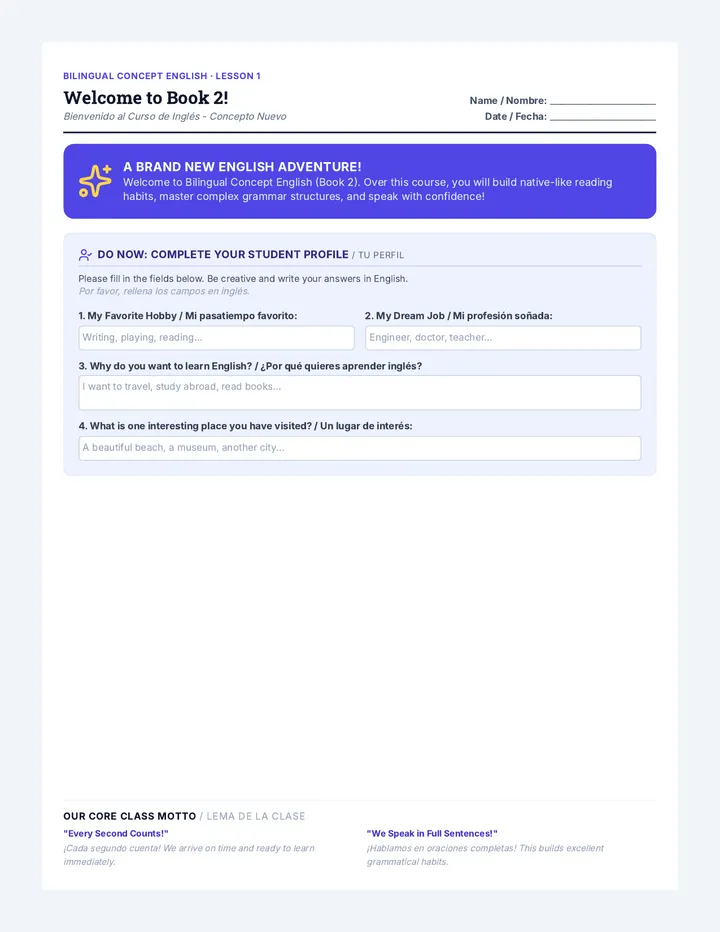
A comprehensive bilingual English-Spanish series based on New Concept English (Book 2). Each lesson features complete vocabulary guides, contrastive grammar lessons, reading comprehension, and beautifully structured print-ready exercises.
A comprehensive 30-day literacy program designed for Spanish-speaking English Learners, focusing on vowels, CVC blending, rhyming, and multisyllabic word decoding. The curriculum uses a 'construction' theme to build reading skills from the ground up, with specific support for ESL phonetic challenges.
A Spanish language learning sequence focused on family descriptions, subject pronouns, and present-tense verb conjugations.
A comprehensive introductory unit for 8th-grade Spanish, focusing on global geography, essential communication, and rich cultural traditions through a 'Cultural Passport' lens.
A cohesive Spanish sequence designed to teach physical appearance, colors, and clothing styles using the verbs 'ser', 'tener', and 'llevar'. Seamlessly bridges Spanish 1 and Spanish 2 levels.
A high-impact introductory pronunciation sequence for High School Spanish 1 designed to build absolute confidence in phonetic spelling, vowel purity, consonant exceptions, and reading fluency through collaborative, gamified missions.
A series of fast-paced 10-minute Spanish phonics mini-lessons for kindergarteners, focusing on letter sounds, blending, and initial syllables through engaging jungle and animal themes.
A unit covering animal vocabulary, descriptions, and likes/dislikes in Spanish, designed for Level 1 learners to build foundational communication skills about the natural world.
A comprehensive unit for beginner Spanish students to master the verb 'estar' and 'tener' idioms for expressing emotions, physical states, and needs. Through interactive games, role-plays, and data collection, students learn to articulate their internal feelings and conduct wellness checks on others.
A comprehensive lesson on the historic earthquakes of Mexico City (1985 and 2017), focusing on interpretive reading and academic writing using the Claim, Evidence, Reasoning (CER) framework. Students explore community impact, resilience, and historical comparison.
A comprehensive 2nd-grade Spanish lesson focusing on greetings, farewells, and the social awareness of respect (formal vs. informal). The lesson uses an 'I Do, We Do, You Do' format, starting with a projection-based introduction and transition into four interactive learning centers to accommodate 23 students in a 35-40 minute push-in context.
A comprehensive visual guide to the 20 most frequently used Spanish verbs, featuring conjugations, translations, and color-coded tenses.
A vibrant 3rd-grade Spanish lesson teaching numbers 20-30 through the lens of a bustling Mexican market. Students develop linguistic proficiency while practicing self-awareness and social collaboration.
An introductory Spanish 1 lesson focusing on pronunciation, spelling, the alphabet, vowels, and foundational calendar vocabulary.
A comprehensive lesson where students in grades 8-10 design a detailed, budgeted travel itinerary for a target-language country, incorporating cultural research and speaking challenges.
A vibrant Novice-Low Spanish lesson exploring days of the week, months of the year, basic descriptions, and El Salvador's culture through the 7-step language acquisition model.
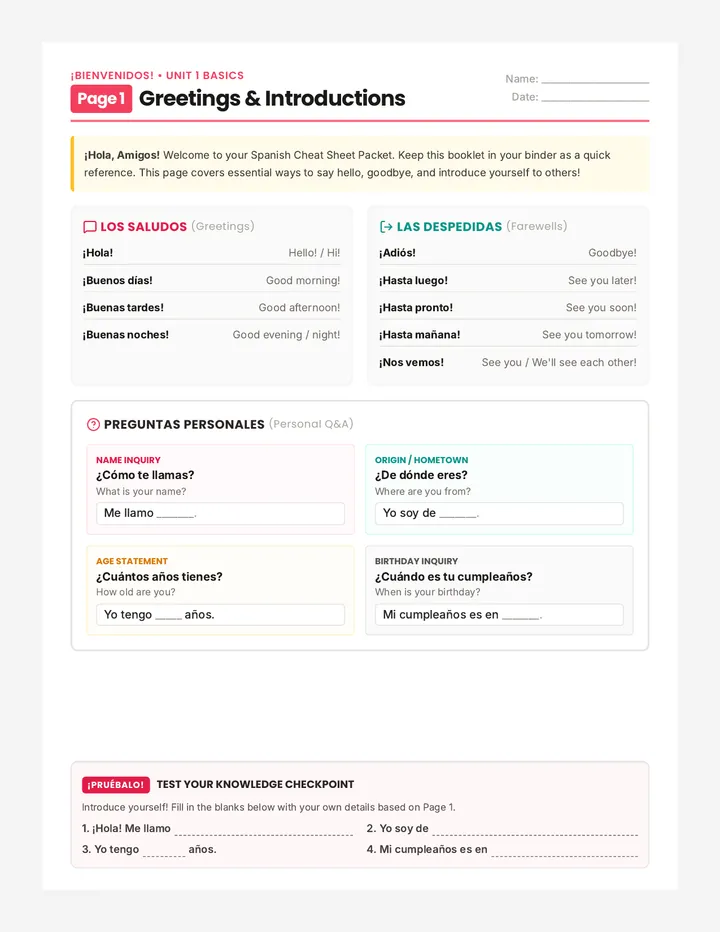
An introductory Spanish lesson focusing on greetings, self-introductions, and classroom expectations. Students learn basic phrases, actively listen to a visual teacher presentation, and engage in structured peer conversations.
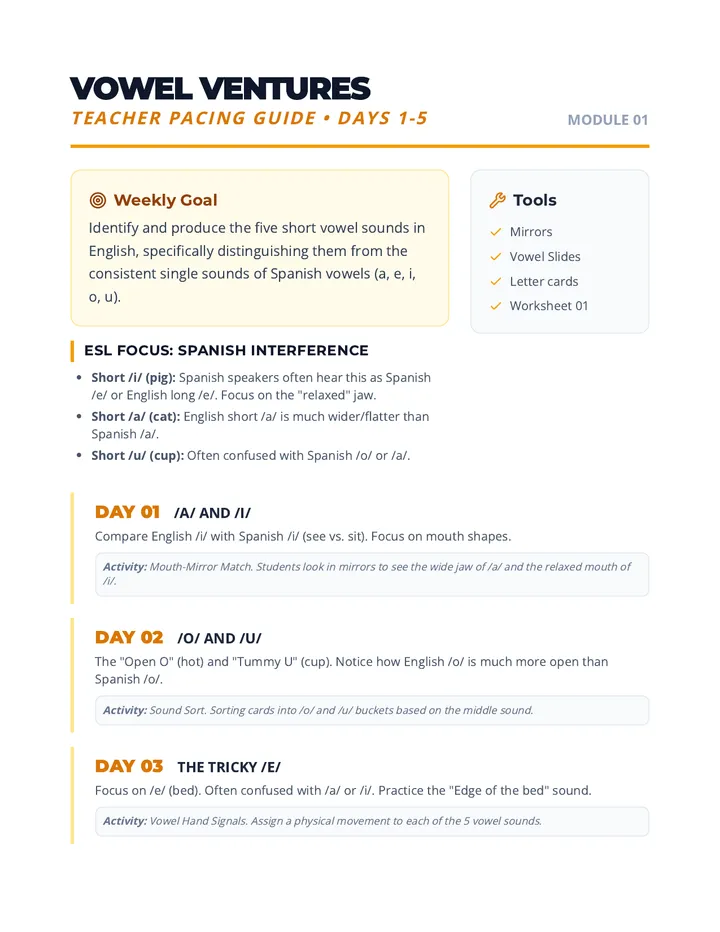
A multisensory lesson focusing on the phonetic distinction between the English short /ɪ/ and long /i/ sounds, specifically designed for students bridging from Spanish.
A comprehensive Spanish lesson focused on family and relatives vocabulary through a detective-themed investigation. Students will identify, describe, and discuss family members using a variety of interactive and written exercises.
A calm, highly visual Spanish lesson for 2nd graders to learn and practice asking and stating age, plus numbers 20-30, using silent signals and partner matching to respect low-stimulation classroom needs. This lesson aligns with NYS World Language Standards and incorporates SEL elements through self-reflection and cooperative quiet sharing.
An introductory Spanish 1 lesson focused on family vocabulary, possessive adjectives, and the verbs ser, tener, and llamarse. Students will learn to describe their family members and pets while practicing subject pronouns.