Complex sentence structures, resultative complements, and the nuanced use of aspect particles. Strengthens communication through passive voice constructions and formal transition words.
Printable assets for Lesson 3, including a Syllable Surgeon word list and a group practice surgery mat with a surgical checklist. Revised for contrast and balance.
Student practice sheet for Lesson 3: Closed Door Divide, featuring VC/CV syllable division exercises and application to science vocabulary. Revised for layout and single-page fit.
Teacher facilitation guide for Lesson 3: Closed Door Divide, focusing on identifying and dividing VC/CV syllable patterns in academic vocabulary. Revised for layout.
Printable assets for Lesson 2, including stress comparison cards for rubber band practice and a 'Stress Mountain' anchor chart visual.
Student practice sheet for Lesson 2: Stress Search, featuring word stress identification exercises and noun/verb stress shift analysis. Revised for casing uniformity and layout.
Teacher facilitation guide for Lesson 2: Stress Search, focusing on identifying primary word stress using kinesthetic rubber band stretching.
Printable assets for Lesson 1, including vocabulary cards and syllable sorting mats. Revised for page-break compliance and asset separation.
Student practice sheet for Lesson 1, featuring instructions for the chin drop method and syllable counting exercises. Revised to fit on a single page.
Teacher facilitation guide for Lesson 1: The Academic Beat, focusing on oral syllable segmentation using the chin drop method. Revised for layout and font size.
A comprehensive reference chart of academic prefixes, roots, and suffixes for secondary ELLs, including meanings and Tier 2/3 vocabulary examples.
A comprehensive inventory chart of physical and digital materials required for each of the 30 Multisyllabic Mastery lessons, designed as a teacher preparation checklist.
A 4-page comprehensive student reference guide for secondary ELLs, covering syllable division patterns, word stress, morphology, and phoneme manipulation strategies with professional visuals.
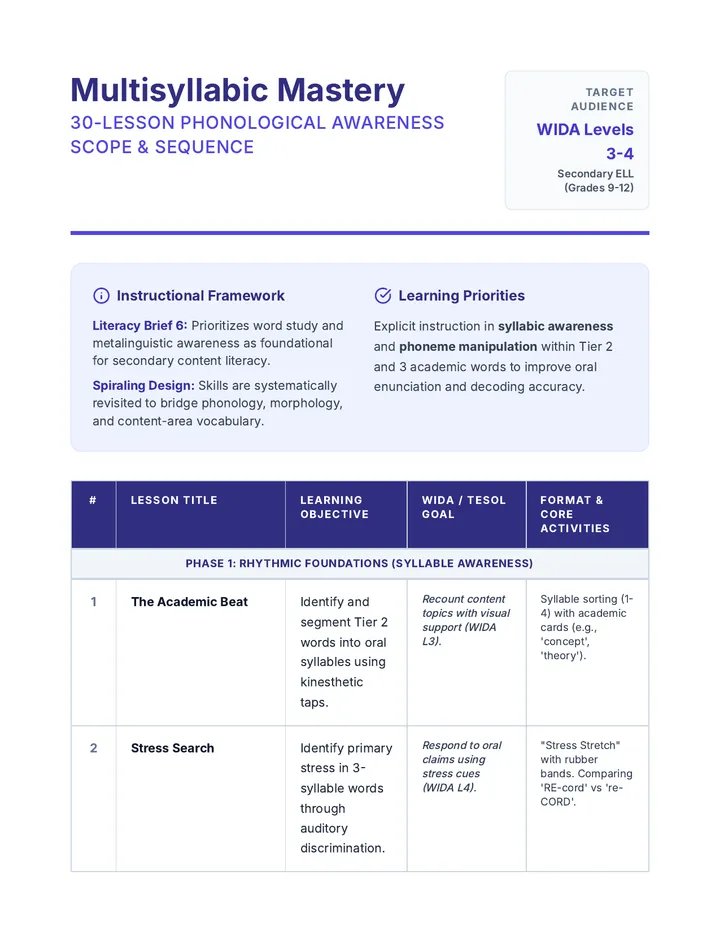
A comprehensive program for teaching phonological awareness to secondary ELLs, focusing on multisyllabic academic vocabulary and phoneme manipulation.
A sequence focused on leveraging digital translation tools for language self-assessment and speech improvement. Students learn to use Google Translate not just for translation, but as a 'mirror' for their own pronunciation, grammar, and fluency.
This sequence immerses graduate students in the lexical and cultural nuances of professional Mandarin. Students will progress from mastering formal etiquette and financial reporting to navigating legal contracts and complex business negotiations.
A specialized sequence for graduate students to master the formal register of Chinese news media. The course covers headline syntax, economic reporting logic, passive structures in incident reports, bias in editorials, and cross-regional news synthesis.
This sequence explores the deep connection between language and culture by focusing on idiomatic expressions (Chengyu) and the unwritten rules of social interaction for intermediate-advanced Mandarin learners. Students investigate historical contexts, social networking (Guanxi), dining etiquette, modesty norms, and generational slang to build sophisticated communication skills.
This intermediate Mandarin Chinese sequence focuses on identifying and analyzing complex sentence structures (sequential, concessive, causal, conditional, and simultaneous) to improve reading fluency and logical comprehension in 8th-grade students.
A comprehensive 5-lesson sequence for intermediate Mandarin students to compare the daily lives and educational systems of Chinese and American middle schoolers through authentic-style reading materials.
A 12th-grade Mandarin Chinese listening sequence focused on practical daily interactions. Students move from sequencing routines to navigating transportation, ordering food, and analyzing complex dialogues in real-world scenarios.
This sequence explores the nuances of the Mandarin particle 'le', focusing on its dual roles in marking completion and change of state while avoiding common pitfalls for English speakers.
A comprehensive sequence for 11th-grade Mandarin students focusing on the critical distinction between 'bu' and 'mei' negation patterns. Students progress from basic subjective negation to objective past-tense negation, culminating in a high-stakes rebuttal simulation.
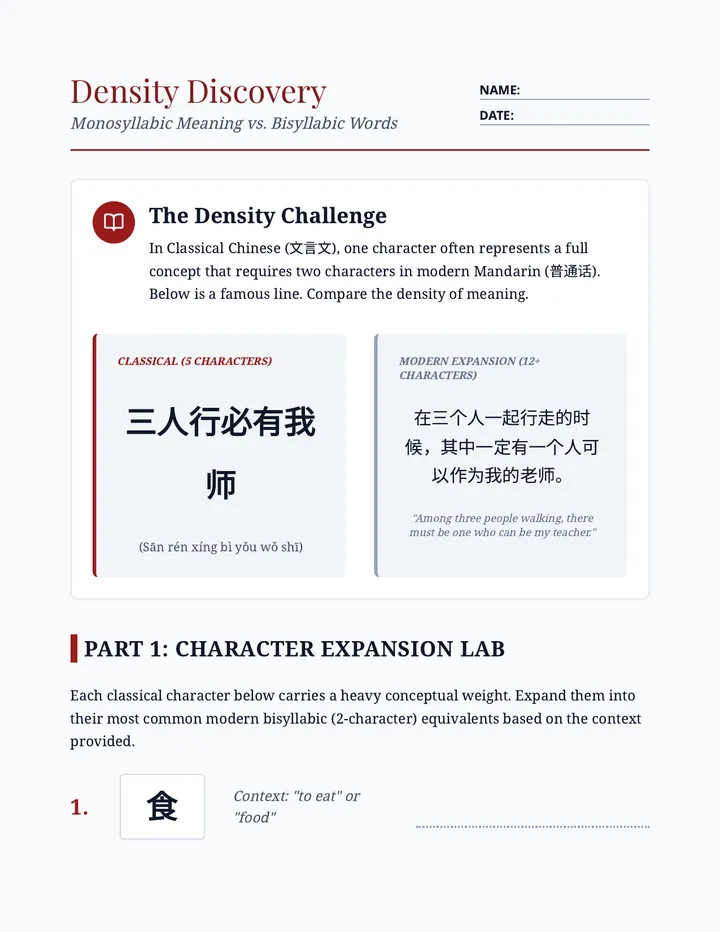
A rigorous analysis of Mandarin sentence structure, moving students from SVO assumptions to the Time-Location-Action hierarchy (STPVA). Students master word order rules, learn the Topic-Comment structure, and develop editing skills to eliminate 'Chinglish' syntactic errors.
A comprehensive sequence for 12th-grade Mandarin students focusing on the versatile particle 'le'. Students will master its use for marking completed actions, changes of state, and duration while developing narrative skills through aspect-based storytelling.
Third lesson in the sequence, focusing on identifying and dividing the VC/CV (closed syllable) pattern in academic vocabulary.
Second lesson in the sequence, focusing on identifying and manipulating primary word stress in academic vocabulary.
A comprehensive scope and sequence for teaching phonological awareness to secondary ELLs, focusing on multisyllabic academic vocabulary and phoneme manipulation.
This lesson teaches students how to use Google Translate's speech-to-text and text-to-speech features to self-evaluate their spoken language. Focus areas include pronunciation clarity, grammatical accuracy of transcribed text, and oral fluency.
In this culminating simulation, students apply all learned vocabulary to a high-stakes merger negotiation. Teams represent different stakeholders and must draft terms, present data, and negotiate a final agreement using only formal professional Mandarin.
Students learn the linguistic art of soft rejection, conditional acceptance, and strategic ambiguity often used in Chinese negotiations. The lesson emphasizes syntactic patterns that maintain harmony while firmly holding a position.
Learners dissect standard business contracts to identify key legal terms, liability clauses, and formal grammatical structures specific to legal documents. The lesson bridges the gap between spoken agreement and written obligation.
This lesson focuses on the specific vocabulary required to describe graphs, trends, and financial reports. Students practice using precise verbs and adverbs to articulate increases, decreases, fluctuations, and projections within a fiscal context.
Focuses on the nuances of honorifics, formal introductions, and corporate hierarchy in Chinese business culture. Students learn the essential vocabulary to navigate networking and formal meetings without loss of face.
A culminating simulation where students synthesize information from multiple regional sources to create a professional executive summary of a current event.
Develops critical reading skills to identify subjective language, rhetorical questions, and ideological framing within Chinese editorial and opinion pieces.
Analyzes the specific usage of 'ba' and 'bei' structures in formal reports of crime, accidents, and legal proceedings to clarify agency and impact.