Sophisticated idioms (chengyu), professional terminology, and complex linguistic nuances for formal settings. Strengthens communication skills for academic discourse, business negotiations, and literary analysis.
In this culminating simulation, students apply all learned vocabulary to a high-stakes merger negotiation. Teams represent different stakeholders and must draft terms, present data, and negotiate a final agreement using only formal professional Mandarin.
Students learn the linguistic art of soft rejection, conditional acceptance, and strategic ambiguity often used in Chinese negotiations. The lesson emphasizes syntactic patterns that maintain harmony while firmly holding a position.
Learners dissect standard business contracts to identify key legal terms, liability clauses, and formal grammatical structures specific to legal documents. The lesson bridges the gap between spoken agreement and written obligation.
This lesson focuses on the specific vocabulary required to describe graphs, trends, and financial reports. Students practice using precise verbs and adverbs to articulate increases, decreases, fluctuations, and projections within a fiscal context.
The sequence concludes with a formal debate where students synthesize learned vocabulary and rhetorical structures to argue for or against specific social policy proposals.
A workshop focused on integrating Chengyu (idioms) and advanced conjunctions to strengthen persuasive arguments and demonstrate cultural erudition in public debate.
Students explore the lexicon of environmental science and government policy, focusing on sustainable development, carbon neutrality, and pollution metrics through policy analysis.
Focusing on demographic trends and the 'aging society,' this lesson introduces terminology for healthcare policy, pension systems, and the 'silver economy' using statistical analysis.
Students examine the vocabulary surrounding China's rapid urbanization and the household registration (hukou) system, focusing on socioeconomic terminology and academic reading comprehension.
Focuses on the nuances of honorifics, formal introductions, and corporate hierarchy in Chinese business culture. Students learn the essential vocabulary to navigate networking and formal meetings without loss of face.
A culminating simulation where students synthesize information from multiple regional sources to create a professional executive summary of a current event.
Develops critical reading skills to identify subjective language, rhetorical questions, and ideological framing within Chinese editorial and opinion pieces.
Facilitator guide for the final structured debate, including a suggested script for the moderator, classroom management tips, and differentiation strategies.
A facilitator's guide for the high-stakes merger simulation, providing the timeline, grading rubric, and tips for managing classroom dynamics.
Detailed evaluation rubric for the final social policy debate, focusing on language accuracy, logic, rhetoric, and teamwork.
Debate preparation toolkit for Lesson 5, guiding students through argument mapping, rhetorical planning, and anticipating counter-arguments.
A formal template for a merger agreement to be filled out by students following the boardroom simulation, testing their ability to translate verbal agreements into formal legal writing.
Visual presentation for Lesson 5, outlining the structured debate format, potential social policy topics, and evaluation criteria for the final assessment.
Confidential role cards for a merger simulation, providing specific financial objectives and secret linguistic mandates for each group of students.
Facilitator guide for Lesson 4, including pedagogical strategies for using idioms in debate, classroom activity instructions, and common student error alerts.
Visual slide deck setting the stage for a high-stakes merger simulation, outlining the background of the two companies and the rules of the boardroom.
Worksheet for Lesson 4 featuring idiom mastery cards, rhetorical refinement exercises, and a writing workshop for logical connectives.
A worksheet for students to practice converting direct rejections into culturally appropriate "Strategic Ambiguity" phrases in formal Mandarin, using conditional structures.
Visual presentation for Lesson 4, focusing on powerful idioms (chengyu) and rhetorical strategies for academic and public debate in Mandarin.
This advanced Mandarin Chinese sequence for graduate students focuses on analyzing contemporary social issues through the lens of sophisticated rhetoric and four-character idioms (chengyu). Students explore urbanization, demographic shifts, and environmental policy to build a high-level academic vocabulary and persuasive argumentation skills.

This sequence immerses graduate students in the lexical and cultural nuances of professional Mandarin. Students will progress from mastering formal etiquette and financial reporting to navigating legal contracts and complex business negotiations.
A specialized sequence for graduate students to master the formal register of Chinese news media. The course covers headline syntax, economic reporting logic, passive structures in incident reports, bias in editorials, and cross-regional news synthesis.
A graduate-level sequence exploring contemporary Chinese literature, focusing on 'Sanwen' essays, Chengyu integration, sociolinguistic subtext, and thematic analysis to build advanced reading and interpretation skills.
A high-level Mandarin Chinese sequence for graduate students focusing on media literacy, logical argumentation, and academic discourse. Students transition from summarizing news to debating complex ethical issues and synthesizing multiple perspectives.
A sequence for graduate students focusing on advanced Mandarin narrative techniques, rhetorical strategies, and descriptive mastery to bridge the gap between functional language and expressive fluency.
This sequence explores the deep connection between language and culture by focusing on idiomatic expressions (Chengyu) and the unwritten rules of social interaction for intermediate-advanced Mandarin learners. Students investigate historical contexts, social networking (Guanxi), dining etiquette, modesty norms, and generational slang to build sophisticated communication skills.
A comprehensive series for graduate students to master formal Mandarin communication within Chinese corporate environments. This sequence covers hierarchical protocol, negotiation tactics, the cultural nuances of 'face', formal written registers, and high-stakes meeting facilitation.
A project-based sequence for 12th-grade students to master Pinyin as a digital input method. Students progress from basic IME setup to advanced predictive text logic and phrase-based typing, culminating in a real-world digital communication simulation.
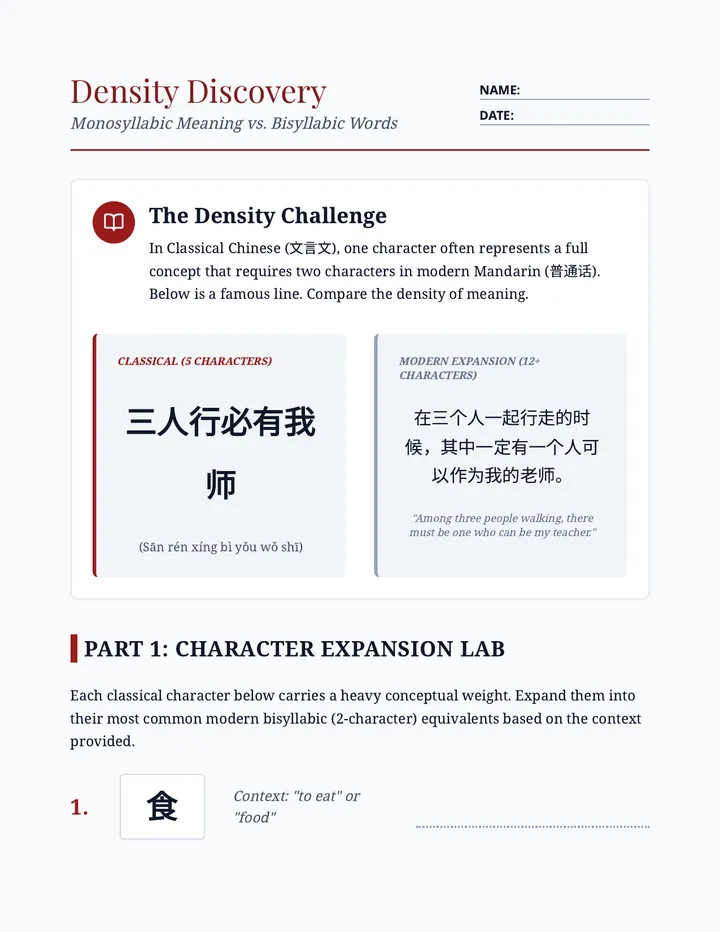
A project-based sequence for 8th-grade Mandarin students focusing on the morphology of compound words (cíyǔ) and their contextual usage. Students explore root characters, differentiate synonyms, learn idioms, and create a thematic glossary.
A graduate-level sequence focused on cognitive science and mnemonic strategies for retaining complex, low-frequency Mandarin characters. Students move beyond rote memorization to explore the method of loci, narrative encoding, and kinesthetic reinforcement.