Complex character recognition, radical analysis, and historical etymology for high-level literacy. Strengthens reading fluency through academic vocabulary and formal literary contexts.
A deep analytical dive into the etymology and structural logic of the Chinese writing system for graduate-level adult learners. The sequence moves from basic mechanics and stroke order to complex phono-semantic decoding and aesthetic synthesis through calligraphy.
An advanced exploration of Mandarin character structure for graduate students, focusing on the semantic and phonetic logic of HSK 3-4 vocabulary to facilitate rapid lexicon expansion and academic reading skills.
A graduate-level sequence focused on the mechanics of Mandarin character production, bridging the gap between traditional handwriting discipline and modern digital input efficiency. Students refine stroke order, spatial balance, and digital literacy through workshops and professional projects.
A 7th-grade sequence exploring the 3,000-year evolution of Chinese characters, from ancient Oracle Bone pictographs to modern Simplified Hanzi, integrating history, art, and linguistics.
This sequence explores the etymological evolution of Mandarin Chinese characters from ancient Oracle Bone Script to modern digital input. Students analyze pictographs, ideographs, and phono-semantic compounds to understand the logic of the written language and apply this knowledge to real-world environmental print.
A hands-on exploration of Chinese calligraphy, tracing the history of characters from ancient Oracle Bone script to modern brush arts. Students learn the tools, techniques, and philosophy of traditional writing while creating their own calligraphic masterpieces.
This intermediate Mandarin Chinese sequence focuses on the 214 Kangxi radicals, specifically the 50 most common ones. Using a flipped classroom model, students learn to categorize vocabulary by their semantic 'roots,' building mental frameworks for better character retention and structural analysis.
This workshop-style sequence focuses on the mechanics and aesthetics of writing intermediate Mandarin characters. Students refine their handwriting by mastering stroke order for complex characters and exploring structural balance using Tian Zi Ge grids, ultimately creating a calligraphic portfolio.
An inquiry-based exploration of Mandarin Chinese semantic-phonetic character structure, empowering 6th-grade students to decode unfamiliar characters using structural logic.
A comprehensive sequence for 8th Grade students focused on the structural logic of Chinese characters. Students learn to use semantic radicals as keys to unlock the meaning of intermediate (HSK 3-4) vocabulary, moving from rote memorization to analytical decoding and mnemonic creation.
A graduate-level sequence focused on cognitive science and mnemonic strategies for retaining complex, low-frequency Mandarin characters. Students move beyond rote memorization to explore the method of loci, narrative encoding, and kinesthetic reinforcement.
A graduate-level sequence exploring the subtle nuances of Mandarin Chinese synonyms. Students analyze emotional coloring, register, fixed collocations, academic precision, and the art of brevity to achieve advanced proficiency in character selection.
A culminating workshop applying theoretical knowledge of structure, balance, and 'qi' through brush calligraphy. Reinforces spatial relationships and character composition.
Mastery of the 214 Kangxi radicals and the logic of dictionary organization. Students practice retrieving information from physical and digital resources using visual components.
Focuses on phono-semantic compounds, identifying how semantic components suggest meaning and phonetic components suggest sound. Develops predictive skills for decoding unfamiliar characters.
Learners explore the evolution of pictographs and ideographs from ancient oracle bone scripts to modern forms. Focuses on the visual representation of physical and abstract concepts.
Students analyze the standard rules of stroke order and directionality using the 'Eight Principles of Yong' framework. Focuses on the mechanical logic that ensures fluid writing and digital recognition.
Students synthesize their skills by producing a short, handwritten professional bio or cover letter. They then digitize this text, ensuring perfect character selection, effectively bridging their handwriting and digital typing skills.
Students explore how character structure applies to digital environments, comparing Pinyin input with structure-based methods like Wubi or handwriting recognition. They analyze how stroke order knowledge improves predictive text algorithms and handwriting recognition accuracy.
Students identify and practice distinguishing between visual look-alikes (e.g., 待 vs. 持, 己 vs. 已 vs. 巳). The lesson uses rapid recognition drills and comparative writing exercises to ensure precision in both reading and writing.
This lesson analyzes the spatial composition of characters, focusing on the ratio between top/bottom and left/right components. Students practice writing characters in grid paper to achieve professional aesthetic balance suitable for handwritten correspondence.
A culminating simulation where students apply structural knowledge to decode specialized academic texts and infer meanings of unfamiliar vocabulary.
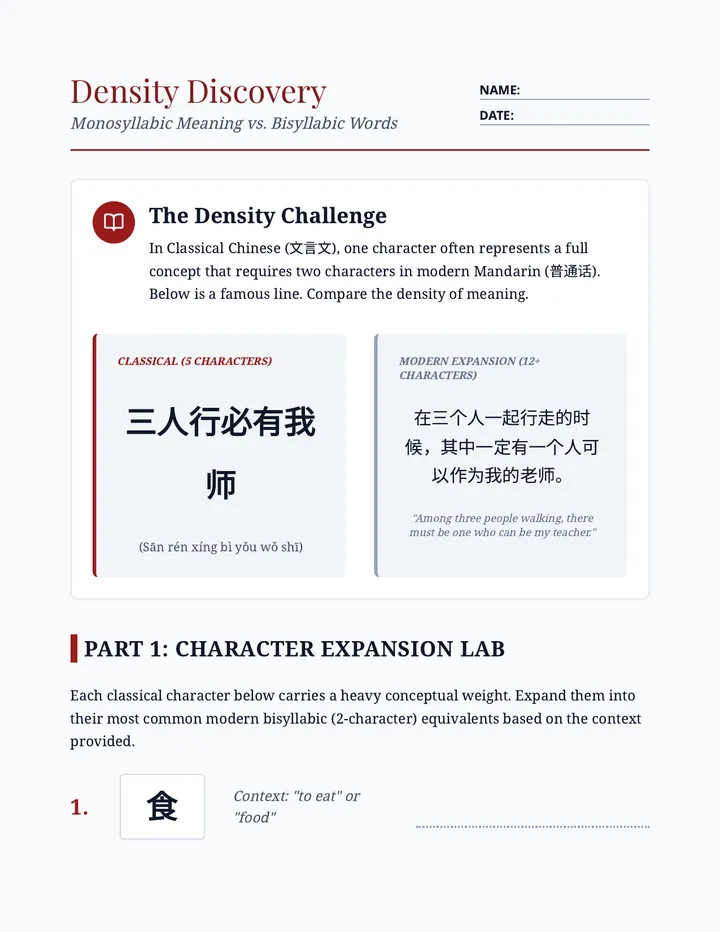
Analyzes the internal logic of two-character compound words, focusing on parallel, modifying, and verb-object morphological structures.
Investigates phonetic series and historical sound shifts to help students predict pronunciation of unfamiliar characters.
A culminating workshop guide for students to apply theoretical knowledge of structure, balance, and 'qi' through brush calligraphy practice and spatial analysis.
A sophisticated slide deck for graduate students exploring the aesthetic principles of calligraphy, including 'qi', structural balance, and spatial relationships.
A workshop activity for graduate students to practice identifying radicals, calculating stroke counts, and navigating dictionaries to decode unfamiliar characters.
A technical slide deck for graduate students explaining the Kangxi radical system, the indexing logic of dictionaries, and strategies for identifying primary radicals.
A technical matrix for graduate students to practice decoding phono-semantic compounds by identifying conceptual domains and phonetic anchors.
A technical slide deck for graduate students explaining the structural logic of phono-semantic compounds (Xíngshēng) through a linguistic and statistical lens.
An etymology worksheet for graduate students analyzing the visual evolution and logical transition of Chinese characters from ancient pictographs to modern ideographs.
A visual presentation for graduate students exploring the etymology and evolution of Chinese pictographs and simple ideographs from oracle bones to modern script.
A technical worksheet for graduate students to practice and analyze stroke order rules, featuring predictive sequencing and mechanical analysis.
A sophisticated slide deck for graduate students deconstructing the 'Eight Principles of Yong' and standard stroke order rules through a mechanical and logical lens.
A comprehensive teacher's answer key and facilitation guide covering the stroke order, spatial architecture, and distinction drills from the sequence.
A professional manuscript template and guide for the final synthesis project in Lesson 5, allowing students to produce a handwritten bio and its digital equivalent.