Basic auditory recognition of the four Mandarin tones, Pinyin phonetics, and high-frequency vocabulary. Targets comprehension of common greetings, numbers, and simple daily interactions.
Third lesson in the sequence, focusing on identifying and dividing the VC/CV (closed syllable) pattern in academic vocabulary.
Second lesson in the sequence, focusing on identifying and manipulating primary word stress in academic vocabulary.
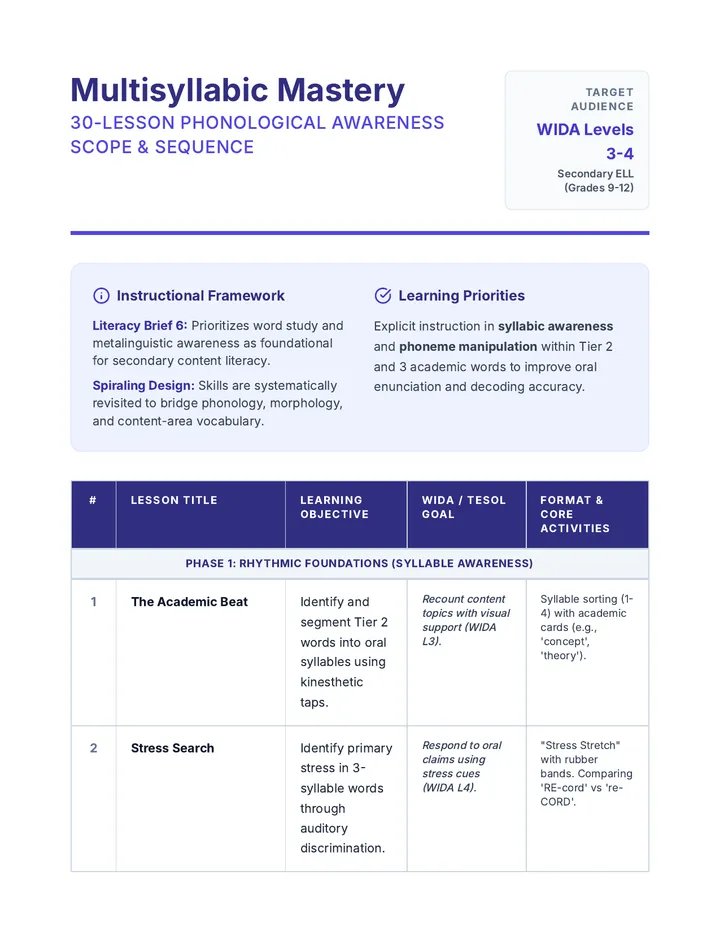
A comprehensive scope and sequence for teaching phonological awareness to secondary ELLs, focusing on multisyllabic academic vocabulary and phoneme manipulation.
This lesson teaches students how to use Google Translate's speech-to-text and text-to-speech features to self-evaluate their spoken language. Focus areas include pronunciation clarity, grammatical accuracy of transcribed text, and oral fluency.
This culminating lesson applies the four tones to the syllable 'ma' to demonstrate how meaning changes (mother, hemp, horse, scold). Students participate in a listening game where they identify the correct image based on the tone they hear.
Students practice the sharp, falling pitch of the fourth tone, associating it with a firm 'No!' or a karate chop. The lesson focuses on energy and assertive vocalization to differentiate it from the other tones.
Students engage with the dipping pitch of the third tone, visualizing it as a roller coaster that goes down and up. Through physical bouncing movements, students practice the lower register dip required for this tone.
Learners practice the rising pitch of the second tone, associating it with the English questioning sound 'Huh?'. Students use upward arm movements to trace the sound as they practice rising vocal inflections.
A mastery-based lesson using 'Lǎoshī shuō' (Simon Says) to integrate all previous commands into complex sequences.
Learning 'Pāi shǒu' (Clap hands) and 'Tiào' (Jump) with rhythm and music to reinforce high-energy action vocabulary.
The sequence concludes with a song 'Wǒ ài wǒ de jiā', combining vocabulary with the verb 'to love' and expressive hand motions.
Focusing on sensory verbs 'Tīng' (Listen) and 'Kàn' (Look) through a detective-themed scavenger hunt.
A comprehensive program for teaching phonological awareness to secondary ELLs, focusing on multisyllabic academic vocabulary and phoneme manipulation.
A sequence focused on leveraging digital translation tools for language self-assessment and speech improvement. Students learn to use Google Translate not just for translation, but as a 'mirror' for their own pronunciation, grammar, and fluency.
A high-energy Mandarin Chinese sequence for Pre-K students using the Total Physical Response (TPR) method. Students learn to respond to physical commands and action verbs through games and movement, building direct meaning without translation.
A foundational Mandarin Chinese sequence for Pre-K students focused on identifying family members. Students learn vocabulary for parents, siblings, and grandparents through interactive games, songs, and visual inquiry.
A foundational sequence for Pre-K learners to explore the four tones of Mandarin Chinese through auditory play, physical movement, and vocal exploration. Students learn to associate pitch changes with meaning using relatable sounds like questioning 'Huh?' or firm 'No!' gestures.
A physical and auditory introduction to the four Mandarin tones for Pre-K learners, using movement, animal analogies, and games to make pitch concrete.
A project-based sequence for 7th graders to master basic Mandarin characters through their school environment. Students progress from naming individual objects to designing and labeling a complete classroom layout.
A 5-lesson sequence for 5th-grade students focused on mastering Mandarin Chinese characters for numbers 1-10 and immediate family members through game-based learning and logical puzzles.
This sequence introduces Kindergarten students to Mandarin Chinese characters for numbers 1-10 through visual mnemonics, hand gestures, and playful simulations. Students progress from simple horizontal lines to complex symbols, culminating in a classroom shop and Bingo game to reinforce character recognition.
A beginner Mandarin Chinese listening sequence for 12th-grade students focused on decoding kinship terms, physical descriptions, spatial locations, and personal preferences through context clues and keyword spotting.
This sequence focuses on the cognitive processing of numerical data in Mandarin Chinese, moving from basic digits to complex phone numbers, calendar dates, clock times, and marketplace currency. Students will develop rapid auditory recognition through gamified scenarios like emergency dispatch, time travel, and transit scheduling.
A high-stakes immersive sequence where 12th-grade students act as 'Protocol Analysts' to master Mandarin greetings and introductions. Students progress from basic register recognition to complex social deduction through simulated audio audits and role-play analysis.
Printable assets for Lesson 3, including a Syllable Surgeon word list and a group practice surgery mat with a surgical checklist. Revised for contrast and balance.
Student practice sheet for Lesson 3: Closed Door Divide, featuring VC/CV syllable division exercises and application to science vocabulary. Revised for layout and single-page fit.
Teacher facilitation guide for Lesson 3: Closed Door Divide, focusing on identifying and dividing VC/CV syllable patterns in academic vocabulary. Revised for layout.
Printable assets for Lesson 2, including stress comparison cards for rubber band practice and a 'Stress Mountain' anchor chart visual.
Student practice sheet for Lesson 2: Stress Search, featuring word stress identification exercises and noun/verb stress shift analysis. Revised for casing uniformity and layout.
Teacher facilitation guide for Lesson 2: Stress Search, focusing on identifying primary word stress using kinesthetic rubber band stretching.
Printable assets for Lesson 1, including vocabulary cards and syllable sorting mats. Revised for page-break compliance and asset separation.
Student practice sheet for Lesson 1, featuring instructions for the chin drop method and syllable counting exercises. Revised to fit on a single page.
Teacher facilitation guide for Lesson 1: The Academic Beat, focusing on oral syllable segmentation using the chin drop method. Revised for layout and font size.
A comprehensive reference chart of academic prefixes, roots, and suffixes for secondary ELLs, including meanings and Tier 2/3 vocabulary examples.
A comprehensive inventory chart of physical and digital materials required for each of the 30 Multisyllabic Mastery lessons, designed as a teacher preparation checklist.
A 4-page comprehensive student reference guide for secondary ELLs, covering syllable division patterns, word stress, morphology, and phoneme manipulation strategies with professional visuals.