Basic stroke orders, common radicals, and high-frequency characters for foundational literacy. Builds recognition of essential nouns and verbs while connecting Pinyin pronunciation to written Hanzi forms.
A foundational vocabulary lesson for K-5 heritage learners focusing on nature elements and common animals through visual flashcards and practice activities.
Third lesson in the sequence, focusing on identifying and dividing the VC/CV (closed syllable) pattern in academic vocabulary.
Second lesson in the sequence, focusing on identifying and manipulating primary word stress in academic vocabulary.
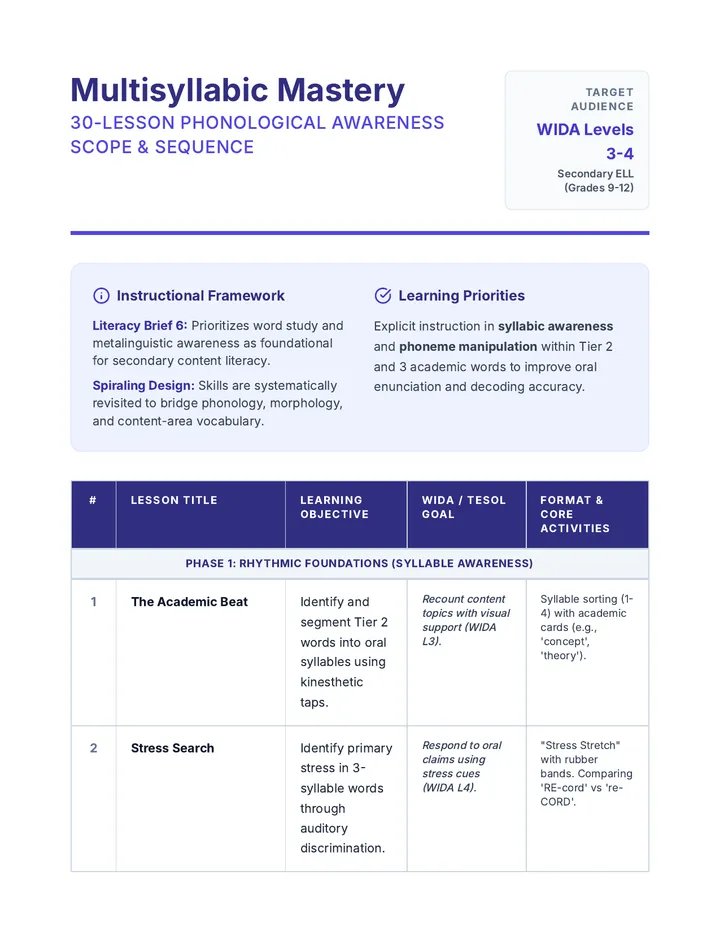
A comprehensive scope and sequence for teaching phonological awareness to secondary ELLs, focusing on multisyllabic academic vocabulary and phoneme manipulation.
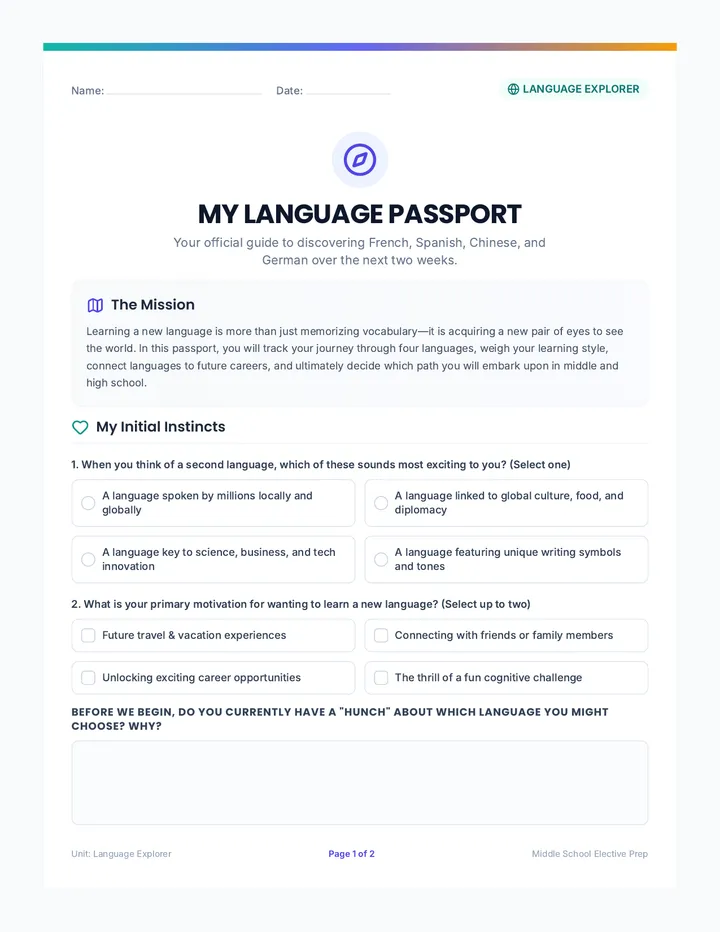
Foundational lessons designed to establish common learning routines (PASAPORTE, REISE, TABI) and introduce the philosophy of cultural empathy and language acquisition.
The final unit showcase where students present their cultural research and linguistic progress.
A comprehensive program for teaching phonological awareness to secondary ELLs, focusing on multisyllabic academic vocabulary and phoneme manipulation.
A comprehensive introductory unit for 8th-grade Spanish, focusing on global geography, essential communication, and rich cultural traditions through a 'Cultural Passport' lens.
A foundational ESL sequence focused on animal names, movement verbs, and the sentence structure 'The animal can verb'. Designed for young learners with visual support and interactive activities.
A deep analytical dive into the etymology and structural logic of the Chinese writing system for graduate-level adult learners. The sequence moves from basic mechanics and stroke order to complex phono-semantic decoding and aesthetic synthesis through calligraphy.
A graduate-level sequence focused on the mechanics of Mandarin character production, bridging the gap between traditional handwriting discipline and modern digital input efficiency. Students refine stroke order, spatial balance, and digital literacy through workshops and professional projects.
A 7th-grade sequence exploring the 3,000-year evolution of Chinese characters, from ancient Oracle Bone pictographs to modern Simplified Hanzi, integrating history, art, and linguistics.
A 5-lesson sequence for 7th-grade students focused on decoding Mandarin Chinese characters through semantic radicals. Students learn to identify nature and human-related components, understand compound character logic, and use radical-based systems for information retrieval.
A foundational sequence for 5th graders to master Mandarin Chinese sentence structure using high-frequency verbs and pronouns through a 'Flipped' and 'Simulation' approach.
A 5-lesson sequence for 5th-grade students focused on mastering Mandarin Chinese characters for numbers 1-10 and immediate family members through game-based learning and logical puzzles.
A 5th-grade project-based sequence exploring the pictographic origins and evolution of Mandarin Chinese characters, from ancient oracle bone script to modern simplified forms. Students develop visual mnemonic strategies and create a portfolio demonstrating the transformation of concrete objects into abstract symbols.
A 5-lesson inquiry-based sequence where 5th-grade students become 'Linguistic Detectives' to decode Mandarin Chinese characters by analyzing their radicals. Students move from simple nature-based radicals to complex compound characters, culminating in a real-world decoding challenge.
A foundational unit for 5th graders on the mechanics of Chinese writing, focusing on stroke direction, order rules, and character balance. Students progress from basic horizontal and vertical lines to complex characters like 'Eternity'.
A visual slide deck introducing fundamental Chinese characters with visual hooks, cultural context, and a comprehension check. Subtitle and contrast improved.
A practice worksheet for K-5 heritage learners to review character meanings and practice basic stroke writing with guidance grids (Tian Zi Ge style). Section alignment and contrast improved.
A set of 12 printable flashcards featuring fundamental Chinese characters for nature and animals, designed for K-5 heritage learners with characters, Pinyin, and English meanings. Darker contrast and better layout for print.
A comprehensive teacher resource with learning objectives, pedagogy tips for heritage learners, and a complete answer key.
Printable assets for Lesson 3, including a Syllable Surgeon word list and a group practice surgery mat with a surgical checklist. Revised for contrast and balance.
Student practice sheet for Lesson 3: Closed Door Divide, featuring VC/CV syllable division exercises and application to science vocabulary. Revised for layout and single-page fit.
Teacher facilitation guide for Lesson 3: Closed Door Divide, focusing on identifying and dividing VC/CV syllable patterns in academic vocabulary. Revised for layout.
Printable assets for Lesson 2, including stress comparison cards for rubber band practice and a 'Stress Mountain' anchor chart visual.
Student practice sheet for Lesson 2: Stress Search, featuring word stress identification exercises and noun/verb stress shift analysis. Revised for casing uniformity and layout.
Teacher facilitation guide for Lesson 2: Stress Search, focusing on identifying primary word stress using kinesthetic rubber band stretching.
Printable assets for Lesson 1, including vocabulary cards and syllable sorting mats. Revised for page-break compliance and asset separation.
Student practice sheet for Lesson 1, featuring instructions for the chin drop method and syllable counting exercises. Revised to fit on a single page.