Refines fluency through nuanced debate, complex literary analysis, and advanced idiomatic usage. Equips learners to navigate professional and academic environments using sophisticated grammatical structures.
A unit exploring the intersection of art, culture, and society in the French-speaking world, focusing on aesthetic judgment and historical context.
An advanced French literature sequence for graduate students, exploring the stylistic and philosophical depths of Francophone authors from Camus to Djebar. Students analyze the 'passé simple', 'écriture blanche', and themes of post-colonialism and Negritude to master literary interpretation in French.
This sequence immerses graduate students in the landscape of contemporary French journalism, focusing on current events and social debates. Students move from identifying the structural components of news articles to analyzing complex opinion pieces and synthesizing multiple perspectives on sensitive topics like secularism.
An analytical approach to French phonology for graduate students, focusing on the mechanical production of sounds, nasal vowels, liaison, and prosody. Students move from individual phonemes to fluid sentence-level communication through articulatory awareness.
A graduate-level exploration of French syntax, focusing on double pronoun placement, the imperative, nominalization, complex relative pronouns, and techniques of emphasis (mise en relief) to achieve academic fluency.
This advanced sequence explores the architecture of literary French, focusing on the passé simple, imparfait du subjonctif, and formal syntactic structures. Students move from morphological recognition to active stylistic analysis and translation, culminating in the ability to manipulate high-register prose.
This advanced French grammar sequence for graduate students explores the nuanced application of the subjunctive mood as a rhetorical and semantic tool. Students move beyond basic rules to master mood selection in relative clauses, the stylistic 'ne explétif', temporal sequencing with the past subjunctive, and sophisticated rhetorical framing using conjunctions.
An advanced French grammar sequence for undergraduate students focused on the power of nominalization to create dense, formal, and concise academic writing. Students progress from morphological basics to complex syntactic transformations and academic abstract composition.
An advanced French grammar sequence focusing on the causative construction (Faire + Infinitive) and verbs of perception (Laisser, Voir, Entendre). Students will master the distinction between agency and causation, pronoun placement in complex structures, and the nuances of permission and perception.
A comprehensive exploration of hypothetical structures in French, moving from basic 'si' clauses to complex expressions of regret, media nuance, and formal conditions. Designed for undergraduate students to master the nuances of causality and abstract reasoning.
This advanced French sequence explores the sociolinguistic dimensions of grammar, focusing on how language shifts between 'langue populaire', 'langue standard', and 'langue soutenue'. Students develop the ability to navigate different social contexts by mastering register-specific grammatical structures, from slang reductions to formal inversions.
A comprehensive advanced French grammar sequence focusing on the mastery of double object pronouns and adverbial pronouns (y, en). Students progress from basic object identification to complex oral fluency in real-time communication.
An exit ticket for the 'Murs Parlants' lesson, featuring two identical cut-out slips to assess students' vocabulary retention and their ability to use logical connectors in an opinion sentence.
A set of 6 discussion cards for French 4 Honors students to debate topics related to urban art, including ownership, commercialization, and social impact. Each card includes a specific connector prompt.
A reference and practice sheet for French 4 Honors students to master logical connectors (transition words) when discussing urban art. Includes categories for addition, opposition, cause/consequence, and conclusion.
A visual presentation with image prompts and guiding questions in French to lead a 'See-Think-Wonder' warm-up activity about urban art. Features categories for murals, stencils, and installations.
A warm-up activity for French 4 students to brainstorm vocabulary and express initial thoughts on urban art using the 'See-Think-Wonder' strategy and a word-association wall.
A teacher answer key for the 'Murs Parlants' matching worksheet, providing the correct associations and sample definitions in French.
A vocabulary graphic organizer for French 4 students to categorize urban art terms, techniques, and social impacts. Includes sections for types of art, tools, intentions, and descriptive adjectives. Revised to remove placeholder text from student work areas.
A vocabulary graphic organizer for French 4 students to categorize urban art terms, techniques, and social impacts. Includes sections for types of art, tools, intentions, and descriptive adjectives.
An image-to-word matching worksheet for French 4 students to practice urban art vocabulary, featuring specific terms like 'pochoir', 'fresque murale', and 'trompe-l'œil'.
A teacher answer key and model response guide for the Art en Débat lesson, providing advanced-level French sentence structures and evaluation criteria.
A critical analysis worksheet for students to compare classical and contemporary art forms, requiring justification of opinions and use of advanced French grammar.
A visually engaging presentation comparing classical masterpieces with street art to facilitate classroom discussion on aesthetic criteria.
A high school French 4 lesson exploring the vocabulary and cultural impact of urban art, including murals, graffiti, and public installations. Students will learn to describe techniques, materials, and the social messages behind street art.
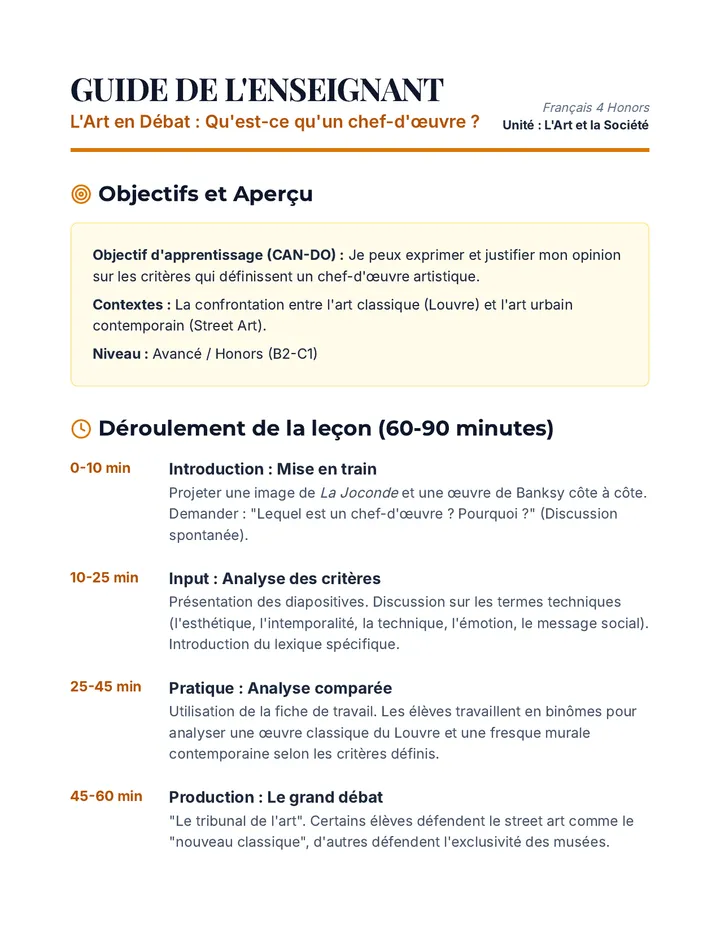
A high-level French Level 4 Honors lesson where students evaluate and debate the criteria that define a 'masterpiece,' comparing classic Louvre works with contemporary street art.
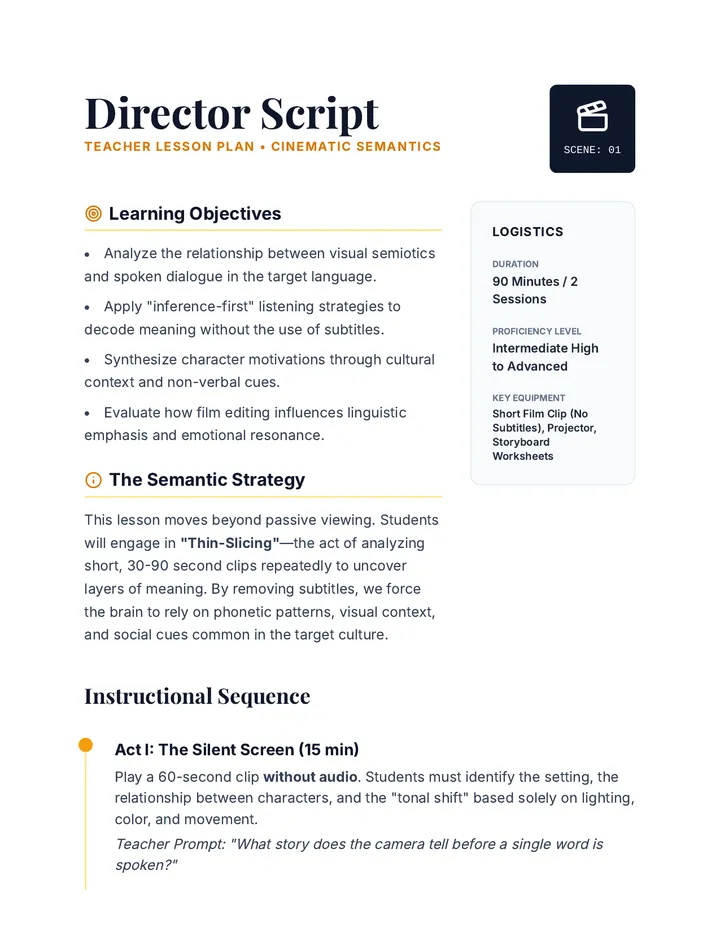
A comprehensive framework for foreign language educators to guide students through deep linguistic and cultural analysis of film, focusing on visual storytelling and advanced listening strategies.
A comprehensive toolkit for foreign language teachers to bridge the gap between rote memorization and spontaneous oral communication through interactive activities and low-stakes scaffolding.
Synthesize skills by performing a comparative analysis of two Francophone texts, focusing on register, tone, and thematic expression of exile.
Explore the rhythmic and subversive power of Negritude poetry through the works of Césaire and Senghor, focusing on metaphor and linguistic identity.
Analyze post-colonial narratives by Djebar and Ben Jelloun, focusing on descriptive imagery, sensory vocabulary, and the construction of identity.
A mastery-focused lesson on identifying and interpreting the 'passé simple' in 19th and 20th-century French literature to understand narrative distance.
Examine the opening of Camus' 'L'Étranger' to understand how grammatical choices like the 'passé composé' create existential detachment and 'écriture blanche'.
Culminating lesson where students synthesize information from multiple sources to prepare for a debate or written synthesis.
Focuses on reading interviews and transcribed speech, identifying register shifts and the representation of spoken French.
Students read complex texts regarding the French concept of secularism, decoding historical and legal vocabulary.