Complex syntax, rhetorical devices, and formal argumentative structures for upper-level fluency. Equips learners to master varied linguistic registers and professional correspondence.
Un programme de révision intensif et structuré sur 3 semaines pour préparer sereinement les épreuves de SVT, Physique-Chimie et Histoire-Géographie du Diplôme National du Brevet.
A high school French 4 lesson exploring the vocabulary and cultural impact of urban art, including murals, graffiti, and public installations. Students will learn to describe techniques, materials, and the social messages behind street art.
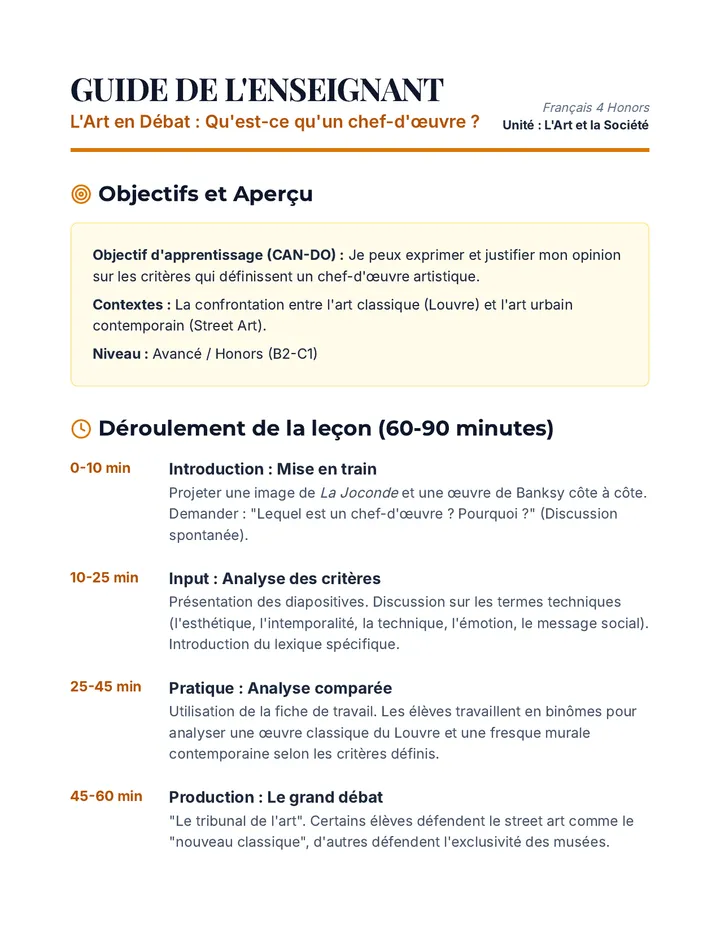
A high-level French Level 4 Honors lesson where students evaluate and debate the criteria that define a 'masterpiece,' comparing classic Louvre works with contemporary street art.
Synthesize skills by performing a comparative analysis of two Francophone texts, focusing on register, tone, and thematic expression of exile.
Explore the rhythmic and subversive power of Negritude poetry through the works of Césaire and Senghor, focusing on metaphor and linguistic identity.
Analyze post-colonial narratives by Djebar and Ben Jelloun, focusing on descriptive imagery, sensory vocabulary, and the construction of identity.
A mastery-focused lesson on identifying and interpreting the 'passé simple' in 19th and 20th-century French literature to understand narrative distance.
Examine the opening of Camus' 'L'Étranger' to understand how grammatical choices like the 'passé composé' create existential detachment and 'écriture blanche'.
Culminating lesson where students synthesize information from multiple sources to prepare for a debate or written synthesis.
Focuses on reading interviews and transcribed speech, identifying register shifts and the representation of spoken French.
Students read complex texts regarding the French concept of secularism, decoding historical and legal vocabulary.
Learners examine 'les tribunes' (op-eds) to distinguish objective reporting from subjective argumentation through linguistic markers.
A unit exploring the intersection of art, culture, and society in the French-speaking world, focusing on aesthetic judgment and historical context.
An advanced French literature sequence for graduate students, exploring the stylistic and philosophical depths of Francophone authors from Camus to Djebar. Students analyze the 'passé simple', 'écriture blanche', and themes of post-colonialism and Negritude to master literary interpretation in French.
This sequence immerses graduate students in the landscape of contemporary French journalism, focusing on current events and social debates. Students move from identifying the structural components of news articles to analyzing complex opinion pieces and synthesizing multiple perspectives on sensitive topics like secularism.
A graduate-level exploration of French syntax, focusing on double pronoun placement, the imperative, nominalization, complex relative pronouns, and techniques of emphasis (mise en relief) to achieve academic fluency.
This advanced sequence explores the architecture of literary French, focusing on the passé simple, imparfait du subjonctif, and formal syntactic structures. Students move from morphological recognition to active stylistic analysis and translation, culminating in the ability to manipulate high-register prose.
This advanced French grammar sequence for graduate students explores the nuanced application of the subjunctive mood as a rhetorical and semantic tool. Students move beyond basic rules to master mood selection in relative clauses, the stylistic 'ne explétif', temporal sequencing with the past subjunctive, and sophisticated rhetorical framing using conjunctions.
An advanced French grammar sequence for undergraduate students focused on the power of nominalization to create dense, formal, and concise academic writing. Students progress from morphological basics to complex syntactic transformations and academic abstract composition.
An advanced French grammar sequence focusing on the causative construction (Faire + Infinitive) and verbs of perception (Laisser, Voir, Entendre). Students will master the distinction between agency and causation, pronoun placement in complex structures, and the nuances of permission and perception.
A comprehensive exploration of hypothetical structures in French, moving from basic 'si' clauses to complex expressions of regret, media nuance, and formal conditions. Designed for undergraduate students to master the nuances of causality and abstract reasoning.
This advanced French sequence explores the sociolinguistic dimensions of grammar, focusing on how language shifts between 'langue populaire', 'langue standard', and 'langue soutenue'. Students develop the ability to navigate different social contexts by mastering register-specific grammatical structures, from slang reductions to formal inversions.
A comprehensive advanced French grammar sequence focusing on the mastery of double object pronouns and adverbial pronouns (y, en). Students progress from basic object identification to complex oral fluency in real-time communication.
An advanced French grammar sequence focused on voice manipulation in media. Students explore the passive voice, pronominal verbs, and the indefinite subject 'on' to understand how agent suppression impacts objectivity and responsibility in journalistic and political contexts.
Une version mise à jour de la fiche mémo de français pour le brevet, incluant désormais les 10 procédés littéraires incontournables (avec la comparaison, l'allégorie, l'anaphore, la gradation, l'antithèse, la métaphore, etc.) présentés dans une grille ultra-synthétique et lisible pour éviter tout dépassement.
Le corrigé officiel et détaillé de la fiche d'exercices de grammaire et compétences de langue pour le Brevet. Il comprend les réponses attendues pour les 10 exercices, des conseils de correction et des rappels théoriques.
Une fiche d'exercices intensive de grammaire focalisée sur les natures et fonctions. Ce document de 2 pages contient 10 grands exercices sans titre, comportant chacun 5 consignes ou phrases d'application avec espaces lignés.
Le corrigé officiel et détaillé de la feuille d'exercices de réécriture en Français. Ce document comprend les réponses rédigées, l'explication pas-à-pas de chaque piège d'accord ou de conjugaison, ainsi qu'un barème d'évaluation type DNB.
Une série d'exercices de réécriture calqués sur les épreuves de français du Brevet des années précédentes. Ce document de 2 pages comprend les sujets d'entraînement avec des lignes d'écriture spacieuses pour permettre aux élèves de formuler leurs réponses.
Un guide méthodologique et notionnel complet pour le Brevet en SVT, Physique-Chimie et Histoire-Géo. Ce document de 3 pages regroupe les définitions incontournables, les formules indispensables et des fiches de méthode pas-à-pas pour réussir le jour J.
Un calendrier de révision sur 3 semaines, structuré jour par jour pour le Brevet (SVT, Physique-Chimie, Histoire-Géo). Conçu pour être imprimé et affiché, il propose un rythme quotidien équilibré avec des cases à cocher pour suivre sa progression.
A reading comprehension activity for French 4 students about the street art culture in Vitry-sur-Seine. Includes an article, vocabulary sidebar, and analysis questions covering comprehension and critical thinking.
An exit ticket for the 'Murs Parlants' lesson, featuring two identical cut-out slips to assess students' vocabulary retention and their ability to use logical connectors in an opinion sentence.
A set of 6 discussion cards for French 4 Honors students to debate topics related to urban art, including ownership, commercialization, and social impact. Each card includes a specific connector prompt.
A reference and practice sheet for French 4 Honors students to master logical connectors (transition words) when discussing urban art. Includes categories for addition, opposition, cause/consequence, and conclusion.
A visual presentation with image prompts and guiding questions in French to lead a 'See-Think-Wonder' warm-up activity about urban art. Features categories for murals, stencils, and installations.