Motor Marvels Teacher Guide Active Athletes Academy
Motor Marvels
Teacher's Playbook • Lesson 1: Locomotor & Motor Skills
45 Minutes
Target Grade
Grades 2 - 4
Focus Skills
Skipping, Throwing, Catching
Equipment Need
Cones, Foam Balls, Spots
Dynamic Warm-Up (10 Minutes)
Prepare students physically and neurologically for movement. Establish high energy and boundary rules early.
1
Boundary Jog (3 min) Students jog inside marked field lines. On whistle blow, hold static freeze balance on one foot.
2
High-Knees & Butt-Kicks (3 min) Perform length-wise down the field and back to prime hip flexors and hamstrings.
3
Arm Windmills (2 min) Slow, forward and backward rotational arm circles to release tension in the shoulders.
4
Frankenstein Walks (2 min) Stretching active hamstrings by kicking straight up towards opposite outstretched hand.
Skill 1: The Skipping Rhythm (15 Minutes)
Skipping is a complex locomotor skill requiring an alternating step-hop pattern. It is critical for dynamic balance, coordination, and athletic agility.
Phase 1 Step-Hop
Practice single step-hops on the spot. Isolate the mechanical sequence before combining.
Prompt: "Step, hop! Step, hop!"
Phase 2 High Drive
Drive the lead knee upwards at 90 degrees while pumping opposite arm for lift-off height.
Prompt: "High knees, reach high!"
Phase 3 Flow
Link step-hops sequentially. Focus on soft balls-of-feet landings and fluid continuous momentum.
Prompt: "Keep the rhythm flowing!"
Common Misconception: Landing flat-footed or using a double gallop. Keep reminders active on a consistent alternating "Step-Hop" chant.
Active Athletes Academy Curriculum • Unit 1 Teacher Playbook Guide Page 1 of 2
Active Athletes Academy
Skill Mechanics
Teacher's Playbook • Throwing, Catching & Evaluation
Lesson 1 Page 2
Skill 2: Overhead Throwing
Focus on the 5-point sequence to build velocity and target accuracy:
T-Position: Face sideways, shoulder pointed toward target.
Opposite Step: Step with foot opposite the throwing arm.
Hip Rotation: Rotate hips forward to generate floor power.
High Release: Extend elbow, release ball high over head.
Follow Through: Arm sweeps across opposite hip.
Key Cue: "Opposite step, point, throw, drag pocket!"
Skill 3: Soft-Hands Catching
Position hands based on trajectory to prevent drops or injury:
Ready Stance: Knees bent, weight on toes, hands forward.
High Target: Thumbs together, fingers up for high ball.
Low Target: Pinkies together, palms up for low ball.
Track Ball: Eyes locked onto ball all the way to hands.
Shock Absorb: Give with ball, retracting hands slightly.
Key Cue: "Thumbs high, pinkies low, pull soft!"
Observational Assessment Checklist
Use during partner practice to check mechanical proficiency. Note mastery vs. needing development.
Movement Skill Proficiency Indicators Common Corrections Skipping Rhythm • Alternates step-hop pattern consistently. • Drives knee and opposite arm vertically. • Galloping/stepping without rhythmic hop. • Stiff upper body with zero arm swing. Overhead Throw • Steps forward with foot opposite throwing hand. • Directs shoulder toward target, fluid trunk. • Stepping with same foot as arm, loses power. • Pushing ball from shoulder instead of throwing. Soft-Hands Catch • Tracks ball; hand orientation matches ball height. • Absorbs impact by retracting ball to torso. • Trapping ball against chest directly. • Stiff fingers cause ball rebound drop.
Active PE Facilitation Strategy
Maximize MVPA: Keep instructions under 90 seconds. Demonstrate using students, and release immediately into active repetitions to ensure optimal dynamic memory patterns!
Active Athletes Academy Curriculum • Unit 1 Teacher Playbook Guide Page 2 of 2
Motor Mastery Challenge Card Active Athletes Academy
Athlete Challenge Card
Level 1 Mastery
Athlete Name:
Date:
Your Goal Today: Complete the 3 Motor Master Challenges!
Work with an athlete partner. Check off each skill tier as you show your teammate perfect form. Focus on the mechanical cues on your playbook guide!
01
The Skipping Rhythm Sprint
Alternating Pattern
Perform a rhythmic skip from line to line (20 yards). Your partner checks off your mechanics:
Level 1: Step-Hop
Even rhythm on both legs
Level 2: Knee Drive
Knees up to hip height
Level 3: Soft Land
Landing quietly on toes
02
Target Throwing Masterclass
Overhead Precision
Throw a foam ball at a wall target from 10 feet. Build points based on your kinetic mechanics:
Step Foot:
Step opposite throwing arm
Overhead:
Release high above head
Follow:
Sweep arm across opposite hip
03
Soft-Hands Catch Relay
Trajectory Tracking
Toss a ball back and forth with your partner. Record your consecutive catching records below:
Attempt 1 _____ catches
Attempt 2 _____ catches
Attempt 3 _____ catches
Athlete Self-Reflection & Next Goal Write 1-2 sentences explaining which motor mechanic was easiest for you and one focus cue you will use to improve your throwing or catching in the next lesson.
Active Athletes Academy Curriculum • Student Challenge PE-1-Locomotor-Challenge
Active Bodies Slide Deck Active Athletes Academy
Active Bodies
Lesson 1: Locomotor & Motor Skills
Slide 1 / 3
Dynamic Warm-Up
Before we perform complex athletic tasks, we must wake up our muscles and joints. Focus on steady control over pure speed.
1
Boundary Jog (Warm muscles)
2
High Knees (Hip mobility)
3
Arm Circles (Shoulder rotation)
Get Ready: Position at your designated spots Physical Literacy • Movement Excellence
The Playbook Cues
Skill Keys
Master Your Locomotor & Projectile Mechanics
Slide 2 / 3
Skipping Rhythm
• Step-Hop Pattern: Even alternating rhythm.
• Vertical Drive: Push knee to 90 degrees.
• Soft Landing: Control weight on toes.
"Step, Hop! Keep the Flow!"
Overhead Throw
• T-Position: Sideways alignment to target.
• Opposite Step: Step with opposite leg.
• Follow Through: Arm sweeps past hip.
"Point, Step, Whip, and Swipe!"
Key Reminder: Keep eyes tracked on the ball for soft catches! Kinematic Chain • Level 1 Core
Partners & Protocols
Practice Rules
Gym safety rules are essential for athletic success
Slide 3 / 3
Partner Setup
Grab your Challenge Card and partner up. Choose a partner who will challenge you and give honest feedback on your motor form!
Safety Spacing
Keep 10 feet of clear space between partner channels.
Whistle Freeze
On whistle blow, instantly freeze, place balls on floor, look up.
Positive Coaching
Encourage your partner with mechanical cues, not general insults.
Ready... Set... Go! Let's hit the court! Active Athletes Academy Curriculum • Unit 1
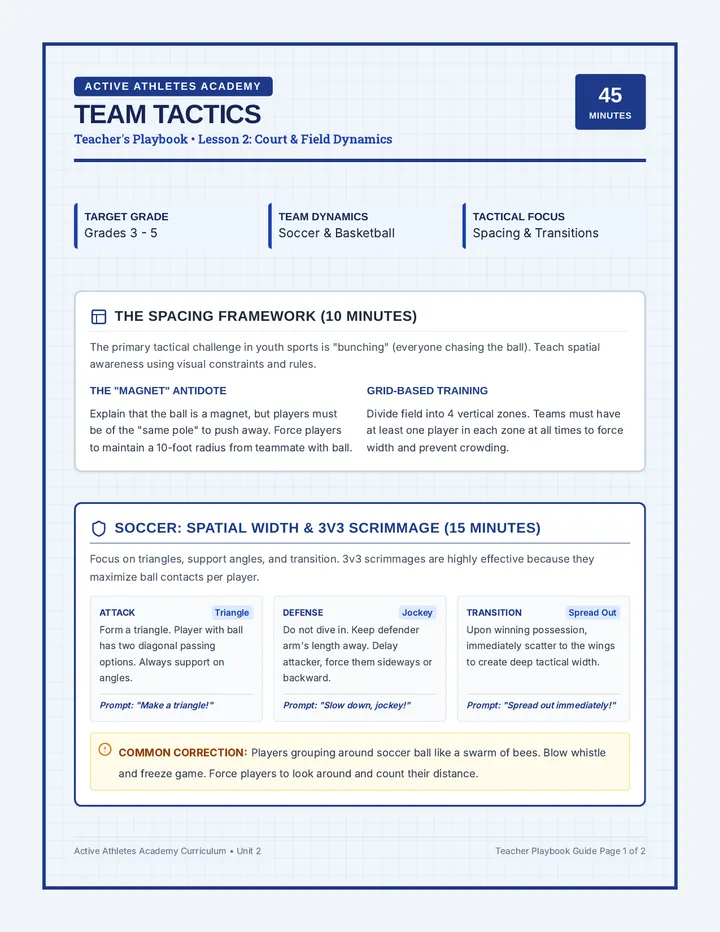
Team Tactics Teacher Guide Active Athletes Academy
Team Tactics
Teacher's Playbook • Lesson 2: Court & Field Dynamics
45 Minutes
Target Grade
Grades 3 - 5
Team Dynamics
Soccer & Basketball
Tactical Focus
Spacing & Transitions
The Spacing Framework (10 Minutes)
The primary tactical challenge in youth sports is "bunching" (everyone chasing the ball). Teach spatial awareness using visual constraints and rules.
The "Magnet" Antidote
Explain that the ball is a magnet, but players must be of the "same pole" to push away. Force players to maintain a 10-foot radius from teammate with ball.
Grid-Based Training
Divide field into 4 vertical zones. Teams must have at least one player in each zone at all times to force width and prevent crowding.
Soccer: Spatial Width & 3v3 Scrimmage (15 Minutes)
Focus on triangles, support angles, and transition. 3v3 scrimmages are highly effective because they maximize ball contacts per player.
Attack Triangle
Form a triangle. Player with ball has two diagonal passing options. Always support on angles.
Prompt: "Make a triangle!"
Defense Jockey
Do not dive in. Keep defender arm's length away. Delay attacker, force them sideways or backward.
Prompt: "Slow down, jockey!"
Transition Spread Out
Upon winning possession, immediately scatter to the wings to create deep tactical width.
Prompt: "Spread out immediately!"
Common Correction: Players grouping around soccer ball like a swarm of bees. Blow whistle and freeze game. Force players to look around and count their distance.
Active Athletes Academy Curriculum • Unit 2 Teacher Playbook Guide Page 1 of 2
Active Athletes Academy
Court Dynamics
Teacher's Playbook • Basketball & Tactical Formations
Lesson 2 Page 2
Basketball: Give & Go
Focus on simple, effective spatial cuts to bypass defender defenses:
The Pass: Pass cleanly to wing teammate using a chest or bounce pass.
The Fake: Take one step away from ball to throw defender off-balance.
The Cut: Sprint directly to the hoop with hands ready to catch.
Wing teammate passes right back for a layup/close shot.
Teamwork Playbook and Reflection Active Athletes Academy
Teamwork Playbook
Tactics Log
Athlete Name:
Date:
Your Tactical Guide: Spacing, Roles, and Communication!
In team sports, the best athletes don't just watch the ball—they see the entire court. Complete the tasks below to show your deep tactical knowledge!
01
The Tactical Matchup
Draw Lines to Match
Draw a straight line to connect each tactical term on the left with its correct definition on the right:
A. Spatial Width
B. Jockeying Defense
C. Give & Go Play
1. Slowing down the attacker and forcing them wide.
2. Passing, cutting hard, and catching a return pass.
3. Spreading out to sidelines to drag defenders away.
02
Tactical Scenario Assessment
Multiple Choice
Read the team sports situation below. Place a checkmark inside the square next to the **best tactical decision**.
The Scenario: Your teammate is dribbling the soccer ball down the left wing, and three defenders are sprinting towards them. You are currently standing 5 feet away from your teammate in the middle of the field.
Option A: Sprint directly to your teammate to help shield the ball from the defenders.
Option B: Sprint backwards toward your own goalkeeper to prepare for an immediate defensive stop.
Option C: Spread out to the far right wing, creating open passing space and forcing the defenders to separate.
Tactical Teamwork Reflection Explain what verbal communication calls you used to help your teammate today (e.g. "Pass!", "I got ball!"), and explain how maintaining spatial width helped your team score.
Active Athletes Academy Curriculum • Student Playbook PE-2-Tactics-Playbook
Tactical Positioning Slides Active Athletes Academy
Tactical Spacing
Lesson 2: Spacing & Team Positioning
Slide 1 / 3
The Spacing Law
Do not swarm the ball! Spreading out forces defenders to chase you, creating wide open passing lanes and scoring opportunities.
1
The 10-Foot Radius (Keep distance)
2
Fill Open Wings (Force defender spread)
3
Constant Scans (Watch court space)
Key Goal: Maintain spatial awareness in active scrimmages Tactical Training • Game On
Soccer Mechanics
Soccer Spacing
Mastering Triangles & Defensive Delay
Slide 2 / 3
Attack Triangles
• Diagonal Paths: Support ball at side angles.
• Spread Out: Pull defenders to the wings.
• Quick Transitions: Move space to save passing lanes.
"Attackers create angles, defenders stay goal-side!"
Jockeying Defense
• Delay Attacker: Slow down the ball carrier.
• Staggered Feet: Low bent knees, side slide.
• No Diving In: Stay arm's-length distance away.
"Delay, don't dive! Guide them wide!"
Tip: Keep physical space to let teammates execute clean control. Soccer Science • Tactical Width
Basketball Tactics
Court Playbook
Basketball Give & Go and Man-to-Man
Slide 3 / 3
The Give & Go
Pass the ball cleanly to your wing teammate. Take a step back, then sprint hard to the hoop to receive a quick return pass!
Goal-Side Position
Always stay between your offensive matchup and the basket.
See Ball & Player
Form a physical triangle with your body to watch both target balls.
Verbal Calls
Shout "Open!", "Ball!", and "Got Ball!" to direct teammates.
Get ready to scrimmage! Match up and play smart! Active Athletes Academy Curriculum • Unit 2