Tactical Vision Player Workbook
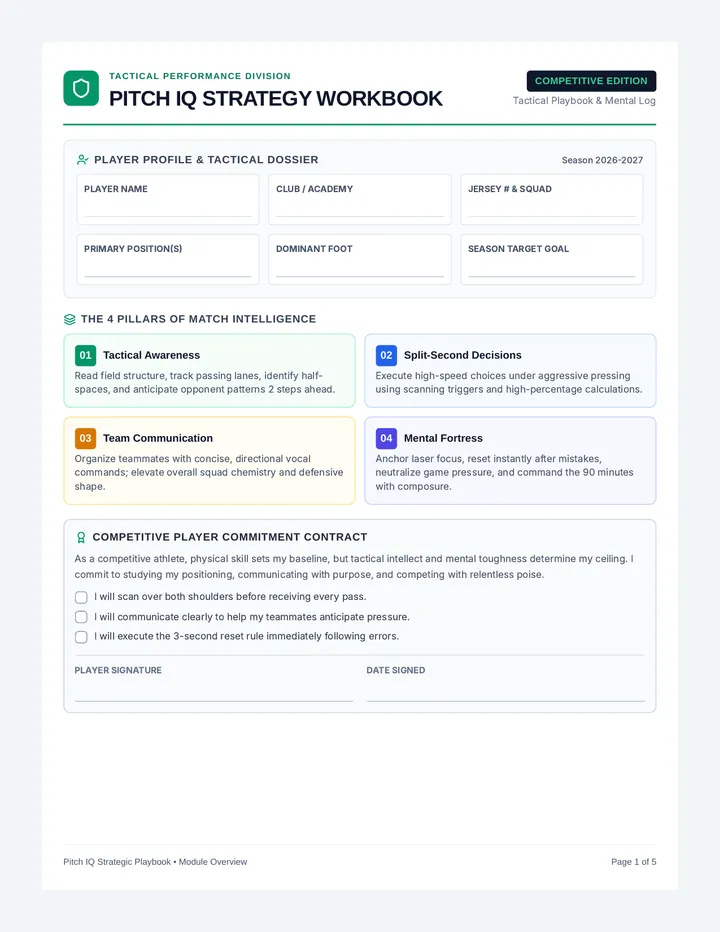
Competitive Academy Edition TACTICAL IQ SERIES
TACTICAL VISION WORKBOOK
Positioning, Game Phases, Spatial Dominance & Pitch Intelligence
Player Name
Squad # / Role
Team / Academy
Match Date / Cycle
1
Pitch Geography: The 5 Vertical Channels & 3 Thirds
WING HALF CENTRE HALF WING DEFENSIVE 3RD MIDDLE 3RD ATTACKING 3RD
The Half-Spaces (Channels 2 & 4)
The most dangerous attacking corridors. Passing from here diagonals toward goal, putting center backs and fullbacks in conflict over who steps out.
The 3 Pitch Thirds
Defensive 3rd: High risk, minimal dribbling, secure circulation. Middle 3rd: Progression & line-breaking passes. Attacking 3rd: Creative risks, crosses, cutbacks, and box overloads.
Golden Spatial Rule
Never occupy the same vertical channel as a teammate in the same horizontal line. Create diagonal passing lanes.
2
Elite Tactical Lexicon: Academy Vocabulary
1. Rest Defense (Restabsicherung)
Defensive Phase
The defensive structure your team organizes while you have the ball. Typically a 3+2 or 2+3 setup to stop opponent counter-attacks before they launch.
2. Overload to Isolate
Attacking Phase
Flooding 4–5 players on one flank to suck the opponent's entire defensive block over, then hitting a rapid switch to create an isolated 1v1 on the weak side.
3. The Third Man Run
Attacking Phase
Player A passes to Player B, who sets the ball into space for sprinting Player C. Impossible to defend when executed at speed because defender tracks ball, not runner.
4. Pressing Trigger
Transition / Defending
A specific opponent action (bouncing touch, slow back-pass, facing own goal, ball trapped on sideline) signaling your entire unit to hunt the ball together.
Player Tactical Check: In your primary position, which vertical channel should you dominate? Write your answer below
Tactical Vision Academy Playbook Page 1 of 5 • Pitch Geography & Foundations
Match Dynamics Masterclass
THE 4 PHASES OF THE MATCH
Tactical Cycle Matrix
Elite players think two phases ahead. Soccer is an unbroken cycle of possession, loss, defending, and recovery.
1
Attacking (In Possession)
Objective: Create superiorities, unbalance the opponent, score goals.
- Width & Depth: Stretch opposing block vertically and horizontally.
- Body Profile: Open body shape to scan the full field before receiving.
- Passing Lines: Form passing triangles; never hide behind opponents.
2
Transition to Defend (Turnover)
The 5-Second Rule: Gegenpress immediately or organize recovery.
- Closest 2 Players: Sprint immediately to suffocate ball-carrier.
- Rest Defense Unit: Drop and track runners in behind immediately.
- No Turning Allowed: Force opponent backward or into touchline.
3
Defending (Out of Possession)
Objective: Protect central zones, stay compact, force errors.
- Compactness: Team length under 30 yards; width squeezed tight.
- Line Coordination: Move as a single accordion; step up when ball moves back.
- Defensive Stance: Side-on posture; steer play toward your pressing trap.
4
Transition to Attack (Ball Win)
First Decision: Exploit disorganization or retain possession?
- First Pass Forward: Break counter-press immediately if forward lane is open.
- Breakout Runners: Wingers and strikers sprint into open half-spaces.
- Escape Valve: If pressured, recycle through pivot to retain control.
Negative Transition Decision Matrix: Press vs. Drop Tactical Rule
TRIGGER: COUNTER-PRESS IMMEDIATELY
When we have at least 2 players within 5 yards of turnover, opponent has head down or back to our goal, and our rest defense has locked the center.
TRIGGER: DROP & DELAY (MID-BLOCK)
When ball carrier has head up with open passing options, our teammates are caught ahead of the ball, or space behind backline is exposed.
Tactical Reflection 1: What is your exact responsibility the split-second your team loses possession in the attacking half?
Tactical Reflection 2: When your team wins the ball in your own defensive third, how do you decide between a counter-attack and resetting possession?
Tactical Vision Academy Playbook Page 2 of 5 • The 4 Phases & Transition Speed
Formation Mechanics & Roles
THE 1-4-3-3 POSITIONAL BLUEPRINT
Shape & Triangles
Modern football relies on positional structures that naturally generate triangles, passing diamonds, and numerical overloads.
1 2 4 5 3 6 8 10 7 9 11
The Rule of Triangles
Every player on the ball must always have a minimum of two passing angles (left, right, or central drop). If you don't offer an angle, you are out of the game.
The Pivot (#6) Function
The engine room. Operates behind the opponent's first pressing line to connect center backs with attacking midfielders (#8 & #10).
Wide Width vs. Inverted Runs
When wingers (#7/#11) stay wide, fullbacks (#2/#3) can invert into central midfield. When wingers cut inside, fullbacks overlap to deliver crosses.
Unit Roles Across Formation Lines
Backline Unit (#2, 4, 5, 3)
In Possession: Split wide, step out with ball to provoke pressure, play penetrating vertical balls.
Out of Possession: Maintain offside line, command aerial duels, defend rest space.
Midfield Engine (#6, 8, 10)
In Possession: Rotate constantly, play in half-turns, find pockets between opponent midfield and defense.
Out of Possession: Screen central passing lanes, trigger midfield press, win second balls.
Attacking Trident (#7, 9, 11)
In Possession: Pin back opponent center backs, execute blindside runs, finish inside the 18-yard box.
Out of Possession: Steer opponent build-up into trap zones, cut passing return lanes to goalkeeper.
Positional Application: In your specific position, what two teammates must you form passing triangles with during build-up? Describe your movement when they are pressed:
Tactical Vision Academy Playbook Page 3 of 5 • Formation Mechanics & Positional Blueprint
Match Decision Scenarios
PITCH PROBLEM SOLVING & READS
Match IQ Scenarios
Great players don't just react—they recognize recurring tactical patterns and execute the optimal solution under pressure.
SCENARIO A
Beating the Aggressive Man-to-Man High Press
Defensive Third Build-Up
1 4 5 6 X9 X7 X11
The Problem: Opponent commits 3 forwards to lock your center backs and goalkeeper inside the 18-yard box, cutting easy short passes.
Tactical Solution: What movement breaks this press? (e.g. #6 drop, third-man run, clipped ball to fullback)
SCENARIO B
Defending a 3v2 Overload on the Counter
Transition to Defend
4 5 X9 X7 X11
The Problem: Ball lost high up the pitch. Opponent ball carrier attacks central corridor with two sprinting wingers outside your 2 center backs.
Tactical Solution: Do you dive into a tackle or delay/channel the carrier? What are your cues?
SCENARIO C
Unlocking a Packed 10-Man Low Block
Attacking Third / Box Entry
10
The Problem: Opponent defends with two flat lines of 4 inside their penalty area, shutting down all straight through-balls.
Tactical Solution: Detail 2 creative patterns (e.g. wall-pass combo, cutback cross, overlapping run) to breach the block:
Elite Academy Mindset Rule
"Before you receive any pass, you must ask yourself: 1. Can I play forward? 2. Can I break a line? 3. If not, can I circulate cleanly to shift their shape?"
Tactical Vision Academy Playbook Page 4 of 5 • Tactical Problem Solving Scenarios
Self-Scouting & Performance Review
TACTICAL IQ AUDIT & DEBRIEF
Match Evaluation
Tactical development accelerates when you intentionally scout your own performance, scanning rate, and in-game decisions.
The In-Game Scanning Protocol (Before, During, After) Target: 3-5 Scans Every 10 Seconds
1. Before Ball Arrival
Check shoulder twice. Identify nearest opponent pressure, space in behind, and teammate outlet.
2. On First Touch
Touch into the open channel away from pressure. Open body angle toward opponent's goal.
3. After Releasing
Never admire your pass. Immediately move 3–5 yards to create the next passing triangle.
Pre-Match Tactical Mission Blueprint
1. My Direct Matchup
Opponent #, dominant foot, tendency:
2. Attacking Objective
Channel target, runs in behind, combos:
3. Defending Objective
Pressing cue, rest defense role:
Post-Match Tactical Decision Rubric (Rate 1 - 5)
| Tactical Dimension | Focus Criterion | Self-Score (1-5) |
|---|
| Spatial Awareness | Did I maintain proper distance in my channel and avoid crowding teammates? | [ / 5 ] |
| Scanning Frequency | Did I scan over my shoulder 3+ times before receiving the ball under pressure? | [ / 5 ] |
| Transition Urgency | Did I react within 2 seconds of turnover (counter-press or recovery drop)? | [ / 5 ] |
| Line-Breaking Vision | Did I identify and exploit open half-spaces and diagonal passing angles? | [ / 5 ] |
Post-Match Tactical Debrief: What was the most difficult tactical problem the opponent posed during this match, and how will you adapt next time?
Tactical Vision Academy Playbook Page 5 of 5 • Self-Scouting & Post-Match Debrief