Premiers Pas Curriculum Map
French 1 Curriculum Suite
PREMIERS PAS
Unit 1: Greetings, Introductions, & Cultural Sociolinguistics
3-Week Extended Pace
Target Level: Novice-Low to Novice-Mid
Big Ideas
First impressions are culturally shaped. Language structure reflects social relationships, intimacy, and respect.
Essential Questions
How do French speakers greet differently based on age and status? How does who I am speaking to change what I say?
ACTFL Standards
Interpersonal: Novice-Low exchange. Interpretive: Recognize simple spoken/written cues. Cultural: Compare norms.
Sociolinguistic Core: Tu vs. Vous
In French-speaking cultures, selecting the correct form of address is critical to showing respect. Tu is singular & informal (peers, family, children, pets). Vous is singular-formal (adult strangers, teachers, authorities) or plural (any group). The shift from vous to tu (tutoiement) represents a formal social transition.
Unit Lexicon & Phonetic Guide
| French Lexeme | Phonetic Target (IPA) | Phonetic Key (Approx.) | English Meaning & Usage |
|---|
| Bonjour | /bɔ̃ʒuʁ/ | [bohn-zhoor] | Hello / Good day (Formal/neutral) |
| Salut | /saly/ | [sah-loo] (no "t") | Hi / Bye (Highly informal) |
| Ça va? | /sa va/ | [sah vah] | How's it going? / I'm good. |
| Comment t'appelles-tu? | /kɔmɑ̃ tapɛl ty/ | [ko-mahn tah-pell too] | What's your name? (Informal) |
| Comment vous appelez-vous? | /kɔmɑ̃ vuzaple vu/ | [ko-mahn voo-zah-play voo] | What's your name? (Formal/Plural) |
| Enchanté(e) | /ɑ̃ʃɑ̃te/ | [ahn-shahn-tay] | Nice to meet you (silent final e) |
| Et toi? / Et vous? | /e twa/ / /e vu/ | [ay twah] / [ay voo] | And you? (Informal / Formal) |
La Bise: Kinesthetic Etiquette
A critical non-verbal cultural ritual. Friends and family tap cheeks while making a light kissing sound. The number of cheek kisses (1 to 4) is highly regional (e.g., 2 in Paris, 3 in Montpellier). Instruct students that handshakes are reserved for first introductions in formal domains.
Pronunciation Pitfalls
Silent Consonants: Emphasize that final consonants (like 't' in salut, 's' in vous) are typically silent unless followed by a vowel (Liaison: vous_appelez). The French "U" (/y/): Model rounded lips posture to master this vowel.
Premiers Pas Curriculum Suite Page 1 of 3
DAILY PACING MAP
WEEKS 1 & 2 • DAILY SEQUENCING
Days 1 - 10 Outline
Day
Can-Do Objective
Core Interactive Activities & Methods
Formative Check
D 1
Recognize cognates & French sounds.
Welcome & Sound Bath: Teacher greets in French (90% target language). Students match cognates from lists & sort common sounds. Introduce simple "Oui" and "Non".
Thumbs Up/Down sound sort.
D 2
Greet others informally.
Salut / Ça va: Model informal greetings using TPR. Introduce physical gestures (handwaves vs cheek kisses). Direct student-to-student rapid milling activity.
Exit Ticket: Match greet to scene.
D 3
Introduce myself informally.
Je m'appelle: Practice "Comment t'appelles-tu ?" & "Je m'appelle..." with a passing ball circle game. Reinforce the silent final consonants.
Spoken introduction with partner.
D 4
Express emotional states.
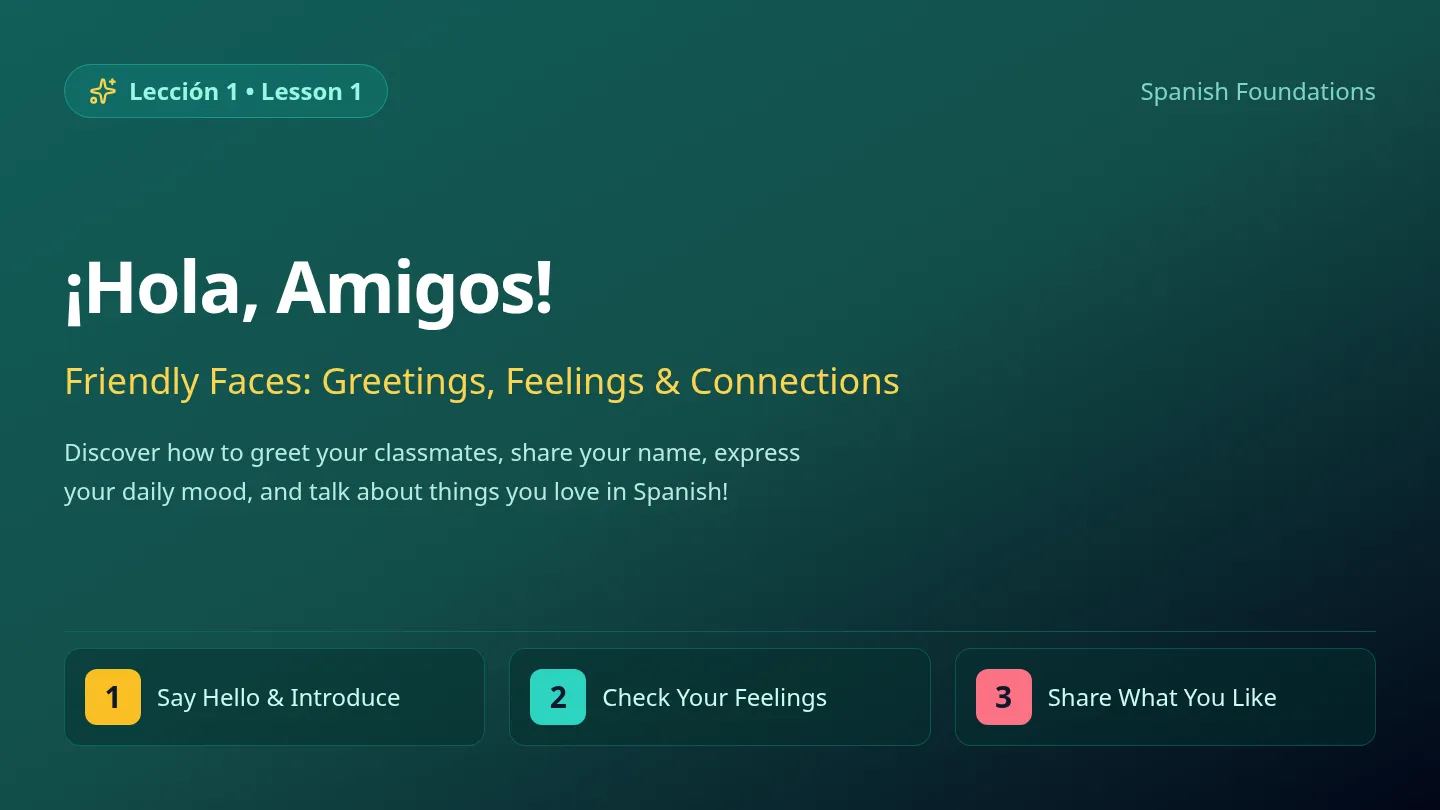
L'humeur: Introduce très bien, pas mal, fatigué(e), malade, comme ci comme ça. Students pair up to roleplay brief dialogues under different emotion prompts.
Emoji matching hand gestures.
D 5
Synthesize informal dialogue.
Speed Greeting Mixer: Students receive informal profiles. They rotate, greeting others, sharing names, checking mood, and parting with salut or au revoir.
Teacher checklist during run.
D 6
Identify formal settings.
Formal Bonjour & Titles: Introduce titles Monsieur, Madame, Mademoiselle. Analyze video/audio clips of French speakers in formal domains. Outline strict use cases.
Visual classification of scenes.
D 7
Differentiate Tu vs. Vous.
The Linguistic Boundary: Analyze scenario cards (e.g., student to boss, grandma to baby, friends). Play "Tu ou Vous?" where students raise cards based on prompts.
Card raising task (100% check).
D 8
Ask & tell names formally.
Comment vous appelez-vous ?: Introduce formal structure. Contrast with Day 3. Practice polite responses including "Enchanté(e)". Match gesture (polite nod) to words.
Partner formal dialog checklist.
D 9
Use formal greetings/goodbyes.
Polite Closings: Learn bonne journée, bonsoir, bonne nuit. Map greetings/departures to specific times of day (morning vs. afternoon vs. night).
Clock-matching timeline game.
D 10
Compare greeting structures.
Formal vs. Informal Matrix: Create direct comparison graphic organizer. Compare US/local greeting spaces with French parameters. Prepare students for upcoming presentations.
Graphic organizer completion.
Pacing Rationale for French 1 Beginners
This extended pacing dedicates 5 complete days to formal registers. Lower-level textbooks often rush this, causing lifelong student confusion. By spending Week 2 entirely on formal registers and the *Tu/Vous* dichotomy, students build a deep instinct for sociolinguistic levels.
Premiers Pas Curriculum Suite Page 2 of 3
DAILY PACING MAP
WEEK 3 • CONSOLIDATION & ASSESSMENT
Days 11 - 15 Outline
Day
Can-Do Objective
Core Interactive Activities & Methods
Formative Check
D 11
Introduce a third party.
Je vous présente...: Model introducing someone else. Compare "Je te présente" (informal) vs "Je vous présente" (formal). Practice in groups of three.
Trio interaction observation.
D 12
Integrate courtesy formulas.
Polite Interactions: Teach S'il vous plaît / S'il te plaît, merci beaucoup, de rien. Students rewrite a rude dialogue to make it polite based on status.
Rude dialogue correction worksheet.
D 13
Review all unit objectives.
Interactive Review Stations: 1) Phonetics/Pronunciation feedback, 2) Tu vs. Vous scenario matching, 3) Interpersonal dialogue drafting, 4) Kinesthetic "La Bise" practice.
Station check-off scorecard.
D 14
Demonstrate spoken proficiency.
Performance Assessment - Part 1: Interpersonal Speaking. Pairs draw random context cards (e.g., "Meeting exchange teacher" vs "Meeting cousin's friend"). Complete ungraded interview.
Recorded/live performance rubric.
D 15
Assess reading/writing skill.
Performance Assessment - Part 2: Interpretive Reading (read email greeting, identify errors) & Presentational Writing (write dialogue greeting formal partner). Unit Wrap-up.
Written assessment score.
Summative IPA Blueprint
1. Interpretive Mode
Students listen to three greeting exchanges and identify relationships (informal vs. formal) and physical context based on auditory cues, pauses, and formal titles.
2. Interpersonal Mode
In pairs, students pick a random situation card and perform an unscripted greeting and name exchange, using corresponding physical cues (la bise vs. handshake).
3. Presentational Mode
Students write a quick text message chain welcoming a visiting French exchange partner, selecting the correct pronoun register based on age and social background.
Instructional Facilitation Strategy
- Target Language Standard: Maintain 90% instruction in French by leveraging gestures, expressions, and physical emoji cards. Resort to English only for structural contrast.
- Scaffolded Speaking: Keep speaking activities brief (under 3 minutes) but highly repetitive. Fast rotations ease performance anxiety and maximize verbal output.
- Differentiated Speed: For students moving faster, introduce secondary descriptors like "ravi de vous rencontrer" or additional numerals (up to 50) for phone numbers.
Premiers Pas Curriculum Suite Page 3 of 3