Serenity Lesson Plan Screen Free Serenity
Mastering Mindful Breaks for Mental Health
Duration 60 Mins
Audience
12 Year Olds
Setting
Outdoor Active Space
Approach
Active Discussion & Sport
Why This Matters
This lesson empowers students to manage screen time and appreciate mental well-being using physical activity and structured breaks, contributing to overall balance in daily life.
Learning Objective
Students will learn strategies for taking mindful breaks, reducing screen time, and supporting mental health through active and engaging outdoor activities.
Preparation (10 mins)
Review the lesson plan for detailed structure
Set up an outdoor area for discussion and volleyball activity
Ensure volleyball equipment is available and safe to use
Familiarize yourself with discussion prompts
Materials Checklist
Screen-Free Serenity Lesson Plan
Volleyball Net and Balls
Outdoor Field or Court Space
Whistle (Optional)
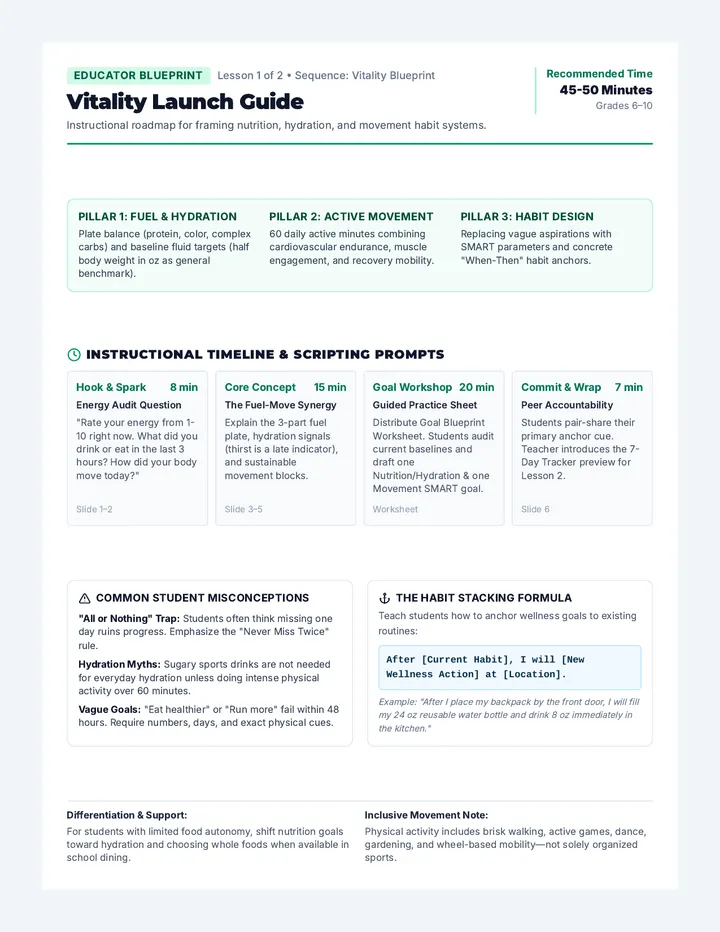
Lesson Timeline
10 MIN Warm Up
Mindful Movement Warm-Up
Light physical stretching and jogging paired with a session introduction focused on the "why" of screen-free breaks.
10 MIN Theory
Lesson Overview & Discussion
Concept introduction: what is a mindful break? Open-ended questions about the impact of excessive screen time.
25 MIN Practice
Volleyball Activity
The main event: active gameplay used as a metaphor for balance. Teams practice taking breaks even during high-intensity play.
15 MIN Reflection
Cool Down & Reflection
Deep breathing and stretching. Structured group share on takeaways and how to apply strategies at home.
Serenity Facilitator Script Facilitator Script
Screen-Free Serenity: Mastering Mindful Breaks
Introduction
"Good morning, everyone! Today, we're going to have a special outdoor lesson called 'Screen-Free Serenity: Mastering Mindful Breaks for Mental Health.' We're going to learn why taking breaks is important for our minds, how too much screen time can affect us, and how physical activity—like playing volleyball—can help us feel balanced and refreshed."
Warm Up (10 minutes)
"Let's start with a quick physical warm-up. Everyone, please stand up and follow my lead as we stretch our arms and legs. We're going to do some light stretching and jogging in place for about two minutes. This will get our bodies ready for today's fun activities."
[ACTION: Lead light stretching and jogging. Gather students back together after.]
"Great job, everyone! Now that we're warmed up, I want you to think about how you feel after a little bit of exercise. Has this movement made you feel a bit more awake or happy?"
Lesson Overview & Discussion (10 minutes)
"Now, let's talk about mindful breaks. A mindful break is a time when you step back from your activities—especially screen time—and take care of your mind and body. Think of it as giving your brain a little rest so it can work better."
"I have a few questions for you:"
"What do you enjoy doing when you're not on your phone or computer?"
"Have you ever noticed that after playing outside or being active, you feel more relaxed or happy?"
"Feel free to share your thoughts. Remember, there's no right or wrong answer; we just want to discuss what works best for each of us."
[PROMPT: Encourage responses. Follow up with: "Can you explain why that makes you feel better?" or "How do you think taking breaks helps you concentrate later?"]
Volleyball Activity (25 minutes)
"Now, we're going to put our discussion into action with a fun game of volleyball. I've split you into teams. As you play, remember these key points:"
Teamwork: "Encourage one another and work together on the court."
Taking breaks: "If you feel tired or need to catch your breath, it's perfectly okay to take a moment to rest. Think of these as little mindful breaks."
Balance: "Just like in volleyball, our lives need a balance of activity and rest."
"Let's head over to the volleyball area and start our game. I'll be checking in with each team. Have fun!"
[DURING PLAY: Stop teams occasionally. Ask: "How are you feeling? Do you need a quick break?" Ensure teams rest if needed.]
Cool Down & Reflection (15 minutes)
"Let's bring our game to a close and settle down for a cool down. Please gather in a circle. First, we'll do deep breathing. Inhale deeply through your nose... hold it... now exhale slowly through your mouth. Let's do this three times together."
"Reflection questions:"
"What did you learn about taking breaks today?"
"How did the volleyball game help you understand the importance of resting and being active?"
"How can you use what you've learned when you're at home?"
[WAIT: Allow time for students to think and share. Offer reinforcement: "Thank you for sharing those insights!"]
Closing
"Before you head back to class, remember: just like a well-played game of volleyball, life is about balance. Accepting breaks and managing screen time is one of the best ways to care for yourself. Thank you for participating today!"
Mindful Breaks Discussion Worksheet Mindful Breaks
Student Worksheet
Name
Date
Let's explore how taking breaks can make you feel better and why spending less time in front of screens might be good for you. Use this space to jot down your thoughts!
Opening Questions
1. What do you usually do when you take a break from your screens (phones, tablets, computers)?
2. How do you feel after spending time away from screens? (Does it help you relax, make you feel happier?)
3. What fun activities do you enjoy that don’t involve screens? (For example, playing volleyball, drawing, etc.)
Deeper Dive
Why do you think our brains need breaks from screens?
How can you tell if you might need a break? What signs does your body or mind give you?
Can you think of a time when taking a break helped you feel better or think more clearly? What happened?
Group Reflection & Planning
1. What are some ideas for simple activities you can do during a break?
2. How can you encourage your friends or family to take screen-free breaks too?
3. If you were to make a plan for a "Perfect Break," what would it look like?
Volleyball Balance Activity Guide Volleyball Balance
Active Play & Mindful Breaks Activity Guide
25 Minutes
Outdoor Court/Field
Objective
Demonstrate the importance of balance between high-intensity activity and conscious rest.
Gear Needed
Volleyball & Net
Boundary Markers
Step-by-Step Instructions
1
Organizing Teams
Divide the class into small teams. Ensure each team has an opportunity to play and observe.
2
Game Rules & Objectives
Begin with a brief explanation of volleyball rules. Emphasize teamwork and communication. Critical Rule: If a student feels tired or needs a moment to regroup, they are encouraged to take a quick mindful break (e.g., stepping aside, taking deep breaths) before returning to play.
3
Reflecting on Breaks
Before starting, ask students to notice how they feel during intense moments of play. Encourage them to notice how it feels to pause and return with renewed energy.
4
Active Game Play
Start the game and monitor the teams. Occasionally, pause the game and ask students how they feel. Guiding Questions: "How does taking a break make you feel?" "What changes when you take a moment to rest?"
Closing Discussion
What did you notice when you took a break?
How did your energy or teamwork change after a break?
How can this apply to screen time or study routines?
This activity puts into practice the lesson of 'Screen-Free Serenity,' showing that balance is essential in both physical activity and mental health.
Mindful Volleyball Game Guide Mindful Volleyball Game
A High-Energy Lesson in Intentional Pausing
Team Competition
25 Minutes
Game Mission
Integrate mindful breaks into a competitive volleyball game to observe how short pauses can positively impact energy, focus, and overall well-being.
Rules of Play
1
Balanced Teams
Split the class into teams. Ensure every student gets time both on the court and as a resting "reserve" player.
2
The "Break Signal"
If a student feels over-exerted or notices a drop in concentration, they can signal for a mindful break by raising a hand and stepping to the sidelines.
3
Action During Breaks
While on break, students should take 3 deep breaths, stretch briefly, or close their eyes. They rejoin only when they feel "recharged."
4
Teacher-Led Pauses
Call occasional "Full Class Mindful Pauses" to check in on energy levels and focus across all teams.
Mid-Game Prompts
"How do you feel after that short pause?"
"Did you notice a change in your focus?"
Takeaways
"Performance improves with rest."
"Listen to your body's signals."
Post-Game Debrief
01
What benefits did you notice from taking a mindful break during the high-speed game?
02
Did the game feel different when you were allowed to pause and refresh without penalty?
03
How might you use this 'pause and refresh' strategy during difficult school assignments?
Mindful Movement Warm Up Guide Mindful Movement
Warming Up the Body and Mind
This warm-up is designed to gently prepare your body for outdoor activity while introducing the concept of mindfulness. Follow these steps to get started!
01
Overall Stretch
Stand in a large circle. Begin with gentle stretches for the arms, neck, and legs. Instruction: Focus on slow, intentional movements rather than speed.
02
Breathing Exercise
Close your eyes for a moment and take three deep, mindful breaths. Notice how your chest and belly expand as you inhale and relax completely as you exhale.
03
Dynamic Movement
Jog in place: 1 minute, slowly increasing pace.
Arm circles: 10 forward and 10 backward.
Toe touches: Reach for toes, then reach high to the sky.
04
Mindful Check-In
Reflect on how your body feels after the movement. Activity: Share one word that describes your current state (e.g., "ready," "awake," "warm").
Post-Warm Up Note
How does your body feel right now compared to when you started?
Reflective Cool Down Activity Guide Reflective Cool Down
Transitioning to Calm and Balance
This activity helps transition from high physical activity into a state of relaxation, allowing space to reflect on mindful breaks and mental well-being.
01
Guided Stretching
Form a large circle. Lead the group through gentle stretches for the arms, legs, and back. Hold each stretch for 15–20 seconds . Focus on the feeling of tension releasing.
02
Deep Breathing Exercise
Instruct students to stand comfortably:
Inhale deeply through the nose
Hold for a count of three
Exhale slowly through the mouth
Repeat 3 times
03
Reflection Prompts
Allow 5 minutes for sharing with a partner or the whole class:
Prompt A
"What was one thing you learned today about taking mindful breaks?"
Prompt B
"How did you feel before, during, and after the activities?"
Prompt C
"How can you use what you learned today to balance rest and activity at home?"
"Remember: Taking breaks—whether during a game or a study session—is crucial for your physical and mental health. Balance is a practice you can take with you everywhere."
Serenity Parent Handout Screen-Free Serenity
A Family Guide to Mindful Breaks & Mental Health
Lesson Overview
Welcome to our parent resource for the "Screen-Free Serenity" lesson! Today, your child participated in a specialized 1-hour outdoor session designed to foster awareness around screen-time habits and the importance of intentional rest.
By blending physical activity—specifically volleyball—with mindful discussions, students learned that balance is not just about stopping, but about recharging to perform better in everything they do.
Our Core Goal
Promoting mental well-being through activity and rest.
What We Covered
Mindful Breaks
Students explored the "power of the pause"—taking short, intentional moments to clear the mind.
Screen-Free Time
We highlighted why the brain needs time away from digital stimulation to recover focus and energy.
The Power of Balance
Through volleyball, students experienced how physical activity and rest work together for better mental health.
Support at Home
How you can reinforce the lesson
1
Encourage Regular Breaks
Remind your child to take short 5-minute breaks during homework. A quick stretch or three deep breaths can reset their focus.
2
Promote Outdoor Play
Getting outside—even for 15 minutes—benefits both body and mind. Encourage physical activities like biking, walking, or sports.
3
Discuss the Benefits
Ask your child: "How did you feel after spending time outside today?" Open dialogue helps them recognize their own mental state.
4
Practice Mindfulness Together
Try a family breathing exercise before bed. It's a simple, screen-free way to reconnect and lower stress levels.
Thank you for supporting your child's journey toward a balanced, healthy lifestyle. By reinforcing these ideas at home, we can help mindful breaks become a regular part of their daily routine.
Screen-Free Serenity 2026