Quake Chronicles English Reading Document Quake Chronicles
Informative Reading: 1985 and 2017
Name: ____________________________________
Date: _____________________________________
Instructions:
Read the following paragraphs about the historic earthquakes of Mexico City. As you read, highlight key vocabulary in yellow and underline important dates or facts in red.
THE GREAT 1985 EARTHQUAKE
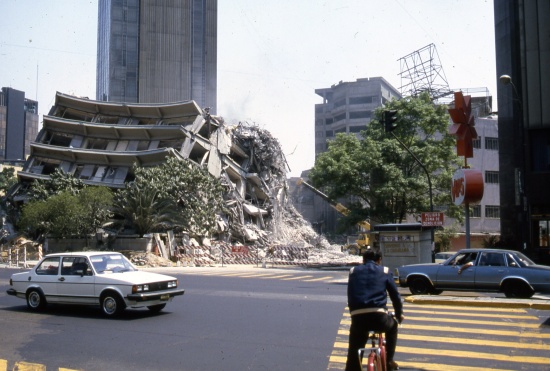
On Thursday, September 19, 1985, at exactly 7:17 in the morning, Mexico City suffered one of its worst tragedies. A massive earthquake with a magnitude of 8.1 originated on the Pacific Coast near Michoacán. Although the epicenter was far away, the seismic waves traveled rapidly toward the capital, causing a devastating impact on the historic center and the city's oldest residential areas.
Geologically, Mexico City is a very unique and dangerous place during a tremor. The city was built on an ancient lakebed, making the soil extremely soft and moist. During the 1985 earthquake, this soil acted like a bowl of jelly, amplifying the force of the waves. Many multi-story buildings lacked modern or resilient structures and collapsed completely within minutes.
The physical consequences were catastrophic and nearly incalculable for the time. Thousands of homes, schools, and offices disappeared under the rubble. Iconic sites like Juárez Hospital and the Nuevo León building in Tlatelolco suffered total destruction. The city fell into absolute silence: there was no electricity, traffic lights were out, and telephone lines were cut, leaving families without communication for many days.
Amid the chaos, an incredible human response emerged because the national government was not prepared for a disaster of such magnitude. Ordinary citizens quickly organized themselves into aid brigades. These volunteers, later known as the "Topos" (Moles), used their hands, shovels, and buckets to remove debris and search for survivors. This solidarity proved that the community was stronger than any natural disaster.
The legacy of 1985 changed Mexico's culture forever. Mexicans learned that prevention is vital, and the government created the National Civil Protection System. New, very strict building codes were established so that new structures could withstand strong seismic movements. Since then, a national drill is held every September 19 to remember the victims and practice safety measures.
THE RETURN OF THE TREMOR: 2017
Thirty-two years later, an almost unbelievable coincidence occurred. On September 19, 2017, at 1:14 in the afternoon, the earth shook violently once again. Most ironically, the 7.1 magnitude earthquake happened only two hours after the entire city had finished the commemorative drill for the 1985 disaster. Many people initially thought the seismic alarm was just part of an additional practice exercise.
Although the magnitude of this quake was lower than in 1985, the epicenter was much closer to the capital, in the state of Morelos. The movement was "trepidatory," meaning the ground moved up and down very quickly. This caused many older buildings that already had previous damage to suffer deep cracks. Several modern constructions also failed, causing a new wave of fear among the population.
Just like in the past, the community response was immediate and brave. Professional rescuers and thousands of young volunteers worked day and night. A famous image from this year was the "raised fist": when rescuers raised their fists, everyone kept absolute silence to listen for possible cries for help beneath the stones. This time, technology and social media helped organize food and medicine quickly.
The damage in 2017 was significant, especially in schools and apartment buildings in neighborhoods like Condesa and the downtown area. However, the building laws from the 1980s saved thousands of lives, as the city's largest skyscrapers did not suffer serious damage. Despite this, many families lost their entire heritage and needed months or years to rebuild their homes and regain normalcy in their lives.
The great lesson of 2017 was that the "culture of prevention" in Mexico is real and necessary. Mexico City now has a network of sensors that trigger a seismic alert throughout the capital, giving citizens valuable seconds to evacuate their buildings. Although earthquakes are inevitable, the experiences of 1985 and 2017 have formed a resilient, united society that is always ready to help one another in times of crisis.
Epicenter: The point on the Earth's surface directly above where an earthquake starts.
Magnitude: A number that shows the power or amount of energy released by an earthquake.
Debris: Scattered pieces of waste or remains from destroyed buildings.
Rescuers: People who save others from dangerous or difficult situations.
Drill: A practice of training people what to do in an emergency.
Survivor: A person who remains alive after an event in which others have died.
Resilient: Able to withstand or recover quickly from difficult conditions.
Evacuate: To remove someone from a place of danger to a safe place.
Tremor Tales Reading Document Expanded Crónicas del Temblor
Lectura Informativa: 1985 y 2017
Nombre: ____________________________________
Fecha: _____________________________________
Instrucciones:
Lee con atención los siguientes párrafos sobre los terremotos históricos de la Ciudad de México. Mientras lees, resalta el vocabulario clave en amarillo y subraya con rojo los datos o fechas importantes.
EL GRAN TERREMOTO DE 1985
El jueves 19 de septiembre de 1985, exactamente a las 7:17 de la mañana, la Ciudad de México sufrió una de sus peores tragedias. Un terremoto masivo con una magnitud de 8.1 grados se originó en la costa del Océano Pacífico, cerca de Michoacán. Aunque el epicentro estaba lejos, las ondas sísmicas viajaron rápidamente hacia la capital, causando un impacto devastador en el centro histórico y en las zonas residenciales más antiguas de la ciudad.
Geológicamente, la Ciudad de México es un lugar muy especial y peligroso durante un temblor. La ciudad fue construida sobre el lecho de un antiguo lago, por lo que el suelo es extremadamente blando y húmedo. Durante el terremoto de 1985, este suelo actuó como un plato de gelatina, amplificando la fuerza de las ondas. Muchos edificios de varios pisos no tenían una estructura moderna o resistente y colapsaron por completo en pocos minutos.
Las consecuencias materiales fueron catastróficas e incalculables para la época. Miles de hogares, escuelas y oficinas desaparecieron bajo los escombros. Lugares emblemáticos como el Hospital Juárez y el edificio Nuevo León en Tlatelolco sufrieron daños totales. La ciudad quedó en silencio absoluto: no había electricidad, no funcionaban los semáforos y los servicios de teléfono estaban cortados, dejando a las familias sin comunicación por muchos días.
En medio del caos, surgió una respuesta humana increíble porque el gobierno nacional no estaba preparado para un desastre de tal magnitud. Los ciudadanos comunes se organizaron rápidamente para formar brigadas de auxilio. Estos voluntarios, conocidos más tarde como "Topos", usaron sus manos, palas y cubetas para remover piedras y buscar sobrevivientes. Esta solidaridad demostró que la comunidad era más fuerte que cualquier desastre natural.
El legado de 1985 cambió la cultura de México para siempre. Los mexicanos aprendieron que la prevención es vital y el gobierno creó el Sistema Nacional de Protección Civil. Se establecieron nuevas leyes de construcción muy estrictas para que los edificios nuevos pudieran resistir movimientos sísmicos fuertes. Desde entonces, cada 19 de septiembre se realiza un simulacro nacional para recordar a las víctimas y practicar la seguridad.
EL REGRESO DEL TEMBLOR: 2017
Quake Impact Exit Ticket Document Boleto de Salida
Exit Ticket: Impacto y Reflexión
Nombre: ____________________________________
Fecha: _____________________________________
Reflexión Final:
¿Cuál terremoto tuvo más impacto y por qué? (Escribe 1–2 oraciones en español).
Pienso que __________________________________________________________________________________________
porque ______________________________________________________________________________________________
Entrega este papel al salir
¡Buen trabajo!
Boleto de Salida
Exit Ticket: Impacto y Reflexión
Nombre: ____________________________________
Fecha: _____________________________________
Reflexión Final:
¿Cuál terremoto tuvo más impacto y por qué? (Escribe 1–2 oraciones en español).
Pienso que __________________________________________________________________________________________
porque ______________________________________________________________________________________________
Entrega este papel al salir
¡Buen trabajo!
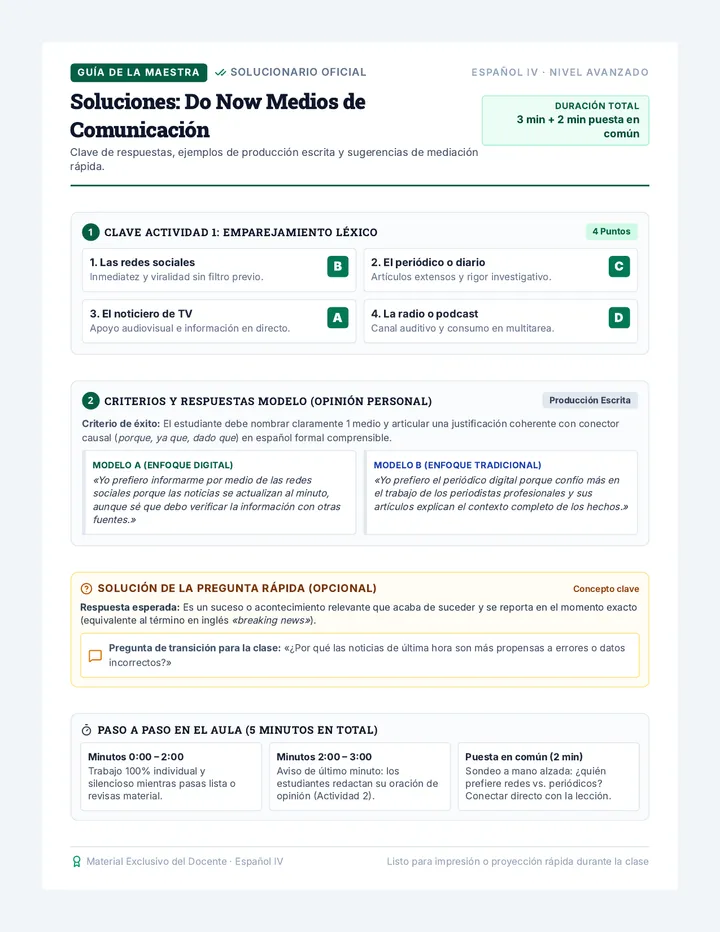
Quake Notes Answer Key Document Quake Chronicles
Guided Notes Answer Key
Teacher Resource For Presentation Slides (15 Slides)
Verified Answers
Learning Target
I can explain the impact of earthquakes using academic vocabulary.
Essential Question
How do natural disasters affect a community?
I. Vocabulary Key
1. El terremoto Earthquake
2. La magnitud Magnitude
3. Los edificios Buildings
4. Los daños Damage
5. La comunidad Community
6. Los rescatistas Rescuers
II. Geology & 1985 History
Mexico City is built on an ancient lake bed called Lake Texcoco.
The soft soil creates a "Jelly" effect, which amplifies seismic waves.
1985 Magnitude
8.1
1985 Time
7:17 AM
The volunteer rescuers who crawled into rubble were called "Los Topos" (The Moles).
III. 2017 History & Tech
The 2017 quake happened exactly 32 years after the first one.
Magnitude
7.1
Epicenter Proximity
Closer
Modern warnings come from the Alerta Sísmica sirens.
Coordination happened on Redes Sociales (Twitter, WhatsApp).
IV. Reflection & Debate
Question: Are buildings safer today?
ANS: Yes. After 1985, building codes were overhauled and seismic retrofitting became mandatory for larger structures.
Question: Which had more impact?
Varies: 1985 had more raw destruction/deaths, but 2017 showed the power of modern technology in civic rescue.
Tremor Response Scoring Guide Document Scoring Guide
Mexico City Quakes Response
TEKS E1.8A
TEKS E1.5C
Task Type
Short Constructed Response
Writing Prompt / Pregunta
"Which earthquake (1985 or 2017) had more impact on the community and why?"
Score Description of Response 2 Proficient
|
The response is a complete explanation of the impact of the chosen earthquake.
Includes a clear and specific claim that directly addresses the prompt.
Includes relevant text evidence from "Tremor Tales" (e.g., magnitude, deaths, "Los Topos," or technology use).
Includes specific commentary that explains how the evidence supports the claim.
Analysis reflects an understanding of the author's message (TEKS E1.8A).
|
| 1
Developing
|
The response is a partial explanation of the impact.
May include a vague claim or only partially answer the prompt.
May include some text evidence, but it may be weak or poorly integrated.
Includes little or no commentary to explain the connection.
Analysis of purpose or message may be superficial.
|
| 0
Incomplete
|
The response is incorrect or irrelevant.
Does not answer the question or provides an incorrect claim.
Is too vague to determine a response.
No text evidence is provided.
Response is written in a language other than English/Spanish without translation context (if applicable).
|
Evidence Check
Students should cite specific details like "magnitude 8.1" or "32 years later" to reach a Score 2. Look for keywords like "According to the text" or "Based on the reading."
CER Connection
Ensure the student doesn't just list facts. The "Reasoning" portion is critical—it shows their original commentary on why these facts prove the community impact they claimed.
Quake Notes Teacher Key Final Quake Chronicles: Teacher Key
Master Answer Key • 15 Slide Presentation
Answer Key
Learning Target:
I can explain the impact of earthquakes using academic vocabulary.
Essential Question:
How do natural disasters / quakes affect a community?
I. Vocabulary
1. El terremoto: Earthquake
2. La magnitud: Magnitude
3. Los edificios: Buildings
4. Los daños: Damage
5. La comunidad: Community
6. Los rescatistas: Rescuers
II. Geology & 1985 History
Mexico City is built on an ancient lake bed called Lake Texcoco.
The soft soil creates a "Jelly" effect, which amplifies seismic waves.
1985 Magnitude: 8.1
1985 Time: 7:17 AM
The volunteer rescuers who crawled into rubble were called "Los Topos" (The Moles).
III. 2017 History & Tech
The 2017 quake happened exactly 32 years after the first one.
Magnitude: 7.1
Epicenter: Much closer to the city
Modern warnings come from the Alerta Sísmica sirens.
Coordination happened on Redes Sociales (Twitter, WhatsApp).
IV. Reflection Key
Are buildings safer today? Why?
Yes. Post-1985 building codes became some of the strictest in the world. Modern materials and seismic dampers allow buildings to sway without collapsing.
Exit Ticket Prompt:
Pienso que el terremoto de 1985 tuvo más impacto porque causó más muertes y destrucción masiva que cambió las leyes de construcción para siempre.
Tremor Response Worksheet V3 Final Revised Plus Revised V2 Final NAME / NOMBRE:
DATE / FECHA:
TEKS E1.8A
Analyze the author’s purpose, audience, and message within a text.
Analizar el propósito del autor, la audiencia y el mensaje dentro de un texto.
Purpose / Propósito
Audience / Audiencia
Message / Mensaje
Writing Prompt / Pregunta
Which earthquake (1985 or 2017) had more impact on the community and why?
¿Cuál terremoto (1985 o 2017) tuvo más impacto en la comunidad y por qué?
RESPONSE / RESPUESTA (CER)
Quake Notes Guided Document 15 Slides English Tremor Chronicles: Guided Notes (15 Slides)
Fill-in-the-blank notes for the presentation
Name: ____________________________________
Date: _____________________________________
Learning Target:
I can explain the impact of earthquakes using academic _________________________.
Essential Question:
How do natural _________________________ affect a community?
I. VOCABULARY
1. El terremoto: _________________________
2. La magnitud: _________________________
3. Los edificios: _________________________
4. Los daños: _________________________
5. La comunidad: _________________________
6. Los rescatistas: _________________________
II. GEOLOGY & 1985 HISTORY
Mexico City is built on an ancient _________________ _________________ called Lake Texcoco.
The soft soil creates a "_________________" effect, which amplifies seismic waves.
1985 Details: Magnitude: _________________ | Time: _________________ AM.
The volunteer rescuers who crawled into rubble were called "_________________ _________________."
III. 2017 HISTORY & TECH
The 2017 quake happened exactly _________________ years after the first one.
Magnitude: _________________ | The epicenter was much _________________ to the city.
Modern warnings come from the Alerta _________________ sirens.
Coordination happened on Redes _________________ (Twitter, WhatsApp).
IV. REFLECTION
Are buildings safer today? Why?
____________________________________________________________________________________________________
Exit Ticket Prompt:
Pienso que el terremoto de _________________ tuvo más impacto porque ________________________________.
Quake Chronicles Slides Final 15 Slides Updated Crónicas del Temblor
The History and Resilience of Mexico City
Spanish 1 & 2 | Earthquakes: 1985 & 2017
Warm-up: Observation
Looking at the projected images, write 3 sentences in Spanish:
1. Yo veo... (I see...)
2. Hay... (There is/are...)
3. Parece que... (It seems that...)
Signal: Thumbs up when done! 👍
Learning Target (Can-Do)
I can interpret information about Mexico City's earthquakes and explain the impact using key academic vocabulary.
Essential Question
¿Cómo afectan los desastres naturales a una comunidad?
(How do natural disasters affect a community?)
Key Vocabulary 1
El terremoto
The earthquake
La magnitud
The magnitude
Los edificios
The buildings
Los daños
The damages
Key Vocabulary 2
La comunidad
The community
Los rescatistas
The rescuers
Ayudar
To help
Reconstruir
To rebuild
An Ancient Lake Bed
Mexico City was built on Lake Texcoco.
The Aztecs built Tenochtitlan on an island in the middle of the lake.
Today, the water is gone, but the sediment remains.
Painting of Tenochtitlan on Lake Texcoco
The "Jelly" Effect
The soil is soft and wet (lake sediment).
This soil amplifies seismic waves.
Think of a bowl of jelly on a plate being shaken.
September 19, 1985
Time: 7:17 AM
Magnitude: 8.1
The quake that changed everything.
Resource: seattletimes.com/nation-world/world/mexico-city-remembers-the-1985-earthquake-that-changed-everything/
Remembrances of 1985
The Rise of "Los Topos"
The government was not prepared for the disaster.
Civilians used their bare hands to find survivors.