Blade Basics Worksheet
Principles of Culinary Arts Unit: Knife Skills • Day 1
TOTAL: _____ / 25 PTS
Blade Basics Worksheet
Chef's Knife Anatomy, Specialty Blades & Culinary Applications
Name
Date
Station / Period
1
Part 1: Anatomy of a Chef's Knife
8 Points • Write matching number (1–8) in the box
Examine the numbered chef's knife diagram below. Write the matching number (1 through 8) inside each box next to its correct culinary term and definition.
1 2 3 4 5 6 7 8
Spine: Thick, unsharpened top edge; adds rigidity & strength.
Point: Very front piercing tip used for fine detail cutting.
Bolster: Thick steel collar adding balance & guarding fingers.
Tip: Forward curved portion used for delicate slicing & prep.
Heel: Rear cutting edge built for heavy chopping forces.
Cutting Edge: Sharpened working bevel along blade bottom.
Tang: Full steel extending into handle for leverage & safety.
Handle: Secure ergonomic gripping surface secured by rivets.
2
Part 2: Knife Profiles & Primary Culinary Uses
6 Points • 1 pt each
Match each kitchen task and blade profile to the correct knife type from the word bank.
Chef's Knife Paring Knife Bread Knife Boning Knife Carving Knife Cleaver Santoku Knife
1. Serrated blade featuring a row of sharp teeth that act like a saw to cleanly slice crusty loaves, pastries, and ripe tomatoes without crushing.
Answer:
2. Japanese sheep's foot blade with a flat cutting edge for straight up-and-down chopping; features dimpled Granton indentations to reduce sticking.
Answer:
3. Features a strong, flexible blade engineered to bend easily around complex joints and bones when separating poultry and fabricating whole fish.
Answer:
4. Small, short-bladed knife used for high-precision in-hand tasks: turning carrots, shaping mushrooms, coring strawberries, and peeling produce.
Answer:
5. Wide-bladed, heavy rectangular tool designed to withstand forceful blows when cutting through animal bone and cartilage or crushing ginger and garlic.
Answer:
6. Features a narrow, long, stiff blade designed for precise, uniform, razor-thin portioning of roasted meats, whole poultry, and baked hams.
Answer:
Principles of Culinary & Hospitality • Knife Skills Series Turn over for Materials, Maintenance & Station Scenarios → Page 1 of 2
Part II Materials, Maintenance & Practical Kitchen Safety
Blade Basics Worksheet • Page 2
3
Part 3: Knife Construction & Blade Materials
3 Points • 1 pt per blank
Complete the technical comparison matrix based on the manufacturing methods and characteristics from the slideshow.
| Blade Type | Manufacturing Process | Key Strength | Key Vulnerability |
|---|
| Forged Blade | Heated and hammered steel into shape from raw bar. | Heavy, sturdy construction; exceptional balance & easily sharpened. | Disadvantage: |
| | | |
| Stamped Blade | Manufacturing method: | | |
| Lighter in weight, flexible blade; holds edge longer. | More fragile than forged; lacks bolster heft. |
| Ceramic Blade | Pure ceramic or titanium nitride coated ceramic. | Primary strength:
| Extremely brittle; prone to snapping or chipping if dropped. |
4
Part 4: Edge Maintenance — Honing vs. Sharpening
4 Points • Technical Differences
Honing (Honing Steel) Routine Care
Does honing grind away metal from the blade? [ YES / NO ]
Mechanism (1 pt): Realigns microscopic _____________________________ on the blade edge.
Recommended frequency: Routine / Frequent daily use
Sharpening (Stone / Grinder) Periodic Reform
Does sharpening grind away metal from the blade? [ YES / NO ]
Mechanism (1 pt): Aggressively grinds steel to create a brand new _________________________.
Recommended frequency: 1–2 times per year
Culinary Safety Axiom (2 pts): "A dull knife is significantly more dangerous than a sharp knife." Explain why:
5
Part 5: Kitchen Station Scenarios — Select the Best Knife
4 Points • 1 pt each scenario
Read each commercial kitchen challenge below. Identify which knife from today's lesson is the single best fit, and explain what specific blade feature makes it ideal.
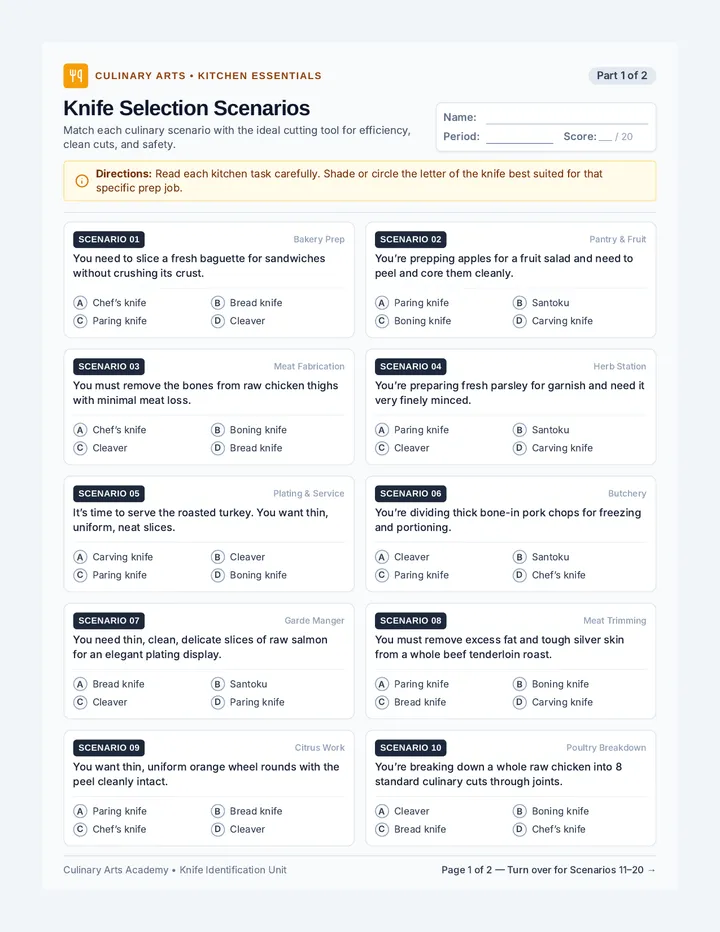
Scenario A: Bakery & Sandwich Line Station 1
Prep cook Mateo is slicing warm crusty artisan baguettes and ripe heirloom tomatoes. His current knife squashes the bread and bursts the tomatoes instead of slicing cleanly.
Best Knife:
Why this blade fits:
Scenario B: High-Volume Stir-Fry Prep Station 2
Chef Zoe has 30 lbs of potatoes, cucumbers, and bell peppers to dice with rapid up-and-down chops. Slices keep sticking to her blade, slowing down her prep efficiency.
Best Knife:
Why this blade fits:
Scenario C: Meat & Fish Fabrication Station 3
Apprentice Liam is deboning chicken thighs and fabricating whole salmon. He must navigate tight spaces around joints and follow curves along bones without losing meat.
Best Knife:
Why this blade fits:
Scenario D: Banquet Carving Board Station 4
Chef Marcus is portioning a 15-lb cooked prime rib roast and smoked turkey breasts at a live buffet, needing paper-thin, uniform, unbroken slices in single smooth strokes.
Best Knife:
Why this blade fits:
Principles of Culinary & Hospitality • Knife Skills Day 1 Assessment Total Score: _____ / 25 PTS Page 2 of 2
Blade Basics Answer Key
Teacher Answer Key • Grading Guide Unit: Knife Skills • Day 1
MAX SCORE: 25 / 25 PTS
Blade Basics Answer Key
Complete Master Key, Diagram Numerical Index & Scoring Rubrics
Class / Section: All Kitchen Stations Course: Principles of Culinary Arts
1
Part 1: Anatomy of a Chef's Knife Master Solutions
8 Points • 1 pt each
Diagram reference key for pins 1 through 8. Match numbers to the anatomy list below.
1 2 3 4 5 6 7 8
3
Spine: Thick, unsharpened top edge; adds rigidity & strength.
1
Point: Very front piercing tip used for fine detail cutting.
6
Bolster: Thick steel collar adding balance & guarding fingers.
2
Tip: Forward curved portion used for delicate slicing & prep.
5
Heel: Rear cutting edge built for heavy chopping forces.
4
Cutting Edge: Sharpened working bevel along blade bottom.
8
Tang: Full steel extending into handle for leverage & safety.
7
Handle: Secure ergonomic gripping surface secured by rivets.
2
Part 2: Knife Profiles Master Answers
6 Points • 1 pt each
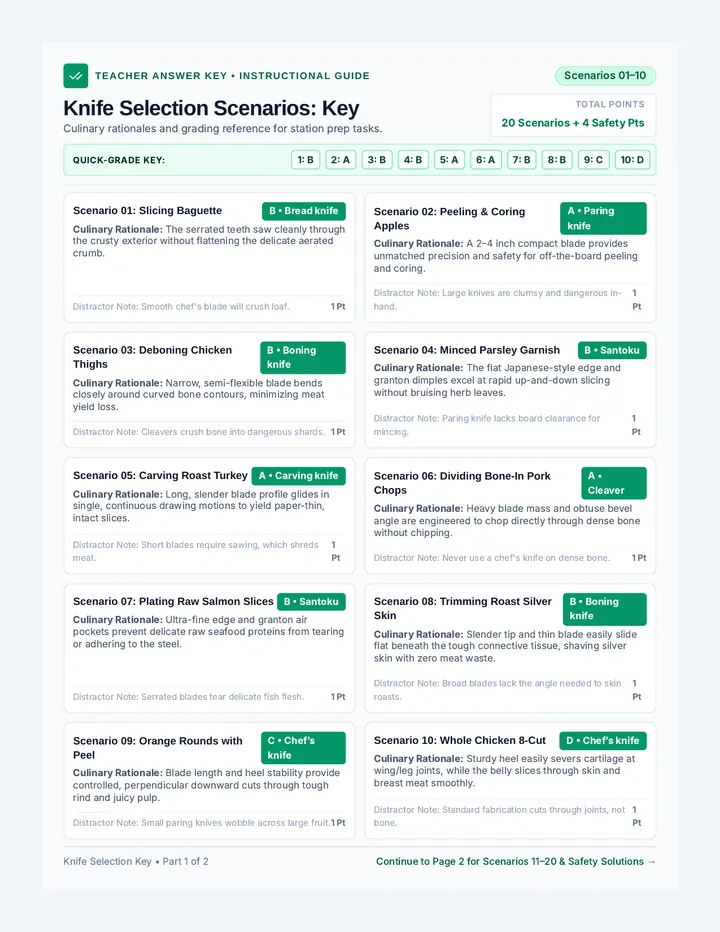
1. Serrated blade featuring a row of sharp teeth that act like a saw to cleanly slice crusty loaves, pastries, and ripe tomatoes without crushing.
Answer: Bread Knife
2. Japanese sheep's foot blade with a flat cutting edge for straight up-and-down chopping; features dimpled Granton indentations to reduce sticking.
Answer: Santoku Knife
3. Features a strong, flexible blade engineered to bend easily around complex joints and bones when separating poultry and fabricating whole fish.
Answer: Boning Knife
4. Small, short-bladed knife used for high-precision in-hand tasks: turning carrots, shaping mushrooms, coring strawberries, and peeling produce.
Answer: Paring Knife
5. Wide-bladed, heavy rectangular tool designed to withstand forceful blows when cutting through animal bone and cartilage or crushing ginger and garlic.
Answer: Cleaver
6. Features a narrow, long, stiff blade designed for precise, uniform, razor-thin portioning of roasted meats, whole poultry, and baked hams.