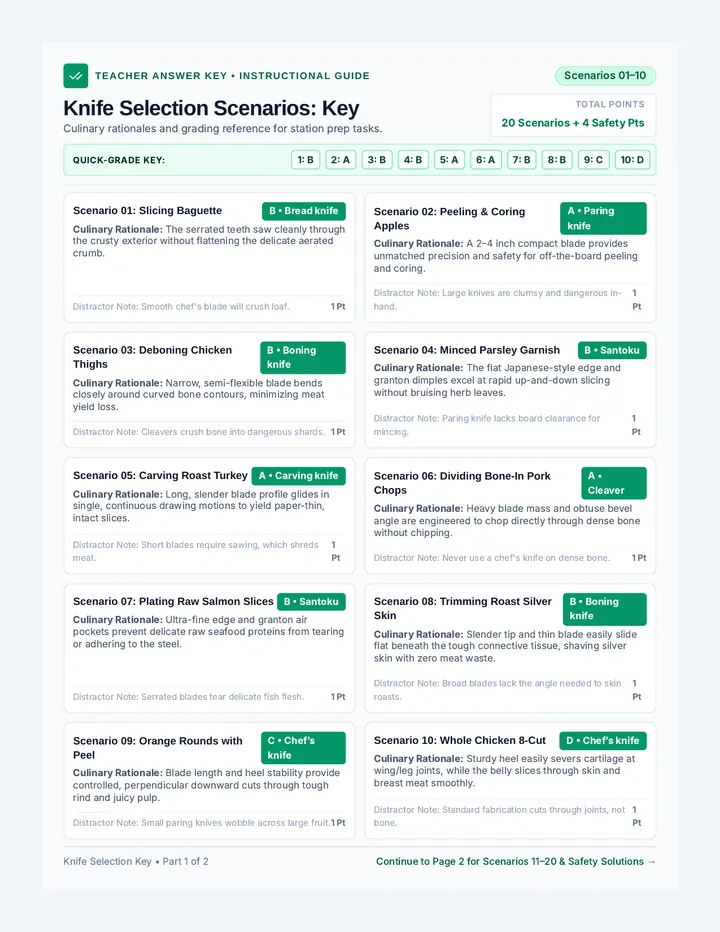
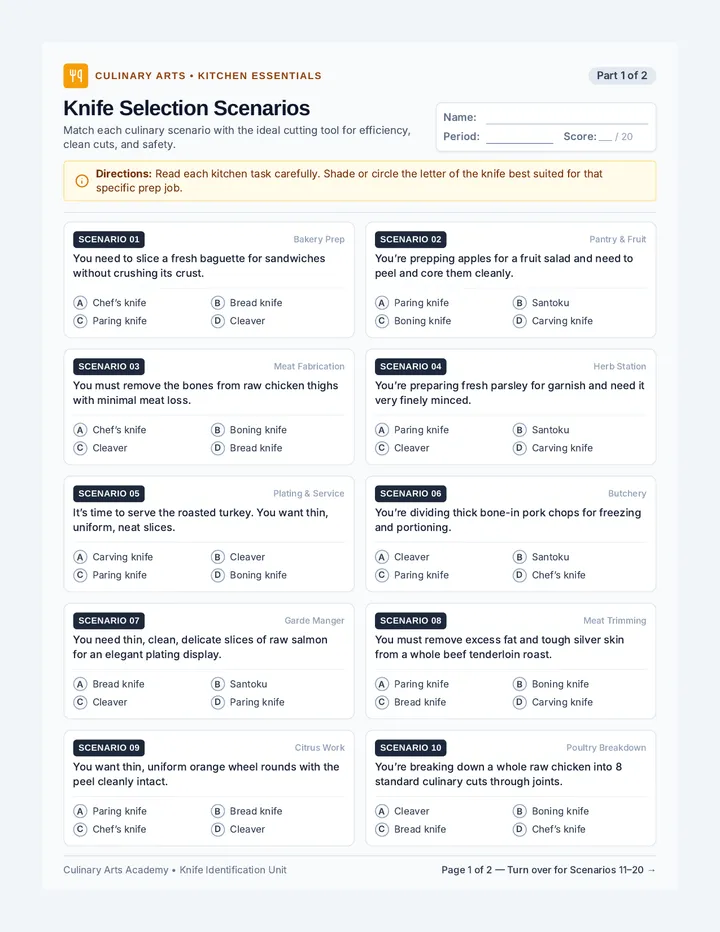
Scenario 09: Orange Rounds with Peel C • Chef’s knife
Culinary Rationale: Blade length and heel stability provide controlled, perpendicular downward cuts through tough rind and juicy pulp.
Distractor Note: Small paring knives wobble across large fruit. 1 Pt
Scenario 10: Whole Chicken 8-Cut D • Chef’s knife
Culinary Rationale: Sturdy heel easily severs cartilage at wing/leg joints, while the belly slices through skin and breast meat smoothly.
Distractor Note: Standard fabrication cuts through joints, not bone. 1 Pt
Knife Selection Key • Part 1 of 2 Continue to Page 2 for Scenarios 11–20 & Safety Solutions →
Knife Selection Scenarios: Key (Part 2)
Scenarios 11–20
Quick-Grade Key:
11: A 12: C 13: A 14: A 15: B 16: A 17: A 18: A 19: A 20: A
Scenario 11: Carrot Flower Garnish A • Paring
Rationale: Short blade allows fine micro-movements for fluting and carving decorative garnishes.
Focus: Delicate motor control 1 Pt
Scenario 12: Cubing Butternut Squash C • Chef’s
Rationale: Heavy spine and broad blade give required leverage and downward force for dense winter squash.
Focus: Leverage & spine strength 1 Pt
Scenario 13: Rapidly Dicing Onions A • Chef’s
Rationale: Curved belly supports the continuous rocking motion essential for standard uniform mirepoix dice.
Focus: Primary prep workhorse 1 Pt
Scenario 14: Filleting Round Fish A • Fillet
Rationale: Highly flexible blade flexes against the spine and rib cage, cleanly separating flesh from skin.
Focus: Extreme blade flexibility 1 Pt
Scenario 15: Breaking Chocolate Block B • Chef’s
Rationale: Broad, flat blade permits safe two-handed downward palm pressure across the spine to split blocks.
Focus: Safe downward palm force 1 Pt
Scenario 16: Slicing Whole Watermelon A • Chef’s
Rationale: 8–10 inch blade provides sufficient reach to span large melons without getting stuck or binding.
Focus: Blade length and clearance 1 Pt
Scenario 17: Thin Tomato Slices A • Serrated
Rationale: Scalloped teeth pierce the slippery, smooth tomato skin without squeezing out juice and seeds.
Focus: Piercing taut food skins 1 Pt
Scenario 18: Stripping Herb Leaves A • Paring
Rationale: Lightweight hand-held maneuverability allows rapid snipping of woody thyme and rosemary stems.
Focus: Intricate station prep 1 Pt
Scenario 19: Charcuterie Cheese Slices A • Cheese
Rationale: Blade holes or narrow profile reduce surface friction, preventing cheese slices from sticking.
Focus: Anti-suction blade design 1 Pt
Scenario 20: Slicing Flank Steak A • Carving
Rationale: Smooth, long strokes across muscle grain sever tough fibers cleanly without tearing cooked meat.
Focus: Tender across-grain slices 1 Pt
Culinary Skills Check: Model Solutions & Rubric
2 Pts Each (4 Pts Total)
Q1: Why is a dull knife more hazardous?
Model Answer: A dull knife requires excessive force and tends to slip off ingredients rather than biting into them, leading to unpredictable, severe cuts.
Q2: Proper non-knife hand position?
Model Answer: The "Claw Grip" (curling guide fingertips inward like a bear claw, with the flat side of the knife blade resting safely against the knuckles).
Knife Selection Key • Part 2 of 2 Grading Scale: 22–24: Exceeds • 19–21: Proficient • <18: Needs Review