Court to Career Lesson Plan
TEACHER GUIDE PE & CAREER READINESS
COURT TO CAREER
Translating Gym Teammate Habits into High-Impact Workplace Competencies
Grade Band: 8th–12th Grade
Duration: 60–75 Minutes
Setting: Gymnasium & Debrief Area
Focus: Transferable SEL Skills
Essential Question
“How do the habits that make someone an elite teammate on the court make them an indispensable asset in the 21st-century workforce?”
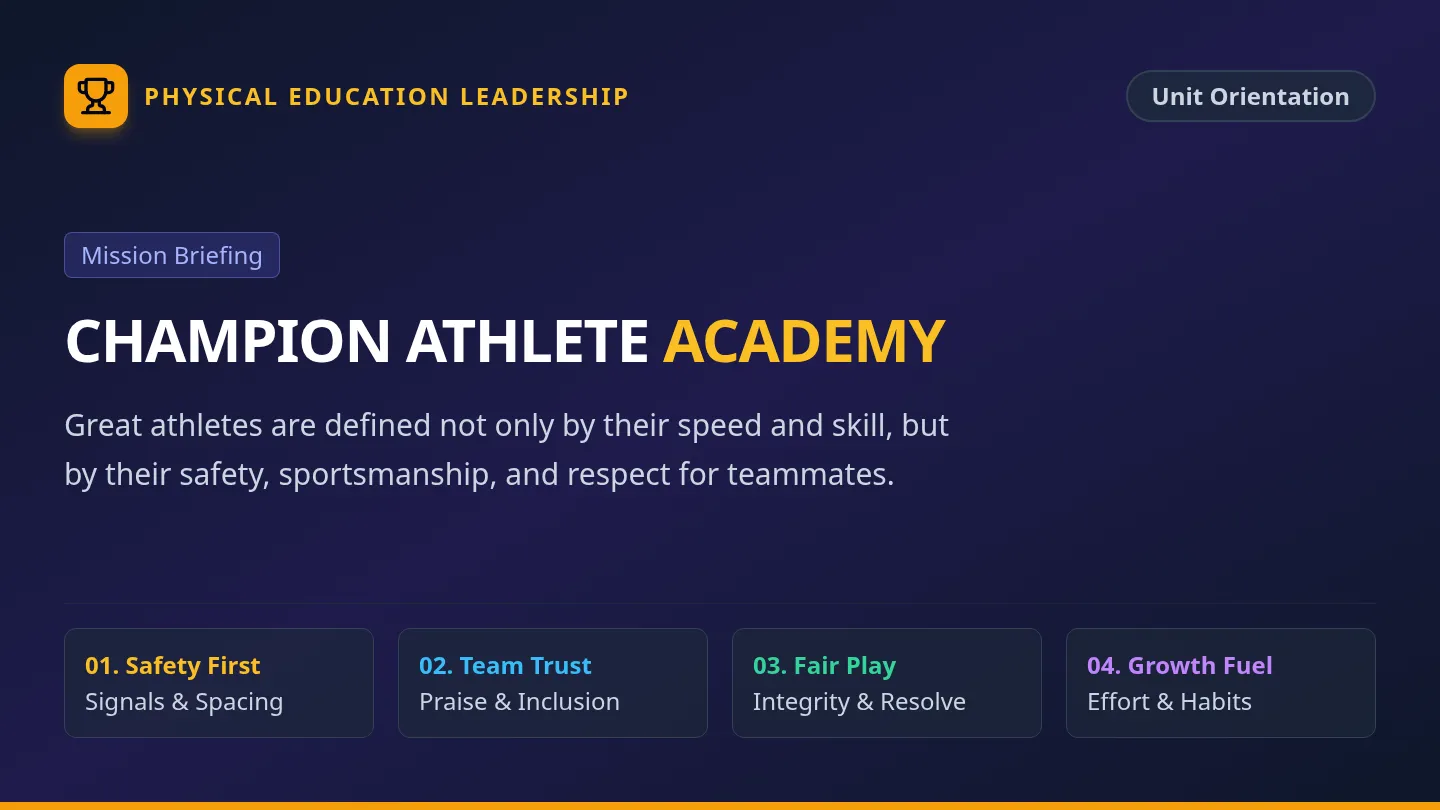
The Four Transferable Pillars
1. Collaboration
Court: Setting screens, trusting passing lanes, sharing ball possession.
Career: Delegating tasks, cross-functional projects, celebrating shared wins.
2. Leadership
Court: Raising energy when trailing, guiding defensive sets, vocal encouragement.
Career: Taking initiative on blockers, mentoring junior staff, driving momentum.
3. Communication
Court: Calling “I got ball”, directional switches, constructive huddle tips.
Career: Concise status updates, active listening, tactful peer feedback.
4. Accountability
Court: Showing up equipped, raising hand on personal fouls, hustle defense.
Career: Meeting project deadlines, owning mistakes immediately, high work ethic.
Lesson Timeline & Instructional Protocol
| Time | Phase | Teacher Moves & Gym Setup | Student Experience |
|---|
| 10 Min | The Friction Hook | Run a 3-minute chaotic mini-game with intentional rule ambiguities. Freeze action. Ask: “What ruined the play—fitness or team friction?” | Experience team dysfunction firsthand; identify communication breakdown vs. physical skill gap. |
| 15 Min | Pillar Walkthrough | Introduce the 4 Pillars. Display contrasting “Toxic Teammate” vs. “Catalyst Teammate” behaviors on gym whiteboard. | Distribute Court-to-Career Activity Sheets; form 4 mixed-ability squad rosters. |
| 30 Min | The 4 Gym Stations | Facilitate 4 high-interdependence physical challenges (7 min per station + 1 min rotation). Observe & note specific leadership behaviors. | Rotate through active challenges; log real-time performance adjustments on activity handouts. |
| 10 Min | Huddle to Boardroom | Circle up at center court. Facilitate the “Boardroom Translation” debrief connecting gym hurdles to modern workplace crises. | Analyze workplace case studies; share peer commendations for on-court leadership. |
| 10 Min | Exit Assessment | Distribute “Transferable Teammate Exit Ticket”. Collect as formative assessment before dismissal. | Complete individual self-audit rating and personal professional growth pledge. |
Court to Career: Lesson Plan • Page 1 of 2 Instructional Focus: Transferable PE Competencies
IMPLEMENTATION PLAYBOOK
GYM STATIONS & GUIDED DEBRIEF
Station Protocols • Differentiation
The Four Active Gym Challenge Stations
Station 1: Communication
Blindfolded Minefield Relay
Precision & Trust
Physical Task: One blindfolded runner navigates a grid of cones guided only by a teammate using single-word directional cues (“Left”, “Freeze”, “Step”).
Workplace Bridge: Remote communication where ambiguous messages create costly errors. Demands concise, clear instruction delivery without panic.
Station 2: Collaboration
The Multi-Ball Volley Vortex
Role Fluidity & Support
Physical Task: Squad forms a circle and keeps 3 volleyballs airborne continuously without consecutive touches by the same person, calling names before sets.
Workplace Bridge: Cross-functional workflows with concurrent client deliverables. Demands unselfish setups and recognizing overwhelmed colleagues.
Station 3: Leadership
The Silent Architecture Build
Nonverbal Strategy & Initiative
Physical Task: Teams transport and assemble 8 pieces of gym equipment into a designated pattern across the gym floor without verbal speech.
Workplace Bridge: Project coordination in fast-moving conditions. Illustrates how leaders read body language, clarify goals, and coordinate without micromanagement.
Station 4: Accountability
The Penalty Box Recovery Run
Owning Errors & Fair Play
Physical Task: Continuous relay. If an athlete steps outside lane lines, they self-report the infraction aloud and complete a recovery lap while the squad covers their zone.
Workplace Bridge: Operational integrity and psychological safety. Hiding errors creates cascading failure; immediate ownership enables rapid team problem-solving.
Guided Debrief Prompts (DOK 2–3)
- Collaboration: “When a ball dropped at Station 2, did people blame or reset? How does that mirror missing an office sprint?”
- Communication: “Why did screaming louder fail at Station 1? When does quiet precision work better in workplace meetings?”
- Accountability: “Why do insecure workers conceal mistakes, and how does owning faults early protect the company?”
Differentiation Strategies
- Mobility Adaptations: Modify relay distances; use tactile sensory paths; allow seated or wheelchair toss variations.
- Reluctant Communicators: Provide color-coded cue cards or hand signals prior to requiring vocal commands.
- Advanced Leadership Track: Designate student “Project Leads” who facilitate a 30-second rapid retrospection after each round.
Formative Checks: Station engagement, 2-page Student Activity packet completion, and Exit Ticket rubric standard ≥ 80%.
Court to Career: Lesson Plan • Page 2 of 2 Instructional Focus: Gymnasium Station Protocols & Guided Reflection
Court to Career Activity
STUDENT PLAYBOOK PE TO WORKFORCE TRANSLATION
COURT TO CAREER CHALLENGE
Name:
Date:
Period:
Squad:
The Core Rule:
Employers don't just hire resumes—they hire teammates. Every habit you practice on this gym floor is an audition for your future career.
1 Part 1: The Skill Translation Matrix
Identify the Pillar & explain the workplace impact
Match each Gym Teammate Action to its Workplace Equivalent, then write the corresponding Pillar (Collaboration, Leadership, Communication, Accountability).
Gym Court Action
“Calling out screens and switching defensive assignments loudly before the opponent scores.”
Workplace Equivalent
“Flagging an impending software bug in Slack so your team can patch it before a client demo.”
Target Pillar:
Why it matters at work:
Gym Court Action
“Admitting you stepped out of bounds or committed a foul before the referee blows the whistle.”
Workplace Equivalent
“Notifying your supervisor immediately that you missed a budget calculation rather than concealing it.”
Target Pillar:
Why it matters at work:
2 Part 2: Active Station Field Logs (Stations 1 & 2)
Record tactical insights immediately after completing station
Station 1
Blindfolded Minefield Relay (Communication Focus)
Role: Navigator / Runner
What specific cueing style worked best when guiding your teammate? When in your career will you need to give precise directions under pressure?
Station 2
Multi-Ball Volley Vortex (Collaboration Focus)
Rounds Cleared: ____
How did your team handle moments when multiple balls were falling at once? What happens in a workplace when everyone focuses only on their own task and refuses to cover others?
Court to Career: Student Activity Packet • Page 1 of 2 Pillars: Collaboration • Leadership • Communication • Accountability
FIELD LOG CONTINUED • APPLICATION
STATIONS 3–4 & WORKPLACE CASE STUDIES
Student:
3 Part 3: Active Station Field Logs (Stations 3 & 4)
Record tactical insights immediately after completing station
Station 3
The Silent Architecture Build (Leadership Focus)
Build Status: Success / Incomplete
How did leadership emerge without speaking? How can an employee display leadership without having an official “manager” title?
Transferable Teammate Exit Ticket
EXIT TICKET FORMATIVE CHECK • COURT TO CAREER
TRANSFERABLE TEAMMATE AUDIT
Name:
Date:
Period:
Score:
1 Part 1: Four Pillars Performance Self-Audit
Rate your personal conduct during today's gym challenges honestly on a scale of 1 to 4.
| Pillar & Behavior Descriptor | 1: Rare | 2: Sometimes | 3: Consistent | 4: Exemplary |
|---|
| Collaboration: I shared equipment, unselfishly set up teammates, and prioritized collective success over my personal glory. | | | | |
| | | | |
|
|
|
| Leadership: I energized my squad when trailing, offered clear solutions rather than complaints, and guided group strategy. |
|
|
|
|
| Communication: I gave concise, calm directional cues, avoided shouting in frustration, and actively listened to others. |
|
|
|
|
| Accountability: I self-reported my own rule violations, owned mistakes without excuses, and hustled on every play. |
|
|
|
|
2 Part 2: Workplace Dilemma Application
Scenario: At your job, your team is 24 hours away from delivering a critical proposal to an executive client. You discover a teammate made a significant formatting error that invalidates several budget tables. Which response reflects an elite teammate?
A)
Privately message your supervisor to document that the error was not your fault so your personal performance review is protected.
B)
Call a brief 5-minute huddle with the teammate, calmly point out the discrepancy, and partner with them to correct the numbers before submission.
C)
Assume the teammate noticed the mistake themselves and remain silent to avoid an uncomfortable interpersonal confrontation.
D)
Publicly point out the error in the full group channel to demonstrate your sharp eye for detail and hold the teammate accountable.
3 Part 3: Personal Growth & Career Translation
1. Which specific teammate skill was your greatest strength today, and how will it make you valuable to a future employer?
2. Name one unproductive habit you sometimes show in PE (e.g., arguing calls, tuning out, blaming others). What concrete action will you take to replace it?