First Ice Slides Day 1 & 2 • Unit Foundations
Glide & Guide Sequence
First Ice & Safe Falls
Mastering equipment checks, rink etiquette, the athletic ready stance, and confident ice recovery.
1. Gear & Lacing
Snug ankle support
2. Ready Stance
Soft knees & center of mass
3. Safe Recovery
Tuck, roll, fists, stand
Safety Check 01
Equipment Protocol
The Skate Fit & Lacing Rule
A proper fit prevents twisted ankles, wobbling blades, and early fatigue.
1
Toes Touch End
Toes should lightly graze the front without curling. No thick double socks—single athletic socks work best.
2
Snug Ankle Lock
Laces over the bridge and ankle bend must be firm. Your heel must stay locked inside the pocket when you flex.
3
Two-Finger Test
Only one to two fingers should slip into the top collar. Tie a double knot and tuck excess lace ends inside.
Never step on concrete, rubber mats without guards, or metal bleachers in bare blades.
Safety Check 02
Rink Spatial Awareness
Rink Etiquette & Traffic Flow
Ice rinks operate like public highways—rules protect all skaters.
Always Do
• Skate counter-clockwise in the main flow of traffic.
• Maintain a two-arm-length bubble around other skaters.
• Keep your eyes up looking forward, never at the ice.
Never Do
• Never skate backwards against the designated direction.
• Never stop or gather in rink entry/exit gates.
• Never carry personal items or phones onto the ice sheet.
Entering the ice: Step on with knees bent; hold boards with one hand only until balanced.
Skill 01
Athletic Neutral Stance
The Athletic "Ready" Stance
Balance on ice begins with low center of gravity and soft joints.
🦆
Duck Feet
Heels close together, toes turned slightly outward in a soft "V" shape.
🦵
Soft Knees
Bend knees so kneecaps align right over the front lace hooks.
✈️
Aeroplane Arms
Hands held forward and slightly wide, palms facing down for stability.
👀
Eyes Level
Look straight forward across the rink wall, never downward at your boots.
Coach Cue: "If you can see your toes, your back is leaning too far forward! Sink your hips!"
Skill 02
Controlled Falling
Safe Falling: The Cannonball Roll
Falling is a natural part of learning to skate. Falling correctly prevents injury.
Step 1: Bend Deep
When losing balance, do not fight it by standing tall. Immediately drop your hips and bend into a low squat.
Step 2: Land on Thigh
Slide down onto the side of your thigh and hip. Avoid falling directly onto your tailbone or straight wrists.
Step 3: Make Fists!
Immediately tuck fingers into tight fists against your chest to protect fingers from passing blades.
Golden Safety Rule: Never leave flat open hands or splayed fingers resting on the ice sheet!
Skill 03
Self-Recovery
The 4-Step Ice Recovery
Stand up safely and independently without slipping or using the boards.
1
All Fours
Roll over onto hands and knees like a table.
2
One Foot Flat
Place your favorite foot flat between your hands.
3
Second Foot
Bring the second foot flat beside the first in a squat.
4
Press Up
Push hands on knees to rise back into duck ready stance.
Remember: Keep your blade completely flat on the ice—never push off with your toe picks!
On-Ice Mission
Day 1 & 2 Goal
The 5-Fall Confidence Challenge
Before we glide across the rink, we conquer the ice surface!
Individual Reps
Practice 5 deliberate controlled drops to the ice from a stationary ready stance. Tuck, fist your hands, roll to knees, and recover smoothly within 10 seconds.
Partner Spotting
Your partner checks two things: 1) Were your hands in closed fists? 2) Did both skate blades stay flat when standing up?
Log your baseline comfort and recovery times on your Skate Readiness Checklist!
Skate Readiness Checklist Glide & Guide • Ice Skating Unit
Days 1 & 2 • Student Resource
Skate Readiness & Safety Protocol
Name:
Date:
Period:
A
Equipment & Lacing Inspection (Check Before Stepping on Ice)
Boot Sizing: Toes lightly graze the front without pinching. Heel stays firmly seated down.
Ankle Lock: Laces firmly pulled through mid-instep; ankle boot does not bend sideways.
Lace Safety: Double-knotted with loops tucked securely inside boot collar. No dangling loops.
Protective Gear: Warm gloves or mitts secured (mandatory for finger protection on ice).
B
Rink Etiquette & Safety Commitments
1. Counter-Clockwise
Always follow the universal directional flow around the perimeter.
2. Safety Bubble
Maintain two full arm lengths distance from all skaters at all times.
3. Clear Gates
Never socialize or stand stationary in entry doors or rink gate paths.
4. Head & Eyes Up
Scan 15 feet ahead; looking at feet causes loss of balance and collisions.
5. Fist Hands
Whenever on the ice, instantly curl fingers into fists to guard hands.
6. Board Courtesy
If resting near boards, keep one hand on the rail and body tucked inward.
"I agree to follow all safety rules to protect myself and my classmates."
Skater Signature:
C
Baseline Comfort & Experience Self-Rating
Evaluates Day 1 Starting Point
Circle the level that best matches your prior ice or roller skating experience today:
Level 1
First Timer
Never been on ice; feeling cautious or nervous about balance.
Level 2
Board Walker
1-2 times on ice; heavily reliant on holding the perimeter wall.
Level 3
Independent Stepper
Can march away from boards, but glide and stops feel unsteady.
Level 4
Confident Glider
Can glide forward comfortably on two feet; ready to refine technique.
My Day 1 Mindset & Unit Goal:
Physical Education Ice Skating Unit • Complete page 2 during on-ice practice
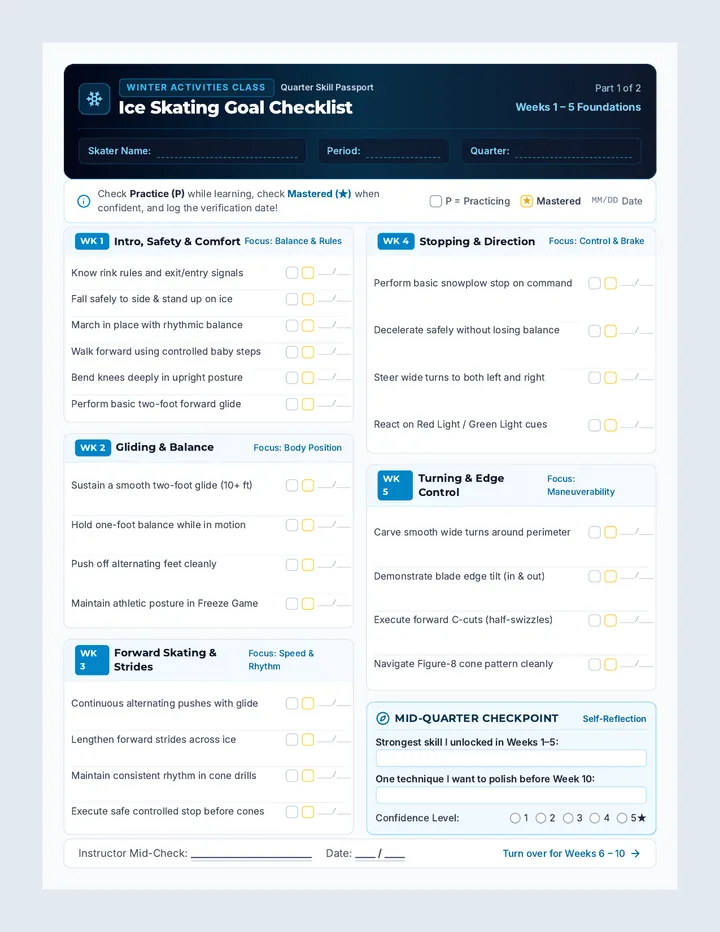
Skill Progression Tracker
Safe Falling & Independent Recovery Log
Skater:
Partner:
D
Ready Stance Form Check (Peer Verification)
1. Feet in 'V' Heels together, toes out
Motion Mastery Slides Days 3 & 4 • Unit Propulsion & Braking
Glide & Guide Sequence
Strides, Glides & Snowplow Stops
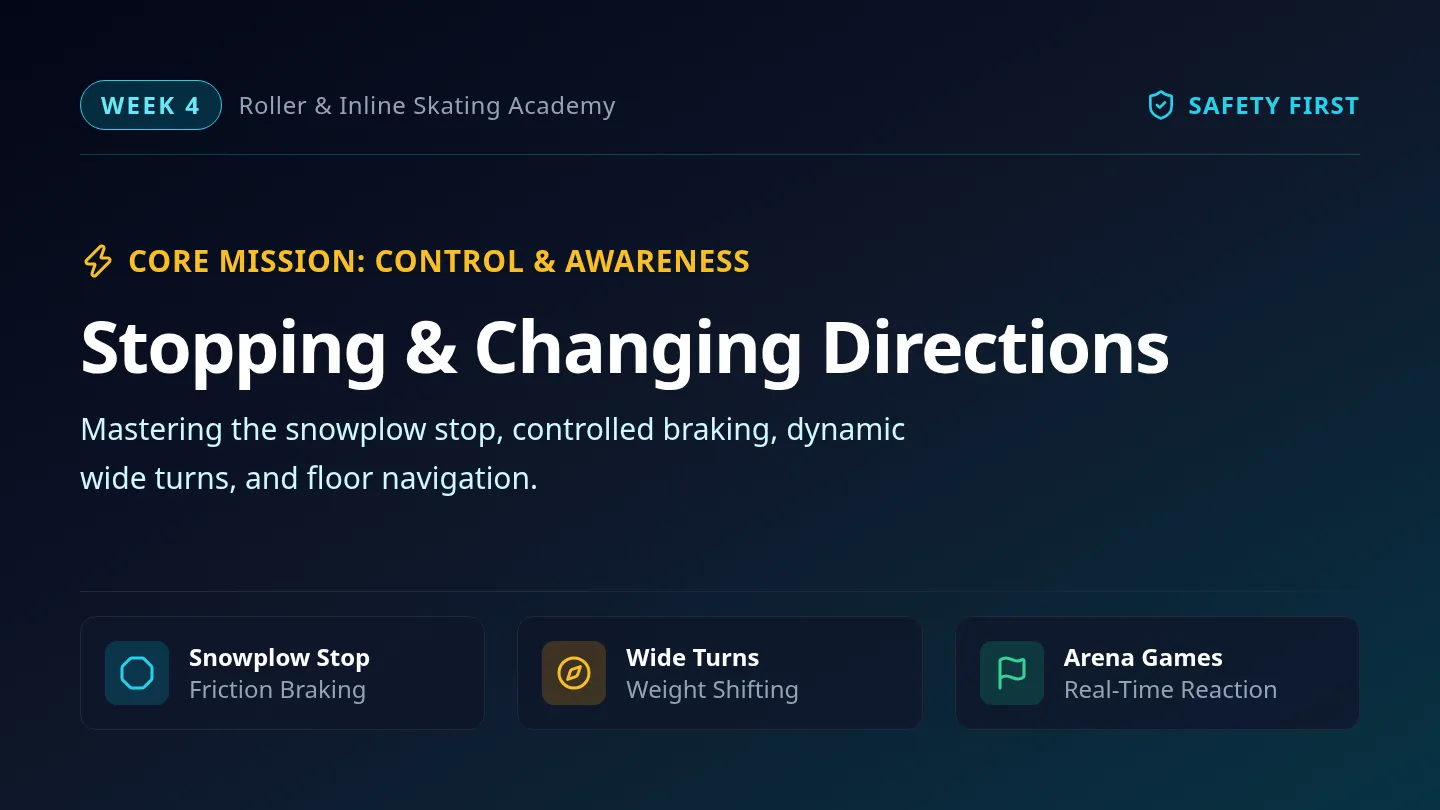
Building forward momentum, mastering balance on two blades, and controlling deceleration on demand.
Phase 1: March to Glide
Short steps into parallel coast
Phase 2: Dips & Swizzles
Deep knee bend & edge carve
Phase 3: The Snowplow
Scraping ice to a full stop
Skill Progression 01
Forward Propulsion
Marching Steps → Two-Foot Glide
Skating forward does not start with pushing backwards—it begins with small forward marching steps.
1. March Small
Take 4 to 6 small marching steps forward with toes pointing out in a narrow "V". Lift each foot only 2 inches off the ice.
2. Feet Together
Bring both skates side-by-side, shoulder-width apart, with blades parallel like train tracks.
3. Ride the Glide
Hold your "statue" position! Soft knees, weight centered over middle of the blade, coasting smoothly forward.
Goal: Coast for at least 3 body lengths without wobbling or dropping into a lean.
Skill Progression 02
Deep Balance & Edge Work
The Dip & Swizzles ("Lemons")
Deepening your knee bend creates stability, while swizzles teach inside-edge pressure.
The Dip (Low Squat Glide)
• While gliding, sink hips down until thighs are parallel to ice.
• Reach arms straight forward for counter-balance.
• Chest stays upright; don't collapse forward onto knees.
Forward Swizzles ("Lemons")
• Start heels touching in a "V". Bend knees and push skates outward.
• At widest point, turn toes inward and squeeze blades together.
• Blades draw smooth oval lemon shapes without lifting off the ice.
Key Mechanic: Swizzles create propulsion purely from pressure on inside edges, no toe picks!
Skill Progression 03
Controlled Stopping
The Snowplow Stop: Shaving Ice
Stopping safely is the most important skill on the rink. Learn to create friction on demand.
Step 1: Two-Foot Glide
Begin with a balanced glide at medium speed. Knees bent, weight distributed evenly.
Step 2: Push Heels Out
Rotate toes slightly inward and push one or both heels outward into an inverted "V" (pizza slice).
Step 3: Shave the Ice
Press down firmly through inside edges. You should hear a distinct crunch and see shaved ice spray forward!
Glider Circuit Activity Glide & Guide • Ice Skating Unit
Days 3 & 4 • Practice Stations
Glider Circuit Training Tracker
Skater:
Partner:
Period:
Rotate through the 4 on-ice stations with your peer partner. Partner acts as safety spotter and checks execution criteria. Record your repeated practice reps to demonstrate progression before Friday's skills evaluation!
1
Station 1: March & Two-Foot Glide Alley
Focus: Weight Transfer & Coasting
Take 4 to 6 deliberate marching steps with toes turned out ("V"), bring feet parallel, and hold a continuous two-foot glide.
Trial Glide Distance Held Parallel Blades? Head Up? Partner Notes Rep 1 Rep 2 Rep 3 Rep 4
2
Station 2: The Dip & Swizzle Channel
Focus: Knee Bend & Inside Edges
Part A: Lower into a 3-second stationary/gliding dip. Part B: Complete 4 continuous forward swizzles ("lemons") without lifting blades.
Part A: The Dip (Hold Count)
Attempt 1: ______ seconds (Hold form)
Attempt 2: ______ seconds (Hold form)
Attempt 3: ______ seconds (Hold form)
Part B: Consecutive Swizzles
Attempt 1: ______ lemons carved
Attempt 2: ______ lemons carved
Attempt 3: ______ lemons carved
Coaching Tip: Look for bent knees absorbing shock; if ankles roll inward, remind partner to press heels firm.
Page 1 of 2
Circuit Stations & Progress Reflection
Deceleration & Spatial Awareness Loop
Date:
Rink Zone: B / Center
3
Station 3: Snowplow Target Stop Zone
Focus: Edge Friction & Controlled Halt
Glide toward target marker, push heels outward on inside edges, and bring blades to a complete halt before reaching the boundary line.
Trial Ice Shaved (Audible)? Halted Before Cone? Balanced / No Spin? Stop 1
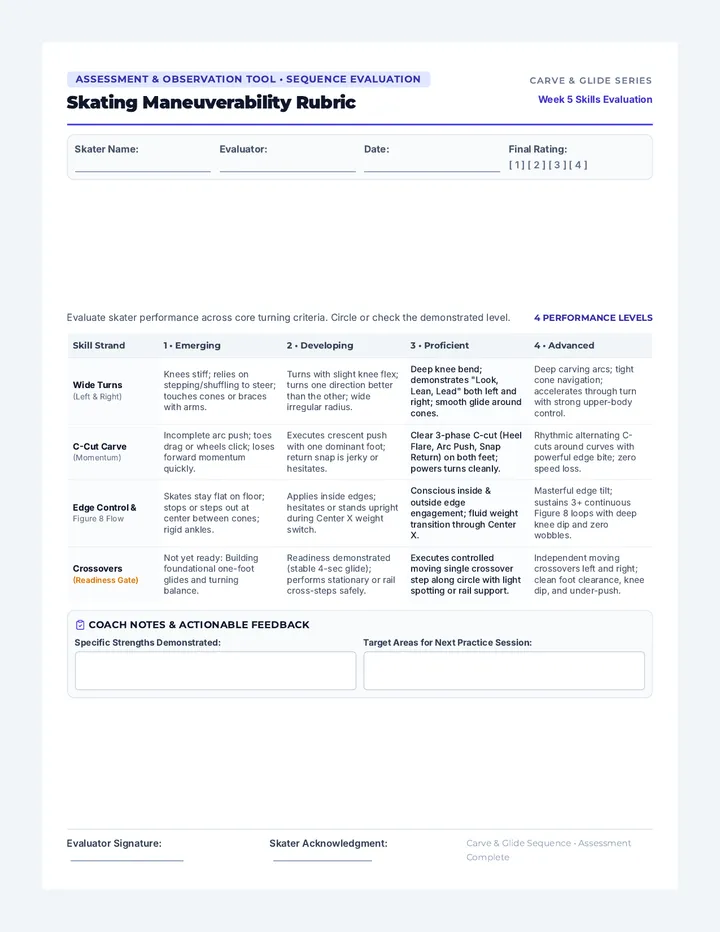
Skating Skills Rubric Guide Culminating Unit Assessment • Teacher Guide
Day 5 Evaluation Instrument
Skating Skills Performance Rubric
Evaluation Scale: 40 Total Points
| Criteria / Domain | Level 1: Emerging
The Culminating 4-Stage Showcase Routine
Students perform in groups of 3 along designated rink lanes: 1. Controlled Safe Drop: Demonstrate drop to hip, fist hands, rise independently. 2. Forward Propulsion: 4 marching steps into a solid two-foot glide. 3. Dynamic Balance: Execute a 3-second dip or forward swizzle lemon. 4. Snowplow Halt: Execute controlled snowplow stop before the boundary cones.
Skater Growth Portfolio Culminating Unit Portfolio • Student Record
Day 5 Culminating Showcase
Skater Growth & Skills Portfolio
Name:
Period:
1
My 5-Day Progression Snapshot (Day 1 vs. Day 5)
Measures Individual Growth
Fall & Recovery
Day 1: ______ sec
Day 5: ______ sec
2-Foot Glide Dist.
Day 1: ______ lengths
Day 5: ______ lengths
Snowplow Stopping
Day 1: Needed wall
Day 5: Stopped on mark
Ice Confidence (1-5)
Day 1 Level: ______
Day 5 Level: ______
2
Core Fundamentals Self-Evaluation
Fundamental Skill My Rating (1 to 4) Personal Technique Evidence 1. Ready Stance & Balance [ 1 ] [ 2 ] [ 3 ] [ 4 ] 2. Safe Fall & Fast Rise [ 1 ] [ 2 ] [ 3 ] [ 4 ] 3. Forward Glide & Dip [ 1 ] [ 2 ] [ 3 ] [ 4 ] 4. Snowplow Edge Stop [ 1 ] [ 2 ] [ 3 ] [ 4 ]
3
Rink Safety & Etiquette Badges Earned
Traffic Navigator
Always skated counter-clockwise in flow
Safety Bubble
Kept 2-arm length spacing at all times
Fist Reflex
Protected fingers during all on-ice drops
Supportive Peer
Encouraged partner & checked safety
Glide & Guide Student Growth Portfolio • Continued on Page 2
Self-Reflection & Synthesis
Performance Reflection & Future Goals
Day 5 Showcase Reflection
Part 4, 5 & 6
4
Showcase Routine Execution Debrief
During your final 4-stage showcase routine (Safe Drop → March to Glide → Knee Dip → Snowplow Stop):
Which part of the sequence felt smoothest?
Where did you have to focus hardest on your balance?
5
In-Depth Written Reflection (Effort & Growth)
1. Effort & Perseverance: Describe a specific moment this week when you felt unsteady, fell, or lost confidence. How did you push through and reset your stance?
2. Technical Mastery: What physical cue (e.g. "soft knees over laces", "scrape the ice with inside edges", "keep chin up") created the biggest breakthrough in your skating?