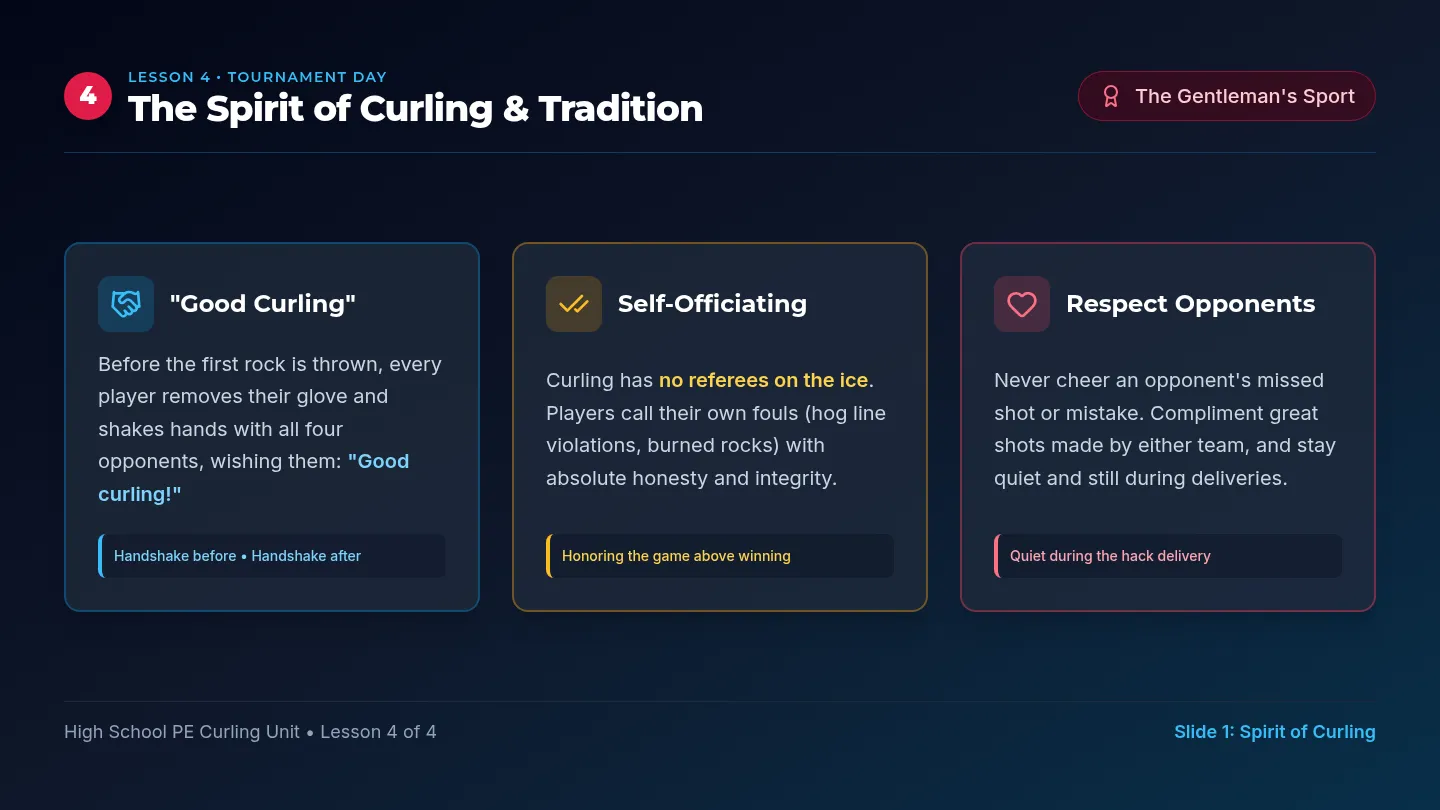
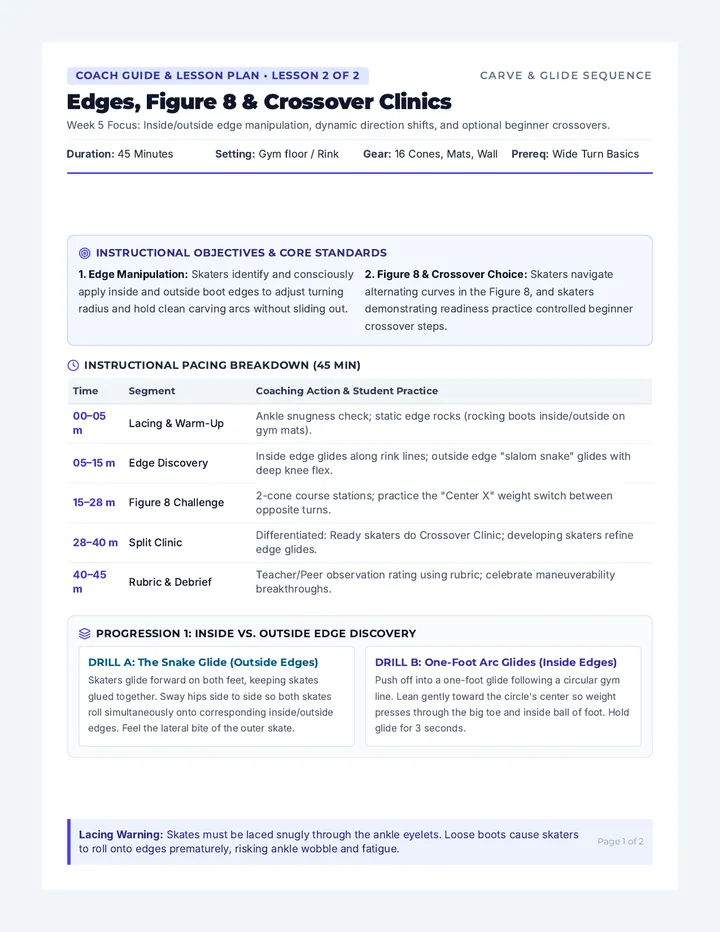
A comprehensive four-lesson on-ice curling unit designed for high school physical education. Students master ice safety, slider and hack mechanics, sweeping physics, tactical shot-making, and game etiquette culminating in an authentic mini-bonspiel tournament.
Curling stones should guide line, not support body weight. Push out from the hack holding only a broom in stabilizer position. Slide across the near hog line with hands free.
Attempt 1 Balance Rating:
Solid • Wobbled • Leaned on Broom
Attempt 2 Balance Rating:
Solid • Wobbled • Leaned on Broom
Curler Self-Reflection & Analysis
1. Did your stone rotate smoothly (2.5–3 full turns) or did it "dump" (stop rotating early)? Explain what caused the outcome:
2. When attempting to increase stone velocity (takeout vs. draw), what mechanical change should you make in the hack?
Curling Physical Education • Lesson 1 Delivery Station Page 2 of 2
"burned"
1. Call It Instantly: The curler who touches it must immediately yell "BURNT!"
2. The Penalty: Between hog lines, the stone is removed from play. Beyond the hog line, the non-offending skip decides placement.
High School PE Curling Unit • Lesson 2 of 4 Slide 3: Roles & Integrity
Skip & Sweeper Dialogue
On-Ice Communication Vocabulary
Decisive & Loud!
"HURRY!"
Sweep Hard Now!
The stone is light on weight or curling too early. Sweep with maximum body pressure and speed.
Call origin: Skip or Vice
"WHOA / OFF!"
Stop Sweeping
Immediately lift brushes off the ice. The stone has ample momentum or needs to curl aggressively around a guard.
Brooms off immediately
"CLEAN!"
Light Debris Sweep
Gently sweep frost/debris ahead of the stone without putting down heavy pressure that adds distance.
No thermal melting
"LINE vs WEIGHT"
Shared Call
Sweepers call the weight (speed/distance); Skip calls the line (directional path to target).
Continuous communication
High School PE Curling Unit • Lesson 2 of 4 Slide 4: Calls & Signals
Trial
Strokes in 15s
Calculated SPM (×4)
Partner Observations on Body Pressure
Trial 1 (Warm-up)
Trial 2 (Power Test)
Trial 3 (Fatigue Test)
Part B: Tactical Communication Scenarios
Scenario 1: Your team throws a draw shot to the four-foot. At the hog line, you realize the rock is light on speed and slowing rapidly. What is the exact verbal call, and what action must both sweepers take immediately?
Scenario 2: The skip calls for an out-turn around a high corner guard. The rock has plenty of weight but starts curling right towards the guard. Should you sweep to hold the line or stay off? Explain the physics behind your decision:
Scenario 3: As you sweep through the house, your broom shaft accidentally clips the top of the stone. Detail your exact immediate words and actions according to the Spirit of Curling:
Curling Physical Education • Lesson 2 Sweeping Field Guide Page 2 of 2
• Prior to the 6th stone of an end, any opposition stone located in this zone cannot be removed from play.
• You may bump or tap it, but if it crosses out of bounds, it is replaced to its original spot, and your thrown stone is removed!
Why FGZ Revolutionized Curling
Without this rule, teams would peel away every rock in the first 4 shots, leaving an empty, boring house with zero strategy.
The 5-Rock rule forces teams to set guards, curl around obstacles, build angles, and stage dramatic multiple-point finishes!
High School PE Curling Unit • Lesson 3 of 4 Slide 3: Free Guard Zone
End Management
The Strategy of the Hammer (Last Stone)
Curling's Greatest Advantage
WITH the Hammer
Offensive
✓ Primary Objective: Score 2 or more points in the end.
✓ Tactic: Split the house! Throw to the wings and corner guards, leaving the center open for the final draw.
✓ The Blank: If only 1 point is available, throw through the rings to retain hammer next end.
WITHOUT the Hammer
Defensive
✓ Primary Objective: Force the opponent to score only 1 point (or "steal" a point).
✓ Tactic: Clog the centerline! Place tight center guards and draw behind them into the 4-foot.
✓ Outcome: Forcing 1 point transfers hammer to your team next end.
High School PE Curling Unit • Lesson 3 of 4 Slide 4: Hammer Strategy
Tactical Lab
Analyze the game scenarios below. As team Skip, decide on your tactical call and provide your rationale.
Scenario 1: Defending Without the Hammer (End 2 of 2)
You are Yellow • No Hammer
Situation: The game is tied 1-1. You are throwing rock #7 of the end (Second Vice shot). The Red team (holding hammer) has a stone sitting open in the 8-foot ring on the left wing. The centerline is completely clear.
A. What shot do you call (Draw, Guard, or Hit)?
B. Turn and Weight Called:
C. Tactical Rationale (Why this shot? What risk are you eliminating?):
Scenario 2: The Final Hammer Throw (Down by 1)
You are Red • Final Rock (#8)
Situation: You trail 2-3 in the final end. You have the last rock of the game. Yellow has shot rock biting the button, guarded by a tight center guard at the top of the 12-foot. There is open ice on the right wing.
A. Selected Shot Option:
B. Target Location in the House:
C. Tactical Rationale (Explain how your call either ties for extra ends or wins):
Hammer Strategy Golden Rules:
• With Hammer: Play to corners, split the house, score 2+ or blank.
• Without Hammer: Clog the center, force a single point, or steal.