Cardio Testing Lesson Plan Peak Fitness Lab • Day 1 of 4
Cardiovascular Endurance: PACER & Mile Run
Grades 9–12
Duration: 45 Minutes
Essential Question
How does cardiovascular endurance support heart and lung health, and how can pacing strategies improve aerobic performance?
Measurable Learning Objectives
Performance: Complete the 20m PACER test (or 1-mile walk/run alternative) using steady pacing, accurately recording total laps on the Personal Fitness Tracker.Cognitive: Explain how aerobic fitness strengthens the heart and lungs and identify two pacing strategies during Think-Pair-Share.Affective: Demonstrate supportive partner observation and encouraging feedback while tracking a peer's laps.
NYS PE Learning Standards (2020)
Standard 3 (Fitness): Demonstrates knowledge and skills to achieve and maintain a health-enhancing level of fitness (3.1a, 3.2b).
Standard 4 (Social Behavior): Exhibits responsible personal and social behavior that respects self and others (4.1, 4.3).
Standard 5 (Value): Recognizes the value of physical activity for health, enjoyment, and challenge (5.1).
Danielson Framework Connections
1c / 1e (Planning): Coherent 45-minute pacing with clear objectives and differentiated cardio options.
2a / 2b (Environment): Culture of personal best over peer comparison; supportive partner roles.
3a / 3c (Instruction): Clear audio/visual modeling of PACER lines and active Think-Pair-Share engagement.
3d (Assessment): Real-time lap verification, self-tracking, and exit reflection.
Materials & Equipment
PACER audio track & gymnasium sound system
Cones & floor tape marking 20-meter lanes
Personal Fitness Tracker Sheets & clipboards/pencils
Stopwatches (for 1-mile walk/run alternative)
Unit Instructional Slide Deck (Slides 1–7)
Academic Vocabulary
Cardiovascular Endurance: Ability of the heart, lungs, and blood vessels to deliver oxygen during sustained exercise.Aerobic Fitness: Exercise powered by oxygen that strengthens the cardiorespiratory system.Pacing: Managing speed and effort so energy lasts throughout an endurance test.
Teacher Modeling & Engagement
Teacher demonstrates two sample 20m PACER shuttles showing proper foot-behind-line touch, controlled turn, and waiting for the beep. Students use Think-Pair-Share to predict pacing challenges and act as Cooperative Partner Observers counting laps and cheering peers.
Safety Considerations
Ensure dry, clear gym floor and 1.5m lane spacing to prevent collisions on turns.
Remind students to wear tied athletic sneakers and monitor breathing/dizziness.
Mandatory 2–3 minute cool-down walk after stopping; never sit immediately.
Peak Fitness Lab • NYS PE Standards & Danielson Aligned Day 1 Lesson Plan • Page 1 of 2
45-Minute Instructional Procedures — Day 1
Cardiovascular Endurance
1. Do Now / Introduction
5 Minutes
Display Slides 1–5 as students enter. Students complete a quick Think-Pair-Share : "Why does a stronger heart help you in both sports and everyday life?" Teacher introduces the 4-day Peak Fitness Lab unit, emphasizing personal growth over peer comparison, and distributes Personal Fitness Tracker Sheets.
2. Dynamic Warm-Up
5 Minutes
Whole-class dynamic warm-up across the gym: 60s light jog, high knees, butt kicks, lateral shuffles, walking lunges with torso twist, and ankle/calf mobility pulses to gradually elevate heart rate and prepare lower-body joints for shuttle turns.
3. Teacher Demonstration & Safety Instructions
5 Minutes
Review Slides 6–7. Teacher models two PACER shuttles: starting behind the cone, reaching the opposite 20m line before the beep, pivoting safely, and stopping after two missed beeps. Explain the 1-Mile Walk/Run as an alternative cardiovascular assessment (4 laps on track/course) and review cool-down walking rules.
4. Fitness Testing / Wave Stations
25 Minutes
Class splits into Partner Pairs (Group A & Group B) to ensure accurate counting and safe lane spacing:
Wave 1 (10 min): Group A runs the PACER test while Group B stands at the baseline with clipboards, tallying each completed lap and offering verbal encouragement.Transition & Cool-Down (3 min): Group A walks perimeter laps to lower heart rate; partners swap clipboards and review lap counts.Wave 2 (10 min): Group B runs the PACER test while Group A observes, counts, and encourages.Alternative Option: Students with medical/pacing accommodations complete a timed 1-mile walk/run or modified 15m shuttle lane monitored by the teacher.
5. Closure & Student Reflection
5 Minutes
Students record their final PACER lap count (or 1-mile time) on their Personal Fitness Tracker. Guided reflection prompt: "How did your pacing feel in the first 10 laps compared to your final 5 laps, and what is one cardiovascular goal for this semester?" Collect trackers for safekeeping.
Differentiation & Accommodations
ELL / Visual Learners: Visual lane cones, projected Slides 6–7 diagrams, and teacher physical demonstration.IEP / 504 / Medical: Self-paced 1-mile walk option, 15m modified shuttle lane, or heart-rate zone check-ins instead of max-effort sprints.Advanced Athletes: Challenge to maintain steady negative-split pacing into higher PACER levels (Level 8+).
Assessment Methods
Formative: Teacher observation of pacing mechanics, Think-Pair-Share responses, and partner counting accuracy.Summative: Recorded PACER lap score (or 1-mile walk/run time) on the Personal Fitness Tracker and Day 4 Written Fitness Test.
Peak Fitness Lab • NYS PE Standards & Danielson Aligned Day 1 Lesson Plan • Page 2 of 2
Personal Fitness Tracker Sheet Peak Fitness Lab • Grades 9–12
Personal Fitness Tracker
Focus: Personal Growth
Compare yourself to yesterday, not others
Name: ______________________
Period / Teacher: ______________
Start Date: __________________
Day
Assessment
Fitness Component
Your Score / Result
Partner Initials
Day 1
PACER Test (20m)
Cardiovascular Endurance
laps
| |
| Day 1 Alt | 1-Mile Walk/Run | Cardiovascular Endurance |
min : sec
| |
| Day 2 | Push-Up Test
reps
| |
| Day 2 | Wall Sit Test (90°) | Lower-Body Muscular Endurance |
seconds
| |
| Day 3 | Sit-Up Test (60 sec)
reps
| |
| Day 3 | Single-Leg Balance
R: ________ sec L: ________ sec
| |
| Day 4 | Pull-Up Test (Standard) | Upper-Body Strength & Endurance |
reps
| |
| Day 4 Mod | Assisted Pull-Up / Row
reps / sec
| |
| Day 4 | Sit-and-Reach Test
cm
| |
Partner & Safety Expectations
Count only repetitions completed with safe, full range of motion. Stop immediately if you feel sharp joint pain, dizziness, or shortness of breath, and notify your teacher.
Peak Fitness Lab • Student Data Log Page 1 of 2
SMART Fitness Goal & Unit Reflection
Day 4 Wrap-Up
Part 1: Build Your SMART Fitness Goal
Choose one fitness component from your Page 1 results that you want to improve over the next 6–8 weeks. Complete each SMART step in the blank boxes below.
S — Specific
What exact test or fitness component will you improve?
M — Measurable
What is your Day 1–4 baseline and your target number?
A — Achievable
What weekly actions or exercises will help you reach it?
R — Relevant
Why does this goal matter for your health, sport, or daily life?
T — Time-Bound
By what exact date will you re-test and check progress?
1. Which fitness assessment felt most challenging this week, and what strategy (pacing, breathing, or form) helped you through it?
2. Explain one difference between a health-related fitness component (e.g., cardiovascular endurance) and a skill-related component (e.g., balance).
Peak Fitness Lab • SMART Goal & Reflection Page 2 of 2
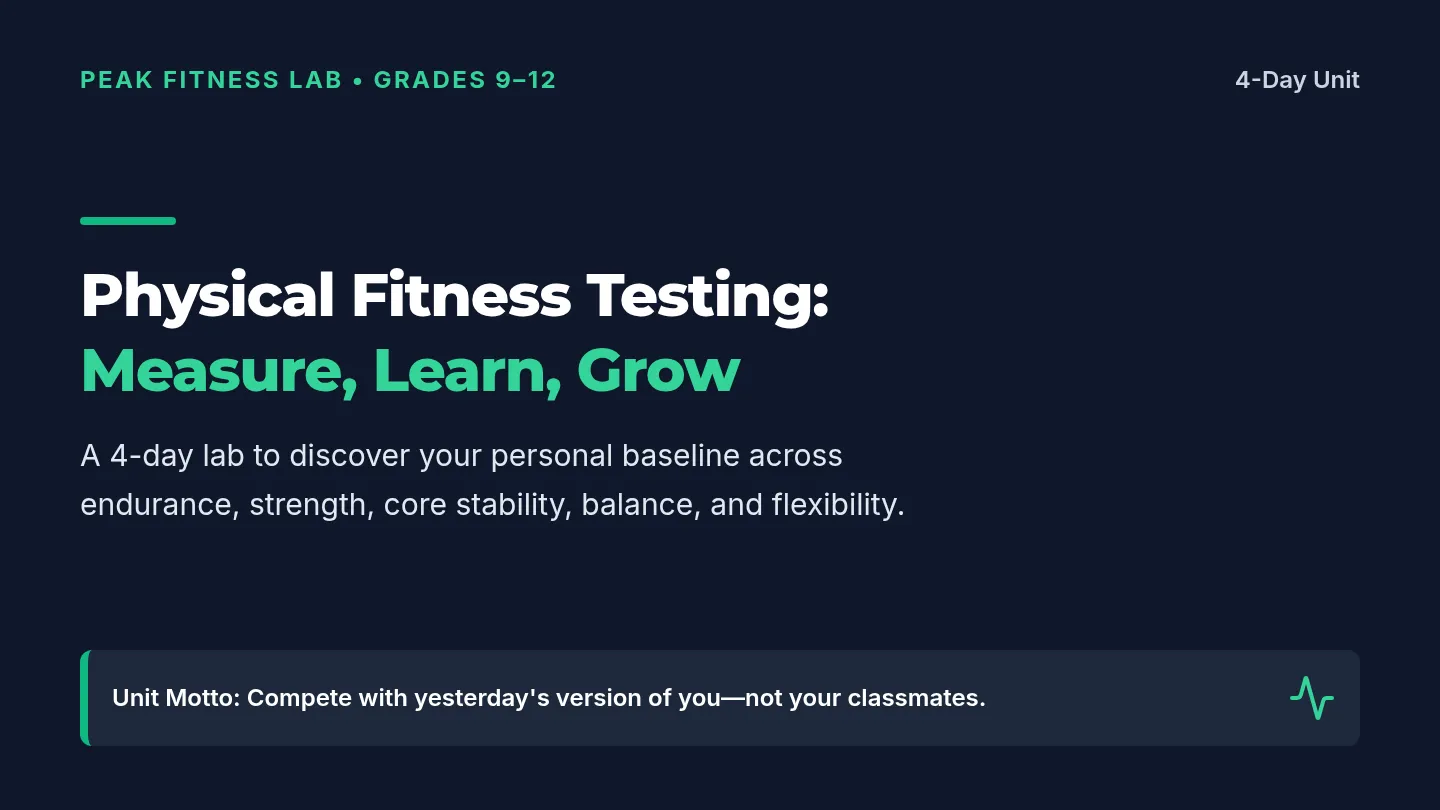
Fitness Testing Unit Slides Peak Fitness Lab • Grades 9–12 4-Day Unit
Physical Fitness Testing:
Measure, Learn, Grow
A 4-day lab to discover your personal baseline across endurance, strength, core stability, balance, and flexibility.
Unit Motto: Compete with yesterday's version of you—not your classmates.
Slide 2 • Big Picture
Why Is Physical Fitness Important?
Lifelong Health
Lowers risk of heart disease, strengthens bones, and boosts daily energy.
Focus & Mood
Movement reduces stress, improves sleep, and sharpens classroom focus.
Everyday Capability
Makes climbing stairs, carrying bags, and playing sports easier and safer.
Think-Pair-Share: Which everyday activity outside of PE feels easier when you are fit?
Slide 3 • Core Framework
Five Health-Related Components of Fitness
01
Cardiovascular Endurance
Heart & lungs delivering oxygen.
02
Muscular Strength
Max force in one effort.
03
Muscular Endurance
Repeated muscle work over time.
04
Flexibility
Full joint range of motion.
05
Body Composition
Ratio of lean mass to fat mass.
Note: Skill-related components (like Balance , Agility, Speed) support performance, while these 5 directly protect long-term health.
Slide 4 • Key Distinction
Muscular Strength vs. Muscular Endurance
Muscular Strength
The maximum amount of force a muscle can produce in a single effort.
Real-World: Lifting a heavy sofa once or completing 1–3 strict pull-ups.
Muscular Endurance
The ability to repeat contractions or hold a position without fatiguing.
Real-World: Carrying groceries up 3 flights, push-ups, or holding a wall sit.
Knowledge Check: Is holding a 60-second plank muscular strength or muscular endurance?
Slide 5 • Day 1 Focus
Cardiovascular Endurance & Heart Health
Cardiovascular Endurance is how efficiently your heart, lungs, and blood vessels deliver oxygen to working muscles during sustained activity.
A stronger heart pumps more blood per beat, lowering resting heart rate.
Real-World: Hiking, swimming laps, dancing, or walking briskly without getting winded.
Aerobic Fitness
Oxygen + Steady Pace = Sustained Energy
Discussion: Why does smart pacing matter more than sprinting at the start of a cardio test?
Slide 6 • Day 1 Assessment
PACER Test: Purpose, Procedures & Safety
Measures: Cardiovascular (aerobic) endurance using progressive 20m shuttles.
Procedures: Run 20m before the beep, touch the line with one foot, and wait for the next beep. Two missed beeps end your test.
Safety: Stay in your lane, control turns, and walk 2–3 minutes to cool down afterward.
20 Meters
Touch Line & Pivot Safely
Muscles Used: Heart (cardiac muscle), quadriceps, hamstrings, calves, and glutes.
Slide 7 • Day 1 Alternative
Timed 1-Mile Walk/Run Assessment
Purpose & Procedures
An alternative cardiovascular endurance test where students cover 1 mile (4 track laps) at a steady pace—jogging, walking, or a mix.
Score: Total time in minutes and seconds.
Pacing & Safety Tips
Start at a conversational pace; avoid sprinting Lap 1.
Use steady nasal-mouth breathing.
Cool down by walking after crossing the finish line.
Real-World Link: Knowing your mile pace helps you plan safe outdoor walks, hikes, or 5K training.
Slide 8 • Day 2 Assessment
Push-Up Test: Technique & Muscles Used
Measures: Upper-body muscular endurance .
Muscles Used: Pectorals (chest), triceps (back of arms), deltoids (shoulders), and core stabilizers.
Proper Form: Hands under shoulders, straight body plank, lower until elbows bend 90° , push back up. Stop if hips sag.
90°
Flat Back • 90° Elbow Bend
Modifications: Knee or incline push-ups build the same muscles safely—record them separately!
Slide 9 • Day 2 Assessment
Wall Sit Test: Technique & Muscles Used
Measures: Lower-body muscular endurance (isometric hold).
Muscles Used: Quadriceps (front thighs), glutes, and calves.
Proper Form: Back flat on wall, knees at 90° directly above ankles, hands off thighs. Breathe steadily!
90°
Knees Over Ankles • Hands Off
Real-World Link: Strong quadriceps protect your knees when hiking downhill, skiing, or standing for long shifts.
Slide 10 • Day 3 Focus
Core Strength & Endurance
More Than "Abs"
Your core includes your rectus abdominis, obliques, lower back, and hip stabilizers —acting as a natural brace for your spine.
Why Core Endurance Matters
Supports upright posture at desks.
Prevents lower-back strain when lifting.
Transfers power in throwing, jumping, and running.
Think-Pair-Share: How does a weak core affect your posture by the end of the school day?
Slide 11 • Day 3 Assessment
Sit-Up Test: Technique & Muscles Used
Measures: Core muscular endurance (60 seconds).
Muscles Used: Rectus abdominis, obliques, and hip flexors.
Safety Rule: Cross arms over chest (never pull your neck!), knees bent 90°, elbows touch thighs, shoulder blades return to mat.
Arms Crossed • Knees Bent
Modification: Partial curl-ups or forearm plank hold if you have lower-back discomfort.
Slide 12 • Health vs. Skill
Balance & Stability
Skill-Related Component
What Is Balance?
Maintaining your center of gravity over your base of support—both standing still (static ) and moving (dynamic ).
Real-World & Sports
Why It Matters
Prevents ankle sprains and falls on icy sidewalks, stairs, skateboards, or when cutting on a court.
Knowledge Check: Is balance a health-related or skill-related fitness component?
Slide 13 • Day 3 Assessment
Single-Leg Balance Test: Procedures & Safety
Measures: Static balance (skill-related) up to 30 seconds per leg .
Muscles Used: Ankles/calves, glute medius (hip stabilizers), and core.
Timer Stops If: Lifted foot touches floor, hands leave hips, or you hop. Test both Right and Left legs!
Hands on Hips • Eyes Forward
Safety: Stand near a wall or partner spotter so you can catch yourself safely if you wobble.
Slide 14 • Day 4 Assessment
Pull-Up Test: Technique & Muscles Used
Measures: Upper-body muscular strength & endurance .
Muscles Used: Latissimus dorsi (lats), rhomboids (upper back), biceps, and forearms.
Form: Overhand grip, start from full hang, pull until chin clears the bar without swinging/kipping.
Chin Over Bar • No Swinging
Alternative: Band-assisted pull-ups or inclined bar rows—recorded in their own tracker row!
Slide 15 • Day 4 Focus
Flexibility & Range of Motion
What Is Flexibility?
The ability of a joint and surrounding muscles to move smoothly through a full, pain-free Range of Motion (ROM) .
Real-World Benefits
Reduces muscle stiffness and lower-back tightness.
Improves athletic stride, reach, and posture.
Helps you tie shoes, reach overhead, and twist safely.
Key Rule: Stretch slowly to mild tension—never bounce or force a joint into pain.
Slide 16 • Day 4 Assessment
Sit-and-Reach Test: Procedures
Measures: Flexibility of the hamstrings (back of thighs) and lower back.
Protocol: Remove shoes, sit with legs flat against the box, stack hands evenly, exhale and reach forward smoothly for 1 second.
Score: Best of 3 slow trials recorded in centimeters (cm).
Knees Flat • Smooth Reach
Safety: Partner holds knees gently flat—never push on a partner's back!
Slide 17 • Functional Fitness
Other Assessments: Chair Squats & Chair Stands
What Do They Measure?
Functional lower-body muscular strength and endurance (quadriceps, glutes, hamstrings) plus balance control.
How They Work
Students stand up from a standard chair and sit back down with arms crossed for 30 seconds—often used as a safe, accessible alternative to wall sits.
Real-World Link: Standing up smoothly without using your hands is a key marker of lifelong mobility.
Slide 18 • Health Component #5
Body Composition & Overall Health
What Is Body Composition?
The ratio of fat mass to lean mass (muscle, bone, organs, and water) in your body.
Healthy Habits First
We do not weigh students in class. Instead, focus on balanced nutrition, regular movement, hydration, and sleep—which naturally support healthy body composition.
Key Idea: Two people can weigh the exact same amount but have very different muscle-to-fat ratios.
Slide 19 • Lab Rules
Fitness Testing Safety & Expectations
1. Warm Up & Cool Down
Prepare joints before testing and walk 2–3 minutes after cardio tests.
2. Form Over Numbers
Stop if form breaks down or you feel sharp pain, dizziness, or chest tightness.
3. Honest Partner Counting
Count only full-ROM reps and encourage your partner respectfully.
4. Zero Comparison
Keep scores private and celebrate personal effort and growth.
Always wear athletic sneakers and bring water to every testing session.
Slide 20 • Data Literacy
Understanding & Recording Fitness Results
Your Baseline
Day 1–4 scores show your starting point—your personal "before" snapshot.
Log Modifications
Record modified tests (like assisted pull-ups) in their separate row so future comparisons stay accurate.
Spot Patterns
Notice your strengths and one area you want to target next.
Check Your Tracker: Are all units (laps, reps, seconds, cm) filled in clearly?
Slide 21 • Action Plan
Setting SMART Fitness Goals
S
Specific
Exact test or skill.
M
Measurable
Track with numbers.
A
Achievable
Realistic action plan.
R
Relevant
Matters to your life.
T
Time-Bound
Clear target date.
Example: "I will increase my PACER score from 28 to 35 laps in 6 weeks by jogging 20 minutes 3x/week."
Slide 22 • Unit Wrap-Up
Fitness Unit Review & Reflection
What We Mastered
5 Health-Related Components vs. Skill-Related Balance
Safe, accurate technique across 7 assessments
How to track baseline data & build a SMART goal
Final Reflection
What was your proudest effort during these 4 days, and what is your #1 fitness habit for the next month?
Next Step: Complete your Personal Fitness Tracker reflection and the 20-question Written Test!
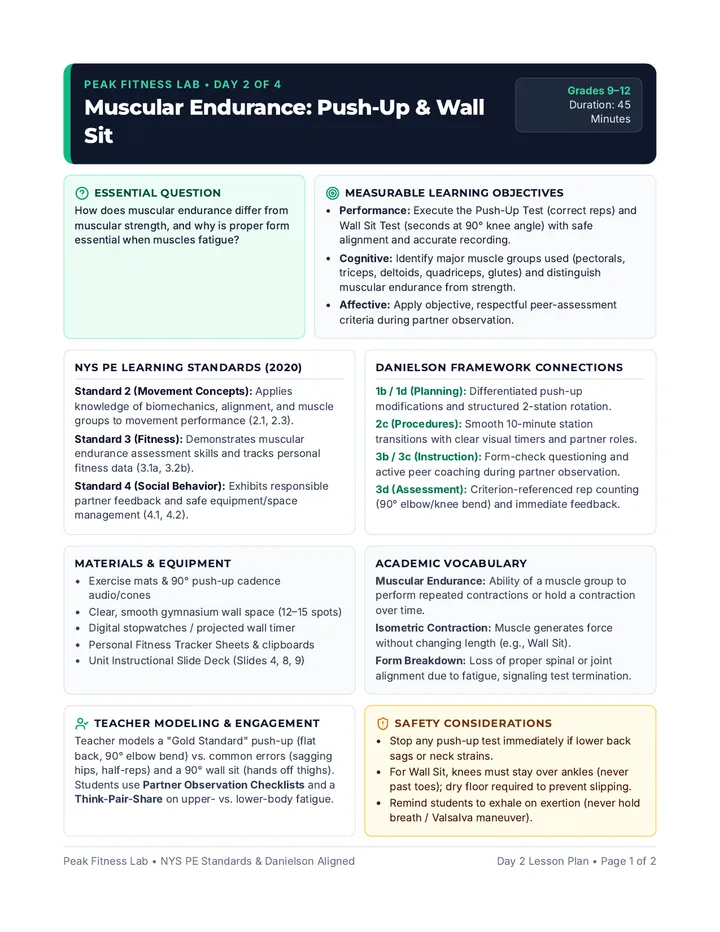
Muscular Endurance Lesson Plan Peak Fitness Lab • Day 2 of 4
Muscular Endurance: Push-Up & Wall Sit
Grades 9–12
Duration: 45 Minutes
Essential Question
How does muscular endurance differ from muscular strength, and why is proper form essential when muscles fatigue?
Measurable Learning Objectives
Performance: Execute the Push-Up Test (correct reps) and Wall Sit Test (seconds at 90° knee angle) with safe alignment and accurate recording.Cognitive: Identify major muscle groups used (pectorals, triceps, deltoids, quadriceps, glutes) and distinguish muscular endurance from strength.Affective: Apply objective, respectful peer-assessment criteria during partner observation.
NYS PE Learning Standards (2020)
Standard 2 (Movement Concepts): Applies knowledge of biomechanics, alignment, and muscle groups to movement performance (2.1, 2.3).
Standard 3 (Fitness): Demonstrates muscular endurance assessment skills and tracks personal fitness data (3.1a, 3.2b).
Standard 4 (Social Behavior): Exhibits responsible partner feedback and safe equipment/space management (4.1, 4.2).
Danielson Framework Connections
1b / 1d (Planning): Differentiated push-up modifications and structured 2-station rotation.
2c (Procedures): Smooth 10-minute station transitions with clear visual timers and partner roles.
3b / 3c (Instruction): Form-check questioning and active peer coaching during partner observation.
3d (Assessment): Criterion-referenced rep counting (90° elbow/knee bend) and immediate feedback.
Materials & Equipment
Exercise mats & 90° push-up cadence audio/cones
Clear, smooth gymnasium wall space (12–15 spots)
Digital stopwatches / projected wall timer
Personal Fitness Tracker Sheets & clipboards
Unit Instructional Slide Deck (Slides 4, 8, 9)
Academic Vocabulary
Muscular Endurance: Ability of a muscle group to perform repeated contractions or hold a contraction over time.Isometric Contraction: Muscle generates force without changing length (e.g., Wall Sit).Form Breakdown: Loss of proper spinal or joint alignment due to fatigue, signaling test termination.
Teacher Modeling & Engagement
Teacher models a "Gold Standard" push-up (flat back, 90° elbow bend) vs. common errors (sagging hips, half-reps) and a 90° wall sit (hands off thighs). Students use Partner Observation Checklists and a Think-Pair-Share on upper- vs. lower-body fatigue.
Safety Considerations
Stop any push-up test immediately if lower back sags or neck strains.
For Wall Sit, knees must stay over ankles (never past toes); dry floor required to prevent slipping.
Remind students to exhale on exertion (never hold breath / Valsalva maneuver).
Peak Fitness Lab • NYS PE Standards & Danielson Aligned Day 2 Lesson Plan • Page 1 of 2
45-Minute Instructional Procedures — Day 2
Muscular Endurance
1. Do Now / Introduction
5 Minutes
Project Slide 4 (Muscular Strength vs. Muscular Endurance). Students complete a Think-Pair-Share : "Is carrying groceries up three flights of stairs an example of muscular strength or muscular endurance? Why?" Connect responses to today's Push-Up and Wall Sit assessments.
2. Dynamic Warm-Up
5 Minutes
Targeted upper- and lower-body prep: arm circles (forward/backward), scapular push-ups, wrist mobility, bodyweight squats (10 slow reps), inchworms, and 20s plank hold to activate pectorals, deltoids, core, and quadriceps.
3. Teacher Demonstration & Safety Instructions
5 Minutes
Review Slides 8–9. Model full Push-Up form (and modified knee/incline push-up option) and Wall Sit 90° alignment (back flat against wall, hands at sides, feet shoulder-width). Explain the 2-warning rule for form breakdown and how partners count/time fairly.
4. Fitness Testing / Two-Station Rotation
25 Minutes
Class divides into Station 1 (Push-Up Mats) and Station 2 (Wall Sit Zone) , working in Partner Pairs (11 min per station + 3 min transition):
Station 1 – Push-Up Test: Partner A performs continuous push-ups to 90° elbow flexion while Partner B counts valid reps and monitors hip alignment. Switch roles after 2 minutes of rest.Station 2 – Wall Sit Test: Partner A holds a 90° wall sit while Partner B operates the stopwatch and checks knee angle/hands-off-thighs. Switch roles after 2 minutes of recovery.Rotation: At the 12-minute whistle, groups sanitize mats if needed and rotate stations.
5. Closure & Student Reflection
5 Minutes
Students record Push-Up reps (noting standard or modified) and Wall Sit seconds on their Personal Fitness Tracker. Quick stretch (quadriceps & chest doorway stretch) while answering: "Which muscle group fatigued faster today, and what exercise could build its endurance?"
Differentiation & Accommodations
Modifications: Offer knee push-ups or elevated wall/bench push-ups (recorded separately); allow slightly higher wall sit angle (100°–110°) for knee discomfort.ELL / Visual: Projected form diagrams (Slides 8–9) with labeled muscle groups.Extension: Challenge advanced students to follow strict 3-second cadence push-ups.
Assessment Methods
Formative: Teacher circulates with form-check rubric; peer observation accuracy during partner testing.Summative: Push-Up reps and Wall Sit seconds logged on Personal Fitness Tracker; muscle group identification on Day 4 Written Test.
Peak Fitness Lab • NYS PE Standards & Danielson Aligned Day 2 Lesson Plan • Page 2 of 2
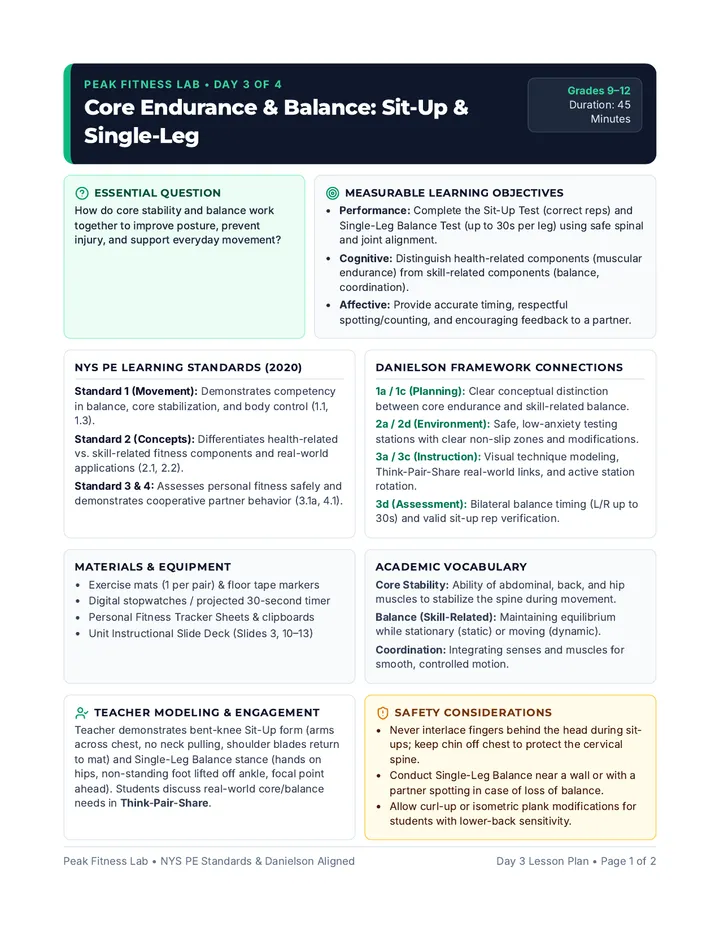
Core Balance Lesson Plan Peak Fitness Lab • Day 3 of 4
Core Endurance & Balance: Sit-Up & Single-Leg
Grades 9–12
Duration: 45 Minutes
Essential Question
How do core stability and balance work together to improve posture, prevent injury, and support everyday movement?
Measurable Learning Objectives
Performance: Complete the Sit-Up Test (correct reps) and Single-Leg Balance Test (up to 30s per leg) using safe spinal and joint alignment.Cognitive: Distinguish health-related components (muscular endurance) from skill-related components (balance, coordination).Affective: Provide accurate timing, respectful spotting/counting, and encouraging feedback to a partner.
NYS PE Learning Standards (2020)
Standard 1 (Movement): Demonstrates competency in balance, core stabilization, and body control (1.1, 1.3).
Standard 2 (Concepts): Differentiates health-related vs. skill-related fitness components and real-world applications (2.1, 2.2).
Standard 3 & 4: Assesses personal fitness safely and demonstrates cooperative partner behavior (3.1a, 4.1).
Danielson Framework Connections
1a / 1c (Planning): Clear conceptual distinction between core endurance and skill-related balance.
2a / 2d (Environment): Safe, low-anxiety testing stations with clear non-slip zones and modifications.
3a / 3c (Instruction): Visual technique modeling, Think-Pair-Share real-world links, and active station rotation.
3d (Assessment): Bilateral balance timing (L/R up to 30s) and valid sit-up rep verification.
Materials & Equipment
Exercise mats (1 per pair) & floor tape markers
Digital stopwatches / projected 30-second timer
Personal Fitness Tracker Sheets & clipboards
Unit Instructional Slide Deck (Slides 3, 10–13)
Academic Vocabulary
Core Stability: Ability of abdominal, back, and hip muscles to stabilize the spine during movement.Balance (Skill-Related): Maintaining equilibrium while stationary (static) or moving (dynamic).Coordination: Integrating senses and muscles for smooth, controlled motion.
Teacher Modeling & Engagement
Teacher demonstrates bent-knee Sit-Up form (arms across chest, no neck pulling, shoulder blades return to mat) and Single-Leg Balance stance (hands on hips, non-standing foot lifted off ankle, focal point ahead). Students discuss real-world core/balance needs in Think-Pair-Share .
Safety Considerations
Never interlace fingers behind the head during sit-ups; keep chin off chest to protect the cervical spine.
Conduct Single-Leg Balance near a wall or with a partner spotting in case of loss of balance.
Allow curl-up or isometric plank modifications for students with lower-back sensitivity.
Peak Fitness Lab • NYS PE Standards & Danielson Aligned Day 3 Lesson Plan • Page 1 of 2
45-Minute Instructional Procedures — Day 3
Core & Balance
1. Do Now / Introduction
5 Minutes
Display Slides 3 & 10. Students complete a Think-Pair-Share : "Why is balance classified as a skill-related fitness component while core endurance is health-related? Give one real-world example of each."
2. Dynamic Warm-Up
5 Minutes
Core & stability activation: cat-cow spinal mobility, dead bugs (10 slow reps), standing knee-to-chest marches, ankle circles, and tandem heel-to-toe walks across the gym floor.
3. Teacher Demonstration & Safety Instructions
5 Minutes
Review Slides 11–13. Model Sit-Up technique (knees bent 90°, feet anchored lightly or unanchored per protocol, elbows touch thighs, shoulder blades touch mat) and Single-Leg Balance rules (timer stops at 30s or if lifted foot touches floor, hands leave hips, or hopping occurs).
4. Fitness Testing / Two-Station Rotation
25 Minutes
Class splits into Station 1 (Core Endurance Mats) and Station 2 (Balance Zone) in Partner Pairs (11 min per station + 3 min transition):
Station 1 – Sit-Up Test (60 seconds): Partner A performs maximum correct sit-ups in 1 minute while Partner B counts valid reps and checks form. Rest 2 minutes, then switch roles.Station 2 – Single-Leg Balance Test (30s max per leg): Partner A balances on Right leg (up to 30s), rests 30s, then balances on Left leg (up to 30s) while Partner B times and spots. Switch roles.Rotation: Whistle signals clean mat transition at the 12-minute mark.
5. Closure & Student Reflection
5 Minutes
Students record Sit-Up reps and Right/Left Single-Leg Balance times on their Personal Fitness Tracker. Reflection prompt: "Did you notice a difference between your right and left leg balance? How does core stability support sports, work, or injury prevention?"
Differentiation & Accommodations
Core Modifications: Partial curl-ups or forearm plank hold (recorded separately) for students with back pain.Balance Modifications: Light fingertip wall touch or eyes-open/wider stance progression for vestibular/ankle needs.Extension: Challenge advanced students to test eyes-closed balance (unscored bonus) after 30s mastery.
Assessment Methods
Formative: Teacher checklist on spinal alignment, partner timing accuracy, and Think-Pair-Share conceptual responses.Summative: Sit-Up reps and L/R balance times recorded on Personal Fitness Tracker; Day 4 Written Test.
Peak Fitness Lab • NYS PE Standards & Danielson Aligned Day 3 Lesson Plan • Page 2 of 2
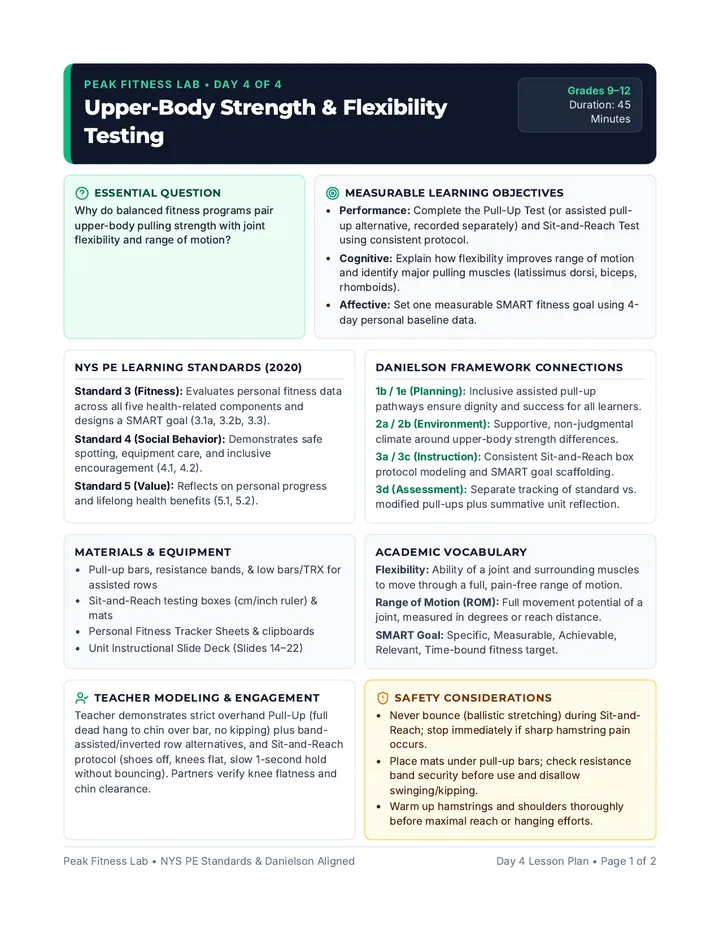
Strength Flexibility Lesson Plan Peak Fitness Lab • Day 4 of 4
Upper-Body Strength & Flexibility Testing
Grades 9–12
Duration: 45 Minutes
Essential Question
Why do balanced fitness programs pair upper-body pulling strength with joint flexibility and range of motion?
Measurable Learning Objectives
Performance: Complete the Pull-Up Test (or assisted pull-up alternative, recorded separately) and Sit-and-Reach Test using consistent protocol.Cognitive: Explain how flexibility improves range of motion and identify major pulling muscles (latissimus dorsi, biceps, rhomboids).Affective: Set one measurable SMART fitness goal using 4-day personal baseline data.
NYS PE Learning Standards (2020)
Standard 3 (Fitness): Evaluates personal fitness data across all five health-related components and designs a SMART goal (3.1a, 3.2b, 3.3).
Standard 4 (Social Behavior): Demonstrates safe spotting, equipment care, and inclusive encouragement (4.1, 4.2).
Standard 5 (Value): Reflects on personal progress and lifelong health benefits (5.1, 5.2).
Danielson Framework Connections
1b / 1e (Planning): Inclusive assisted pull-up pathways ensure dignity and success for all learners.
2a / 2b (Environment): Supportive, non-judgmental climate around upper-body strength differences.
3a / 3c (Instruction): Consistent Sit-and-Reach box protocol modeling and SMART goal scaffolding.
3d (Assessment): Separate tracking of standard vs. modified pull-ups plus summative unit reflection.
Materials & Equipment
Pull-up bars, resistance bands, & low bars/TRX for assisted rows
Sit-and-Reach testing boxes (cm/inch ruler) & mats
Personal Fitness Tracker Sheets & clipboards
Unit Instructional Slide Deck (Slides 14–22)
Academic Vocabulary
Flexibility: Ability of a joint and surrounding muscles to move through a full, pain-free range of motion.Range of Motion (ROM): Full movement potential of a joint, measured in degrees or reach distance.SMART Goal: Specific, Measurable, Achievable, Relevant, Time-bound fitness target.
Teacher Modeling & Engagement
Teacher demonstrates strict overhand Pull-Up (full dead hang to chin over bar, no kipping) plus band-assisted/inverted row alternatives, and Sit-and-Reach protocol (shoes off, knees flat, slow 1-second hold without bouncing). Partners verify knee flatness and chin clearance.
Safety Considerations
Never bounce (ballistic stretching) during Sit-and-Reach; stop immediately if sharp hamstring pain occurs.
Place mats under pull-up bars; check resistance band security before use and disallow swinging/kipping.
Warm up hamstrings and shoulders thoroughly before maximal reach or hanging efforts.
Peak Fitness Lab • NYS PE Standards & Danielson Aligned Day 4 Lesson Plan • Page 1 of 2
45-Minute Instructional Procedures — Day 4
Strength & Flexibility
1. Do Now / Introduction
5 Minutes
Project Slides 14–16. Students complete a Think-Pair-Share : "How does tight hamstring or shoulder flexibility affect athletic performance and daily posture?" Preview today's final two tests and unit SMART goal setting.
2. Dynamic Warm-Up
5 Minutes
Shoulder & posterior-chain prep: banded/arm pull-aparts, shoulder pass-throughs, dead-hang scapular shrugs (10s), walking Frankenstein kicks, and gentle standing hamstring sweeps to warm muscles before Sit-and-Reach.
3. Teacher Demonstration & Safety Instructions
5 Minutes
Model standard Pull-Up vs. assisted pull-up (resistance band or inclined inverted row), emphasizing that modified results are recorded in their own column. Model Sit-and-Reach: shoes off, one knee flat (or both per box), 3 slow reaches, record best of 3 in centimeters.
4. Fitness Testing / Two-Station Rotation
25 Minutes
Class rotates between Station 1 (Pull-Up / Assisted Bar Zone) and Station 2 (Sit-and-Reach Boxes) in Partner Pairs (11 min per station + 3 min transition):
Station 1 – Pull-Up Test: Students choose Standard Pull-Up or Assisted Pull-Up (band/inverted row). Partner counts strict reps (chin clears bar, full arm extension) and records score in the matching tracker column.Station 2 – Sit-and-Reach Test: Partner gently holds down-knees flat (no pushing) and reads the ruler after 3 smooth reaches. Record best measurement (cm) for Left, Right, or Both.Rotation: Groups rotate at the 12-minute mark after wiping down bars/boxes.
5. Closure, SMART Goal & Unit Reflection
5 Minutes
Review Slides 20–22. Students review all 4 days of data on their Personal Fitness Tracker, draft one SMART Fitness Goal for the semester, and prepare for the 20-question Written Fitness Test.
Differentiation & Accommodations
Upper-Body Pathways: Resistance-band assisted pull-ups, flexed-arm hang (seconds), or inclined bar rows recorded separately.Flexibility Pathways: Back-saver Sit-and-Reach (one leg bent) to reduce lower-back strain.ELL / IEP: Visual step-by-step SMART goal template and bilingual vocabulary support.
Assessment Methods
Formative: Teacher observation of safe ROM, pull-up form, and SMART goal quality check.Summative: Completed 4-Day Personal Fitness Tracker + 20-question Written Fitness Test (12 MC, 4 T/F, 4 Short Answer).
Peak Fitness Lab • NYS PE Standards & Danielson Aligned Day 4 Lesson Plan • Page 2 of 2
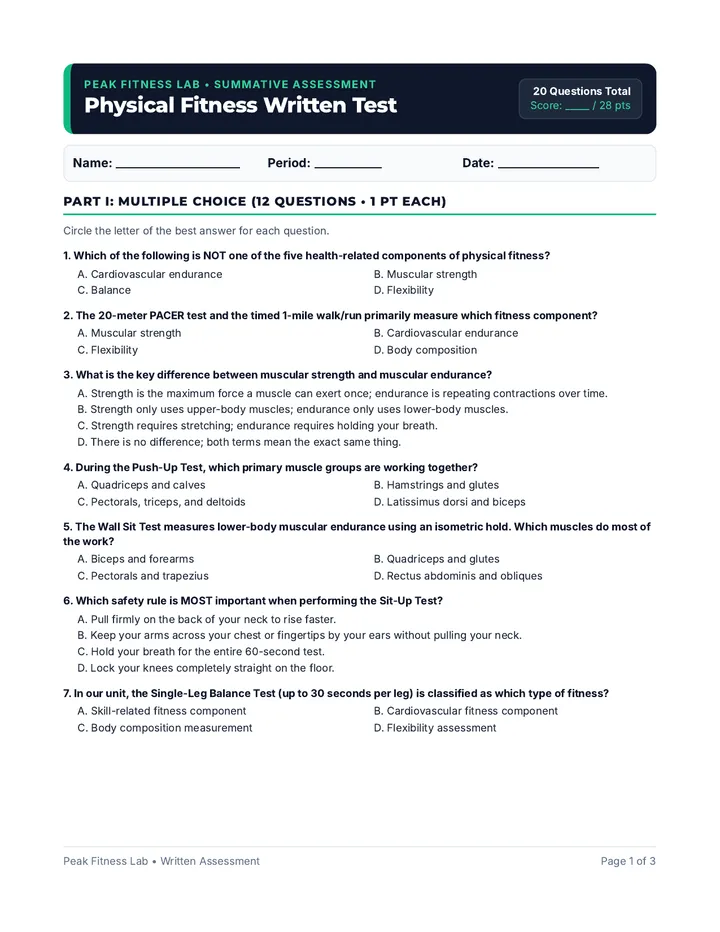
Fitness Mastery Written Test Peak Fitness Lab • Summative Assessment
Physical Fitness Written Test
20 Questions Total
Score: _____ / 28 pts
Name: ______________________
Period: ____________
Date: __________________
Part I: Multiple Choice (12 Questions • 1 pt each)
Circle the letter of the best answer for each question.
1. Which of the following is NOT one of the five health-related components of physical fitness?
A. Cardiovascular endurance
B. Muscular strength
C. Balance
D. Flexibility
2. The 20-meter PACER test and the timed 1-mile walk/run primarily measure which fitness component?
A. Muscular strength
B. Cardiovascular endurance
C. Flexibility
D. Body composition
3. What is the key difference between muscular strength and muscular endurance?
A. Strength is the maximum force a muscle can exert once; endurance is repeating contractions over time.
B. Strength only uses upper-body muscles; endurance only uses lower-body muscles.
C. Strength requires stretching; endurance requires holding your breath.
D. There is no difference; both terms mean the exact same thing.
4. During the Push-Up Test, which primary muscle groups are working together?
A. Quadriceps and calves
B. Hamstrings and glutes
C. Pectorals, triceps, and deltoids
D. Latissimus dorsi and biceps
5. The Wall Sit Test measures lower-body muscular endurance using an isometric hold. Which muscles do most of the work?
A. Biceps and forearms
B. Quadriceps and glutes
C. Pectorals and trapezius
D. Rectus abdominis and obliques
6. Which safety rule is MOST important when performing the Sit-Up Test?
A. Pull firmly on the back of your neck to rise faster.
B. Keep your arms across your chest or fingertips by your ears without pulling your neck.
C. Hold your breath for the entire 60-second test.
D. Lock your knees completely straight on the floor.
7. In our unit, the Single-Leg Balance Test (up to 30 seconds per leg) is classified as which type of fitness?
A. Skill-related fitness component
B. Cardiovascular fitness component
C. Body composition measurement
D. Flexibility assessment
Peak Fitness Lab • Written Assessment Page 1 of 3
Part I: Multiple Choice (Continued)
8. Which major muscles are primarily targeted during a standard or assisted Pull-Up Test?
A. Quadriceps and hamstrings
B. Latissimus dorsi, rhomboids, and biceps
C. Pectorals and triceps
D. Gastrocnemius and soleus
9. The Sit-and-Reach Test evaluates flexibility and range of motion primarily in which areas?
A. Shoulders and chest
B. Neck and wrists
C. Hamstrings and lower back
D. Ankles and calves
10. What does "body composition" refer to in health-related fitness?
A. The ratio of fat mass to lean mass (muscle, bone, and water) in the body.
B. How fast a person can run a 20-meter shuttle.
C. The maximum weight a student can lift one time.
D. How long a person can balance on one foot.
11. Why should you NEVER bounce (ballistic stretching) during the Sit-and-Reach Test?
A. It makes your arms shorter.
B. It can trigger a muscle strain or tear and gives an inaccurate measurement.
C. It only tests upper-body strength.
D. It lowers your heart rate too quickly.
12. In a SMART fitness goal, what does the letter "M" stand for?
A. Maximum
B. Muscular
C. Measurable
D. Motivational
Part II: True or False (4 Questions • 1 pt each)
Circle True or False for each statement.
13. Pacing yourself during the early laps of the PACER test helps conserve energy for faster levels later.
True / False
14. If a student completes assisted pull-ups using a resistance band, those reps should be recorded in the exact same column as unassisted pull-ups without noting the modification.
True / False
15. After completing a high-intensity cardiovascular test like the PACER, students should walk for 2–3 minutes to cool down rather than sitting down immediately.
True / False
16. Chair squats and chair stands are functional fitness assessments used to evaluate lower-body strength and endurance.
True / False
Peak Fitness Lab • Written Assessment Page 2 of 3
Part III: Short Answer (4 Questions • 3 pts each)
Answer each question in complete sentences using accurate fitness vocabulary.
17. Explain how regular cardiovascular exercise (like the PACER or 1-mile run) improves the function of both the heart and lungs, and give one real-world benefit outside of sports.
18. Why is core stability important for posture and injury prevention? Describe one safe technique rule for the Sit-Up Test.
19. Choose ONE test from our unit (Push-Up, Wall Sit, Pull-Up, or Sit-and-Reach). Name the fitness component it measures, list two muscles involved, and explain how form breakdown affects safety.
20. Why does our Physical Education program emphasize personal improvement over comparing your fitness scores to classmates?
Peak Fitness Lab • Written Assessment Page 3 of 3
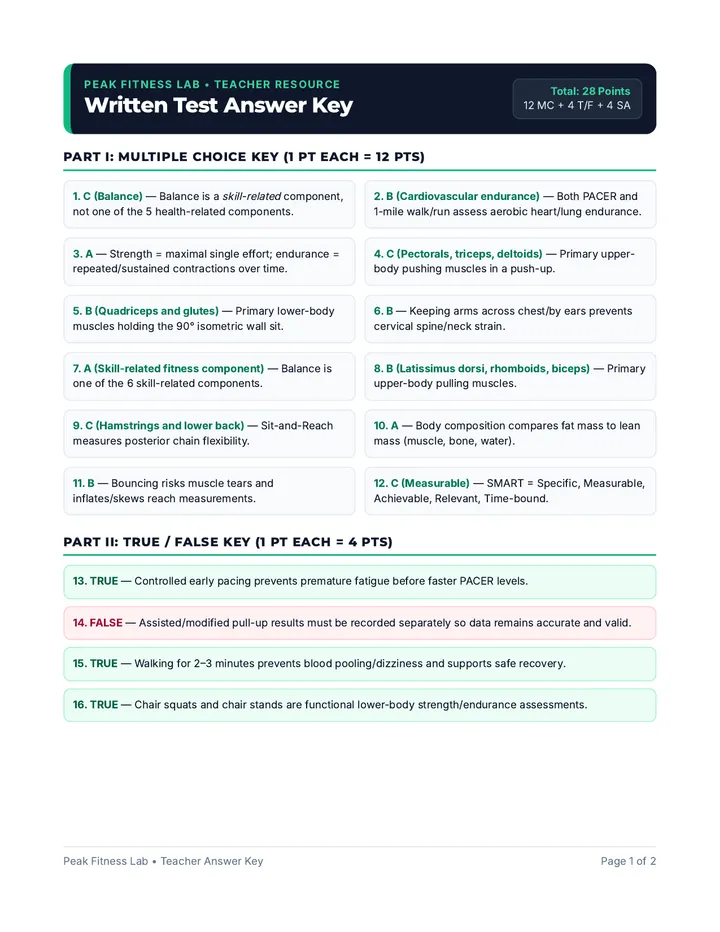
Fitness Test Answer Key Peak Fitness Lab • Teacher Resource
Written Test Answer Key
Total: 28 Points
12 MC + 4 T/F + 4 SA
Part I: Multiple Choice Key (1 pt each = 12 pts)
1. C (Balance) — Balance is a skill-related component, not one of the 5 health-related components.
2. B (Cardiovascular endurance) — Both PACER and 1-mile walk/run assess aerobic heart/lung endurance.
3. A — Strength = maximal single effort; endurance = repeated/sustained contractions over time.
4. C (Pectorals, triceps, deltoids) — Primary upper-body pushing muscles in a push-up.
5. B (Quadriceps and glutes) — Primary lower-body muscles holding the 90° isometric wall sit.
6. B — Keeping arms across chest/by ears prevents cervical spine/neck strain.
7. A (Skill-related fitness component) — Balance is one of the 6 skill-related components.
8. B (Latissimus dorsi, rhomboids, biceps) — Primary upper-body pulling muscles.
9. C (Hamstrings and lower back) — Sit-and-Reach measures posterior chain flexibility.
10. A — Body composition compares fat mass to lean mass (muscle, bone, water).
11. B — Bouncing risks muscle tears and inflates/skews reach measurements.
12. C (Measurable) — SMART = Specific, Measurable, Achievable, Relevant, Time-bound.
Part II: True / False Key (1 pt each = 4 pts)
13. TRUE — Controlled early pacing prevents premature fatigue before faster PACER levels.
14. FALSE — Assisted/modified pull-up results must be recorded separately so data remains accurate and valid.
15. TRUE — Walking for 2–3 minutes prevents blood pooling/dizziness and supports safe recovery.
16. TRUE — Chair squats and chair stands are functional lower-body strength/endurance assessments.
Peak Fitness Lab • Teacher Answer Key Page 1 of 2
Part III: Short Answer Exemplars & Rubric (3 pts each = 12 pts)
3-Point Scoring Guide per Short Answer:
3 pts: Complete, accurate explanation addressing all parts with specific fitness vocabulary. | 2 pts: Mostly accurate, missing one detail/example. | 1 pt: Partial/vague response. | 0 pts: Blank or incorrect.
17. Cardiovascular Function & Real-World Benefit
Exemplar: Regular aerobic exercise strengthens the heart muscle so it pumps more blood per beat (higher stroke volume) and increases lung efficiency for oxygen delivery. Outside of sports, this makes daily tasks—like climbing stairs, walking across campus, or carrying heavy backpacks—feel easier with less fatigue.
18. Core Stability & Safe Sit-Up Technique
Exemplar: Core stability supports the spine, improves upright posture, and protects the lower back from strain during lifting or athletic movements. A safe Sit-Up rule is keeping arms crossed over the chest (never pulling the neck) and lowering shoulder blades smoothly to the mat.
19. Assessment, Muscles, & Form Breakdown
Exemplar (e.g., Push-Up Test): Measures upper-body muscular endurance using the pectorals, triceps, and deltoids. If form breaks down (hips sagging or back arching), stress shifts to the lower back and shoulders, increasing injury risk—which is why the test stops on form breakdown.
20. Personal Improvement Over Comparison
Exemplar: Everyone has different genetics, body types, and starting fitness levels. Focusing on personal baseline scores and SMART goals builds intrinsic motivation, confidence, and lifelong healthy habits rather than discouragement from comparing with peers.
Peak Fitness Lab • Teacher Answer Key Page 2 of 2