Mind Matters Slides
Middle School Health & Wellness
10-Minute Focus Session
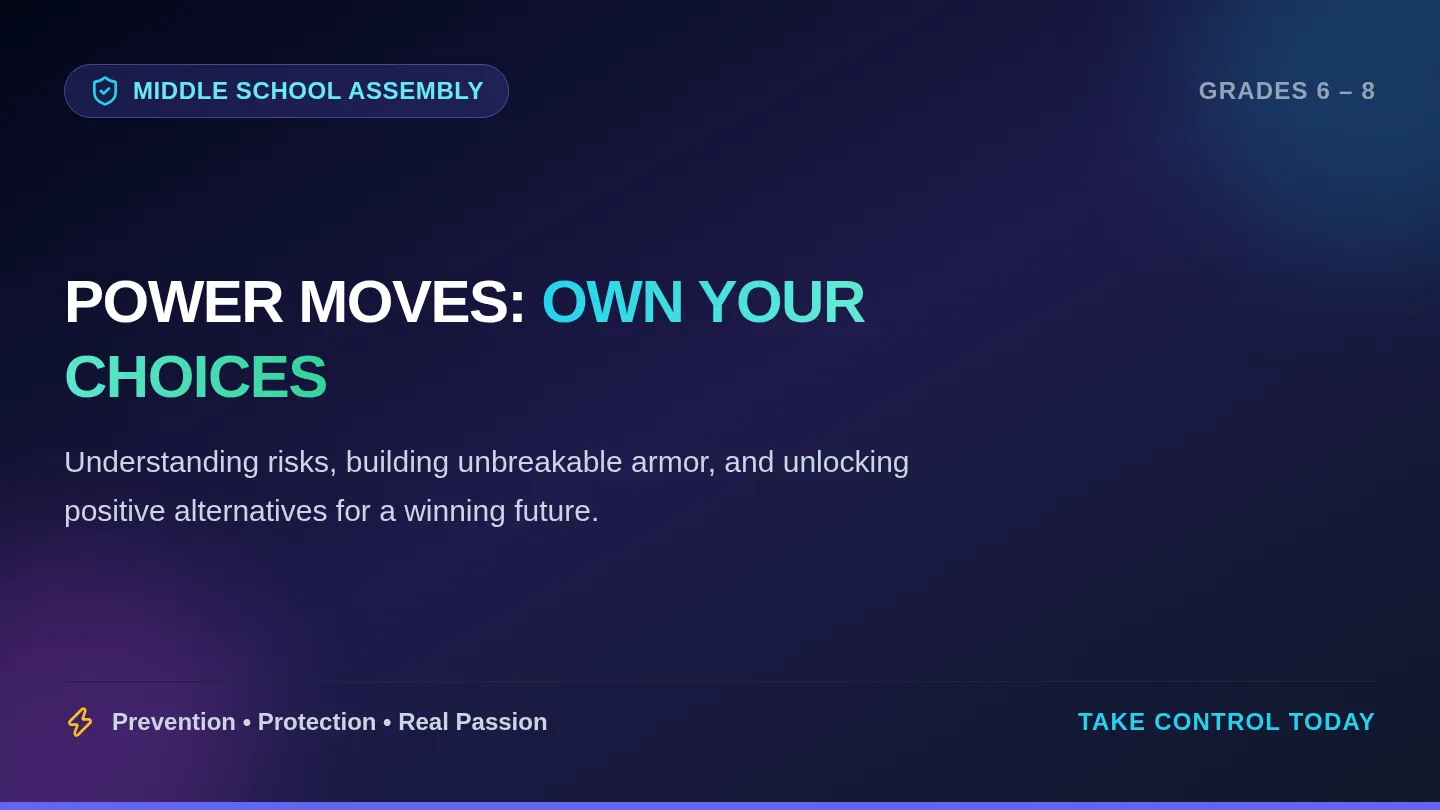
Mind Over Matter Drugs, Alcohol & Your Developing Brain
Understanding the real biology, navigating real-world choices, and building bulletproof refusal skills.
Brain & Body Biology
Choices & Impact
Refusal Strategies
Part 1: The Science
Your Brain is Under Construction
Between ages 11 and 25, your brain is rewiring faster than at almost any other time.
Prefrontal Cortex
The brain's "CEO" — controls impulse control, reasoning, and long-term planning. It is the last part to finish wiring (around age 25).
Substances disrupt these wiring pathways, making healthy decision-making much harder.
Limbic System
The emotional and reward engine. In middle school, this center is hyperactive, driving curiosity, risk-taking, and peer connection.
Drugs hijack natural dopamine rewards, creating rapid addiction loops in teenage brains.
Key Fact: Because adolescent synapses are pruning, substance exposure during these years can permanently alter memory and stress responses.
Part 2: Physiology
How Substances Attack the Body
What actually happens behind the scenes when foreign substances enter your system?
Alcohol
Central Nervous Depressant
- • Slows reflexes & impairs motor coordination
- • Shuts down short-term memory encoding (blackouts)
- • Dehydrates vital organs & taxes the liver
Dull sensory signals & balance
Nicotine/Vapes
Powerful Neural Stimulant
- • Constricts blood vessels & spikes heart rate
- • Irritates delicate lung tissue with toxic aerosols
- • Rewires brain to crave chemical dopamine fixes
Fast-track chemical dependency
Cannabis & Drugs
Neuro-Chemical Disrupter
- • Distorts depth perception & time awareness
- • Reduces REM sleep and academic focus
- • High risk of synthetic chemicals (fentanyl poisoning)
Unpredictable potency & risk
Substances don't solve stress or problems — they temporarily mask them while adding new biological hazards.
Part 3: The Ripple Effect
Choices Have Cascading Consequences
One decision rarely stays isolated. It ripples across every part of your everyday life.
Short-Term Impact
- → Broken trust: Loss of phone, privileges, and independence from parents
- → Performance drops: Cut from sports teams or dropping grades
- → Dangerous situations: Compromised judgment leads to accidents & fights
Long-Term Impact
- → Addiction pathways: High risk of lifelong substance struggle
- → Relationship damage: Drifting away from true friends and mentors
- → Closed doors: Disciplinary records blocking college, trade, or job goals
Class Reflection:
"How long does it take to lose trust versus how long it takes to rebuild it?"
Part 4: Reality Check
The Myth vs. The Reality
Movies and social media make it seem like "everybody does it." Here is the real truth.
The Pressure Myth
• "Everyone in 8th grade is vaping or drinking at parties."
• "If I say no, nobody will hang out with me anymore."
• "Trying it once never hurt anyone; you're just being scared."
Pressure usually comes from someone else's insecurity, not yours.
What Data Actually Proves
• Over 85% of middle schoolers nationwide choose NOT to use substances.
• Confident refusals are almost always respected by peers.
• True friends never condition their friendship on breaking your boundaries.
You are in the overwhelming majority when you choose to stay substance-free.
Remember: People who pressure others are usually looking for company to justify their own bad choices.
Part 5: Refusal Skills
The 4-Way Refusal Playbook
When someone puts you on the spot, you don't have to freeze. Pick your favorite strategy:
1. The Direct No
"No thanks, I'm good."
Clear eye contact, calm voice, zero drama. You don't owe anyone a debate.
2. The Blame Shift
"My parents drug test me / Coach will bench me."
Use strict parents, coaches, or early morning plans as your automatic shield.
3. The Pivot
"Nah, let's go grab food / play 2K."
Change the focus immediately to an activity you actually want to do.
4. The Walk Away
"I gotta take off."
If someone won't drop it, excuse yourself to the bathroom or head out.
Practice makes it natural: knowing what you'll say before you're in the moment keeps you in control.
Part 6: Support System
You Never Have to Handle It Alone
Whether you're feeling pressured or worried about a friend, help is always accessible.
Trusted Adults
Parents, school counselors, favorite teachers, nurses, or sports coaches who listen without jumping to punishment.
Safe in-person allies
Confidential Lines
Free 24/7 confidential help. Text HOME to 741741 or call 988 anytime for judgment-free support.
100% private support
Being a True Ally
If a friend is passed out, uncoordinated, or in danger, never leave them alone. Getting adult help saves lives.
Safety over secrecy
The "X-Plan" Code Word: Text your parent or guardian just the letter "X" for an instant, no-questions-asked pickup.
Final Thought
Your Future is Built on Today's Choices
Three essential rules to carry with you throughout middle school and beyond:
01
Protect Your Brain
Your prefrontal cortex is still building your personality, talents, and future. Don't short-circuit it.
02
Own Your "No"
Saying no isn't weak — it's the ultimate sign of self-confidence and knowing what you value.
03
Keep Your Circle
Surround yourself with friends who lift your goals up, not friends who push you toward danger.
Exit Question to Consider
What is one goal in sports, arts, school, or life that is too important to risk?
Make the Call